Wednesday, February 10, 2010

Boston Globe Staffers - Self-Inflicted Cuts Boost Parent Company Profits


While Boston Globe staffers, believing the hyped up dire situation presented to them, last July, accepted an almost 10% pay cut (combined salaries and benefits) during tough contract negotiations with management. Amidst a down economy, these staffers felt they had no choice when presented with a deal that was repeatedly rejected in previous months. (Boston Globe's biggest union accepts wage and benefits cuts, 7/21/09).

Meanwhile, even while total revenue was down, the $20,000,000 that staffers willingly gave back to the paper, boosted the $90,900,000 in net income that the parent company of the Globe - The New York Times Company - showed on it's books (Times Company Reports Profit for Quarter and Year, 2/10/10).

(Continued after the Jump)

Thus, the company was able to further pay down it's debt load, and further benefited from an up-turn in the stock market to aid their pension obligations. As the company ramps up plans to charge for some of it's online content, a 10.3% increase in the fourth quarter for advertising revenues meant $102,000,000 in income for the quarter. This helped reduce the net loss of 4.1% for the entire year, partially attributable to the recession last year. Thus, it would be reasonable to project that online advertising revenues will grow further in the coming quarters, without a recession to bog down growth.

It is unfortunate that staffers were hoodwinked into accepting a substantial cut in salaries and benefits, because the end beneficiary is the corporate profit centers, at the expense of the staffers whose content makes the paper great.

Remember, it's not personal, it's just business. Next time, don't give in, they are profiting out of your pocket-books.


Please post your comments by clicking the link below. If you've got questions, please pose them in our Photo Business Forum Flickr Group Discussion Threads.


[More: Full Post and Comments]

Aperture v3 - Out of the Gate

With over 200 new features, Aperture 3 is a remarkable (albeit long overdue) update to it's preceding version. Let's take a look at some of the highlights (and low-lights) of the new application.

In many ways, Aperture 3 ("A3") is playing catchup like Windows is constantly playing catchup with OS X, when it comes to Lightroom.

Aperture has a very nice feature with the importing of both RAW and JPEG files. The downside to importing RAW files is that it's so damn slow, regardless of Aperture or Lightroom, and that's not the applications' fault, it's the reality of all the data being moved around as well as preview building. A3 gives you the option of importing both RAW and JPEG when you ingest, but the challenge, to date, has been that so often when speed is critical, you just handle JPEGs, but then have to go back and manually marry-up the corresponding RAW files, or just start from scratch. Now, A3 allows you to re-ingest the RAW files later, and match them to the JPEG. That's pretty slick. Further (and this is really slick) if you've applied metadata/cropping/toning to the JPEGs, you can sync these between these now re-matched files. So, for those working on deadline with JPEGs, but still shooting RAW, you're in for a real treat.


(Continued after the Jump)

Another feature that has significant potential is the ability to export a library of images to share. This way, you can send a library to a client and they can browse it. There are a few problems, however, with this. Apple (NASDAQ: AAPL) chose not to allow you to specify shared preview file sizes/dimensions, which can make libraries unwieldy. Second, of course, your client, likely working in an enterprise environment, won't have Aperture, and that's a requirement. Unlike the Filemaker application, where you can share out content to people who don't own Filemaker, or Acrobat, for people who can get a free Acrobat Reader application, you still have to have a full version of Aperture to see the images. Apple's position is that this is a feature designed to exchange libraries between a laptop and desktop, and not so much for distribution to clients, and that would more sense, and further, more beneficial.

A3's metadata interface has received a significant update and, frankly, looks better than Lightrooms'. The panel is better than Lightroom for sure, but the browsing is still better in Lightroom than A3. Further, A3 has taken a feature from Photo Mechanic, which allows you to right-click on a photo with GPS data, and show the location that the photo was taken, on a map. Further, A3 allows you to create custom data fields, which is pretty cool. As photographers move in the direction of geo-tagging their images more and more in the coming years, they will find much room to grow with A3's GPS functionality. Further, you can also reverse geo-tag, selecting, say, all images with metadata that identifies it as being shot at the US Capitol, and then assigning the GPS coordinates to the image. There is even more support in there, so be sure to go poke around all of the "geo" features.

A3's new image adjustments capability, allowing for localized editing/corrections/adjustments is a huge addition in this version, and was a required given to this version, since Lightroom has had this for some time. A3's localized editing is substantially improved over Lightroom, and one of the really interesting new features in A3 is the ability to "extend" your control of image data in curves, with an "extended curves" capability, which enhances custom recovery in, for example, highlights you think are blown.

When it comes to image recognition, it seemed also a given that Aperture would include the face recognition "Faces" capability from Omron Global that iPhoto '09 has. One of the challenges that this technology has, is that it not only gets better as you use it to identify certain people, but it might also get worse, if, say, you're identifying profile images often. While there is some anecdotal discourse on this subject, Apple seems to be of the opinion that it won't really have a big impact. That said, I can sure see a benefit to being able to use it to ID all 535 (plus delegates, I know) Members of Congress so I am not hunting for names after a shoot. Faces recognition happens on ingest, and it certainly wasn't designed for hundreds of people, but I wonder at what point the technology would bogg down if too many faces were in the system. Further, one can only hope that A3 is escaping the "Racist Camera" problem that Time Magazine reported on regarding some cameras and computers (here). Also, you can set up Faces to be a smart folder.

One really big addition is A3's ability to handle video and audio, and you can bet that the folks at Adobe (NASDAQ: ADBE) are now going to scramble to play catchup on this one. Aperture's really got some slick interfaces to let you manage video and audio, thanks no doubt to their genius with Final Cut Pro.

A3 also has some interesting slideshow themes and features. This idea came from the ease of making slick slideshows in things like iPhoto and iMovie, but one feature that temporarily made it into a previous release but then was removed is the ability to set a slideshow to a particular audio track. Now, the feature is back and in full effect. I sure could have used this when I had to do a slideshow in 10 minutes for a client recently, and the last 2 minutes of images were showing to no audio. Even better is the ability to set unique slide durations. Simply play the slideshow and hit the return key when you want the slide to change (for example, to a beat/tempo) and you are good to go, "recording" the duration as you watch. The slideshow feature has more controls and customization worth looking into, so be sure to check this out.

A3 continues to offer awesome photo book capabilities, and here is one place where total Apple integration makes Lightroom look like the poorly-abled relative. A supercharged feature is the ability to include travel maps within the book of photos. While this is a very pro-sumer/consumer feature, it's nice to have none-the-less. One of our vendors, GraphiStudio, is among the third party book producers that has a plug-in for Aperture, so you can do amazing custom albums/books. I have been hugely impressed with the quality of GraphiStudio books, so if you're an Aperture user, check out their plug-in here. To learn about the other third-party book producers, check here.

Lastly, it's now 64-bit, and that will ensure a speedy application all around. There doesn't seem to be any stated upper limit on the number of images in a library, however some users with upwards of 200,000 images are not reporting significant slow-downs, so we'll wait and see as more people get huge libraries and what the real limits are.

So, what are the downsides? Well, I'm a huge proponent of DNG - which is an openly documented format that Adobe created, and Aperture just doesn't play well with images that I have in Lightroom and might want to move into Aperture. Yes, Aperture can ingest DNG's, say, from a Leica camera that shoots DNG. However, if, I ingest a RAW file, make adjustments, and then export the DNG and build a new preview based upon my adjustments, Aperture will initially display that adjusted preview, but then on the preview build stage of ingest, will wipe it out and re-build a preview based upon the untouched data. Could you migrate to Aperture with a ton of DNGs that you've worked on? Not if you want to keep that work. You can, however, export metadata to a DNG.

Next, where is the PLUS metadata in Aperture? Why Apple would prevent Aperture users from embedding industry standard rights metadata is beyond me. What's worse, PLUS rights metadata that is present in an image file will be invisible to Aperture users, which unnecessarily creates significant liability for image users. With every trade association on the planet endorsing the PLUS standards, Apple needs to wake up, jump on the PLUS bandwagon, and add the ability to read and write PLUS metadata.

Also, Aperture is Mac only, so PC users are SOL. Let's take a long-view look at this issue. For years, creatives used Macs because they were (and still are) easier to use/maintain/etc when it comes to essentially everything under the sun. Adobe hasn't been focused on fixing things that the should have when it comes to Lightroom, and this leaves them open to a repeat of the "Premiere" debacle. For those of you not in the know on this, Adobe had Premiere, their major-market-share video editing application, that was trounced to within an inch of it's life by Final Cut Pro, just like Adobe's InDesign destroyed the defacto Quark design application that owned that market. While many people bought Macs for the abilities of Final Cut Pro, I don't see people doing the same for A3.

There isn't any clear conversion path between Aperture and Lightroom, and there should be. I know this is an oversimplification of intellectual property rights issues, but comparatively, just as you can open a Word file in Wordperfect, or Excel spreadsheets in other applications, so too should you be able to open up a DNG with corrections from Photoshop or Lightroom. I know there are proprietary issues there, but Adobe and Apple should stop acting like bratty 13-year-olds (like they still are with Flash support) and just play nice on this. I know that A3 and Lightroom render things differently.

In the end, if you're an Aperture user that was considering switching to Lightroom, don't. If you're a Lightroom user that really wants to be able to manage your video, audio, and stills in one place, then you have one heck of a migration patch with weeks (or longer) re-building your RAW files to where they looked in Lightroom. However, it just may be that you Lightroom users may have just found a really great management tool for your audio and video in a separate application. For this reason alone, I can tell you I've already ordered my Aperture 3 Upgrade to my licensed seats.

My recommendation: Buy (full version link)

(Below is my proof of purchase!)


Please post your comments by clicking the link below. If you've got questions, please pose them in our Photo Business Forum Flickr Group Discussion Threads.


[More: Full Post and Comments]

Friday, February 5, 2010

Northern Short Course 2010 - New Brunswick, NJ

For the last decade, I've supported the National Press Photographers Association Northern Short Course as a presenter. This year, for three days, we'll be in New Brunswick, New Jersey (exit 9!) March 11th through 13th. I present on, what else? - the business of photography. Here's the entire program, which includes William Foster on social marketing/websites, Paula Lerner on multimedia, Tom Sperduto on lighting, courses on audio, Final Cut Pro, and portfolio reviews, and more!. Check it out! (I blogged about it last year too here).

(Comments, if any, after the Jump)


Please post your comments by clicking the link below. If you've got questions, please pose them in our Photo Business Forum Flickr Group Discussion Threads.


[More: Full Post and Comments]

Thursday, February 4, 2010

Costs of Photography - Explained in an Exceptional Way

Naples Newborn and Children's Photographer Nicole Zumaeta (known as Nicole Z) has reposted a really exceptional job that explains what the value and costs are associated with hiring a professional photographer, which was originally written by Marianne Drenth. So, rather than try to summarize what Marianne's written (and which Nicole had the permission to re-post), I commend you to head over to her blog and check it out!

(Comments, if any, after the Jump)


Please post your comments by clicking the link below. If you've got questions, please pose them in our Photo Business Forum Flickr Group Discussion Threads.


[More: Full Post and Comments]

Friday, January 29, 2010

PILFERED Magazine - Copyright Scumbags10

Pilfer: to steal stealthily in small amounts and often again and again

Source: Merriam-Webster

There are scumbags, and then there are SCUMBAGS. In my book, when you are a "publication" whose sole existence is based upon stealing and exploiting work from all over the internet by creatives, then you are the embodiment of the word "scumbag", and as such, PILFERED magazine is one such uber-scumbag.

When your website's About page defines you, in part, as such:
"PILFERED is a place where artists, photographers, designers, and the inspired can submit their favorite visuals pilfered from the web to share with one another. Founded on the spirit of web democracy, and built to aid in communicating ideas and concepts, PILFERED Magazine aims to assist in speaking the thousand words – visually."
You seem to be headed down a dangerous path.
(Continued after the Jump)

The lawyers for PILFERED, however, can't have it both ways. Despite a publication title and raison d'etre that seems to promote the theft of intellectual property, their privacy policy page notes under "Prohibited Uses" that you may not:You may not use the PILFERED MAGAZINE site and or its services to transmit any content which...causes distress...upon any other person...includes any unlawful...material...may infringe the intellectual property rights or other rights of third parties, including trademark, copyright, trade secret, patent, publicity right, or privacy right.

Then they state under their "No Warranty and Limitation of Liability" :
"You understand and agree that you use the Site and Services at your own discretion and risk and that you will be solely responsible for any damages that arise from such use....UNDER NO CIRCUMSTANCES SHALL PILFERED MAGAZINE BE LIABLE FOR ANY DIRECT, INDIRECT, SPECIAL, INCIDENTAL, CONSEQUENTIAL OR PUNITIVE DAMAGES OF ANY KIND...INCLUDING WITHOUT LIMITATION, DAMAGES RELATED TO USE, MISUSE, RELIANCE ON, INABILITY TO USE AND INTERRUPTION,...DAMAGES RESULTING FROM LOSS OF USE, SALES, DATA, GOODWILL OR PROFITS, WHETHER OR NOT PILFERED MAGAZINE HAS BEEN ADVISED OF SUCH POSSIBILITY. YOUR ONLY RIGHT WITH RESPECT TO ANY DISSATISFACTION WITH THIS SITE OR SERVICES OR WITH PILFERED MAGAZINE SHALL BE TO TERMINATE USE OF THIS SITE AND SERVICES. "
And you think that these disclaimers will get you out of legal hot water when you are infringing peoples' copyrights? Really? REALLY??!!??

Founders and Chief-Thiefs Patrick Hoelck, Rudj, Nate "Res" Harvey, and Mia Van Valkenburg, promote themselves as "hav[ing] in the past spent hours surfing the web to put together presentations for various commercial ad and editorial jobs…and noticed the hours it took to gather images and felt it was time to have a massive image collective shared by the people, for the people." What about the people who's creative works you're stealing?

Their About page goes on:
"Content on PILFERED is submitted from around the world and carefully edited by an in-house team, as well as a new monthly guest editor, to keep issues cutting edge, fresh and informative."

Guest editors? What mini-scumbags have agreed to participate in such a scheme? Well, while their March 2009 issue was a "test issue", the rest:
  • King Britt was the guest editor for the April 2009 issue, who describes himself as a "media revolutionary" and believes that he is one who "set the example of an individual who...show[s] what freedom truly is."
  • Cory Kennedy was the guest editor for the May 2009 issue.
  • For the guest editor for the July issue they had twins Gisela Getty and Jutta Winkelmann, described as being "actively involved with the German underground Communist Organization...they meet the young millionaire heir Paul Getty III and become life's play companion with him..."
  • George Pitts guest edits the July 2009 issue, describing himself as a photo editor and photographer whose own photographic work "is an extensive meditation on Women...", and was a former editor for Vibe Magazine
  • Guest editing the August issue is Tyler Gibney, and his site's about page lists his business "HVW8 Art + Design gallery was established in Los Angeles as a studio + gallery space for HVW8 and friends. The current mandate is to support avant-garde graphic design..." and then, for some inexplicable reason, contrary to PILFRED, has a contact person where you can contact their representative for licensing - one can only assume, for some form of compensation?
  • Brett Ratner guest edits the September issue. I wonder how he'd feel if someone PILFERED one of his films?
  • Christina Ricci guest edits the October 2009 issue - I wonder how she'd feel if someone PILFERED her likeness to sell products and services?
  • Susan Kirschbaum guest edits the November 2009 issue
  • Yosi Sergant guest edits the December 2009 issue - Sergant is descibed as a "community organizer...he organized and supported artists working to elect then candidate Barack Obama, including...artist Shepard Fairey" - enough said.
  • Anthony Mandler guest edited the January 2010 issue- I wonder how he'd feel if someone PILFERED and profited from his movies, or how his friends like Rihanna would feel about having her work PILFERED? Readers, what do you think? Is Mandler a Jackass?
This seems to me to be but one visual variation on Napster - which was inundated with copyright infringement lawsuits. Yet why hasn't PILFERED been inundated with similar suits by visual artists? There are plenty of well-known images, any one of which could be the cause for a suit that could shut them down. Copyright Action wrote about this site in May of 2009 here - and it seems that on more than one occasion, the site has been shut down, but why not permanently?

When people run around espousing the notion that "copyright is changing", I get it, and I know that. However, there is a huge difference between "changing" and becoming worthless or irrelevant. PILFERED seems to suggest that your copyright is worth something because it's worth stealing, but worth nothing in terms of the creator being paid for the use of their work. Hoelck, in an interview here, suggests " You either get it or you don’t and are pissed by it." No, we get it - you are promoting stealing of creative works. Anyone who's been a guest editor should hope that this "magazine" vanishes into the ether, because if these guest editors ever have their work stolen and they sue, the defendant in that lawsuit will hold up PILFERED and say something to the effect of "...why isn't what's good for the goose, not good for the gander?"

Please post your comments by clicking the link below. If you've got questions, please pose them in our Photo Business Forum Flickr Group Discussion Threads.


[More: Full Post and Comments]

Monday, January 25, 2010

On Commercial Photographers - Everything Is Relative

Anytime people get together to focus attention on the critical matter of the business aspects of photography, even when they are misguided, I applaud it. I applaud even the misguided discussions because someone will come out and get it right, and others will alteast spend some of their otherwise mis-focused thoughts on business for a change, and eventually, they'll get it right.

It is to that end that I applaud Rob Haggart's A Photo Editor, who poses the important question - How Much Money Do Commercial Photographers Make?

And I thought I'd take and make commentary on much of what was said, correctly, or incorrectly.

"One commercial photographer told me he was bringing in $250,000 in profits and another said he has several million in billings."
This is a loaded statement, because someone could have $250k in profits and next to no expenses in a number of circumstances. Further, someone could have several million in billings and be running at a deficit.
(Continued after the Jump)

"So, what do successful commercial photographers make? I’ve always believed it was a lot."
Success is not always defined by what someone makes. For example, the owners of LifeTouch - the business that does a large number of school portraits across the country is a commercial enterprise, bringing in millions each year. Yet is that success? For the owners? For the commercial photographer that runs the on-tripod camera with formulaic strobe setups?
"How has the economy effected the way people price? "
While you might seem to think that there would be an effect, and erroneously, there is, it isn't a long term solution - because when you're a $1,000 photographer for X, and you do the job for 1/2 of X, that client will remember you at the 1/2 price rate when the economy rebounds.
"Are photographers starting to base their usage on their cost of doing business instead of the cost of the use?"
This too is a flawed question - usage should never be based on the CODB, it should be based upon the use. However, one's photographers fees should have, as an absolute floor, that photographer's CODB when it comes to a photographers creative/assignment fees.

Amanda Sosa Stone and Suzanne Sease wrote:
"we had 1 photographer bold enough to give the answer everyone has been waiting for."
I'm not sure which one they are speaking about, so knowing this would be helpful.

The "Hot Emerging Photographer" (HEP) states "...My rep basically bids on what the client’s budget is..." and that's a problem. Knowing what the client's budget is is critical, and it's a question I always ask. However, when the budget is too low to properly do the assignment, then bidding on that can be a problem! Further, sometimes prospective clients will mis-represent the budget for any number of reasons, not the least of which is to see if you come in at a proper number that is well above the stated budget. I understand the point HEP makes when stating "...we push the production as low as we can to do a good job then create the fee out of the gap..." but that gap has to be a number that includes your CODB as well as a fee that compensates you for whatever creative talents you bring to the assignment. Lastly, HEP suggests "...I vote to keep an industry standard of fees..." and that's not going to float from an anti-trust standpoint. However, resources like FotoQuote/FotoBiz, Hindsight, and others are great resources for photographers to refer to outside of and formal establishing of prices by the trade organizations, which legally cannot happen.

The Established Photographer 1 (EP1) suggests "...250K in profits! I want to be him. In my best year, I grossed 225K and I was quite pleased. I can’t remember what I net’d but would have to guess around 1/3 of that." Most businesses look at a 3% - 7% net profit after taxes. If your net profit is 30%, I'd suggest that either you are the most amazing business person of the year, or you're not factoring in overhead items that you should be.

EP1 goes on "...It’s also difficult to compare me to most; I was away from business from 2005-2007 and have had a very challenging economy to grapple with upon my return so there’s no steady recent history for me to gather information with." So, we're to rely on the insights of someone who's been out of business for 2 (or even 3) years, with no steady recent history? This alone should be reason to discount these insights as valuable.

EP1 concludes "...I have estimated jobs based on usage, and I haven’t won many of them :-(" which to me that EP1 isn't doing a proper job of conveying usage to clients, or calculating it.

Next up Established Photographer 2 (EP2) reveals one of the reasons that this industry - especially assignment-type work, is in the current state, when they state "I have always tried to avoid talking about this kind of stuff." Whomever EP2 is needs to be talking about the business of photography with atleast their assistants, if not their local colleagues.

Then EP2 says "Even though I bill well over a Million Dollars in gross billing annually. What you actually pay yourself is much, much less....I am at the top of my game and probably make about what a halfway decent Attorney makes...It is quite exaggerated what photographers make." According to Payscale.com, the median salary for an attorney with 5-9 years ranges from $70K-$114K. An attorney "at the top of their game" can expect a salary of $200k or more coming out of a top-end law school.

Established Photographer 3 (EP3) seems resigned to the fact that they "... can’t say I am a poster boy for usage fees either. " Atleast EP3 acknowledges the possibility (hint: reality) that "..... Maybe I am getting played, but it usually happens in competitive bids where they say the other guy will do this usage for this money, so to be competitive I need to come closer to that number – that kind of thing. I typically but not always cave into it..." THAT is the definition of getting played - that they are playing you against the others, and the others against you.

EP3 does, however, suggest "... in that sense my cost of business does figure into it, but I only consider it when pressed to meet another person’s price." and in doing so, hopefully isn't accepting creative/assignment fees that are lower than their CODB.

EP4, while the least of the providers of information, does include a few details that are worthwhile. EP5 on the other hand, has it right in handling his money properly through a corporation, and I think EP4 was asked the flawed CODB question. EP5 concludes with one model that works for a lot of photographers "...License model, combined with photographers fee (shown as one line item!!) is the way the top guys estimate."

The EP with actual salary numbers provides succicint numbers, however is that a wedding photographer, an event photographer, or some other type? It seems to me that it is a wedding photographer.

The Very Established Art Buyer (VEAB) has some great insights. They know that "... top photographers do gross a million or more in fees.", but those fees cover overhead, and, as they acknowledge, "...agent commissions come out of that, but it’s still a nice living." It's refreshing when they reveal "...I don’t see top photographers any more willing to compromise on pricing than before the economic downturn." and that should be a guide for the rest of us.

The VEAB notes that "...Usage pricing is all over the board and there seems to be no rhyme or reason to it." and this is something that I, along with others (including Leslie Burns Del'Acqua) have been trying to promote for some time now, and that is that usage fees should be a percentage of media buys for advertising, anywhere from 5-7% down to 2% or so for large buys. Heck, if an ad buy is $2,000,000, is it unreasonable that you'd be paid $40,000 when it is your heroic picture selling the product? I don't think so.

I agree with Amanda and Susanne when they say "...you have to do your part to get those jobs and keep those clients and ask for what you are worth – NOT WHAT IT COSTS TO PAY YOUR BILLS!" However, you have to know what it costs to pay your bills before establishing your fees, or risk setting them below your CODB.

Commenter Jacob wrote "...I’ve noticed more and more that major ad campaigns are now crediting the photographer in ad work." and then Suzanne responded "...I am on the phone with Amanda right now and the answer is yes..." and it is important to note that the advertising landscape will change whenever the Orphan Works legislation gets through, because most of the versions I've seen will need photo credits in order to properly protect the work, even in ads.

Glen Wexler commented, on this subject ".... With ad work, a comparable level of freedom rarely exists, and the photographer’s vision is often shaped to the “greater good” of the brand. The process of making an ad is much more collaborative than editorial. An editorial photo credit is a must..." and then he goes on to point out, quite accurately, "...the media buy almost always dwarfs the photo fees" and then makes a huge point "...If photographers begins to reduce fees in exchange for exposure gained by ad work, where is the payoff? Wouldn’t you simply be setting a precedent of reducing fees to gain more reduced fees?"

Edward McCain seems quite fatalistic when suggesting "...I hope young photographers in most parts of the U.S. realize that they probably won’t ever net as much as a school teacher or plumber." If that's the case, the photographer has only themselves to blame. McCain also suggests "...I only know a handful of photographers that actually net more than $25-50K." I do hope ( but doubt) that he's referring to a net on their business income after having paid themselves a reasonable salary.

In the end, the discourse is of significant value, and I do look forward to Amanda and Suzanne's continued contributions.

Please post your comments by clicking the link below. If you've got questions, please pose them in our Photo Business Forum Flickr Group Discussion Threads.


[More: Full Post and Comments]

Tuesday, January 19, 2010

SpiderPic -How Stupid Can Photographers Be?

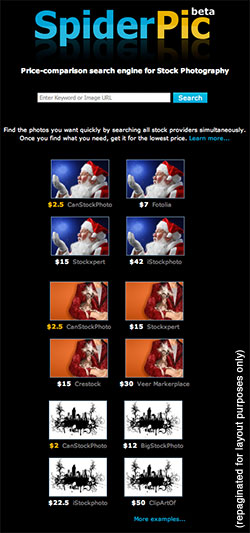
Let's get the upside out of the way here - SpiderPic is a great solution for the photo buyer, in the short term. SpiderPic is an aggregator that brings together search results across microstock sites, showing you your results, and in examples like at right, where there are identical images - which place has the best price. Paul Melcher, in his piece - A Microstock Price War? - has a good analysis of this service, and was where I first learned about it.

I have not delved deep into the ownership of SpiderPic, but what I have learned is that their revenue is from referrals to each of the microstock sites, where they take a piece of each transaction. Melcher is right - this will create a price war. Further, guess what - the loser will be - that's right - the photographer.

But how stupid can these photographers really be?

(Continued after the Jump)

If you are one of the many photographers who are selling the exact same image in different portals, at difference rates, for the same exact usage, then you need to re-think your common sense - not to mention your business sense.

Do I blame SpiderPic for facilitating this? Yes, and no. First, they are just making it easier to do what someone previously had to do manually, and so, for that service, they get a piece. However, as creative budgets get slashed by these low prices, budgets will make it all but impossible to create fresh content for assignments, and that's bad long term.

Now all the microstock photographers can pile on here in the comments, with sentiments like "I just want to see my photo in print, who cares about the money..." and "...for some of us it's not about the money it's about the fame..." and other equally idiotic sentiments. go ahead and subsidize multi-national corporations and mega-corporation quarterly reports with your EOS Rebel or D90 photos. Some day, you'll tire of all the work and the market will be so flooded you'll lose interest. Go ahead - I'll wait.....that's right, patience is a virtue, and while I have more than I need of it, clearly one "virtue" of these microstockers is that they couldn't care less about the profession of photography as a sustainable endeavor. SpiderPic's results demonstrates just one more manifestation of that.


Please post your comments by clicking the link below. If you've got questions, please pose them in our Photo Business Forum Flickr Group Discussion Threads.


[More: Full Post and Comments]

Monday, January 18, 2010

Charitable Giving - Do's, Don'ts, And Cautions

Charitable Giving is a cornerstone of a compassionate citizenry. Yet, it's very important that you know what you can, and can't give, and how to best give.

First - legally, if you designate a specific disaster (for example, Haitian relief) the organization is obligated to spend those funds on Haiti only. Guess what? In a few weeks, there will be another disaster, and if the organization recieves an excess amount of funds earmarked for one disaster - so much so that they can't spend it (guess what - this happens a lot!) they can't transfer those funds to other needs, so don't earmark your donation for a specific incident, let the charity manage their funds as they best can.

Second - your time is NOT a tax-deductible donation. Even if you have an hourly rate of $100, or a rate for an assignment for a charity documentary project of $750 for each day you are doing that type of documentary work, you cannot donate your services and take a deduction for that. If you incur airfare/hotel/food/shooting expenses during the trip, those you can deduct. (For more information on what is, and is NOT deductible, check out IRS Publication 526 - page 6 is where is says "You cannot deduct as a charitable contribution - 4. The value of your time or services,...")

(Continued after the Jump)

Third - make sure your donation is to a true charitable organization, and check them out! For example, making a donation to the Government of Haiti is NOT a tax deductible donation! Further, while everyone from the First Lady to Price Club are encouraging you to donate to the Red Cross, here are a few facts about them you should be aware of:
Red Faces At The Red Cross - In the hours after the Sept. 11 attacks, a record-breaking amount of donations started pouring into more than 1,000 local American Red Cross chapters. What donors didn't know was that some of the chapters entrusted with all that money had been identified by Red Cross headquarters just a few weeks before for having poor accounting procedures, inaccurate financial reports and for keeping national disaster contributions that should have been sent to headquarters in Washington.

Red Cross defends handling of Sept. 11 donations - "Don't confuse us with the 9/11 Fund in New York. Don't confuse us with Habitat for Humanity. Don't confuse us with the scholarship in New York for the victims. We have to get that out," [Healy] said. Controversy over the Liberty Fund was one reason Healy decided to resign at year's end.

Red Cross Blinks - The Red Cross had planned to use about half of the Liberty Fund to build up blood supplies and prepare for possible future terrorist attacks...The public responded with outrage to the disclosure that not all of the donated funds were being spent on victims of the attacks. "I donated money three times for the people directly affected by the attack on America, Sept. 11th. I did not donate money for the Red Cross to use as they wished.
It may be that your local church group, or a specific group, like the one photographer Cameron Davidson supports both with his time and money - The Community Coalition for Haiti, are a better destination for your donations. Just because everyone is championing one cause or another, doesn't mean you should take the easy path and do the same - figure out what you want to give, and how to best do it. Experts are saying that financial donations are best because if you, for example, donate bags of food or clothing, they may not only not be needed, but also, the costs to get them down there could be quite high.

It is important too, to realize that most people have a mindset of "I can give $x amount this year to charity..." and when they give that much, they don't give again for awhile. In the year after September 11, 2001, charitable organizations were reporting sharp drops in donations, because much of what people had planned to give to, say, research for a specific disease, or homelessness, was instead given to 9/11 charities. So, as you give for the current disaster - Haiti - remember your other charitable giving and don't make it an either/or - do both, if at all possible.

Please post your comments by clicking the link below. If you've got questions, please pose them in our Photo Business Forum Flickr Group Discussion Threads.


[More: Full Post and Comments]

Friday, January 15, 2010

Surprise! It's NOT All About The Pictures!

Over at Rob Haggart's A Photo Editor, his article - Good News In Photography - Points out something quite interesting, which I've re-arranged for the sake of discussion:

Here are other key points to why my business is growing:
NON-Photo/Creative Related:
  1. Easy To Work With
  2. Flexible
  3. Honesty
  4. Be Polite
  5. Marketing
  6. Surround Yourself With Good People
Creative-Related:
  1. People are really responding to my vision
  2. Being a true part of the creative process
  3. Personal projects


There's a lot more insight into each of those points in Rob's piece, but I want to make sure you understand that succeeding is often not about great photos, but about all manner of other things!
(Comments, if any, after the Jump)


Please post your comments by clicking the link below. If you've got questions, please pose them in our Photo Business Forum Flickr Group Discussion Threads.


[More: Full Post and Comments]

Monday, January 11, 2010

PhotoShelter - Advice For The AfterStaff Circumstance

The good folks over at PhotoShelter called the other day to ask what 10 things a current staffer should do to prepare for their inevitable "switch" to freelance, and also the 10 things a newfound freelancer from the "Staff World" should do, so I gave them a few ideas, contemplated after a long spell in the shower, and I encourage you to head over there to check them out -

THE 10 THINGS ALL STAFF PHOTOGRAPHERS
MUST DO RIGHT NOW

This advice applies if you are:

  1. A freelancer welcoming the former staffer now newfound freelancer into your community (help them and welcome them, dammit, don't be a selfish jerk)

  2. A staffer who thinks your staff job is safe (it's not - REALLY, IT'S NOT)

  3. A staffer who just was forcibly "switched" to freelance by your (now former) employer

  4. The spouse or partner of a freelancer who is now worried about healthcare, rent/mortgage, and small things like where the next meal is coming from, and wants to know how to kick their freelance spouse back into gear and out of their malaise, and otherwise help.


So, go read, and be enlightened, and be thoughtful - it's a good thing for your karma.
(Comments, if any, after the Jump)


Please post your comments by clicking the link below. If you've got questions, please pose them in our Photo Business Forum Flickr Group Discussion Threads.


[More: Full Post and Comments]
Newer Posts Older Posts