Thursday, June 11, 2009

World Copyright Summit - Public Knowledge Interview

The World Copyright Summit, held June 9th and 10th, 2009 was a who's who of organizations and individuals with a wide array of perspectives on copyright issues. Gigi Sohn, President and co-founder of Public Knowledge, a Google-backed organization, shares her perspective on copyright issues, and Orphan Works. Last year, we reviewed a number of Public Knowledge's statements about Orphan Works - Orphan Works - A Unique Set of "Myths" and "Facts" (6/2/08).

(Comments after the Jump)


Please post your comments by clicking the link below. If you've got questions, please pose them in our Photo Business Forum Flickr Group Discussion Threads.


[More: Full Post and Comments]
Wednesday, June 10, 2009

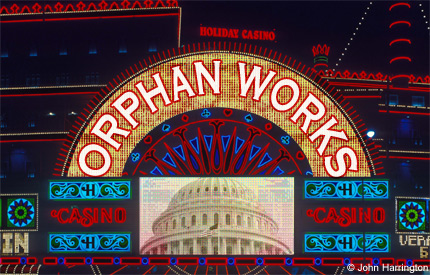
Orphan Works - "in the coming weeks"

During the World Copyright Summit, Sen. Orin Hatch (R-UT), gave the keynote address on the first day of the event, held here in Washington DC at the Ronald Reagan Building. During the address, Sen. Hatch stated that he was actively working to get orphan works legislation passed this Congress.

Senator Hatch's remarks on the subject were:

I also continue to be very active on passing orphan works legislation.

Last year, the Senate unanimously passed bipartisan legislation to encourage the use of orphan works - works that may be protected by copyright but whose owners cannot be identified or located. Countless artistic creations - books, photos, paintings and music - around the country are effectively locked away and unavailable for the general public to enjoy because the owner of the copyright for the work is unknown.

Unfortunately, it often isn’t easy to identify or find these owners of copyrighted work. To make matters worse, many are discouraged or reluctant to use these works out of fear of being sued should the owner eventually step forward.

For years, I have been working with industry stakeholders and copyright experts, including Marybeth Peters, Register of Copyrights, to pass orphan works legislation. The bill seeks to unite users and copyright owners, and to ensure that copyright owners are compensated for the use of their works. I couldn’t agree more with Register Peters when she said, “A solution to the orphan works problem is overdue and the pending legislation is both fair and responsible.”
While it comes as no surprise that orphan works will return this term, such a public pronouncement, during a time when the Senate Judiciary Committee is taking up the nomination hearings for a new Supreme Court Justice, came as somewhat of a surprise. It would have been reasonable to expect that this would be in full discourse this Fall, however, when we contacted Sen. Hatch's office for a comment, his Press Secretary, Mark Eddington, provided us with this quote from the Senator:
(Continued after the Jump)
“Orphan Works remains an important priority for me. Last Congress, the Senate unanimously passed the legislation. I see no reason why Chairman Leahy and I can’t re-introduce this bill in the coming weeks.”
It could reasonably be expected that the bill that is re-introduced will be identical to the one that passed the Senate last session, and then all eyes will turn on Chairman John Conyers. Back in January, at the start of the 111th Congress, we wrote 111th Congress - Orphan Works Futurecast, which details Conyers' past positions as very Pro-IP.

With The President having both Houses of Congress, whatever final bill will have to have the blessing of the President. We detailed our reading of the tea leaves as it regards President's position at the same time, in Orphan Works in the Era of Obama.

It isn't likely that bills will sail through Congress and become law before September, but with a Senate bill dropping in the next few weeks, it would be very probable that the House would hold hearings during the early Fall.


Related Story:
IP Watchdog - Senator Hatch Speaks at World Copyright Summit, 6/9/2009 (includes Sen. Hatch's entire remarks)

Please post your comments by clicking the link below. If you've got questions, please pose them in our Photo Business Forum Flickr Group Discussion Threads.


[More: Full Post and Comments]

Sunday, June 7, 2009

PDN - White-Washed Photo Contest? Hardly

Is Photo District News guilty of "passive raciscm" in their latest photo annual? In a word, no. What started (here) as race-baiting, evolved into money-grubbing race-baiting here, with a well honed charge that PDN's photo contest is passively racist because their jury is all white.

I have been critical of PDN's past photo contests (No Confidence Vote for the PDN/NGS Contest, (1/28/08), but this charge is just outright asinine.

There are three premises that these charges suppose:

1) By having a jury that looks all white, these individuals will select or be pre-disposed to selecting white photographers, white subjects, or issues predominantly of interest to whites.

2) They should have been actively racist in saying "hey we need a _____ guy or a ______ woman here to round out the color spectrum for our judges."

3) That, independant of race, judge(s) "of color" were asked to judge not for the color of their skin but their stature in the industry, and could not do it, for whatever reason.

(Continued after the Jump)


Premises 1 and 2 are actively racist, as compared to the initial charge which suggests passive racism, and premise 3 results from the lack of actual knowledge of the inner goings-on of the contest, and is an assumption by critics.

The judges didn't have a headshot (or likely even a name) associated with each entry during the judging. Judges don't say "hey, all our entries are about the good in the world as represented by white people, we need some black and asian plight to offset that good so our contests' winning entries appears balanced."

Unfortunately, this charge deserved to stay on the backpage of the Weekly World News, and instead, was brought into, for lack of a better way to put it, the mainstream blogosphere by A Photo Editor (here), so I felt it necessary to put forth a response as well. A silly $1k offer, is the best money the critic will never have to spend, in order to get this type of charge out of the backwater where it should have stayed.

An era has arrived when people are largely judged by the content of their character, and not the color of their skin. Does racism remain? You bet. Whites can be racist, just as well as blacks, asians, hispanics, and so on. We will never eradicate all racism. Bush's trusted Secretarys of State? African American, alonside other races in other cabinet posts. Obama's trusted VP and cabinet officials too cross a spectrum of race, and in both administrations, race was not a factor.

PDN is neither actively nor passively racist. Further, neither are the judges.


Please post your comments by clicking the link below. If you've got questions, please pose them in our Photo Business Forum Flickr Group Discussion Threads.


[More: Full Post and Comments]
Thursday, June 4, 2009

Conan O'Brien: Transformed Background an Infringement?

Conan O'Brian, the new host of NBC's signature late night show, has transformed from Carson's curtain, to Leno's cityscape, to what truely looks like the other-worldly Mario Brothers:


The above background from NBC, with the overlay of Mario's kingdom by the good folks at Serious Lunch, (they have an animated gif there that is a challenge to watch for more than a few seconds), show that it's hard to dispute the two are the same. They also have a link to a much larger version for you to look at in more detail.

So, the question is:

Derivitive work?
Was the use transformative?
Did Conan/NBC need to license the scene?
If permission for a derivative work is required, but NBC did not seek it, would Nintendo likely sue?

I have my own opinions on this, but what say you?
(Comments, after the Jump)


Please post your comments by clicking the link below. If you've got questions, please pose them in our Photo Business Forum Flickr Group Discussion Threads.


[More: Full Post and Comments]
Wednesday, June 3, 2009

UPDATED: Gordon Ramsay on Photography & Laughter

Two days ago, we wrote about Gordon Ramsay in In Search of Excellence (6/1/09), which was very significantly commented on, with much color and entrenched opinon. As I am making my way through the series, he makes a point about photography, alongside the idiocy of the owner of a Los Angeles restaurant, who is not only a part time actor, but, apparently, thinking he also can take a photograph. He cannot.


and another one "with ghastly pictures":

Food photography belongs in magazines and cookbooks, it would seem, but definitely NOT on menus. I would humbly agree, unless, perhaps it's Denny's, IHOP, or that type of dining experience.

Next up, is laughter, and the place for it.

(Continued after the Jump)

I've addressed this issue before, as it relates to people in the background while you are on the phone with a client. If you have people in your office, pets, or children, they cannot be making a ruckus while you are on the phone. If you are conversing with a client, and they hear people hooting and hollering while you are carrying on an important conversation, the client will think you are just having a party and taking a few snaps in between beers, and god forbid the laugh in the background come at a pause in the conversation where your client says something that would never warrant a laugh at all.

Dogs barking, children screaming, and other distracting noises in your home office should be verboten during business hours, or at the very least, when you are on the phone. In the above clip, laughter is heard from the kitchen which doesn't make the restaurant come across as professional, or focused on getting the customers' food out in a timely manner.

Details, details details. Unlike the previous clips where many people missed the point and decided to focus on Gordon's language and so on, these clips don't have that.

Please post your comments by clicking the link below. If you've got questions, please pose them in our Photo Business Forum Flickr Group Discussion Threads.


[More: Full Post and Comments]

Monday, June 1, 2009

In Search of Excellence

Of late, one of the best shows about quality and service I have found is Gordon Ramsay's Kitchen Nightmares. The restaurant business can easily be compared to the photography business.

Food = Images
Kitchen = Darkroom/Post-Production space/Image Management
Decor = Photographer attire
Servers = level of service
Hostess stand = initial phone call
Roaming manager = follow-up after shoot

And so on. What I like so much about Ramsay is his commitment - and demand - for excellence. He demands excellence at every turn. Here is a clip from his show:

You must unequivocally be committed to the highest level of excellence as a photographer for every client for every shoot.

(Another video, after the Jump)


Here's another clip:


And one more:


Ramsay makes no excuses for his level of expectation, and neither should you.

Please post your comments by clicking the link below. If you've got questions, please pose them in our Photo Business Forum Flickr Group Discussion Threads.


[More: Full Post and Comments]

Sunday, May 31, 2009

Selling Yourself Short

The refrain I hear from photographers often, when it comes to images they transfer copyright to is "what are the photos work anyway? They're just {insert justification here}...."

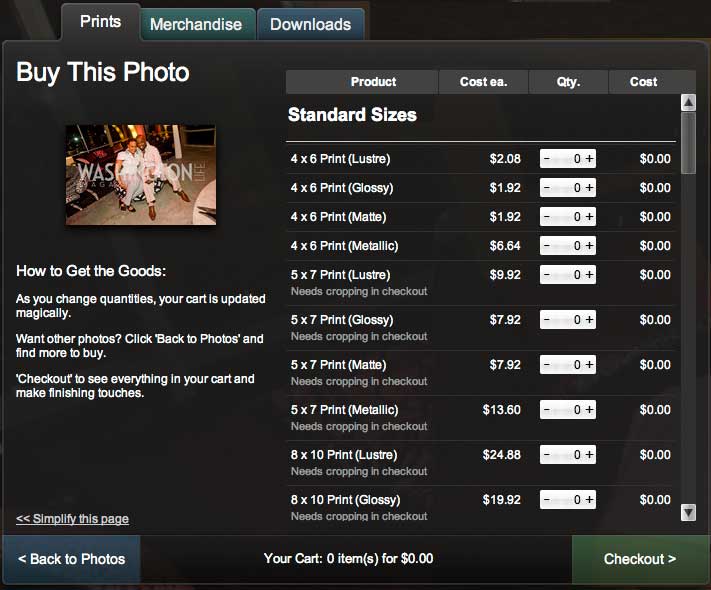
Often, photographers get assigned to cover a party of some sort or another. Then, the excuse is "they're just party pics, who would want them anyway?" Well, let's take a look:

(Continued after the Jump)


So, at about $20 an 8x10, after about 10 prints from a single event, the magazine has recouped the cost of the photographer, and the use of the photos in the magazine is now, essentially, free. And since the magazine - in this case Washington Life - owns the copyright to the photos as per their contract, the photographer is not entitled to a dime of that revenue.

"But it's just a few prints..." you say. Who cares, what does that matter? Well, aside from it being work you created and are entitled to income from (that is until you sold your copyright for a c-note or two), it's just plain wrong, and, it's not limited to prints.

Enter Niche Media. Niche Media publishes a number of magazines: Capitol File, Gotham, and Los Angeles Confidential, among many others. Clicking on those links doesn't take you to the magazine's website, they take you to search results where images from their assignments are being sold/relicensed by Wire Image, again, without the photographer getting paid for those resales. How many sales do you think it will take before the assignment becomes a profit center? One? Two?

NIche Media in their press releases often writes:
"About Niche Media Holdings: Niche Media, a subsidiary of Greenspun Media Group, was founded in 1992 and is the country’s preeminent regional magazine company with the largest network of city-specific luxury publications in the United States. Niche Media consistently delivers the finest editorial content and advertising to a controlled group of influencers with the highest disposable incomes in each city. Niche Media reaches readers who maintain annual household incomes of at least $200,000 and have liquid assets in excess of $1 million, making the pages of these glossies some of the most valuable real estate in Publishing."
Valuable, of course, except to the photographers who don't earn anything from the resale/relicensing of their works. You're a creator of some of "the finest editorial content" yet you don't participate in the fruits of that labor?

When people take your copyright, or require you to transfer all rights in your images to them, they're almost always doing it because those images have value. Just because you can't imagine what the resale/relicensing value is to an image doesn't mean that it doesn't have any.

Think twice before selling yourself short.

Please post your comments by clicking the link below. If you've got questions, please pose them in our Photo Business Forum Flickr Group Discussion Threads.


[More: Full Post and Comments]
Saturday, May 30, 2009

You're A Photographer? THIS is Your Life!


If you've been a photographer even for a few months, you are abundantly aware of the absurdity of client arguments about lowering your rates. You roll your eyes, scream after hanging up the phone, or otherwise express (rightfully so) indigniation about the demands for less now, with a promise of more later. This video (with thanks to Leslie Burns Dell’Acqua for the heads up on this) brings to life that absurdity in other business exchanges, and is absolutely a must-watch. It's only two minutes, but after about the first minute, the message is loud and clear, and the remaining minute is just gravvy.

Hit the jump for two more videos....

(Continued after the Jump)


When I Grow Up I Wanna Work in Advertising


REAL Truth In Advertising:


Harlan Ellison on Getting Paid:


Marc Focus on Being The Best:


Please post your comments by clicking the link below. If you've got questions, please pose them in our Photo Business Forum Flickr Group Discussion Threads.


[More: Full Post and Comments]
Friday, May 29, 2009

PicScout - Rights, Wrongs, and Facts

What a difference a day makes makes in this 24-hour world. One day after we published, in a criticism of PicScout:

PicScout is supposed to be looking out for photographers, and previously, it seemed that they were putting their great technology to use for good. This blog post, full of misinformation about Orphan Works gives every indication that PicScout has re-charted their course into dangerous waters, and they are now intent upon lulling photographers into believing that the previous versions of Orphan Works bills would have been good for them. This is an unfortunate change of strategy at PicScout, and will harm, rather than help, individual photographers and the photography industry at large.
In response to negative reaction to their blog post on the orphan works act, PicScout has made two public statements on the issue. First, the same author who wrote the original piece we were critical of, PicScout's Vice President of Marketing, (Dan Heller Update..., 5/28/09), wrote "The OWA is not relevant to PicScout. PicScout has no financial or other interest in seeing OWA pass or fail. Am I back-peddling? Absolutely not.", and then, in a personnel matter in the same post, he writes, "On an entirely unrelated matter, here’s another bit of news. When I first started working with PicScout, it was on contract. Things evolved to a point where it seemed to make sense that I join the company. But as the weeks wore on, but the reality of day-to-day logistics such as split between the time zones, made it clear that there was too much to do under the unusual conditions of a small and innovative company. So we’ve decided to return our relationship back to the consulting role we originally had."

Then, later that same day, the CEO of PicScout put out a press release:
(Continued after the Jump)

"Earlier this month PicScout announced the appointment of Dan Heller as Vice President of Marketing. After several seeks together, Dan and I have concluded that the fit just isn’t right. So we’re starting fresh. Dan will return to consulting after a brief transition period."

"We wish Dan all the best, and we will continue to be in touch with him in his capacity as an industry analyst.

Offir Gutelzon,
CEO
PicScout
As was noted on the PDN blog (Dan Heller Goes Through Revolving Door at Picscout, 5/28/09), we too believe he meant to write "weeks" and not "seeks" in his press release.

Its hard to reconcile PicScout’s statements yesterday with the recent PicScout blog posts.

Yesterday, PicScout states that "The OWA is not relevant to PicScout. PicScout has no financial or other interest in seeing OWA pass or fail. Am I back-peddling? Absolutely not.”

But on the PicScout blog PicScout states that the outcome of the orphan works act will be “very very beneficial for copyright holders,” and that ” the opportunities for the creation of the OWA database far exceed the downsides,” and that “if people genuinely care about those billions of images, then supporting the OWA will get the database built.” PicScout has publically stated that the photography industry should support the orphan works act. Huh?

Then we see why. PicScout goes on to state that if the OWA passes, web crawlers (such as picscout) will mine” every record of the copyright office database, and that if an infringement case goes to court, the” judge then hears from the copyright holder who says, “Your honor, I simply used the PicScout search-once-takes-a-second engine I the image is right there.”

For a company focused on copyright protection and enforcement, PicScout is sadly misinformed about the orphan works act, copyright law and copyright office regulations. PicScout’s statements are so outlandish, so incorrect and so dangerous to rights holders that I don’t know what else to do, other than to let their statements and my brief replies speak for themselves:
PicScout:
“Once the Orphan Works bill passes, the Copyright Office will create a database so your works can be found”
Wrong. The copyright office has no intention of creating a database for use in finding works (as evidenced by our previous Q&A with them, which appeared in PicScout - Delusions of Grandeur?, 5/27/09), and the Orphan Works Act has no provision requiring that they do so. The copyright office would prefer not to be involved in the process of certification of third party databases, but would do so if required by law.
PicScout:
“ The CO will, as specified by the OWA, create a “certification process”, which means that it will create the specifications for one to be created. Third parties will apply for certification based on those specs. Contractors that are selected will be paid to create the database itself, at which point, the Copyright Office will put it into operation (including populating it with content and administering it).”
Wrong: The OWA has no provision requiring the CO to select contractors to create a database for the CO. The OWA provides that the CO will be a certifying authority for third party databases which will be operated independently of the copyright office, without further CO involvement, management or supervision. The CO will not operate, populate or administer a database under the OWA.
PicScout:
“If you register your works “there is no downside to the Orphan Work Act….If you never register your photos with the copyright office, then all this hoopla about the OWA is entirely irrelevant… The OWA only affects statutory damages, so only registered works are affected.”
Wrong. Under the proposed language of the OWA, whether you register or not, an infringer may use your work for any purpose without your prior knowledge, and if you ever happen to learn about the infringement, you have no right to stop the infringement, even if it conflicts with exclusive licenses that you have issued, and even if it is objectionable to you, and even if it harms or destroys the market for your image.
PicScout:
"copyright law currently states that no one whatsoever can access records within the copyright office without a specific court order"
Wrong. There is no provision in copyright law limiting access to records within the copyright office, and there is no court order required to access copyright office records. Section 705 of the Copyright Act states that all copyright office records including deposits, registrations, recordations and other actions, including copies of copyright deposits “shall be open for public inspection.” Section 201.2(b)1 of the Copyright Office Regulations further provides that the copyright office shall provide the public with access to registrations and deposits. There is no requirement for court orders or other qualifications.
PicScout:
“Fair use is hard to codify into exact language that everyone can agree on, but that hasn’t prevented it from being applied for decades."
There is unfortunately little similarity between the OWA and the Fair Use provisions of copyright law. Fair Use allows usage for very limited purposes (criticism of the work, comment on the work, news reporting on the work, teaching about the work, scholarship related to the work, or research on the work), and only where the use has no negative effect on the rights holders ability to profit from his work. In contrast, the OWA allows usage of the work for any purpose, even purposes that harm or entirely wipe out the owner’s ability to market for the photograph.
PicScout:
“ if there is a dispute about someone’s use of a work, and they happen to gamble on the bet that they can convince a judge that they did a “diligent search”, then like any other judge looking at facts and circumstances, he or she will assess whether it’s apropos…the onus of proof is on the defense, not the copyright holder. All a photographer has to do is come forward with a claim, and the defense has a big decision to make: will a judge really determine that his search was diligent? I would be hard-pressed to believe that any publisher is ever going to take that risk.”
Wrong. Under the OWA, the rights holder bears most or all of the risk when filing a claim of copyright infringement. With the determination of diligence left to the court, a photographer takes a huge risk in filing an infringement claim. In the event that the court finds that the search was diligent, the photographer’s damages will be limited to the fee that both the photographer and the infringer would have agreed upon before the infringement occurred. The fee could be quite low, if for example the infringer can demonstrate that he typically licenses microstock for $1 for unlimited worldwide usage. This would leave the photographer with $1 in damages and tens of thousands of dollars in court costs. An unacceptable risk for most photographers. Pursuing claims of copyright infringement will be nearly impossible under the OWA.
PicScout:
“If so, the OWA could affect some claims made by copyright holders. However, only a tiny fraction of image uses are ever directly linked to profits anyway.”
Wrong. Under existing copyright law, a photographer need only show evidence of the gross revenues of the infringer. The infringer must then prove to the court all revenues that are not attributable to their infringing use of the image. Any profits that the infringer can’t prove unattributable will be awarded to the photographer. The burden of proof is on the infringer, no the photographer, and profits can be directly or indirectly attributable to the use of the image.
PicScout:
“Since the only images that are affected by provisions of the OWA are registered works, then one or both of these will be true: (1) all databases will have a complete set of CO records, and/or (2) web crawlers (such as picscout) will mine every single one of them, fingerprint the images, and still provide the same search-once-takes-a-second methodology.
Wrong, wrong and wrong. Both registered and unregistered works would be significantly impacted by the OWA. There are no plans to allow third parties to mine the CO database.
PicScout:
“The only people who would truly be protected are certain kinds of non-profit educational institutions and uses that are considered education or for the public interest.”
Wrong: the OWA is structured to provide comprehensive legal shelter from copyright infringement remedies for anyone who wishes to use a photograph but can’t find the owner. Not just non-profits, but also publishers, ad agencies, design firms, special interest groups --- anyone. Provided that they complete a diligent search and fail to find the owner, the infringer may use the photograph for any purpose without permission of the owner, and is only liable for a fee that the infringer agrees is reasonable. Further, the owner has no right to stop an infringement once it begins, even if the owner surfaces and objects to the usage because it competes directly with the owner, or because it is otherwise objectionable to the owner.
PicScout:
“No matter how you look at this, the mere existence of a database is a good thing.
I must point out that we can enjoy the benefit of databases without the horror of the orphan works amendments as they were proposed in the last session of Congress, and which will be a likely starting point whenever they return to the legislative scene.

I have so much respect for the fireman who comes to the rescue and saves people from a burning building. I have contempt for the fireman who hopes for a fire so he can come to my rescue. Prior to PicScout telling everyone to "Relax" and misinforming everyone with "If you never register your photos...You already have very little protection (or recourse) against infringers, and OWA doesn’t make it worse..." I saw PicScout as that former fireman who was coming to the rescue of a lot of photographers and doing good. When PicScout took the relax, don't worry position, when every photo trade organization has said OWA is bad for photographers in one way or another, that was a cause for alarm and concern that they might have been the latter fireman.

Well, it seems, PicScout has heard the alarm, and reacted to the smoke in their own firehouse. Let's hope they don't make another mistake, because, frankly, when OWA passes, PicScout, Idee's TinEye, Digimarc, and others yet unannounced, will likely be, in one form or another, parts of the solution. I just don't want them cheering for photographers to need them like that, it's bad karma, if nothing else.

Please post your comments by clicking the link below. If you've got questions, please pose them in our Photo Business Forum Flickr Group Discussion Threads.


[More: Full Post and Comments]

Thursday, May 28, 2009

An Unfair Advantage

If you're a photographer who shoots on white seamless, what's wrong with using someone elses' work to sell yourself on a website? Heck, why not grab some of Avedon's works to show what your work would look like, since he's no longer making photos. The clients won't know they're not your photos. What's the harm? Well, in a nutshell, you are stealing someone elses' work in order to make you look better, more capable, or otherwise promote you.

What about the use of music on your website?

(Continued after the Jump)

If I am a wedding photographer, and I am using tracks from Triple Scoop Music, or Broken Joey Records, is it fair to compete against a local photographer who is using U2's "Beautiful Day" on their website as an audio track to their wedding portfolio slideshow? Setting aside that most consultants recommend against music on websites (the bride and/or groom are likely looking for a photographer in their cubicle in their office, after all), the other photographer is taking an unfair illegal advantage when doing things like this.

I previously wrote about photographers stealing other photographers' work (The Curious Case of Fink Photography, 12/10/08), and I've also written about photographers infringing on other creatives works (© Infringements - Don't be a Hypocrite, 3/23/08), so here's a solution. If you run across someone infringing on the copyright of musical recording, you can either report it because it's the right thing to do, or you can report it because it will eliminate an unfair advantage your competition has. Whatever your motivation, just submit the URL to this link: report piracy. Wouldn't you want someone to report to you that your work was stolen and being used by someone else for their benefit? Not only would I, I have benefited from the kindness of another photographer bringing to my attention the infringing uses of my work.

Please post your comments by clicking the link below. If you've got questions, please pose them in our Photo Business Forum Flickr Group Discussion Threads.


[More: Full Post and Comments]
Newer Posts Older Posts