Wednesday, February 25, 2009

Moving Pictures - Covering Barack Obama's Speech

Covering the President's first address to a Joint Session of Congress is a big deal, and the photographers who are tasked with that responsibility are among the very best around.

Photographers Doug Mills of the New York Times, H. Darr Beiser of USA Today, and Pablo Martinez Monsivais of the Associated Presss (as interviewed by AP photographer Evan Vucci) take a few minutes to talk about their coverage after their pictures have moved to their outlets.

(Comments, if any, after the Jump)


Please post your comments by clicking the link below. If you've got questions, please pose them in our Photo Business Forum Flickr Group Discussion Threads.


[More: Full Post and Comments]
Tuesday, February 24, 2009

Souza Rounds Out His White House Photo Team

Gathering a team of photographers who you trust is one of the key factors in hiring the people who are working for you, and Pete Souza certainly had his pick of whomever he wanted to round out his team.

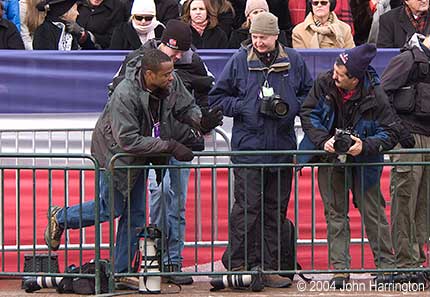
In this photograph from our archives, the caption reads:


Lawrence Jackson (left) of the Associated Press, Chuck Kennedy (center) of Knight Ridder Tribune, and Pete Sousa (right) of the Chicago Tribune (right) pass the time in their position across from the Presidential Reviewing Stand on Pennsylvania Avenue during the Presidential Inaugural Parade celebrating the 2004 Inauguration of President George Bush's second term.
Here Souza is with what will become his future team (minus the third photographer - Samantha Appleton, who will primarily cover the First Lady) that he has chosen to help him document history, photographed passing the time in-front of their new office, four years earlier.

I am friends with both Jackson and Kennedy, and know both of them to be great people who will approach the task with the same historical mindset that Souza has laid out for his role there.

Congratulations to Chuck and Lawrence and best wishes in your new endeavor!

(Continued after the Jump)


Please post your comments by clicking the link below. If you've got questions, please pose them in our Photo Business Forum Flickr Group Discussion Threads.


[More: Full Post and Comments]

Speedlink - Getty Edition

Sometimes, someone elses' blog nails it so hard to the wall that you just want to send your readers there. Often there's a nice list of speedlinks. Today it's a singular suggestion, instead of multiples, where greedy Getty isn't making good on their contractual obligations.


Getty Uses A Nefarious Tactic To Raise Rates
(over at APhotoEditor.com)


This is just one more of the nails in the coffin of Getty. I suggest those of you that are Getty staffers should make your list and check it twice because it wouldn't surprise me in the least that Papa Klein-Grinch would milk you dry of every last one of your bonuses, raises, and so on, before taking a nice billowingly-fat golden parachute out of the company, as you are all shipped off to the unemployment line.

(Comments, if any, after the Jump)


Please post your comments by clicking the link below. If you've got questions, please pose them in our Photo Business Forum Flickr Group Discussion Threads.


[More: Full Post and Comments]

Monday, February 23, 2009

What Does A Magazine Owe You?

I've been sitting here at my desk looking at a particular magazine. I won't say which one, because it's not relevant. But, I've been calling colleagues I know to get their take on it for awhile now. It's a mainstream magazine, and the photos are shot by a well known photographer, and the photos are horrible. They are poorly composed, the lead photo - a double-page spread - is soft, and other images have nasty color casts that could not ever be construed as an artistic style.

This photographer was on assignment for the magazine. Why didn't they just kill the story? Or, at least, the opener that was soft - the image was of a news event, and I know over a dozen photographers who have a far better image of the same thing happening that is sharp, and better composed. Yet, the magazine published a crappy photo.

Why?

(Continued after the Jump)

I called around, and talked to other photographers, and more than one photo editor about this. Sadly, I knew the answer, but these guys reaffirmed it. The photos played because of politics. They had to run these photos, and not get a better image from stock. But, isn't that what a "guarantee against usage" is supposed to be for?

For those of you that don't know, there's a term in the magazine business that is mostly applied to Time, Newsweek, US News, Business Week, and maybe Forbes, People, and a few others. Specifically - if you are assigned a shoot, and you get a $500 assignment fee, plus expenses, that assignment fee is a "guarantee against space". That means that if a magazine normally pays $500 for a 1/2 page, $1,000 for a full page, and $1,500 for a double-page spread, if your image ends up being used just a half-page, you still get the $500, but if you produce a great photo, and they use it as a double-page image, then you get the larger amount - $1,500. If the publication runs two of your photos 1/2 page, you then get $1,000. You get the idea.

In this case, the photographer did a poor job on the assignment, and it showed. Some of the images were lit portraits that no one likely got (and I use the word 'lit' very loosely), so, as bad as they were I understand that they had to run them. However, they could have atleast color-corrected the horrible color casts on them in post, but they did not, and this was not a printing error either. Those you can tell.

Why did the photographer get the play that they did? Yes, I know, politics. But that leaves the readers with a crappy image to contemplate. The magazine felt they owed it to the photographer, but they didn't, not when they had options, and they did. In the end, the obligation is to the readers who in turn patronize the advertisers, and thus, the lights at the magazine stay on, and the editors get paid, and so too, the creatives.

Did the photographer do anything wrong? Yes, a few things. First, I have it on good authority that they used a prosumer lens for the job, and also a prosumer camera with a filesize that could not support a double-page spread. Further, the photographer should have known better than to try to complete a component of an assignment that they have little current experience doing. If you're a boxing photographer, but, well, back in the day, you used to shoot horse races, don't think you can return to your glory days and still make a great image. If you disagree, then don't have your first horse race back be the Kentucky Derby - re-flex your muscle-memory at a few smaller events where everything isn't on the line until you get your sea-legs back.

The best photographers make an assignment look easy. This photographer, generally speaking, makes their assignments look easy, but in this case, bravado got in the way, and the assigning editors didn't have the balls to call shenanigans on the bad photos, and find replacement images, or just kill the story.

In the end, the magazine didn't owe this photographer anything other than the assignment fee and expenses, and they should have done right by their readers and used better images where they were available and this photographer failed.

Please post your comments by clicking the link below. If you've got questions, please pose them in our Photo Business Forum Flickr Group Discussion Threads.


[More: Full Post and Comments]
Thursday, February 19, 2009

ONE NIGHT ONLY!
Detroit Michigan
Business of Photography Presentation
FOTO/LIFE Studios

If you'd like to learn more about negotiating, pricing, and how to be better in business, tonight (Thursday) is your night! I board a plane to Detroit, and am speaking at the FOTO/LIFE Studios in beautiful Hamtramck, Michigan, outside of Detroit.

The FREE program, detailed here as:

John will discuss how he handles the business-side of photography, from pricing to negotiations, client relationships to logistical challenges. How can you better negotiate? How do the needs of editorial and commercial clients diverge and intersect? How might you handle a the negotiations and contract for a magazine assignment or corporate clients? During this presentation we'll touch on these topics and more, as you learn how to handle your business better and more efficiently. In addition, John will share with you actual negotiations with clients, from the back-and-forth over prices, to the final agreement and resulting images.
This program is brought to you courtesy of the good folks of ASMP Michigan, and all are welcome!

Come hang out and socialize starting at 6pm, and the program starts at 7pm.

Details & Directions.

(Comments, if any, after the Jump)


Please post your comments by clicking the link below. If you've got questions, please pose them in our Photo Business Forum Flickr Group Discussion Threads.


[More: Full Post and Comments]

Wednesday, February 18, 2009

Safety In Numbers

How does the reversal of Facebooks' Terms of Service (Zuckerberg's blog -
Update on Terms) apply to you (even if you're not using it), and what does it portend? All to often, I hear from colleagues when a new contract is unceremoniously foisted upon them bemoaning the fact that they have to sign, or they'll lose the client.

Then LOSE THE CLIENT!

If a client doesn't come to you and say "hey, we need to renegotiate our contract with you, as we need to use your photos in more ways..." which should be followed by you responding "hey, that's great, so let me think about what the additional compensation should be...", and instead just dumps it on you and says "that's our new contract, which you need to sign by the first of the month, or we can't hire you anymore", then you need to be in a position to walk away.

(Continued after the Jump)

When you rely on just one client, (more information: Diversify For Safety's Sake, 2/3/09), you're screwed if that client forces a new contract on you. If you have more than one client, you are in a better position to negotiate.

The issue is- if it is just you balking at the contract - unless you have an exclusive set of skills or a totally unique creative approach, you will have little room to negotiate. We wrote previously about some of the flexibility between the Conde Nast contracts they first present you, and the "oh, we're sorry, we sent you the wrong one..." version (Conde Nast/CondeNet Contract: Introduction, 5/26/09). Yet, the second contract isn't much better.

So, how can you affect change? The formation of the group Editorial Photographers (history here) is an example of what can begin when a group of photographers say "enough!" and take a stand. Back in April 2004 (New York Times Contract Tells Another Sad Tale) the New York Times forced upon it's freelancers a new contract. While early efforts seemed to suggest that there would be a critical mass that would object, and cause the NYT to revisit their new non-negotiable contract, the threat of no work from the venerable NYT made too many cave-in and take it.

Enter Facebook. Within days of their new Terms of Service, which we were critical of here - Oh, We're So Sorry - Mea Culpa - We didn't mean that! - Facebook has reverted to their old TOS. Consumerist reports on this here - Facebook Reverts Back To Old Terms Of Service, and blogger Amanda French has done a side by side comparison of several other social networking sites - Facebook terms of service compared with MySpace, Flickr, Picasa, YouTube, LinkedIn, and Twitter - and concluded that Facebook was essentially trying to throw its' weight around.

So, why the reversal?

Safety in numbers. Enough people complained, or canceled their accounts, that Facebook had to....wait for it.....say 'mea culpa'!

While contracts with wire services and many magazines are already pretty bad, and seemingly can't get worse, they will try. When that happens, make sure you are diversified, and make sure you take a stand - and stick to it - so that whatever media organization is trying to cram a new contract taking more of your rights or money away, has to reverse itself, or, in the end you walk away from and keep your dignity.

Please post your comments by clicking the link below. If you've got questions, please pose them in our Photo Business Forum Flickr Group Discussion Threads.


[More: Full Post and Comments]

Viral Marketing - What Can It Do For You?


I am contemplating getting my own Epson 7900. I haven't settled on that one yet, but I hear great things about it. The question is - what do I do with it? Print my own photos as art, perhaps? But can I do more? And, what can you do with it?

Enter Cameron Davidson. Cameron (a friend), who has taken not only his printer, but, the PhotoShelter Viral Marketing tool, to a whole new level. When the internet was invented by DARPA, the purpose for it was for communications between universities and the military. Sometimes, what you plan for the use of the product is just the beginning. So too, with the PhotoShelter tool. Cameron is using the tool to make the world a better place, selling aerial prints via his blog - Aerial Prints for Community Coalition for Haiti - to make a difference in the world. Below are over 150 of his images he's selling, and not making a penny from:


Cameron's blog notes - "The money will be used in two ways: to purchase seeds for farmers who lost their crops last fall when Haiti was walloped by three hurricanes in a row and for a feeding program for a small orphanage in the Central Highlands."

Hats off to Cameron for the difference he's making with this project!

What other things could you do to make a difference?

(Continued after the Jump)


Back when the viral marketing tool was in it's infancy - in November of last year - Vincent Laforet (also a friend) decided to make a difference with a scholarship, and noted on his blog here - "all of the profits from these print sales for the next 30 days to a student internship/scholarship…Yep - all of the income (minus the cost of printing, labor, and shipping) will be put towards a student internship/scholarship that I set up. "

Here is Vincent's gallery:


Vincent's effort was so successful, that he posted - Internship Update - it’s on! - a month later, so one can only hope that Cameron's efforts will be as successful - if not more so - than Vincent's!

Hats off to both Cameron and Vincent for using their talents to make a difference in the world, and in the photo community. I think I've found my justification for getting a sweet printer to follow their lead, now if I could only get a few printers to try out.... :-)

Please post your comments by clicking the link below. If you've got questions, please pose them in our Photo Business Forum Flickr Group Discussion Threads.


[More: Full Post and Comments]

Tuesday, February 17, 2009

Oh, We're So Sorry - Mea Culpa - We didn't mean that!

So, it's about 2am, and I am procrastinating falling asleep when I should be getting my beauty rest for day three of a huge annual report shoot that starts at 8am, but I have been tossing and turning about this all day, so now I am at my desk with another rant.

I am sick and tired of all these organizations that put out these terms that swipe broad (and unreasonable) swaths of photographers rights. I know that PDN didn't like it when Rob Haggart wrote The Biggest Scam in Photography - and called out PDN in the first sentence. Last year, about this time, we wrote - No Confidence Vote for the PDN/NGS Contest, (1/28/08), and then followed it up with a July posting - PDN/Billboard Photo Contest - Fair Terms, when they did have better terms.

Consider the following restrictions:

(Continued after the Jump)
1 - Send us your best concert photo you've taken in the last year. We have three categories:
A: Big Rock Star || B: Rising Star || C: Unsigned Artists
Result:
you will get the most amazing photographs of rock stars big and small. You can write an editorial article about how great the photographer did, and do an editorial story about how that picture was made. No releases necessary.
2 - Send us your best concert photo you've taken in the last year. And, as with the case last summer, here was a part of the rule:
If the photograph contains any material or elements that are not owned by the entrant and/or which are subject to the rights of third parties, and/or if any persons appear in the photograph, the entrant is responsible for obtaining, prior to submission of the photograph, any and all releases and consents necessary to permit the exhibition and use of the photograph in the manner set forth in these Official Rules without additional compensation.
Result:
Good luck trying to get a model release from some multi-platinum-selling artist! You will limit the entries to those which can be commercially exploited (reminder: exploit is not a bad word, it means "use to the maximum extent allowed). If the images were not being used in a commercial way, but rather, editorially, as noted in #1 above, then a release would likely not be necessary.

It is important to note that Daryl Lang, who wrote the response to Haggart, acknowledges that Haggart defends entry fees and so on, and Lang also rightly says "Contests help keep our lights on." While PDN's contests (here) like their 2009 music contest, which closed on Sunday, have good terms now like the requirement that you acknowledge "the right of PDN and Billboard to use the entry for publication in PDN and Billboard magazines, on pdnonline.com, billboard.com and in exhibitions and promotions related to the contest up to 18 months following the contest", and there are now no model release requirements, Xerox's (NYSE: XRX) MyShot08 contest, which we wrote about last year - Xerox - "MyShot" Takes Aim At Unsuspecting Students, was horrible, and, had to be re-written.

Like Xerox, and others, I am getting tired of the long list of organizations who hide behind the lawyers when the bad terms are called to light. Whether it's Xerox, PDN, Billboard, Microsoft, or NGS, people damn-well better be looking at the terms they paid their lawyers to craft. Don't people realize we are now all actually reading these things? I can't wait to see some photo contest entry term that says "entrant (herein after referred to as "Rumpelstiltskin") agrees to convey, for no additional monies, their firstborn child". To an aspiring photographer, often their early best work feels like their first born.

The latest is Facebook. Many of you sent me the suggestion of writing a post about their horrific terms where they got to keep, in perpetuity, all the rights they wanted to your photos, text, videos, and so on, even if you left their service. Heck, I went and looked, and www.FacebookStock.com was even taken, but not for what I thought it might be. Then, of course, The Consumerist wrote - Facebook's New Terms Of Service: "We Can Do Anything We Want With Your Content. Forever." , and, well, interestingly enough, for all the "share the photos, share the music, everything should be free" youth of America, that didn't sit too well. The term in question was:
You hereby grant Facebook an irrevocable, perpetual, non-exclusive, transferable, fully paid, worldwide license (with the right to sublicense) to (a) use, copy, publish, stream, store, retain, publicly perform or display, transmit, scan, reformat, modify, edit, frame, translate, excerpt, adapt, create derivative works and distribute (through multiple tiers), any User Content you (i) Post on or in connection with the Facebook Service or the promotion thereof subject only to your privacy settings or (ii) enable a user to Post, including by offering a Share Link on your website and (b) to use your name, likeness and image for any purpose, including commercial or advertising, each of (a) and (b) on or in connection with the Facebook Service or the promotion thereof.
Now, of course, they're out with their Mea Culpa. Consumerist wrote another piece about this - Facebook Clarifies Terms Of Service: "We Do Not Own Your Stuff Forever", and of course, Mr. Facebook himself, Mark Zuckerberg, had to blog about this, and say - "On Facebook, People Own and Control Their Information", when he writes:
When a person shares information on Facebook, they first need to grant Facebook a license to use that information so that we can show it to the other people they've asked us to share it with. Without this license, we couldn't help people share that information.
Ok, right. He then suggests, as the defense of the "forever" concept:
One of the questions about our new terms of use is whether Facebook can use this information forever. When a person shares something like a message with a friend, two copies of that information are created—one in the person's sent messages box and the other in their friend's inbox.
If that were really the case, then I would have to sign the same type of agreement with my internet service provider, or my website hosting company. This is backpeddling at it's finest. Once again, blame the lawyers when you should have thought this through more in the first place.

Please post your comments by clicking the link below. If you've got questions, please pose them in our Photo Business Forum Flickr Group Discussion Threads.


[More: Full Post and Comments]

Enter the Whiners

Over at one of my daily reads - SportsShooter.com, I was doing some reading there, and was reminded of the fact that the opinions of a student in school somewhere just isn't deserving the same amount of weight and respect as a veteran photo editor, or Pulitzer Prize winner. Unfortunately, students still wet behind the ears, who would never dream of walking up to a veteran in person and tell them think the veteran is out of line, think nothing of doing it online.

To that end, I wrote a post there, that I will re-write here as a standalone piece.

If your status is Student or Intern, you need to be more circumspect in who you suggest has written a critique you don't like and refer to it as "uncalled for". Sorry to be so blunt, but this isn't the Special Olympics, and not everyone gets a trophy and a pat on the back for their performance.

(Continued after the Jump)

Every photographer here wants to get "called up" to "the show", and play in the big leagues. They want to compete against the staff photographer who's won a Pulitzer. They want to stand shoulder to shoulder with the repeat POY winners, and call them "my colleagues".

A pervasive mentality has swept the high schools about 10 years ago, and it's crept into colleges and now many of those beginning their professional careers, of deserving of success. No one gets an "F", and if you feel that 2+2=5, well, then, that's ok if you feel that way.

You have to earn your way to the top - there are no short cuts, and the path has become more treacherous as staff positions become more and more scarce. Freelancing is even harder.

If you are a student - ask good questions, and then pay attention to the answer. If you respect someone enough to ask them the question, you should have done your due diligence in determining if the person you are asking knows what they're talking about. Don't ask a staffer what it's like to be freelance, or how to charge for a freelance gig. Almost all of them treat freelance work like gravy, while the rest of us see that work as meat and potatoes, and know what the market will bear, where to a staffer, it's walking around money.

If you've ever sat in the back of a room where judging was taking place, and had the privilege of watching and listening to the judges at work, you learned a lot. If your work was there, and you heard three people say "out", well, that's one thing. If two people said "out", and the third started arguing for it, then the other two will start trashing it, rightly or wrongly, with a politically-correct attitude or not, and you'll learn a lot about how the viewers/readers will perceive your photos when they're published.

Sitting around listening to your friends pay you compliments is worth very little, except that it's a nice stroke of your ego. When I have solicited the opinion of my friends on my work, I have said to them "don't say nice things, tell me what's wrong with it..." and when they would say they couldn't find anything wrong with a particular image, I knew I had a winner.

What a judge of your work or a portolio reviewer says something you regard as overly harsh, or out of line, with their years of experience it's likely that what was said, - many people - likely thought. You don't have to like what they said - heck, you don't even have to agree with it. Whether I like it, or agree with their comments, is irrelevant. And if what a judge or portfolio reviewer said was offensive to some, get over it. FAST.

If you've ever been sitting around waiting for a rain delay at a NASCAR track, in a ballpark, or waiting for a delayed press conference anywhere, you've heard photographers talk about other photographers work, and not in pleasant terms. The criticisms are straight, honest, and blunt, and they are often profanity laden. The same goes for photo editors. I know many a photo editor, and they know a good photo from a bad one, and they can see the perspective. This makes them good photo editors - they can send someone they know is a compassionate, quiet person, to a funeral, and they can send the aggressive guy who listens to Rob Zombie and Marilyn Manson to the event where they might be most comfortable. They can send the guy who can recite accurate sports stats while drunk to the ballgame, and so on, and so forth.

So, if you want to pour a double-espresso, or work the photo booth at Wal-Mart or the olde-tyme photo shop at a resort town, then feel free to whine when your feelings get hurt. If you want to step up your game, and earn a shot at "the show", then you'll not take your critiques personally, and instead, you'll respect the opinions of those who have been around and know a thing or two about good photos, and maybe, just maybe, you'll learn something.

Please post your comments by clicking the link below. If you've got questions, please pose them in our Photo Business Forum Flickr Group Discussion Threads.


[More: Full Post and Comments]

Sunday, February 15, 2009

Copyright Infringements - Then and Now

Between Shepard Fairey, the Associated Press, TMZ and TechCrunch, the copyright lawyers must be busy indeed.

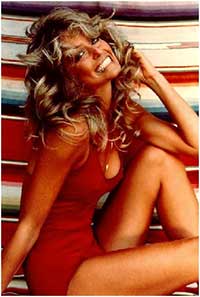
TMZ isn't infringing, but they are reporting on an infringement of the iconic 1978 poster of Farrah Fawcett from the 1970's (at right), by Bruce McBoom. The story goes that a small poster company called Pro Arts, Inc wanted Fawcett to pose in a bikini, and she instead insisted on the red one-piece, but it was apparently a chilly day that day, which is one of the things that made this poster stand out and become one of the best-selling posters of all time.

So, what's the problem? According to TMZ "Fawcett is suing Bio-Graphics inc., Pie International Inc. and author T.N. Trikilis, claiming that Trikilis "has falsely asserted to third parties that [Fawcett] does not own any rights in the photographs." , and that allegation has the potential to diminish Fawcett's ability to continue to license the image in the future, should people become confused about who to write the reprint/relicense/reuse checks to, so, she's suing for $100,000 or more. Maybe Bio-Graphics someone came into possession of the assets of Pro-Arts when they filed for bankruptcy at the end of 1981, or maybe not. But they're saying they have exclusivity, she's saying they don't. Maybe the author of the book about Pro Arts, T.N. Trikilis is just trying to promote his book?

Further, the well-respected website TechCrunch is allegedgly infringing on a Flickr photo, according to Will Seberger over on his blog here - Is TechCrunch Listening? (2/10/09), and Seberger's been in contact with the photographer in question, who has indicated she gave no permission for the photo's use.

(Comments, if any, after the Jump)


Please post your comments by clicking the link below. If you've got questions, please pose them in our Photo Business Forum Flickr Group Discussion Threads.


[More: Full Post and Comments]
Newer Posts Older Posts