Tuesday, January 1, 2008

Don't Be Like Mark Focus!

Thanks to my colleague Stanley Rowin over at Pro Photo Business Blog for revealing this YouTube piece, of a photographer spiraling down from a high dollar figure to free during this 60 second example of self-flagellation, and further evidence of the negotiation axiom "whoever speaks first loses" after price is discussed:

(Continued after the Jump)

Interestingly, the character playing the photographer, humorously named Mark Focus (that's got to somehow be funny to all the people with Canon Mark III cameras having focus problems) is actor Eric Krupnik, who is also listed as a production assistant for this 1969 movie titled Putney Swope. Was Krupnik living the mentality of his character as well? Krupnik has done little since in the film industry, whereas Putney Swope (played by Arnold Jackson) went on to a well rounded career as an actor!

The plotline and one comment about the movie from IMDb:
ark satire in which the token black man on the executive board of an advertising firm is accidentally put in charge. Renaming the business "Truth and Soul, Inc.", he replaces the tight regime of monied white ad men with his militant brothers. Soon afterwards, however, the power that comes with its position takes its toll on Putney...
This movie shows that the free enterprise system and the quest for the almighty buck transcends all racial and ethnic barriers. Ultimately the market place determines the message that is sent to the public....A conservative white-collar advertising company is taken over by a group of street-wise African Americans...who wants to make a buck and believes he can sell products by telling the the truth. But the movie shows that no matter how hard he tries to do something different, the market place and the political system demands that he conform, rendering him no different than his predecessors. Interesting, off-beat movie.

Gotta love the low-five that the "militant" bodyguard (played by Buddy Butler) gives Putney Swope at the end!

Please post your comments by clicking the link below. If you've got questions, please pose them in our Photo Business Forum Flickr Group Discussion Threads.


[More: Full Post and Comments]

Sunday, December 30, 2007

A Time for New Beginnings

Yes yes, I know, everyone has New Year's resolutions. I'm not suggesting you do that, but you will anyway, and you'll likely not follow through on that weight loss plan, get rich scheme, or other bright idea that, at 11:45pm this evening, will seem like such a good idea three shots in, but will be just a blur of an idea the morning after.

Instead, consider that, from a tax and bookkeeping standpoint, beginning to use accounting software like Quickbooks (at right, the TOP link is the PC version - 2008, and at BOTTOM is the Mac version, currently 2007, make sure you pick the right one!), MYOB, or invoicing/estimating software on January 1, 2008 is, in fact, the easiest and cleanest way to get your financial house in order.

It's not that you shouldn't have done it months ago, in fact, the day you started your business (or before) you should have, but it's high time you do so if you have been procrastinating.
(Continued after the Jump)
It's as simple as buying the software today, Monday, and it'll likely arrive by Friday. Over the weekend, you can learn a bit about it, and when your bank statement for December arrives a few days later, use as the closing balance for your December statement (which probably actually closed between the 31st and the 7th) your opening balance in the software.

As checks from jobs from December come in, just re-create your invoice in the software as they were however you did it previously, using the categories that apply, like "photographers assignment fees" become "professional services", and so forth.

After several months, the notion of going back to reconstitute several months' worth of transactions is daunting, so you have a wonderful window of opportunity to get your act straight in a real and meaningful way for the coming year. In addition, six months from now, you'll be able to, with a few clicks of a mouse generate reports that make you look like the real business that you are, and show you how your income is trending, and where your profit centers are. Sound foreign? If so, what are you waiting for, get on it!

Happy New Years!


Please post your comments by clicking the link below. If you've got questions, please pose them in our Photo Business Forum Flickr Group Discussion Threads.


[More: Full Post and Comments]
Thursday, December 27, 2007

Write This Down and Post It Up Somewhere

Write this down, and post it near your phone, or print it as a label and put it on your cell phone where you can see it before you answer any incoming call:


THIS WILL NOT BE
MY LAST ASSIGNMENT.


When your taking a call, you absolutely must not think as if the call you are taking is the only one for tomorrow. this week, or even this month. You must believe truly that it's just one incoming request, or you will beat yourself down on price, rights demands, and, self-valuation.
(Continued after the Jump)

True power comes from the presence of alternatives.

If you have no alternatives, then you will be at a distinct disadvantage when being called for any assignment. To paraphrase a past president - the trouble with our creative colleagues is not that they are ignorant, but that they know so much that isn't so.

I hear so many people talk about things like "...if I mail a copy to myself, I am protected if someone steals my work...", or "...if I don't register my work, after 90 days it falls into the public domain...", or "...the photo editor tells me that I am the first person they've talked to who has a problem with work-for-hire...", and the list goes on and on.

There are so many falsehoods out there about the business of photography. That's why I wrote a book, proofed by some of the best in the industry, and endorsed by the heads of major trade organizations, titled "Best Business Practices for Photographers". I'm glad it's doing so well, not for any reason other than the messages and practices in it are getting into the hands of photographers, many for the first time.

I was watching a 60 Minutes interview with Joel Osteen and he was talking about why he doesn't appeal to his TV audience for money, saying "...we didn't want anything to distract people from watching, to turn off the message, cause we know how people are skeptical of TV ministers - "hey, there's a guy that just wants my money" - I didn't want any of that....", and what he said was a similar mindset I had, and which was why my belief was that the best thing to do was to donate the advance for the book to the ASMP, APA, and NPPA. Because I didn't want, at any time that I encouraged people to buy the book either here on the blog, or in my presentations to think "oh, he's just trying to sell books..." and be skeptical of the content of the book because that thought process is distracting from the important point about the message I was, and am, trying to deliver. Yes, if you click through on the right to buy a book, Amazon gives me a dollar or so, but it doesn't cost you any more, and thus, that dollar comes from Amazon, who is indirectly supporting this blog's mission.

Because the falsehood continue, so too, this blog. We turn one year old next week, and I have countless ideas for the future, and, we've reached nearly a million page-views in that time, and over 148,000 "absolute unique visitors" as well. I honestly had no idea that that would be the case. We will be launching a third blog then, which I think you'll be excited about, because it's interactive in much more of a manner than this one.

Unlike Osteen, who does concede (fairly so) about the fact that he does accept money from attendees and those that send money, saying "well, we need people to support us, or we can't stay on. But we don't get on there and ask for it. And it's amazing how people can see, when you're genuine, they send money.", my bills are paid by the assignments I do, and rights I license, from editorial to corporate, and so on. Osteen has some solid, life-affirming messages, and is changing peoples lives, and if you're not familiar with him, one of his mantras is "why don't you get your hopes up, why don't you start believing that, no matter what you have, or haven't done, that your best days are still out in front of you." Amen pastor.

When what you're reading here, and asking about, is helpful, that's great. That's the purpose. And, many many of you have written, with inquiries, suggestions for topics, and otherwise expressions of appreciation. Thank you for letting me know I am being of some assistance.

Keep those cards and letters coming.

Please post your comments by clicking the link below. If you've got questions, please pose them in our Photo Business Forum Flickr Group Discussion Threads.


[More: Full Post and Comments]

Monday, December 24, 2007

Merry Christmas

After days and days in shopping malls photographing "holiday displays" (come on, just call a spade a spade, they're Christmas displays!) for commercial clients who's entire business is all about decorating the malls around the country, my one wish would be that these malls install auto-power-off switches so that when I am working from 11pm until 6am in an empty mall, that I don't hear the same songs on rotation for days on end. But, alas, when I return home, and it's all about my daughters who are so excited to see Santa, listening to those songs takes on a different - more personal - meaning, and they somehow are not a bother anymore.

My wife asks what I want for Christmas, and I want for nothing. I am healthy, have a job I love, and a wonderful wife and two beautiful children. What more could I ask for?

  • Peace on Earth?
  • Good Will Towards Man?
  • Rights Respecting Clients?
  • Colleagues Who Value Their Own Talents and Rights As Much As Their Clients (secretly) Do?
  • A Photographer's Union?
Come on, let's be realistic, and just enjoy the holiday!


(Comments, if any, after the Jump)


Please post your comments by clicking the link below. If you've got questions, please pose them in our Photo Business Forum Flickr Group Discussion Threads.


[More: Full Post and Comments]
Friday, December 21, 2007

It's Not Your Copy Right, it's Mine

My fellow blogger over at the Pro Photo Business blog brought to my attention this, in his entry - The Generational Divide in Copyright Morality, where he, in turn, refers to an article by David Pogue, of the same title, which can be found here.

This isn't a new mentality, heck, it's been pervasive for several years, most notably because the RIAA sued places like Napster, and the local soccer mom because they were infringing copyrights. The RIAA's position was "poor poor musicians, they're loosing money...", yet, if you know much about the record deals for the poor (read: up-and-coming) musicians, you know that the standard deal they get is that the record label owns the copyright to the first two albums, and further, that the artist pays a portion of whatever they earn back to the record label when they perform "their own" songs. (a common misconception, as they are not actually their own songs.)

Chase Jarvis, on more than one occasion has noted that the world of copyright is changing, and he's right. To wit:

(Continued after the Jump)
"I've said it publicly plenty of times: the face of copyright is changing, and as as visual artists, we should be well aware of how it could effect us. Blindly sticking a stake in the ground for copyright is like re-arranging the deck chairs on the Titanic."
The Pogue article noted that out of 500 people in attendance at his talk, only two thought that downloading music and movies for free off the internet "might be wrong."

Until the laws change, however, while more and more people are going to be infringing on your work, (note: there are two types of creatives in this world - those that have had their creative works infringed, and those that will) there will be more and more opportunities for you to reap the punitive benefits from these thieves. Yes, that means registering your work, and yes, that means pursing them with an attorney. Don't get me wrong, I'm not happy about this, because I'd rather be making pictures. But the fact remains, that when people steal your creative endeavors, you should be vigilant about going after them.

On the other hand, perhaps if you do produce work, and are paid for it, and wish to distribute it after the fact to others for their own private use, then denoting the work - at the least - with a Creative Commons designator stating what you do - and do not - want done with your work, will be one way in which you can share your endeavors, but ensure that it's not used by corporate America without their paying, yet still being available to the every man.

They write:
Creative Commons defines the spectrum of possibilities between full copyright — all rights reserved — and the public domain — no rights reserved. Our licenses help you keep your copyright while inviting certain uses of your work — a “some rights reserved” copyright.
They go on to say:
Too often the debate over creative control tends to the extremes. At one pole is a vision of total control — a world in which every last use of a work is regulated and in which “all rights reserved” (and then some) is the norm. At the other end is a vision of anarchy — a world in which creators enjoy a wide range of freedom but are left vulnerable to exploitation. Balance, compromise, and moderation — once the driving forces of a copyright system that valued innovation and protection equally — have become endangered species.
As it stands, the law is, as above "... a world in which every last use of a work is regulated and in which “all rights reserved” (and then some) is the norm...", and I like that that is the default. Yet, I know of people who don't want to do this, and Creative Commons is their way to designate that.

So, pick your level of comfort, and be sure to designate that as such. Just because "the kids" think it's ok to steal your work, doesn't make it so. When the laws of copyright meet up with the patent laws that only protect pharmaceuticals for about 20 years (more here on that), then it will be a new world order for copyright, and people will, in order for creatives to continue to survive, cost so much more on the front end to commission the work, because of the shortened life-span of copyright. That may end up being an unintended consequence of a change in copyright. Who knows.

Please post your comments by clicking the link below. If you've got questions, please pose them in our Photo Business Forum Flickr Group Discussion Threads.


[More: Full Post and Comments]
Tuesday, December 18, 2007

The Business of Photography - The Proof is in the Pudding

One of my daily reads is Mr. Unknown over at A Photo Editor. I am just making a leap in assuming it's a he, so, go with me on this.

I've been seeing an interesting trend in his entries - many of them are tagged "photography business". Which is good. The latest is about the corporate greed that is driving downwards the availability of talent, by way of the photographers' ability to cover their costs of being in business. Earlier this week, I made an editorial portrait, and I do so again tomorrow, and it's a mix of what I do. I've been saying for some time, and often I feel as if I'm on a soap box without a line to step up when I step down, about how it's the bean counters to blame for what's happening, and how there will be a loss of talent because of it, and now, we're seeing evidence of that as APE is reporting on this greed.

(Continued after the Jump)

My friend and colleague Michael Stewart also recently started a blog - http://foto-tech.com/, and his latest article discusses something called HDR - or, High-Dynamic Range images. He's got an interesting example of a pool and home, and he shows you the images that were used to composite together to make what is otherwise a near impossible image to produce in a single shot. It used to be that it would take thousands of dollars in lighting equipment to make an image like that happen, but it can now be done with available light and a firm tripod, and little else.

These points illustrate that you shouldn't be basing what you do on price, or technical skills. Instead, it should be on vision, and customer service. Is there any difference, really, between this single white t-shirt at Nordstroms for $18, and this pack of 3 fruit-of-the-loom t-shirts at K-Mart for $9.49? Probably not much. But, the service - is it worth it? Nordstrom's has proven that the answer is yes, and photographers who choose to compete on points other than price or rights-give-aways have shown that it works in our field too.

Please post your comments by clicking the link below. If you've got questions, please pose them in our Photo Business Forum Flickr Group Discussion Threads.


[More: Full Post and Comments]
Monday, December 17, 2007

On Assignment: Catering The Photo Shoot

Today we were on a shoot that called for catering. No, it wasn't the client that called for it, they weren't actually on set this time, it was the reality of the circumstances. We had a three assistant crew, two makeup people, two subjects, and four handlers, oh, and me. I get hungry, and anyone who knows me, knows that a sandwich and a Diet Coke will make me much less grumpy. So too, clients and subjects.

But what food, and why should I cater it anyway?

(Continued after the Jump)
When you're called to shoot something, even if it doesn't span a mealtime, bringing along food is critical. It's true - An army marches on it's stomach. So too, do assistants, and the rest of those on site. In fact, I've known more than one client complain about working with other photographers who either were upset because catering wasn't on the estimate, or got to a shoot, and it wasn't there, already laid out.

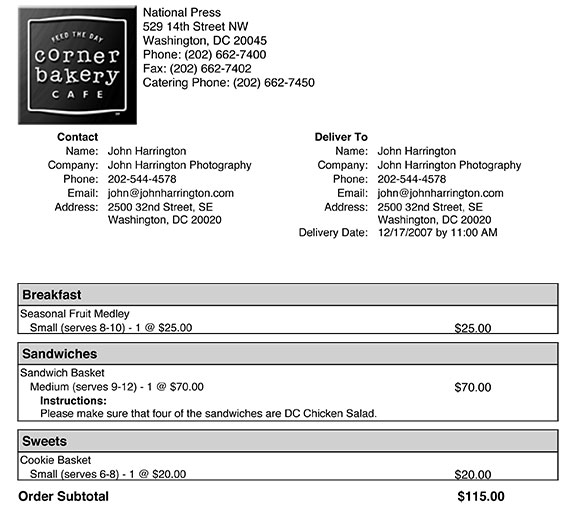
When we arrived today, before the gear came in, before the cameras were in place, the second assistant was detailed to set up the catering. I didn't want anyone arriving on set and not seeing food and beverage. Above is the bill (click to see it larger) for catering, minus the drinks, which we brought in a separate cooler - water, vitamin water, and Diet Coke. On a humorous note, our subjects, half-way through the shoot said "hey, where's the tequila?", to which I responded, without loosing stride "I didn't see that on the rider..." and kept shooting. (they laughed).

But don't even think of catering it yourself, or using Subway or Quizno's. Places which make gourmet sandwiches, cookies, and so forth, are a good solution, we like Corner Bakery here in DC. Be sure to know if anyone who will be partaking has food allergies or restrictions. A wide variety of the riders in the link above outline all sorts of restrictions, from "no pork", to brands of water and so forth. If it's a huge shoot, you may be best served to call in a caterer that has servers, but I'm not going there with this.

When the subjects walked in, they reacted by saying "wow, look at this, I didn't expect this!" And then I introduced her to the makeup and hair stylists, while her handlers grabbed waters and cookies, and headed off to quieter parts of the set with their blackberries in hand, satiated.

During a wardrobe change, the subjects opted to grab a bite, which ensured that they weren't feeling the pangs of hunger that would become moodiness that would result in lesser expressions, and an eagerness to depart. No one felt a need to order in, and when we were done, there were three cookies and four sandwich halves left. There were no Diet Cokes left (my fault, I drank most of them), and a few vitamin waters. All in all, just right.

Please post your comments by clicking the link below. If you've got questions, please pose them in our Photo Business Forum Flickr Group Discussion Threads.


[More: Full Post and Comments]

Sunday, December 16, 2007

In The Photo Business - It's All About The Usage

The frequent refrain from clients I hear when I ask (as a part of our conversation about my producing work that will run as an advertisement or for corporate/commercial uses) about what the photograph will be used for and to what extent is "...oh, we're not sure where we'll use it yet....", which is double-speak for "we want to get the lowest price from you, and if you really knew how much we'd be using your photographs you'd want to charge us more, so we're not going to tell you everything..."

That's not to say that there aren't clients who aren't straight with you up front - there are, but there are many who are not.

(Continued after the Jump)
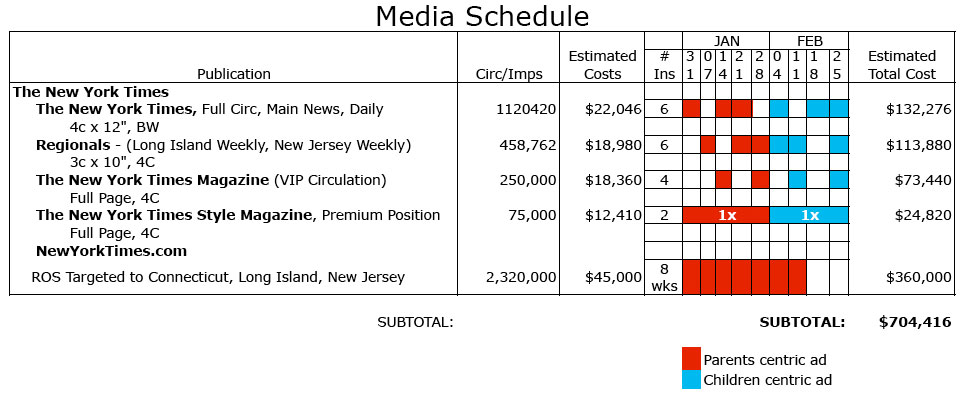
But, it's worth backing up here for a minute, for those of you who don't get "usage". Simply put - if someone wants to use your photograph once (whether you create it specific to their needs, or as pre-existing stock), and it will be in a weekly newspaper serving your community, the benefit the client will receive (and the exposure of your image), will be "X". If the client wants to use it 10 times, then, for that client, the benefit (and thus, the exposure of your image) is 10x. When it then appears on billboards, or in the local daily paper, and on brochures, and so forth, the benefit multiplies again and again. As the client benefits from your work, you are entitled to an increased generation of revenue. It's only fair. Every time an ad agency or PR firm proposes an ad campaign to their client, they give a pitch, putting forth a detailed proposal about the metrics and benefits of the placement. How much it will cost, why certain viewers/readers/public locales/eyeballs are better than others, and how to produce the work.

Here's what one agency's proposal cover sheet actually* contained, as a part of an advertising pitch they made to their client:


The following estimates are provided for the various components based upon the media plan options presented today for XXXX XXXXXXXXX. All pieces will be based upon the XYZABCD concept, and will be customized as necessary for the specific media that was selected.

Photography
Photography that is unique to NYC and it's environs, and reaches both the parents and children is an essential part of this campaign concept. We have looked into a stock photography solution, and were unable to find appropriate shots and highly recommend producing original photography, that can be used for print, collateral, outdoor and web in the New York region.

We recommend a full-day shoot, in one New York City location. This will allow time for shooting photography for both the "parents centric" and the "children centric" ads in the same day, which is the most cost-effective approach. The budget for this shoot, including all photographer's fees, location scout, permit fees, stylist, and photographers rights package is $12,000-$14,000.

The estimate for professional services to review and select an appropriate photographer, coordinate shoot logistics, recruit and retain appropriate talent, attend and art direct the photo shoot, and review and select final photography is $5,500 - $7,500.
Talent
Talent fees for two ads, including a full buyout for the distribution outlined are estimated at $4,500-$6,500, which may include up to four talent.
Professional Services
Print Ad
The estimate for production of two print ads ("parent centric" and "children centric"), including copyrighting, art direction, headline illustration, coordination and management of photo shoot, art production and overall project management is $18,000 - $21,000.
Online Banner Ad
The estimate for creative development of an animated banner ad campaign is $5,500 - $6,500. This estimate includes adapting the creative concept for web use, art direction, copyrighting, and execution of Flash banner ads with static .gif backups. This provides one banner for each "parents centric" and "children centric" execution.


So, when you're contacted by a prospective client for a campaign, recognize that many things are already determined. They will often have already proposed a budget to the end client, however, more often than not, I have been called for a quote for an assignment and been told that what I provide will be for their pitch. Often, this is the case when you are the preferred photographer, that will likely win the assignment if the client wins it.

During the conversation, ask the person calling for the campaign's "media schedule" so you can determine proper usage. Ask for them to e-mail you the PDF, or fax it to you. As above, click here to see what it looked like for this pitch. If they say they don't have one yet, you can say that your estimate will be higher than it might otherwise be without it, and then ask what the usage will be - number of insertions, circulation, size, and so forth.

Your creative and usage/licensing fees will be either combined, or separate (see the points on this debate here), and once the client has outlined their usage, using photography business software like fotoQuote (details about them here), and be sure to use the PLUS language to outline the rights package (as detailed here).

By the time a client calls a photographer, more often than not, many of the details are worked out, the pitch and campaign approved in concept, and dollars allocated. Be sure to ask the right questions during your client dialog so everyone is working from the same page when you prepare your estimate. Ask for comps/layouts so you know what you're going to be expected to produce.

These things are true whether they're for a major campaign, or a one-time small-town paper campaign. They're true when they're for a brochure, an annual report, point-of-purchase poster, billboard, web page ad, and so forth.
______
* note: To protect the source, slight changes have been made to the media schedule and estimate proposal, but the content, look, feel, layout, and all language except identifying names/campaigns, and actual dollars involved are as presented. These dollar figures are comparable to those presented.


Please post your comments by clicking the link below. If you've got questions, please pose them in our Photo Business Forum Flickr Group Discussion Threads.


[More: Full Post and Comments]
Friday, December 14, 2007

Please Welcome fotoBiz & fotoQuote As Our Latest Advertiser!

One of the pieces of software that I find as indispensible as Photoshop and Firefox, and thus, is parked right on my Mac's dock next to them is fotoQuote - simply put, the best and most up-to-date pricing solution for photographers, and one which I rely on. I've been saying this for years in my presentations, and believe it to be just as true then as it is today, so, there's no quid-pro-quo here, I am a true-believer when it comes to how great fotoQuote (and it's larger sibling fotoBiz) are.

Back in 1992, Cradoc Bagshaw began a quest - to solve the pricing dilemas of photographers everywhere - and he has succeeded (and re-succeeded since then) in providing top-notch, real-world information. In 1993, after painstaking research, he released what I honestly feel was a landmark tool for pricing photography. The first tool was the ASMP pricing guide, which, while a milestone back in 1982, but which became problematic for them, as an organization, when the Federal Trade Commission slapped them with concerns about price-fixing. Further, for over two decades, photo buyers and photo editors have pointed to the now outdated pricing guides, that ASMP was prohibited from updating. Not Cradoc. He regularily updates his software.

(Continued after the Jump)

So, what's his story? Well, Cradoc began when he was just 15 working for the Anchorage Daily News as...get this...Chief Photographer! Following that, he worked for Life, Forbes, Time, and countless others, as well as having his work represented by Black Star, West Light, and others. Cradoc really has earned his stripes as a photographer.

Aside from that pedigree, he maintains a very active and engaged life, speaking at NYU, the International Center of Photography in New York, UCLA and Brooks Institute of Photography.

At right, is an example of the over 200 pricing categories that fotoQuote has - this one is for a retail book cover stock photography use.

But the software doesn't stop there, there's an entire coaching section, which is a must-read before you engage in a phone conversation with a prospective client or buyer. And it coaches you for every use category/type, it's truly a remarkable opus, at your fingertips, dealt to you piecemeal, just what you need for what you're negotiating on.

In one instance, in fact, one that appears in my book, I was negotiating with a educational textbook publisher, and I used the software to ask the right questions and, as you can see by the negotiations that ensued between myself and the client starting on page 192 of my book, I was able to move an offer from $275 to $950 each, for two images, all based upon insights from fotoQuote.

This was remarkable, because, in part, the negotiating coach section was developed with the help of a past ASMP National President, Vince Streano. In a prophetic citation from the a 1999 Central Virginia Newsletter "....How do you smoke out actual usage and budgets, and how can you tell how badly the person on the other end of the phone wants your image? Are you prepared to let a sale go for $200 that you might have gotten $900 for?" This is just what I did, and the ending numbers are remarkably similar. Crazy. But, crazy good.

Back in February of 1994, promoting one of the software updates, a press release from the company noted:
FotoQuote automates the process of creating a quote for stock photography submissions. “Our research has shown that when a price quote is given in writing instead of verbally there is a much higher chance of getting the asking price,” said Bagshaw. “ There are fewer problems, including copyright infringement or rights grabs, if the photographer is willing to take the time to send the client the correct paperwork outlining the exact details of the job, including usages and rights that are to be granted."
It goes on to report on how the pricing figures are researched:
All of the prices have been carefully reviewed from actual sales records, and raised or lowered to reflect the current market.
Their website goes on to note:
To get accurate prices we reviewed thousands of confidential sales records from national stock agencies and photographers all across the US. We built a price grid and then checked back with experts in each category to be sure the prices were accurate. As a last step, we again checked the prices against thousands of actual sales records from agencies and photographers.

We scoured all of the available online pricing that we could find, looking for new patterns and checking to see whether or not there was any consistency in those patterns or if they seemed to be a quick and dirty solution to the new pricing situation. We worked with a pile of our own email requests for help from users looking for pricing solutions that were new to the industry and finally we monitored stock photo news groups to see what kind of pricing problems photographers were having and the possible solutions that were being offered. Finally, after building a greatly updated pricing model we started calling industry sources to check the prices we came up with. As a result, we "rewrote the book". You won't find the pricing information in the new fotoQuote anywhere else.
Now, Cradoc has decided he wants to promote his software here, and advertise with us.

As a long-time registered owner of the software, I was upset to learn, in the same ASMP Central Virginia article: -
On a sourer note, the program’s author reports that there are many unlicensed copies of fotoQuote in use by photographers and agencies. If that is the best behavior we as professional photographers can muster, then we deserve what we get. Come on, you know who you are and just howhypocritical that is. Buy the program.
Yes, buy the program. Don't steal his efforts he's made for our benefit. Don't steal his software, it's just as much a creative endeavor as a picture you've made, and when someone steals your photograph, you get upset, so do the right thing and buy it. If you are using a copy that's not yours, now is the time to order your own legitimate copy. It's good karma (and the law!) to do so.

fotoQuote - $139.95 full version, with upgrade pricing.

FotoBiz -" If you need to get your paperwork out, keep track of your images, keyword and caption them, then this is the program for you." $299, full version, with upgrade pricing. (this includes fotoQuote in it!)


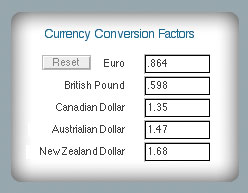
UPDATE: For our foreign readers, fotoQuote has listed the conversion rates for currency. Those shown at right are the default figures, but what with exchange rates fluxuating, you may change the rate as markets change. In addition, if for whatever reason, you think that these real-world surveyed rates need a tweak, you may make an adjustment to a specific use, or an across-the-board percentage increase to all the rates!

Please post your comments by clicking the link below. If you've got questions, please pose them in our Photo Business Forum Flickr Group Discussion Threads.


[More: Full Post and Comments]
Thursday, December 13, 2007

Your Photography Business: Get In The Mix

There are several different dishes I enjoy at restaurants around town. I have become a "destination diner", in that, I'll suggest we go to a certain restaurant because I am craving, say, Tortellini Rose from Paolo's, Tuna Tartare from BLT Steak, a Floating Island from Bistro lepic,  Pho from Pho 75 in Arlington, or my latest, Butterscotch Mousse from Johnny's on the Half Shell after last night's "after gathering" following the White House News Photographer's Holiday Party at the Capitol. However, if I had those dishes even once a week they would loose their appeal.

If every assignment I made was of a concert performance, or a lit portrait, so too, I'd be less excited by them. tonight I scouted a location for a book cover shoot on Monday, and photographed a holiday party for an association. Tomorrow (as you're reading this), I am doing a magazine portrait in the morning, and a corporate portrait in the afternoon, followed by a client's holiday party drop by (sans camera) and then a prospective client has called me to meet with them while they're in town to "look at my portfolio". Meanwhile, two of my colleagues are shooting a corporate assignment for me in New York City that has taken them and the biggest SUV I could rent along with a G5 tower and iMac and my Post Production Manager to deliver on-site files and immediate uploads for the client's review in Texas. (cha-ching!)


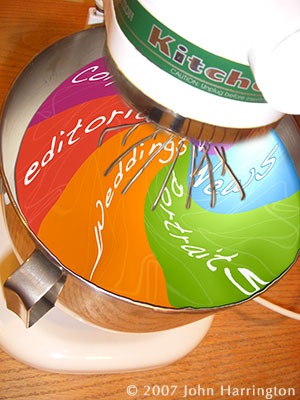
Diversity of a client base is one cornerstone of success as a photographer.

If all I did was portraits, or weddings, or events, or news, or documentaries, or....you get the point...just one (or a few things)  I'd have established a client base that is one-sided, or of just a few clients. An exceptional photographer friend of mine has just one editorial client. He's a freelancer, and he relies soley on them for all his work. Sure, it's a high profile client with sufficient work, but he's at the whim of that client's decision, and he could get the ax at any time.

How do you mitigate this situation?

(Continued after the Jump)
A mix of clients.

Yes yes, there are tons of photographers who specialize, and there is a wide cacophony of voices telling you you should specialize. And, well, yes that's a nice goal, but I've held to the belief that "have check, will take picture", works pretty well. Does that mean I don't try, on my own schedule, and on my own projects, to have a style/genre/etc? Maybe. But, as with too much Pho, or too much Butterscotch Mousse (I stopped after two last night), it begins to loose it's wow factor. 

Perhaps, for some people, portraying the family dog is a calling. For others, babies and their new moms, and again for others, their own muse. Yet, everyone from Ansel Adams to Bill Allard, to well...you know what I'm saying - all the greats - they do not do just what we know them for, but the school portraits (I've lost the image of Adams doing an outdoor school portrait that I once had, but it was a revised perspective that my young eyes once looked upon, seeing that in the lab at Black & White one day when I was getting....ahem...film processed...) and even Annie does corporate portraits (rumored to run $65k) when someone calls.

Who knows what I'll be known for some day. To me, being known as "...the greatest dad in the whole-wide-world..." by my daughters is what I hope to be most proud of, but maybe a picture or two will be remarkable. Then again, maybe not. I, however, sure enjoy the spectrum from Robert Plant to BB King to The President to a bush flight into Alaska for a book project to, well, again, you get the picture. Diversity not only rocks, it can ensure your longevity, and it's about the journey, not the destination.

Please post your comments by clicking the link below. If you've got questions, please pose them in our Photo Business Forum Flickr Group Discussion Threads.


[More: Full Post and Comments]
Newer Posts Older Posts