Friday, January 19, 2007

The Art of the Retoucher

In business, it pays to hire a professional, and the value of a retoucher canot be underestimated. Yes, many of us do it ourselves, but that's often like asking uncle Joe to take photos at your wedding. Hire a professional retoucher when you need retouching. Below are a few folks who do an amazing job.

Consider this -- check out Rocket Studio, which did the retouching for the Apple iPod print ads. They show an amazing before and after of the images they did the retouching on, and I would submit that their retouching actually reaches a level that what they have produced is a new derivative work of the original. They further show a variety of different types of retouching.

Amy Dresser also illustrates the critical value of a talented retoucher, doing work ranging from Las Vegas casinos to Time Magazine covers.

Glenn Feron does a service to the retouching community, in that he lists his retouching rate, at $125/hr, with a two hour minimum. For many, who just list their own services, and then don't go into their hourly rate, the figure seems to come out of some secretive formula. By being open about his rates, he is also giving insight into those who aspire to be a retoucher, just what they should be charging at an hourly rate for their services. Feron spends most of his work (at least as demonstrated from his website) in retouching people (including many celebrities), and showing just what he can do for his clients.

In our office, for editorial clients, retouching is verbotten. However, for corporate or commercial clients, retouching is so integral to the final results of the project, that it is not optional. Currently, we are working our way through retouching 38 portraits from a portrait series we did. From things as simple as the removal of fly-away hair in a portrait, to the insertion of a missing executive (or the removal of a recently fired one) from a group portrait, it is a part of the service we provide. Retouching for corporate portraits is not a line item, it's a part of our fees, however, for many commercial assignments (ads, and so on), we do break out the retouching fees as a line item. Sometimes, it's just a few wrinkles, sometimes it's the removal of a double chin, but always, it makes CEO's, attorneys, and others much more comfortable with the final results from a photo shoot.

Many clients compare the bottom line, and do not realize just what we can do for them, or, what we can recommend to them for outsourcing of retouching needs. Every time I demonstrate simple retouching for a client in front of them, they are amazed, and almost always, they say "so that's how all those celebrities on magazine covers look so good", and I say "without question." Countless clients become long-term clients because we can demonstrate just how we will make their staff look great, right infront of them. We explain, however, that whatever we are doing infront of them is just a demonstration, and that we will do the actual, final, best retouching back at our office.

An absolutely amazing example of the value of the retoucher comes courtesy of Dove, the folks who bring you your daily bar of soap. They have available online a video which shows exactly what goes into an ad campaign on their Campaign for Real Beauty website, where they not only show you the shoot, but also, the retoucher, in action. It's a time-lapse video, spanning less than five minutes, but which gives you an understanding that here-to-fore was unknown. Thank you to Dove for these insights into the value that a retoucher brings to the project.

Next time you are preparing an estimate (or scrutinizing one you've received), be certain you understand all that goes into delivering superior-class service so that you an provide (or expect to receive) it.


Please post your comments by clicking the link below. If you've got questions, please pose them in our Photo Business Forum Flickr Group Discussion Threads.


[More: Full Post and Comments]

Wednesday, January 17, 2007

It seems I've been Found

Today marks the day when several other blogs and sites picked up on this blog, something I've been doing for a while, as well as a private insights and counsel I've been giving for years now. However, today I was found by two clients online, at the same time. Interestingly enough, I can be found first on Google's Page 1 for the search term Washington DC Photographer, as well as first on Yahoo's Page 1 for the search term Washington DC Photographer, and second on MSN's Page 1 for the same Washington DC Photographer. Interestingly enough, the person that ranks #1 is someone who formerly worked for me (and good for him!).

My first call was from a magazine that needs an editorial portrait produced, and needed it done for $800. Small circulation, inside use. No problem, for their circulation and the difficulty of the portrait, that's an ok rate, however, I was successful in negotiating that up to $900. While on the phone discussing the details of that assignment, my caller ID clicks. Now, I make it a habit of never clicking over when talking to a client, and many times friends of mine have found themselves on indefinite hold when I clicked away from them to find a client on the other line, and remained (rightfully so) talking to the client. Thankfully, I have friends who are either photographers themselves, or are understanding non-photographers, so no one ever holds it against me. While on the line, I hopped over to my Vonage online account, which tracks, in real time, all inbound calls (and lets me forward my calls with a few mouse clicks to my cell) and discerned that the number that had called me was a 212 #, i.e. New York City.

Again, while getting the details from this client about the first portrait assignment, I took the prefix and first two digits of the inbound calls' number, and passed it to Google, which returned another media organization. The second I got off the phone, I immediately dialed the missed call, and caught the Art Director for another magazine, who had found me online, and who needed a cover photographed within the next 48 hours. I can be almost certain that he was working his way down his list of prospects, panicked that he'd not have a photographer for the cover shoot. I had gotten back to him within 90 seconds of his calling me, and, he was pleasantly surprised that I'd reached him so fast, and we began discussing the assignment, and I was able to book a $1,250 portait for the cover.

The first client located me from a Google search (I always ask the calling client "who can I thank for the referral", and when they say "oh, I found you online", I respond "which search engine, and do you recall your search terms?") and the second via ASMP's Find A Photographer.

In addition to the power of Google/et al, I want to impress upon you, dear reader, of the critical value of the NPPA's Find A Photographer, the ASMP's Find A Photographer, and APA's Find A Photographer, as well as PPA's Find A Photographer. If for no other reason than your inclusion in these, you should be members of ALL these organizations. Today I was talking to a colleague about whether or not they should be an ASMP member. They were considering it because of Find A Photographer, and wanted to know if it was worthwhile. I reported to them that it definately was, in fact, each year I can point to atleast $5k in assignments that came just via ASMP's list, and other revenue from the others. Spending about $1k combined for memberships in all the organizations is not only the best thing you can do for the industry by being supportive of their existence (and also they are deductable from your taxes), but can prove to be a revenue-positive way that you can be found by prospective clients. Clients who have, be their searching for you on a professional trade organizations' site, have usually pre-qualified themselves away from a lowball assignment fee.

Run, don't walk, to those organizations, and join. Join for the revenue-enhancing potential of being in their lists, and reap the benefits of them that you never new existed. I encourage you to share with others your experiences with all the organizations' Find A Photographer in the comments section below, so that others can know how beneficial these things are.


Please post your comments by clicking the link below. If you've got questions, please pose them in our Photo Business Forum Flickr Group Discussion Threads.


[More: Full Post and Comments]

Tuesday, January 16, 2007

A Triumph of Hope over Experience

Remember when the client said "I don't have much money, but if you'll do this one at this price, I will make it up to you with the next one"?

I am reminded, when hearing this, of one of England's great literary figures, Oscar Wilde, who said that " while a first marriage is the triumph of imagination over intelligence, second marriages are the triumph of hope over experience." (sometimes also attributed to a Wilde predecessor, also a literary figure, Dr. Samuel Johnson).

Bringing up a more timely analogy, as Wimpy J. Wellington said to Popeye "I will gladly pay you Tuesday, for a Hamburger Today."

In over seventeen years, I have never experienced this as a promise kept, and have long since abandoned any hope. In fact, with all these litary references, I shall toss in one more -- "fool me once, shame on you, fool me twice, shame on me."

One solution:
Here's the client's approach, who, in an attempt to get you to accept lower than acceptable terms (as defined by you), says "boy, am I glad to find you. We often have assignments in {enter your city here} and really like your work" and then they go on to say "...the thing is, we only have $400 for this assignment, but I can make it up to you in the future as we frequently have a need in {again, enter your city here} and would love to work with you on an ongoing basis."

Try this: "Wow, that's great. Who've you been working with before finding me?" since they said they often have a local need, why, all of a sudden, are they calling you?

To which you will get the response: "You know, I'd rather not say...", which is because, if you know your local colleagues, you will probably learn that they are either doing these low-ball assignments, or, this client is bluffing, and, moreover, at this lowball rate, the client is dissatisfied, and is literally getting what they paid for.

Either way, try this solution:
"You know, this sounds really enticing. How about this- $400 is really low, in fact, I can't justify it for an assignment like this. But, if it's as you say, and you'll have a frequent need for my services, then let's do this: Assuming that you'll have 10 assignments a year here, that works out to be $4,000, so, what I'll do is charge you $500 for the first eight, and then the 9th and 10th ones will be free. This way, you will stick within your budget over the year, and I'll be assured of a continued relationship and a revenue stream I can count on."

Think I've ever been taken up on this? Nope, and I've proposed it easily a dozen times. Yet, were I able to find a client willing to make that commitment, I would certainly uphold my end of the bargain.

What I have done, is say "let me send you an estimate at the rates I can do this assignment for you, and then let's have a conversation", and my estimate goes out, and I'd say that 80% of the time I complete the assignment at my rates, and moreover, those clients return time and time again.


Please post your comments by clicking the link below. If you've got questions, please pose them in our Photo Business Forum Flickr Group Discussion Threads.


[More: Full Post and Comments]

Saturday, January 13, 2007

You're My First

Do you remember your first time? I do. How about...do you remember looking quizically when someone said to you "you're my first"? Did you think twice about the honesty of the statement? Consider that their interaction with you was just a little too good. Their words an tone just a little to well said? Question, as Stephen Colbert puts it, the Truthiness of what was said? I do.

Now, don't get your dander up. In fact, get your mind out of where it is. I am not talking about the most intimate of intimates, I am talking about the first time a client said to you "you know, you're the first person who insisted on being paid for this photo assignment. Usually we get paid from photographers who want to shoot for us, and, if they're lucky, they get a photo credit in 6pt type, depending upon the whim of the designer, and if they like your name."

Sounds silly when put like that, doesn't it? Yet you hear variations on that "no, we own what you shoot, you're the first photographer to object to that." Or, "well, we don't pay expenses, it's $250 flat, and all your expenses have to come out of that total figure, you're the first person who has said they can't work within that budget."

Just because someone says that something they tell you is "standard", or no one has ever objected to a clause before, doesn't mean you have to accept it, or can't negotiate it. Everything is negotiable.

From "pay by" periods, to placement of photo credit, to receipt requirements, everything is negotiable. Period.


Please post your comments by clicking the link below. If you've got questions, please pose them in our Photo Business Forum Flickr Group Discussion Threads.


[More: Full Post and Comments]

Friday, January 12, 2007

Wise Words for your Client Dialog - When there's a problem or Question

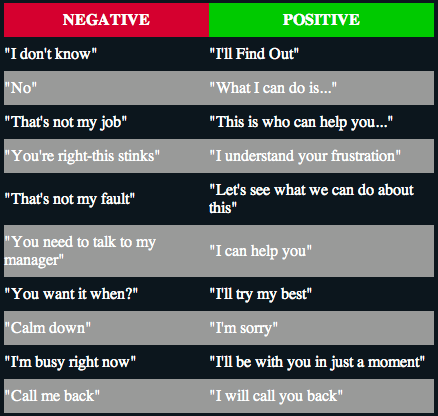
Woe be the photographer who does not respect the value of customer service as a key to their longevity in the business. Your choice of words can make a big difference when dealing with clients and ensure that you keep them coming back. Consider these two sets of sentiments, from the book Customer Service for Dummies:


Just choosing how you convey these simple sentiments can make a world of difference during your brief client interaction on the phone when you are working to resolve a client concern or get information that may not be readily available.


[More: Full Post and Comments]

Thursday, January 11, 2007

At least the Hypocrite Knows Right from Wrong

I have a great regard for photojournalist P.F. Bentley. Back in 1989, when I was a young, inexperienced buck, I ran across P.F. in San Francisco while I was covering the San Francisco Earthquake and he and I talked for awhile. We looked on with amazement as another photojournalist took some "police line do not cross" yellow tape and moved it so it looked better in her photo. We both shook our heads at this ethical breach, yet I was probably more shaking my head because PF was, not because I disagreed, but because, I was taking a que from him, as he affirmed what I knew to be wrong.

PF was celebrated by the President of Time in this article, which reads, in part, "...Gingrich's heady first 100 days were documented close-up by TIME's prizewinning photographer P.F. Bentley. "P.F.'s passion is recording history as it happens," says picture editor Michele Stephenson. "He has great instincts, and he gets rare access because his subjects trust him."

Yet, this trust seemed to actually not carry much weight with the folks at Time, when they devolved their contract with onerous additional rights demands without increasing compensation to their contributors several years back. PF was chosen by the Time contract photographers around March of 2000 to handle negotiations regarding the new contract, which he did, full time for four months, without pay, on behalf of all the contractors (who were able to remain out earning a living completing assignments), and in that proposed contract they raised the day rate by only about $200 (a nominal increase from where it had remained stagnant since the mid 1970's). The contract also had an overbearing rights grab that was not fair. When discussions broke down, and the contractors were talking the talk, both PF and Dirck put their money where their mouth was. Many of the loudest voices of objection to the new contract simply chickened out and caved, and PF and Dirck stood their ground. It didn't make sense for Time to have taken that stand and they lost out. PF either got some well deserved time off, or was (more than likely) booked by others who knew what he brought to the table.

However, most of those that looked up to PF, sought his counsel, followed his lead, or otherwise considered him someone to aspire to be like, chose not to stand in solidarity with him, also objecting to the new contract. They were quick to see this not as an opportunity to do the right thing, but rather, an opportunity to get all those assignments that PF would no longer be doing. I was not one of them. PF did the right thing, and as I was looking to grow my assignment load, I made not one attempt to secure assignments from Time because in doing so, I would be dismissing the actions-as-silent-advice I was getting from PF. Once again, PF and I were standing there at a dinner in Washington discussing the matter some ten or so years later, shaking our heads again, as a line was wrongly being crossed, this time, it wasn't a yellow-taped police line, it was moral line, hypocrites all of them, knowing they shouldn't be doing so, but doing it none-the-less.


[More: Full Post and Comments]

Wednesday, January 10, 2007

Border Bound

I'm heading to Texas -- to the Professional Photographer's of America gathering known as ImagingUSA, where I will be presenting on, what else? Best Business Practices for Photographers. My Monday session, January 15, causes me to be an early riser that day, but I am excited about this presentation. To learn more, visit ImagingUSA.org.


Please post your comments by clicking the link below. If you've got questions, please pose them in our Photo Business Forum Flickr Group Discussion Threads.


[More: Full Post and Comments]

Commentary on Dilbert Commentary

Dilbert, so synonymous with office/job malaise, that The Dilbert Effect term has been coined, and used countless times to describe dissatisfaction with one's job, or station in life.

This week marks two years when, around January 12, of 2005, Dilbert's sights were aimed squarely at the freelance photographer in this series of three strips. I would have made a more timely comment at that time, yet what I had to say was limited to my encouraging my colleagues to get the paper and check it out. Here, in this forum, I can now share my commentary beyond just those few phone calls. Here's the series of strips :


Why is this? Because, sadly, freelancers are being forced from their chosen profession, and into desk jobs. Now, if you work a desk job, that's cool, because you are doing what you love to do there, but, if you're a freelance photographer, riding a desk is not what you want to do. These Dilbert strips illustrate that the phenomenon of freelancers leaving photography is not uncommon. Certainly it had reached a point where the concept became funny and would appeal to the mass audience that the strip reaches.

Freelancers will quickly, as the strip points out, have a hard time adapting, and so, an attention to the business realities that surround photography will ensure that you can remain "wild and unsupervised", "free-ranging" as Dilbert so eloquently put it.


Ed. While the display of this image is a commentary on the strip, and thus, "fair use" should apply, we took the cautious step and secured permission to display these strips from Universal Features Syndicate's clearing house, for those of you who might be wondering. J.H.


[More: Full Post and Comments]

Tuesday, January 9, 2007

Teachable moments

There are times where you are more succepible to learning-and retaining-knowledge than others. Take the proverbial parent who said to me once "Johnny, don't touch that hotplate, it's hot. That's what cooks the pancakes." and what did I do? Defiantely looked at my mother square in the eyes, and put my hand on it. Lesson learned.

It's when you sign a contract with bad terms in it that you learn not to do it again. It's when you estimate an assignment for a portrait that is outdoors and that you will be using a large softbox on it, and you don't include an assistant to keep hold of the soon-to-be airborne softbox, lightstand, and flash head, that you learn to always book atleast one assistant for an outdoor assignment. It's a costly mistake to repair that head, one that you cannot pass on to the client and must now absorb.

When you encounter a client who may not understand just why you've got a web exclusion in your contract, why you charge for post production services, why because they hired you doesn't mean they own the resulting work outright, or why your rates are what they are, this is not the time to get flustered. Take the time to explain, thoughtfully and courtesously, exactly why.

This, however, requires a strong grasp of the reasons. "...because everyone else does..." is not going to float, nor is "...because that's always the way we've done it..." going to cut it.

Explaining, for example, that the use of photography in a company or organization's web site is almost always going to be considered an electronic brochure, and as such, will require model releases from everyone in the photos, just as a printed brochure or advertisement would, will not only give the client a reason to take to their boss or their end-client your understandable reasoning, but will engender in your clients mind the fact that you are a professional and are knowledgable about the rights and responsibilities of producing photography for client use. Further pointing out to clients that you are, in fact, protecting them from a seemingly innoncent misuse of someone's likeness because you are precluding the use of your photograph in that way, and the sharing of these insights is an integral part of the services you offer as a professional photographer. In all of our estimates, we include the URL http://johnharrington.com/about-the-web so that clients can review this as well as provide this link to their senior staff of end-client which has always lead to a greater understanding by all.

Sometimes, it takes consideration by an organization's attorneys to concur with our position, but always the client comes away having experienced a teachable moment, and we have grown our relationship with our client.


[More: Full Post and Comments]

Monday, January 8, 2007

Recommended Online Columns & Resources


  • Mark Loundy's Common Cents column on the photo business. Loundy updates this column monthly, and it appears in not only in the NPPA's News Photographer magazine, but also on the website Digital Journalist.

  • David Hobby's Strobist blog about off-camera lighting by Baltimore Sun photographer. Hobby presents a frequently updated site with a lot of great information.

  • Sportshooter, a site devoted to sports photography (and has expanded to all aspects beyond it)

  • ProPhoto Resource, a good site with a lot of information which sticks to the standard that highly regarded Will Crockett contributes to.

  • Photo Forums, another good site with information about the business of photography

  • Pro Photo Community, the well regarded archives of the Rob Galbraith site, has been taken over by these folks.

  • Photo District News' photo business forum is also a good resource as well.

What with all the above resources, one might wonder how and why this forum exists. Well, it's different. Simply, it's not so much a place where a Q&A takes place, but rather, much like a column in a newspaper or magazine, a place where I, the columnist can share with some insights -- some timely, others timeless. In addition, I will endeavor to expand this list.


[More: Full Post and Comments]
Newer Posts Older Posts