Monday, January 11, 2010

What's In a Picture? Apparently NOT Mr. Hero to "0"!

Gilbert Arenas, known by his jersey number "0" seems to have gone from hero to a REAL zero, and then (at least temporarily) non-existent. Arenas, after apparently breaking the law by not only possessing handguns in Washington DC, but, if some reports are to be believed, brandishing them, is, according to NBA Commissioner David Stern, "...not currently fit to take the court...", then while it would stand to reason that the NBA wouldn't want the bad publicity, why would Getty Images - take down the images? Getty's "editorial policy" (here) states, in part, "...Images illustrate and reflect the events of our world today and therefore have a responsibility to be delivered to the customer with accuracy and impartiality." If this, which is an obvious follow-on to the censoring of the images from the NBA brawl (more here where Getty Images surprisingly had no images to show of the brawl), doesn't demonstrate that Getty Images is, in many ways, NOT an impartial wire service, then I don't know what would. Getty co-mingles images from their commercial clients, and those that are truly editorial/independant, with seeming reckless abandon. Getty Images is a commercial conduit in almost all manner of speaking. Try calling the AP, Reuters, or AFP, and getting them to take down a photograph "because it makes us look bad". Wouldn't happen. The only way I've ever seen a true wire-service photo taken down was when it was demonstrated that the distribution of the photo was in violation of someone elses copyright (as with JonBenet Ramsey, here) or if the photo was manipulated, as with the Reuters "picture kill" (here).

(Continued after the Jump)

The New York Times (here) raises questions about this relationship, and rightly so. I have no problem with Getty being a conduit, but I do have a problem when their content is held out as independently as AP/Reuters/AFP/UPI/Bloomberg. In many cases, it's not.

As an aside, the image of Arenas (as seen in the NYT piece) seems to be a large part of what is responsible for Stern's suspension of Arenas, putting in jeopardy a $111,000,000 contract. Per game suspended, Arenas will lose $147,000 - that's a lot of money to lose over being a tough guy, seemingly full of himself but clearly not man enough to be able to defend his gambling positions with his own force alone, relying on the cowardly weapons that street thugs do. Yet, it is the power of a single photograph, capturing a few seconds of an interaction, that likely filled his cement shoes and sent Arenas packing.

Thus, the power of a photograph.

Please post your comments by clicking the link below. If you've got questions, please pose them in our Photo Business Forum Flickr Group Discussion Threads.


[More: Full Post and Comments]

Friday, January 8, 2010

Obama - Rights of Privacy and Publicity

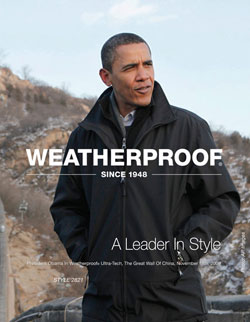
Much has been made of the controversy surrounding the use by PETA and the company Weatherproof of their use without permission of the likenesses of the First Lady and President respectively.

No less than The Washington Post (PETA latest to use an ad with an Obama without permission, 1/8/10) and The New York Times (Coat Maker Transforms Obama Photo Into Ad, 1/8/10) have weighed in on this, along with countless other news outlets, and blogs. The image at right is one in question, of the President in a Weatherproof jacket in China, in this case, what seems to be a catalog page, which is a part of the larger objection to the Times Square billboard, which you can see in context in the Washington Post and New York Times links above.

The law is pretty clear - in order to use someone's likeness in an advertisement/endorsement, you need their permission. Celebrities make untold millions leveraging their likeness for all manner of product, and that is good, right, and fair, since the corporations are profiting, why shouldn't the celebrity get a piece of that when they put their good name on a product or service? Not since prior to the dawn of the internet age have we had a President so primed to be used, given their heroic status. President Clinton was the last real candidate for these types of shenanigans, and the White House had to fend off more than one use, including the use of his likeness to promote a popular sub chain in the DC area - Jerry's Subs and Pizzas, which their Big Bubba sandwich. While the family of Martin Luther King was successful in the case of Martin Luther King, Jr., in the case Center for Social Change, Inc. v. American Heritage Products, Inc., 250 Ga. 135 (1982), it is, in large part, because MLK was a private citizen, and not a public official.

(Continued after the Jump)

Finance companies have used the President's image in video ads, and the President's voice has been used countless times in commercials on radio. Immediately following the Presidents inauguration, Bloomberg published a piece about White House efforts to quell the use of Obamas' likeness (White House Lawyers Look to Limit Commercial Use of President, 1/30/09) and they list a number of uses of the Presidents image and voice which are worth looking at. Of note is the suggestion that "Appropriation of a president’s face and voice, to a large degree, come with the territory, said Princeton University historian Fred Greenstein." Even the first daughters are not immune - when Ty - the makers of Beanie Babies came out with dolls with their names on them, and their names were evoked in ads looking to raise awareness for school lunch programs.

It is important to note that rights of publicity that would govern these issues is a matter of state law, and varies from state to state.

In point of fact, Shepard Fairey's original poster campaign of then Senator Obama, from which Fairey generated a great deal of revenue (which is has publicly stated he re-invested in other Obama-supporting efforts) did not have a release. While a single piece of art (or even a limited edition series) would likely not require a release, a poster campaign with tens of thousands of posters would. Perhaps when Fairey was later commissioned by the campaign to do a poster from a legally obtained image, that contract provided retroactive protections for the previous poster, or then again, perhaps not. However, picking and choosing which battles to fight can be problematic if a case goes to court.

In the end, even if the billboards come down, Weatherproof has gottten their moneys' worth out of the campaign.

Please post your comments by clicking the link below. If you've got questions, please pose them in our Photo Business Forum Flickr Group Discussion Threads.


[More: Full Post and Comments]
Jim Mathis School of Photography - Teaching Wrongs about Rights

It appears that Jim Mathis is teaching really bad business management skills if the message he is delivering to his students is that the price for an image should be the same whether it's a family down the street, or a multi-national corporation looking to use the image as the icon of its business for years.

In response to my November interview in Photo District News about establishing your pricing, Mathis wrote in here and suggested that his studios' establishment in 1973 and immediate price list publication somehow gives him some air of authority, when he says of me "His is the type of attitude I have been fighting for years." Really? Really! Really?

(Continued after the Jump)

Wrong-way Mathis then suggests that my methodology is that of "sizing up the ''schmuck' and charging whatever we think they will pay..." and the only thing more wrong than that opinion is how he uses a portrait of himself with a Nikon F in his article about "digital resolution", where he incorrectly states "In reality, a five-meg, or 5 million pixel camera, is about equal to 35mm film in resolution." No, Jim, that's impossible. The actual megapixel comparison is closer to 21 megapixels.

Fortunately for all, Mathis seems to be standing alone. PDN sought out two industry leaders for their thoughts. Susan Carr, past ASMP National President and current Education Director, wrote here "Pricing photography assignments cannot fit into a one-size-fits-all hourly or day rate system." Carr then goes on to provide several other worthwhile insights on this subject. Next PDN presents the learned thoughts of Jeff Sedlik, former National President of the Advertising Photographers of America, here. Sedlik suggests that some photographers "opt to spend their careers emulating plumbers". I suggest that Mathis has much to learn about his own business. Yes, being paid by the hour regardless of client type is really a day-laborer mindset best left for the picking fields.

Mathis touts his membership in the "International Photography Hall of Fame", on his website here and I submit that he should be the poster child for the International Hall of Photographic Shame for his really really bad photography advice.

Please post your comments by clicking the link below. If you've got questions, please pose them in our Photo Business Forum Flickr Group Discussion Threads.


[More: Full Post and Comments]
Wednesday, January 6, 2010

PETA, Michelle Obama, and Rights of Publicity

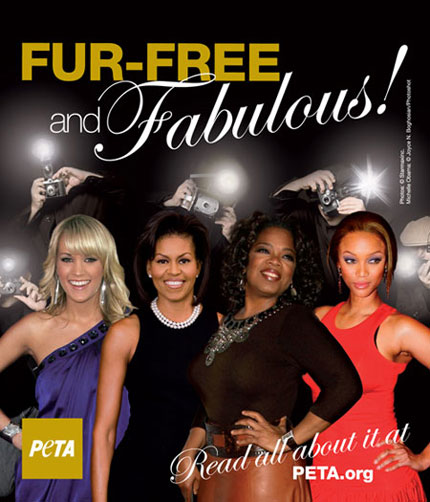
When does "saluting" women in an ad become an endorsement? When the anti-war groups used an image of Gen. Petraeus in their ad (here) being critical, was that fair to do without his permission? How about an and that is positive, saying "Fur-Free and Fabulous!" and directing people to the PETA website to "Read all about it"? It doesn't come across, per se, as an endorsement, however, it seems to come very close to crossing a line - but did it cross the line? ExtraTV reports here that the White House is upset about this.

Here's the ad:


PETA's President, Ingrid Newkirk is quoted as acknowledging they didn't get permission because they knew it couldn't be done, however said "the fact is that Michelle Obama has issued a statement indicating that she doesn't wear fur, and the world should know that in PETA's eyes, that makes her pretty fabulous."

What do you think?

(Comments, after the Jump)


Please post your comments by clicking the link below. If you've got questions, please pose them in our Photo Business Forum Flickr Group Discussion Threads.


[More: Full Post and Comments]

Monday, December 28, 2009

Privacy Rights, Cellphone Searches, and Photographers


What right of privacy do you have to your cell phone? Well, for starters, what about your rights when a search warrant is presented? Most search warrants read something like this:

You are therefore commanded to search:
The Premises and building known and designated as and commonly called:
1234 Main Street, Anytown USA, more specifically described as a brown single-story detached home.
including all rooms, attics, and other parts therein, garages, storage rooms, and outbuildings used in connection with the premises or located thereon and in any receptacle or safe therein;
What's missing from this?

Why, it's items on your person - including things like your cell phone, camera and/or camera bag, briefcase, or backpack, provided of course, that they are on your person.

Thus, a separate warrant, or, more than likely, a warrant that includes what is called a "container search" would need to be included as a part of the warrant. There is a "physical possession test" and a "relationship test" that are applied to ascertain the constitutionality of a container search (more here in PDF form).

Ok, so how is this news, and how does it apply to photographers?
(Continued after the Jump)

It's news because, at least in Ohio, it has just been reported that cell phones cannot be searched without a warrant, according to the states' highest court. The court stated that cell phones are "capable of storing a wealth of digitized information" and therefore they should be considered private. The New York Times writes on it here, and here is the PDF of the ruling.

How about photographers? Well, it is often reported that photographers have had their cameras seized, and either files have been reviewed and then deleted (not only easily provable, but also easily recoverable) and this ruling could be - with little effort - carried over to the privacy of digital cameras, whether or not there is a first amendment issue in play. Carlos Miller writes on his blog Photography Is Not A Crime (here) about the legality of seizing your camera, with an interesting perspective. Miller has been in an ongoing legal battle with the Miami police since 2007 over his rights on this subject. Miller does a great job of summarizing the past year today in his post - 2009: The Photography is Not a Crime year in review. There there was this video where the LA police threaten to submit a photographer's name to the FBI "hit list."

It is, however, important to note that our first amendment rights and our fourth amendment rights, while guaranteed under the constitution, may not necessarily be top-of-mind for those hoping to usurp those rights, even while wearing a badge. Now would be a good time for you, dear reader, to take a few minutes, and not only get the name and both regular and emergency contact numbers for a good first amendment-savvy attorney, but also to put those numbers into your cell phone - the one that's now decreed (at least in Ohio) as private, but also give to someone you might have to call should someone in law enforcement attempt to trample on your rights.

Here's a reminder - that badge they are wearing is what requires them to protect you while protecting others - and that includes protecting you and ALL your rights, including those guaranteed under the 1st and 4th amendments. If you are a staff photographer, be sure you have not just your photo desks' phone number programmed in, but that of your organizations' legal team too. Doing so could well limit your time in a holding cell.


Please post your comments by clicking the link below. If you've got questions, please pose them in our Photo Business Forum Flickr Group Discussion Threads.


[More: Full Post and Comments]

Thursday, December 24, 2009

Twas The Night Before Christmas

Twas the night before Christmas, and all through the house,
not a client was stirring, not even to grouse.

The CDs were burned and shipped with consideration,
in hopes that the photos would earn remuneration.

The staff they were nestled all snug in their homes,
with visions of days off, reading their tomes.
and I wearing both the kerchief and chaps,
had just settled down to write about business mishaps.

When out in the studio there arose such a clatter,
I sprung from my desk to see what was the matter.
Up the stairs that I took, two at a time,
I arrived in the studio with a curious find.

When what to my wondering eyes should appear,
but a colleague with keys and access so clear.
A studio strewn with clothes near and far,
and this colleague, why, they were shooting boudoir!

Boudoir in my studio, it just can't be,
I thought in my head as I looked on intently.
This studio is for food, and head-shots and such,
but I guess with that figure I don't mind very much.

The subject was beautiful, in their own very way,
and the scene quite professional, I certainly must say.
Nothing tawdry or lewd, just art being made,
the capturing of beauty before age makes it fade.

I thought of the scenes of products that sell,
that had been previously shot there, and shot quite well.
Yet nothing compares to the body, the form,
and the expression of a face, looking forlorn.

The focus was true, the light was just right,
the drive of my colleague was set to for a full night.
I knew that the work was not to diminish,
so I left my studio so the colleague could finish.

I considered my art, my creative fruitions,
yet my skills were lacking, I didn't know those positions.
I knew that some art was best left to others,
even if I had my own chaps, and my own druthers.

Late in the night, almost the morning,
I knew they were working on nothing boring.
As the sun rose, on the next day,
I decided there was little else I could say.

Yet an urge called for me, to say something,
as they packed up their props and their holiday bunting.
and all that there was that I think there to say,
I said to the colleague - "have a great day!"

You see, it's the truth, photography is art,
your present this Christmas day should be to give it a start.
Whether food or people, weddings or news,
Not following your passion could give you the blues.

So make tomorrow your day to begin,
not following your passion I think is a sin.
Yet focus on its' business all throughout,
and your spouse will have no reason to pout.

For you see it remains a reality you shouldn't flounce,
that your bills must be paid, or your checks they will bounce.
The business of art, it can be quite fickle,
but be careful or you'll get caught in a pickle.

(Continued after the Jump)


- With apologies to Clement Clarke Moore (the original author of Twas the Night Before Christmas), and to you, dear reader, for the light number of postings this month. Merry Christmas and Happy Holidays.

- John


Please post your comments by clicking the link below. If you've got questions, please pose them in our Photo Business Forum Flickr Group Discussion Threads.


[More: Full Post and Comments]

Monday, December 14, 2009

Earned Success

Recently I was breaking bread with a friend and colleague, who is a highly respected and well known photographer. For the sake of this story, we'll call this photographer Asa. During the conversation, I turned to this photographers' assistant, and asked "how did you come to be assistanting Asa?" What was shared was not, per se, genius, nor, really, a secret. However, it was a validation of the common truths along the path to success, and it is worth sharing.

The story goes, that after the assistant had heard the photographer give a lecture, through happenstance, they ran into each other several months later. Pleasantries were exchanged, and an offer of "if you ever need some help, don't hesitate to call me" was made. Now, it's important to note that this assistant was still in college. A short time later, for a short-term assignment, Asa called the assistant, and the assistant was available. At this point, you might be of the mindset to suggest "oh, well, that assistant just got lucky." And to that I say "perhaps. However, Luck is what happens when preparation meets opportunity." Thus, here is where our erstwhile assistant proved their mettle.

(Continued after the Jump)

Photographers and assistants have an interesting symbiotic relationship. I can recount one instance where my full time assistant, a young women of a mid-sized build, suggested that she was unable to heft several large equipment cases into the production vehicle, and so, rather than push her or expect more, I just helped. No harm no foul, I surmised. However, when a project came that called for a second assistant, after several months with my full time assistant on board, we send the second assistant down to the production vehicle. We arrived there, and I said "wheres all the gear?" This slightly built (also female) assistant said "oh, it's in the car", and from that day forward, the first assistant was loading all the gear herself, and without any quarter for complaint from me. The point is, photographers often get accustomed to just accepting the stated limitations of an assistant, even when the limitations outlined just don't seem to ring quite true. As in my case, Asa had a similar situation. Asa's full time assistant was used to a somewhat tortoise-like travel case handling routine, and as the normal assistant would be moseying along with cases, Asa would have to wait around, and otherwise be delayed by the assistant. However, for Asa, the first sign that the new assistant was a keeper was that when Asa arrived at the curbside, the new assistant had figured out how to load all the gear onto two huge luggage carts and have them ready for Asa without delay. From that point forward, Assistant "Tortoise" had been one-upped by Assistant "Hare", and the fabled ending to that tale is not the same as this one. Here, the Hare proved that when called upon, Hare could deliver.

As we finished out meal, I found it refreshing to find a fine example of success coming to someone who really demonstrated a superior work ethic. To this day, That assistant is traveling all over the world with Asa, and their commitment to excellence shows through each time an assignment comes in and is swiftly completed.


Please post your comments by clicking the link below. If you've got questions, please pose them in our Photo Business Forum Flickr Group Discussion Threads.


[More: Full Post and Comments]

Tuesday, December 8, 2009

FocalPop - Expect Pop Pop Fizzle Out

Who grades these grad school fantasies, Krusty the Klown? FocalPop - the latest incarnation of the idiocy of crowd-sourcing advertising photography assignments has apparently ozzed from the hot Summer nights of UT Austin. Here's the pitch:

1. Seekers fill out a request describing the exact photo they need, how much they'll pay, and how soon they need it.
What's missing: Oh, right - buyers don't get to dictate price.
(Continued after the Jump)
2. FocalPop notifies the community of Photographers of the new Photo Request.
What's missing: Oh, right - qualifications to actually do it. "The proof is in the pudding" doesn't work too well here.
3. Photographers review Request details, shoot photos that meet the Request needs, and upload submissions for review.
What's missing: the best results come from a dialog with the client, and who's covering the expenses for the shoot? Oh, wait, maybe that's the photographer.
4. After the deadline, the Seeker reviews all of the photos submitted, selects their favorite, and pays FocalPop the amount they specified in the Request.
What's missing: What if they don't like any? Unlike other plans, FocalPop will select the winning photographer and pay them from escrowed funds supposedly set aside by the client (a.k.a. "Seeker"). According to their T&C - "The Seeker further agrees that it would be unfair if no photographer received the award(s) offered by the Seeker due to the Seeker abandoning the request. Therefore, if the Seeker does not select the winning design/photographer(s) within seven days after their request ends, the Seeker agrees that FocalPop may select the winning photographer(s) and pay the award(s) on behalf of the Seeker. Additionally, you agree that when you are a Seeker in a request, you will complete wrap-up in your request within thirty (30) days after your request ends. You authorize us to release escrowed funds to pay the winning photographer(s) if more than thirty (30) days have passed since your request ended." Interesting, so let me get this straight - the client has to blindly agree to accept whatever images are produced by an unknown quantity/quality of photographers? Oh no, wait - their Seeker FAQ doesn't quite agree with the T&C above "We take a deposit of 30% at the time a Request is created in order to protect the photographers. We want to ensure no one requests photos that they don’t actually intend to purchase. However, if your Request receives less than 15 submissions and you are not happy with the results, we will gladly refund the 30% deposit – no questions asked."
5. FocalPop provides the high resolution file to the Seeker and pays the winning Photographer a commission on the sale.
What's missing: Hmmm, let's see - FocalPop would be the one recieving a "commission" on the sale, as the conduit. According to their T&C here, they'll take 30% to serve as this conduit. Or, wait - is this the same 30% that the photographer gets if a winner isn't chosen? Hmm, then maybe FocalPop takes 70%?
So far, all 10 of their requests (here) have come from one of the company founders, several of which were used to illustrate the website itself.

So, who are these dreamers? Brian Romanko (LinkedIn: Profile) touts in his biographical sketch about his past - "...Brian worked for numerous startups — both successful and utter failures..." Brian - be glad you got a good grade on this, because the real world has already proven this crowd-sourcing school project of yours to be an utter failure - see Pixish - Stupid Is, As Stupid Does (2/12/08) and Pixish - Finally Down The Tubes (2/7/09), and even the lunacy of David "that model was interesting, but didn't pan out" Norris (7/12/07, OnRequest - Realizing the Obvious). Heck, even Brian's friend Jonathan Cho (LinkedIn: Profile) trashes the idea here "...in the spirit of hating on crowdsourcing, here’s a similar site that my friend’s launching, except instead of design its photography: http://www.focalpop.com/ ...as a fucking awesome designer, i’m a bit ashamed to admit that i’ve submitted a few designs to crowdspring. an hour or two in illustrator = quick buck, right? what’s horrible is that my designs have never been picked. i’ve always lost to much crappier designs. and that is why i hate crowdspring." With friends like that...oh, wait - his friend is actually smart and giving him good advice.


Co-Founder Becky Parker (LinkedIn: Profile) seems to be simultaneously tasked to "Oversee the strategic planning for Sony Electronics' online social marketing programs" at marketing firm Powered, Inc, as well as trying to "...find her passion for offering true value to customers online and in developing meaningful customer relationships" for FocalPop. Becky - try working to find value for the creative talent that will produce this work, not pennies on the dollars of what the projects should really be worth. Hint: A project you facilitate for $100 that earns you $30 for FocalPop really could earn you $300 if it was more appropriately priced at $1,000. I guess, though, that winning the Moot Corp contest taught you to over-value moot money? Tip: moot money is as valuable as monopoly money in the real world.

The third in the trio of wunderkinds is Shawn Carr (LinkedIn:Profile), wooed in by the void left by Ronnie Lebert (LinkedIn: Profile), Eddie Howard (LinkedIn: Profile), who have both left for smarter options at Dell and Datran media respectively. Carr hasn't left the chilly weather of New England where he is an IT manager for a small company, and consulting for Croop-LaFrance. Hint - don't quit your day job, Pixish and OnRequest, as detailed above, are your harbingers of things to come, and that equity you might have - not going to be worth much, just make sure you get paid before you have to post that "out of business" splash page.

FocalPop is the quintessential example of the re-hashed ideas coming from MBAs time and time again. This idea hasn't worked before, and it won't work this time.


Please post your comments by clicking the link below. If you've got questions, please pose them in our Photo Business Forum Flickr Group Discussion Threads.


[More: Full Post and Comments]

Monday, December 7, 2009

Washington Spaces - Empty Space Earns Smiley Face

Former media company turned educational company Washington Post Co (NYSE:WPO) has axed one more of its under-performing assets, under the guise of blaming the economy. Washington Spaces will cease publication with the November/December issue. In an e-mail sent to clients by CEO and President of Greater Washington Publishing Company Becky Loker (LinkedIn: Profile), she refers to this as a “very difficult and painful decision.”

Suffer on, I say. Loker's publication was built upon a faulty premise that you could con photographers to give free use of photographs and cover expenses on assignments. Here is the laughable, and ill-written agreement that they attempted to foist upon contributors:

(Continued after the Jump)

GREATER WASHINGTON PUBLISHING, INC.
AGREEMENT FOR USE OF SUPPLIED PHOTOGRAPHY AT NO COST


I grant a copyright to Washington Spaces magazine to publish the said photos one time at no cost in an issue of the magazine and for use on the Web site in the context of the article. I also grant permission to Washington Spaces magazine to use the photos forever in the context of the article, on the Web site, and to promote the magazine.

I have permission from the homeowners, if applicable, and/or business owners to supply the said photos to Washington Spaces for publication.
Setting aside the illusory phrase "I grant a copyright to" (hint - you grant a right, or, you transfer copyright) it is far and away poor business to demand of your vendors "no cost" products or services. It is not sustainable, period.

Another contract they put out read as follows:
AGREEMENT with FREELANCE CONTRIBUTORS

This Agreement is intended to cover any and all Works (hereinafter “the Work”) you create for use by Greater Washington Publishing, Inc. (hereinafter “GWPI”), or otherwise license for use by GWPI.

You and GWPI agree to the following terms:

1. In exchange for payment to you for each Work accepted by GWPI, you agree to give GWPI exclusive, first-time print publication rights to the Work (if applicable), as well as the subsequent non-exclusive right to reproduce, distribute, adapt or display the Work for any purpose and in any manner or medium worldwide during the copyright term of the Work, without additional compensation. The non-exclusive rights granted may be exercised in any form or media in which the Work may be reproduced, published, distributed or displayed (including but not limited to compilations, microfilm, library databases, videotext, computer databases, CD-ROM and the Internet). Provided, however, this non-exclusive license limits GWPI’s use, transfer or sublicense of the Work to inclusion in works that are marketed, distributed and/or grouped under or in association with GWPI’s name or brand.

2. Other than the rights granted to GWPI set forth above, you own the rights to and are free to sell or license the Work elsewhere following publication in Washington Spaces magazine. Any income from such sale or licensing belongs to you. Third-parties contacting GWPI for permission to use individual Works will continue to be referred to you for purposes of such sale or licensing.

3. You represent and warrant that the Work is your creation and that GWPI’s reproduction and distribution of the Work will not violate any copyright or other right of any third party.
The magazine, which published every other month, had a circulation of 80,000. It has not been stated (yet) how many layoffs will result from this, however, it's almost sure to happen, given this closing.

Here's a tip for future publications - you will attract the top creative talent (for both photographic and writing aspects) which will produce compelling content, and you will sustain that talent over time, if you pay them fees and cover expenses that are fair and reasonable. As a result, advertisers will want to be adjacent to other compelling images as they promote their own products. When planning your budget proposals for your new ventures, don't think you know what a photographer should be paid - contact a number of them whose work you respect (as seen in reputable publications) and ask them what they would charge for a variety of assignments. On more than one occasion, I have been called upon for just such a query.

Upon hearing this, more than one photographer whom you (Washington Spaces) asked to provide "no cost" photography wrote to me: "this made my day"; "more room on the news stands for the good publications"; and other even more colorful missives.

Good riddance, Washington Spaces.

Please post your comments by clicking the link below. If you've got questions, please pose them in our Photo Business Forum Flickr Group Discussion Threads.


[More: Full Post and Comments]

One-Stop Shopping for Photo Buyers - Too Complex and Fractured

One of the questions that continues to surface like so much floatsam and jetsam on the sea of discourse about photography licensing, is why there isn't one centralized location to license images. Dan Heller recently tried to answer the question in his blog post here - Why there's no one-stop shop for photo buyers - (11/29/09), and he compares the business of photography to that of electronics, suggesting that the reason that there is a "viable, stable market for electronics (unlike photos) is because there are mechanisms in place that help establish price points, distributors, manufacturers, and so on. In short, it's a mature industry." There are two problems with that position - #1, photography has been in the marketplace for far and away longer than electronics even existed, and further - is is extremely easy to search for electronics because they have model numbers. It is exceptionally easy to compare two products with the same model numbers, and to enumerate even the most nuanced of differences between models when there is even one or two characters that change (example: Nikon D3 and Nikon D3x, or Canon 5D as compared to the Canon 5D II). Even though, if you don't know exactly what you are looking for, there is a very limited universe of variations on each type of electronics. However, if you try to search for a "cell phone cover" you are hosed. 75 millions results. Iphone cover: 110,000,000 results.

The problem is the nature of the medium. Not the maturity of the industry.

In photography, search is most often not for a particular object or product, but for a concept, which may be expressed by the state of a particular object.

(Continued after the Jump)

For example, If you want to find a dog photo, not a particular photo but a photo that expresses a certain concept, there is no possible answer (other than wading) but reliance on keywords. And when you do that search, if the results have not been edited for quality, you are going to waste time wading through though thousands of images to find a gem. Supplementary keywords added by viewers might improve keywording accuracy, however, it will be decades - at least - before a computer can parse the difference between a person smiling and showing their teeth - and that same person with a angry teeth-barring scowl, not to mention the micro-facial-expressions that differentiate happiness as compared to attraction.

Visual search can help with color, orientation, pattern, but not concept.

Image recognition can help with finding an exact image if you already have one, or an image with similarly structured feature points if you already have the image that you are looking for.

Object recognition can help with finding photographs of clearly delineated, unambiguously rendered objects, such as a bicycle, but will have a tough time distinguishing between a terrier and a cat. This will improve with time, but it takes a pair of eyes and a brain to distinguish subtleties, and this will not change. A combination of object recognition and contextual search will yield better results than either type of search alone.

But if you are conducting a search at a search engine like google, the results are images IN USE, not images FOR SALE. Big difference.

The problem is, there is almost always, as those attempting to solve licensing problems, a failure to recognize the fundamental differences between different types of products, and different types of intellectual property.

Searching for music is easier than searching for photos because there are relatively *few songs*. Searching for music -- a "mature" industry -- is a big headache, if you don't know the artist or the name of the song, but are just looking for a song that expresses a certain concept. However, lyrics can be of some assistance, beats per minute, genre, and so on. Yet, in the end, to be able to actually experience - by listening - to a song, will provide you with the final answer. So too, by seeing concepts in images, you really do have to either see it, or have had someone see it and keyword in conceptual keywords.

Heller, among others, suggest that even the big fish (Getty/Corbis/etc) can't/won't even attempt to solve these problems, because their results are absent images they don't represent. Yet, as noted above, it's more than that - these results would not include images that are for sale, yet not in a stock agency or indexed by Google.

Further, the licensing of images is a challenge too. If I told you that someone needed an aerial photograph of a football stadium, but they only wanted 200 copies for a printed brochure, how would you price that? Well, it's one thing if the brochure is for a local realtor to show how protected a home's traffic access is to the seasonal traffic jams on nearby roads, and completely another if that brochure will be what sells the NFL owners on having the next Super Bowl at that stadium.

Photography (and illustrations, for that matter) will continue to be far too complex and fractured an industry for there to be any one place to centralize the licensing of it


Please post your comments by clicking the link below. If you've got questions, please pose them in our Photo Business Forum Flickr Group Discussion Threads.


[More: Full Post and Comments]
Newer Posts Older Posts