Wednesday, January 9, 2008

UPDATED: Digital Railroad Makes Major Layoffs

Yesterday, rounds of meetings took place in Digital Railroads' offices with staff who were to be kept having early meetings (and they then departed the office) and staff to be laid off went into meetings where they were told, en masse, that they were being laid off. Charles Mauzy, the CEO, writes in a letter "DRR is in the process of re-structuring our company and the team along with all of our employees want to make sure we keep key partners/associations/press informed of the changes taking place. "

Layoffs are reported to be between 22 people and up to 1/2 of the Digital Railroad staff, even while sales staff recently hired for the LA office are still being trained. Some uncertainty remains about the actual number of employees laid off though, as some who remain are contractors and technically not staff. Digital Railroad would not confirm the percentage of staffers or even the total number of staffers laid off. Mauzy notes in his letter, of those departing "The friends and colleagues that we say farewell to today have laid the foundation for our mutual success now and in the future."

(Full post after the Jump)

Indications in December were such that, internally, it was determined that if significant changes were not made by December 31st, the company, reportedly strapped for cash and with a high burn rate, would be in serious jeopardy. Outreach to their current investors saved them from a third round of funding, which is always a risky maneuver. Their last round, reportedly $10M (PopPhoto - 2/5/07 - Digital Railroad Receives Fresh Funds) almost a year ago, infused them with significant resources to move forward. Much of their initial investments came from Morgenthaler Ventures and Venrock Associates. With an additional infusion from them, coupled with a Series B investment round led by London-based venture firm DN Capital, Digital Railroad was set to move forward.

Mauzy writes in the letter “While change is always difficult we are confident that the change we make today will allow us to have long term success. Our investors have tremendous confidence in our leadership team, our strategy and have renewed their financial support with additional investments in capital this month." He then goes on to say "With the support of our investors, founders, board of directors and most importantly our employees, we are necessarily reducing costs not directly related to growth of Marketplace including a reduction in force." This does make sense. However, there were significant departures in their support department, which, hopefully, is because more and more people are becoming familiar with how to use the service, from both a buyers and sellers end, and a reduced call volume was an indicator that cuts could be made there. It should be hoped that these weren't cut because it was easy to reduce customer service. This is doubtful, but possible.

Debate about their major expansion and push into the Research Network, which has been flooded with requests of late from major corporations, the National Geographic, and many others and seems to be poised to do well (as indicated by recent sales department hires being trained as laid off staffers were packing their things), suggest that perhaps Digital Railroad may have expanded more than it was capable of doing. An email sent 2 days ago noted "...we've got over 130 open requests looking for ship point-of-views, local scenics, people, architecture, and more from every corner of Europe."

Mauzy goes on to say "In 2008 our goal is to build on this success and fulfill our mission to drive significantly greater revenue to our members through image licensing in Marketplace. In order to achieve this objective, we are focusing 100% of our resources to attracting top creative professionals—both buyers and photographers—to Digital Railroad and growing sales in Marketplace...[o]ur key leadership team including our newly appointed CEO, Charles Mauzy, Maris Berzins, Mark Ippolito, Andy Parsons and Tom Tinervin all remain with Digital Railroad and have collaborated closely on setting our strategy for 2008 and beyond."

I believe (with a degree of hope) that this will make Digital Railroad leaner and meaner for their "fight" with Getty, et al. There are formidable forces looking to derail them. In 8 months, they have amassed over 2,000,000 images, and those numbers continue to grow and accelerate. I for one have thousands of images there, and use it to serve client assignment imagery, alongside my use of PhotoShelter's Personal Archive solution.


Let's wait and see. More updates as we get them.


Please post your comments by clicking the link below. If you've got questions, please pose them in our Photo Business Forum Flickr Group Discussion Threads.


[More: Full Post and Comments]

Copyright And The Citizenry

Check out The Washington Post's article - "Hey, Isn't That . . . People Are Doing Double-Takes, And Taking Action, As Web Snapshots Are Nabbed for Commercial Uses" article , where, apparently, some unlucky citizen had their web snapshot stolen from her blog and used in a NFL playoffs game broadcast. Examples continue regarding the Virgin Mobile ad in Australia, and so on.

Seems that when it comes to the citizenry, TWP cares. When it comes to ensuring the longevity of the craft of photography by paying a fair rate (read sustaining) to their freelancers, well then, who cares?

(Comments, if any, after the Jump)


Please post your comments by clicking the link below. If you've got questions, please pose them in our Photo Business Forum Flickr Group Discussion Threads.


[More: Full Post and Comments]

Tuesday, January 8, 2008

UPDATED: Karma's a (rhymes with witch)

UPDATE: As of noon today, it was down another 4% or so, to a new low midday of $24.17. Hopefully those referenced below as getting out without losing their shirts got out whist still in their pajamas this morning.

What a difference a day makes! When I'd written just yesterday (Getty Images (GYI) Hits 52-Week Low (again)) "When will the next 52 week low hit? Could be tomorrow..." that was hyperbole more than anything else - not that it doesn't actually belong below 20 (because it does) - but I didn't actually think it would be the next day!

That said, I did write in a responsive comment "What goes around comes around, and it's coming around at a high speed", and so, here it is, comin' around.

Thusly, Getty Images (NYSE: GYI) tanks almost 4% in a single day. Heck, that's about double the DOW and the S&P 500 losses for the day, so not all the blame goes to the market, Getty would have still lost enough, even if GYI doesn't/hadn't trended with the market, to have hit another 52-week low all by it's lonesome.

(Continued after the Jump)

Why is this? Well, Getty has been surprisingly quiet since their earnings call back in November. Oh, except where, as Daryl Lang over at PDN reports, in "Getty Offers 15% Off Everything All Year" Getty still hasn't found the bottom price point for their images yet. Further, Lang did some stellar research to determine that, in fact, while Getty was proposing that that discount was just for political campaigns, Daryl actually demonstrates that it works for all imagery from Getty, probably that $49 web price too! As was reported here (The 'Virus' is Spreading, Aug 30, 2007) "...Bruce Livingstone... has succeeded in bumping Getty's web guru as SVP of Technology Linda Ranz just weeks before the new site launch so that he is now SVP of Technology...", which followed that same day with "Oh, wait, this is our fault...." about the crash of the iStockphoto site, the preceeding six days on August 24th with : "Getty Site - Site Down as Stock Is Down?" I guess that's what you get when you have a self-described "true example of success born from failure", as we cited him quoted in Design Mentor Training, where they report that Bruce Livingstone, SVP of Technology started iStockphoto "...After deciding he was not going to make it in the traditional stock photography business." Wait, in order for you, as a self-described "failure" as a photographer, to evidence the resulting "success born from" in iStockphoto, you have to actually demonstrate that success over time, and the bankers just aren't seeing it that way. Is this what you get when a "failure" is the SVP of Technology, overseeing the proper programming of the site? Is this just one more in a string of his failures?

Could it be that Getty's stock price drops the day that istockphoto's prices were to increase, as Paul Melcher reported (back in December - It's Rising, December 7, 2007) they would?

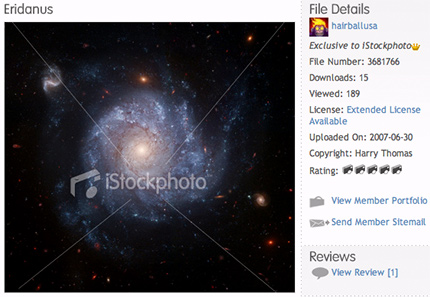
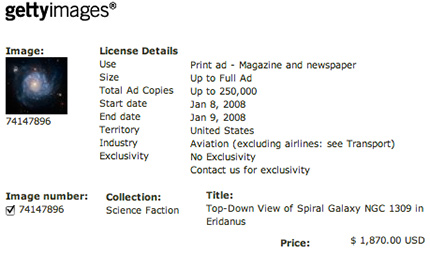
How about, then, the heavy-handed tactics of Getty vis-a-vis their iStockphoto contributors with their do-as-we-say-not-as-we-do approach to stock photography? PDNPulse also reported last week "No More NASA At iStockphoto", which begs the question - why? I didn't check the flight manifest, but I don't think that NASA had a Getty Images photographer on the October 28th flight, as shown here, where the image is being licensed by Getty, but is listed "Copyright: 2007 NASA", and the credit reads "Photo by NASA via Getty Images".

What gives Getty the right to license this image to the general public, when it's owned by the general public? They'll tell you they keyworded it, and otherwise enhanced the images, and that they've registered the images. What they've most likely done, as Corbis has done, is register the image as part of "compilation", a category that the Copyright Office allows you to do, and that the registration is an update to their collection of images that has previously been registered. The title of the work they're registering that will include that image will likely be something like "Getty Digital Online October 2007 & Automated Database", and will then be listed on the Copyright Form VA as something like "Updates from October 1-October 31, 2007 (Updated Monthly)" or something whereby they are able to skirt the Copyright Office's assertions that a registration of this sort is "deminimus", and thus not elligible for Copyright protection. This is a common ploy that is not unique to Getty, but places a "fragile" sticker on registrations done in this manner. A query for "NASA" in the "photographer" field at Getty lists over 1,700 images under the "Getty Images News" brand alone.

Thus, Getty is telling iStockphoto contributors they can't put up images that are in the public domain and earn $0.20 or so off of it, like one iStockphoto contributor has done here of this image:

Because, dear reader, Getty wants to preserve their ability to license to you the same image on the Getty site:

As noted below, they'd lose what could be several thousands of dollars for one ad license, see below:

Why is it that what's good for the goose isn't good for the gander? Why does Getty get to make thousands off of public domain LICENSES to images yet their iStockphoto contributors can't do the same?

But this isn't limited to NASA alone. Searches for U.S. Navy yields over 2,900 results, over 300 for Air Force, and over 400 for Army when the search is done using the "photographer" or "By:" field search. I guess it's just easier to search the acronym NASA in both Getty and iStock archives, as the first tier of clearing iStockphoto of images that are hurting the Getty sales where duplicative, but I would be concerned about the legality of Getty licensing public domain images. What will happen when someone who licenses the images from Getty then refuses to pay?

Don't worry, there's still time to get out with your shirt. There was a nominal spike in after-hours trading, so you could still get out, because I can't see an end in sight to their plummet, can you?


Note: I do not now, nor have I, nor do I plan to have any stock market investments in GYI.

Please post your comments by clicking the link below. If you've got questions, please pose them in our Photo Business Forum Flickr Group Discussion Threads.


[More: Full Post and Comments]
Monday, January 7, 2008

BREAKING: Getty Images (GYI) Hits 52-Week Low (again)

As expected, Getty Images (Stock: GYI) plummets to (as of this writing: $26.10) for a low, before hopping back up above today's open.

When will the next 52 week low hit? Could be tomorrow, could be next week. (It actually spiked downward again while I was writing this from 26:22 to a intra-day low of $26.10.) One thing to count on, is that it will continue to take a dive - certainly as long as it's current leadership is in place, and they continue to compete on price and not quality.

(Comments, if any, after the Jump)


Please post your comments by clicking the link below. If you've got questions, please pose them in our Photo Business Forum Flickr Group Discussion Threads.


[More: Full Post and Comments]

Sunday, January 6, 2008

Imaging USA Report, Day 1 & An Interview with Seth Resnick of D-65

Seth Resnick, a longtime friend of mine not only took time out of his hectic schedule to talk about Adobe's Lightroom, and made an amazing offer to PBN readers. See below the video for the offer! For readers of Photo Business News wishing to attend the highly regarded D-65 "Digital Workflow, Not "Workslow " series, January 11-14, 2008 (Friday - Monday)
*class runs from 9:00 am -5:30pm daily, visit this link to register, and note that you read it here, for a 10% discount on the seminar - that's over $100 in savings!

(Alternate version, and comments after the Jump)

Here's the Brightcove Version:

If you can't see either, click here for Brightcove, and here for YouTube.

Please post your comments by clicking the link below. If you've got questions, please pose them in our Photo Business Forum Flickr Group Discussion Threads.


[More: Full Post and Comments]
Getty Images (GYI) In Decline Again

I looked with pleasant surprise at my iPhone stock tracker, and noted that Getty Images (Details: GYI) is just $0.10 shy of hitting another 52-week low at Friday's close, from when we reported their previous plummet back on September 18, 2007 ("Getty (GYI) Hit New 52 Week low"), and we've certainly not at a loss for writings of a critical nature about Getty. But, they are deserving of criticism, 'else we wouldn't be writing as such.

We wrote back on December 21st ("It's Not Your Copy Right, it's Mine") about the concept of Creative Commons. But there was some digging that I hadn't done that's worth noting.

(Continued after the Jump)

Dan Heller, in his intermittent (yet insightful) postings on his blog, this past Thursday wrote "The Creative Commons and Photography", a seeming treatise on Creative Commons. I strongly encourage you to read through the entire thing. I'll draw out one point (for now), that's may be a reason that the stock market is looking over their horn-rimmed glasses and out from under their green eyeshades at GYI:
"As of December 31, 2007, Flickr's 21 million users uploaded over 2 billions photos. Of those, 56,415,212 (or 2.8%) are tagged as having one of the Creative Commons licenses. For comparison, Getty Images is purported to have about 2 million photos... we can observe longer-term trends and fill in the blanks: year over year revenue at Getty has been declining in close parity with the growth of photo-sharing sites like Flickr."
Yoink! 56 million with CC tags! No doubt a large quantity of those require attribution only, and no compensation!

Heller goes on to make a number of highly insightful statements and suggestions worth pondering, in depth. What remains though, for the sake of reviewing Getty's prospects, is that their future doesn't look so bright. In fact, the future's so dim that the only people wearing shades are the accountants trying to justify the company's diminished valuation. (Note - the dim/shades reference is for your old-timers who remember the Timbuk3 1980's song by a similar name). The only thing Getty can hope for is that their keywording (and thus, search results) are better than the collective mass of images that's free on Fickr.

I've said it before, and I'll say it again. Competing on price is a losing proposition. When you try to do it for the pathetic figure that is $1, someone will come in and do it for free - and has, en masse. Next up? Creatives paying for placement in publications.

Oh wait, when it costs you more to produce the work than you're selling it for, that's essentially the same thing. Guess that's already (indirectly) happening. Here's to hoping for an opening bell Monday that looks dim for Getty's future. Once they've been relegated to the proverbial 8-track heap of history, those of us who actually value the images we produce, and compete on quality and not price will be in a far better position.
_________
DISCLAIMER: I have not, do not, nor plan to hold GYI, or any stock which would benefit from a GYI decline.

Please post your comments by clicking the link below. If you've got questions, please pose them in our Photo Business Forum Flickr Group Discussion Threads.


[More: Full Post and Comments]

Saturday, January 5, 2008

Imaging USA Report, Day 0

Below is a preview of the ImagingUSA Expo in Tampa Florida, a presenation of the Professional Photographers of America.

(Comments, if any, after the Jump)

YouTube version, below.


Yes, yes, I know, it's 2008 now, and the text reads 2007.


Please post your comments by clicking the link below. If you've got questions, please pose them in our Photo Business Forum Flickr Group Discussion Threads.


[More: Full Post and Comments]

Thursday, January 3, 2008

UPDATED: Gary Fong Knockoff! or His Wholesale Source?

Today, I was browsing for some equipment, in a store I don't normally shop, based in Hong Kong, DealExtreme. I stumbled upon an item that I not only paid $49 for from my US source, Gary Fong (at right), but I also paid $19 for a "tungsten" top of the device. Then, I run across the combined pair of items, seen below, for a sum total of $16.64, including shipping from Hong Kong! WHAT GIVES? Is this the same item?

(Continued after the Jump)

Gary has his item identified as the Lightsphere. DealExtreme calls it "Lambency Flash Diffuser". Over 400 of them can be found on Ebay under the Lambency name (below).
The items appear identical, and are available in both clear and opaque versions.

So, the question arises - since it's doubtful that Gary Fong owns the manufacturing of these, and unknown if he actually developed the device, could it be that Gary found these on a trip, and has been importing them for under $8 from the same manufacturer as DealExtreme (and all the ebayers) have, and selling them at a 600%+ markup?

Or, instead, did Fong design and find off-shore manufacturing of the device, and now it's being knocked off by others, or, since Fong has developed a new, WhaleTail and is now selling the Lightsphere at a $10 discount off his $49 price (i.e. drawing down the production), is the plant continuing to churn out the product and selling them to other companies who are selling them now worldwide for a fraction of Fong's price?

I do know that others whom I trust have made purchases without any problems from DealExtreme, so I am not concerned (in this case) about doing business with them. However, really, what gives?


UPDATE: What gives, is that these guys are knocking off Gary's product, as he notes in the comments! (see below)


Please post your comments by clicking the link below. If you've got questions, please pose them in our Photo Business Forum Flickr Group Discussion Threads.


[More: Full Post and Comments]

Wednesday, January 2, 2008

JUST ANNOUNCED! Estimates & Bids

Back in October, we launched Assignment Construct, which delved into the what, where, when, why and how (not so much the who), of assignment photography. To date, nearly 20,000 people have looked at over 50,000 pages of those insights.

So, what was missing? Well, aside from the "who", it was really, the "how much."

(Full post and comments, after the Jump)

Enter Estimates & Bids, and the approach that "many minds, useful results" can provide insights to all.

One of the things that has been happening for probably seven or eight years, is that friends and colleagues have been calling to bounce ideas off me as to pricing and negotiating for a wide variety of assignments. These are calls I was happy to take, and moreover, I've made a few calls myself.

Of late, I've been getting a nice collection of e-mails of the same nature, and moreover, I get the calls and e-mails myself from prospective (and repeat) clients, all looking for estimates for the work I do for them. These inquiries go beyond the inquiries I get that can be resolved by referring to my online calculator on my pricing pages on John Harrington.com. So, what better way than to take those requests, and shine the light of day on them in a public forum. To engage the collective mind, and do a little learnin' in the process?

So, if you're writing to ask me how I might price an assignment, I'm happy to help, and the conduit not only to my help, but that of the collective brain trust of photographers, is Estimates & Bids. Friends and colleagues will continue to call, but, the results of that exchange will (with their permission) likely end up on Estimates & Bids. You will then have the opportunity to put in your two cents, ask questions, and everyone benefits.

But, this is interactive. This requires participation in the comments section of each post. But, for a number of reasons, we've opted to keep the comments moderated, so the level of comment and learnin' will be much higher (hopefully!).

This will, by no means, be something that would take the place of Blinkbid or fotoBiz/fotoQuote. In fact, those software packages should be what you use to prepare your estimates to send off! They have things like terms and conditions, coaching capabilities for your phone calls back and forth, databases of past work, and tracking capabilities, secondary pricing modules for post-assignment stock inquiries, and so forth. I certainly rely on fotoQuote on what seems like an almost daily basis, but which I can be sure is definitely a weekly basis!

Lastly, if you have an inquiry from a prospective client, send it along, and we'll consider posting it with (hopefully) enough time between when you send it and we post it, and when you need to send in your own estimate. Perhaps this will help you in providing a thoughtful response to your prospective client's request.

So, please take a look. There are three real assignments aready up - two assignments I got a call for, and one that was an inquiry from a colleague, to lead things off.

Please post your comments by clicking the link below. If you've got questions, please pose them in our Photo Business Forum Flickr Group Discussion Threads.


[More: Full Post and Comments]

Li-Ion Battery Ban Solution for Airline Travel

There is, rightly so, a great deal of consternation as it pertains to batteries that will be aboard aircraft, effective yesterday. I'd hate to be traveling on assignment with gear in the coming weeks (thankfully, I am not, as of now, scheduled to travel with cameras in the coming weeks), while the TSA gets their act together and learns how to handle professional photographers and videographers under this DOT/FAA change.

In the interim, what can we do, and how, exactly, does this affect us?

Let's look at specific batteries, do the math, and offer a few solutions.

(Continued after the Jump)

Geek Alert: If you're in a hurry, or confuse easily, skip to the bottom for the conclusion...

First things first - the AP is reporting "...air travelers will no longer be able to pack loose lithium batteries in checked luggage...Passengers can still check baggage with lithium batteries if they are installed in electronic devices, such as cameras, cell phones and laptop computers...."The ban affects shipments of non-rechargeable lithium batteries...", but the AP, according to the official DOT website, there is no distinguishing between rechargeable and non-rechargable.

It' all about total Lithium-ion battery content. The full rules were published in the Federal Register back in August, probably when most of us were on vacation and not doing our daily read of the Register. It can be read in PDF form here. (this is worth printing and carrying with you, highlighted where it best serves you, as a part of your travel documents. For those of you not wanting to delve into the nuances of lawmaking, which, like sausage making, is best left unviewed, you can skip to page 22, and highlight the Part 175 section.)

A few worthwhile excerpts:
~ For example, several thousand small lithium batteries consolidated together present a higher potential risk than a shipment of a single lithium battery
Thus, why each passenger can carry a few, because they are expecting that several will carry a small amount. Woe-be-the-press plane with hundreds of battery packs in the hold, or carryon! Political campaigns, are you listening?
~ The amendments adopted here include tightened testing standards to ensure that batteries that pose the greatest risk in transportation are designed to withstand normal conditions of transportation and packaged to minimize risks of mishandling or damage in transit.
Thus, you can expect,in short order, that manufacturers will change the labeling on their batteries to say "air worthy", or some other designator. This is a boon for manufacturers, who will not be able to sell new batteries to all those currently with batteries, because the new batteries will be designated "air worthy."

The FINAL RULE, as outlined in the Federal Register, sets forth several designations:
 Small
(no more than)
Medium
(between)
Large
(more than)
Cells:
  • Primary
  • Secondary
 
1g Li.
1.5g ELC*
 
1g and 5g Li.
1.5g and 5g ELC.
 
5g Li.
5g ELC.
Batteries:
  • Primary
  • Secondary

2g Li.
8g ELC
 
2g and 25g Li.
8g and 25g ELC.
 
&25g Li.
25g ELC.
ELC = Equivilent Lithium Content.
"For purposes of this rulemaking, we use the term ‘‘primary lithium battery’’ to refer to a non-rechargeable battery and the term ‘‘secondary lithium battery’’ to refer to a rechargeable battery."
This is a very important designator, because there are different allowances (as outlined below) for these two types.
"In weighing the costs and benefits of regulation, we consider the mode of transportation and impose the strictest standards in air transportation, particularly passenger service."
Note, they say "passenger service". More on this later.

Almost all of the incidents that occurred, and that the NTSB investigated (as outlined in the Register), were of major battery shipments, although there were a few carry-on issues they noted.
"Inevitably, further technological advances, new product development, and market shifts will drive continued change in risks and benefits. We are committed to addressing those changes in a manner that safeguards our transportation systems and the traveling public, while promoting positive technological advances and minimizing regulatory costs and burdens for
consumers and industry, including small businesses."
Thanks for thinking of us.
HM–224E Rulemaking. Based in part on the June 2004 FAA technical report...The IFR prohibits the ...transportation ...of primary lithium batteries and cells, and equipment containing or packed with large primary lithium batteries (i.e., batteries containing greater than 25 grams of lithium) as cargo aboard passenger-carrying aircraft. In addition, equipment packed with or containing small or medium-size primary lithium batteries (i.e., batteries containing 25 grams or less of lithium) must be transported in accordance with Special Provisions A101 or A102. Under these Special Provisions, a primary lithium battery or cell packed with or contained in equipment may not exceed a net
weight of 5 kg (11 pounds). Finally, the outside of each package that contains a primary lithium battery or cell
forbidden for transport aboard passenger carrying aircraft must be marked ‘‘PRIMARY LITHIUM BATTERIES—
FORBIDDEN FOR TRANSPORT ABOARD PASSENGER AIRCRAFT.’’
Are any of your batteries currently marked as such? Didn't think so.
"Unless contained in equipment, each package containing more than 24 lithium cells or 12 lithium batteries must also be: (1) Marked to indicate it contains lithium batteries and special procedures must be followed in the event that the package is damaged; (2) Accompanied by a document indicating the package contains lithium batteries and special procedures must be followed in the event that the package is damaged; (3) No more than 30 kilograms gross weight; and (4) Capable of withstanding a 1.2 meter drop test in any orientation without shifting of the contents that would allow short circuiting, and without release of package contents."
Note here, the new law is does not use the word "installed", it says "contained in equipment", which lends credence to the idea that a battery could be "contained" in chargers for batteries, like Nikon's, that use a cradle.
"As amended in the IFR, lithium batteries contained in equipment and spares of all types (primary and secondary) are authorized in carry-on or checked baggage."
This looks promising.
"...spare lithium batteries may only be carried in carry-on luggage and that they must be individually protected against short circuits. Unprotected batteries are susceptible to short circuits when exposed to items typically carried by passengers and crew members, such as car keys and coins. We recommend that passengers protect spare batteries by placing them in protective cases or individual zip-top bags or placing non-conductive tape across exposed terminals."
They define:
"Aggregate lithium content means the sum of the grams of lithium content or equivalent lithium content contained by the cells comprising a battery."
So, the aggregated amount is all of your batteries, combined together. Do the math with your batteries. The Register gives you the formula:
Equivalent lithium content means, for a lithium-ion cell, the product of the rated capacity, in ampere-hours, of a lithium-ion cell times 0.3, with the result expressed in grams. The equivalent lithium content of a battery equals the sum of the grams of equivalent lithium content contained in the component cells of the battery.
They go on to say:
" The provisions of paragraph (a)(1) {preclusion from flying on passenger aircraft} do not apply to packages that contain 5 kg (11 pounds) net weight or less of primary lithium batteries or cells that are contained in or packed with equipment and the package contains no more than the number of lithium batteries or cells necessary to power the piece of equipment; "

We fall under the new, Part 175-Carriage By Aircraft, as amended, regulation, which reads:
§175.10 Exceptions.
(a) ***
(17) Except as provided in §173.21 of this subchapter, consumer electronic and medical devices (watches, calculating machines, cameras, cellular phones, lap-top and notebook computers, camcorders, etc.) containing lithium cells or batteries and spare lithium batteries and cells for these devices, when carried by passengers or crew members for personal use. Each
spare battery must be individually protected so as to prevent short circuits (by placement in original retail packaging or by otherwise insulating terminals, e.g., by taping over exposed terminals or placing each battery in a separate plastic bag or protective pouch) and carried in carry-on baggage only. In addition, each installed or spare battery must not exceed the following: (i) For a lithium metal battery, a lithium content of not more than 2 grams per battery; or (ii) For a lithium-ion battery, an aggregate equivalent lithium content of not more than 8 grams per battery, except that up to two batteries with an
aggregate equivalent lithium content of more than 8 grams but not more than 25 grams may be carried.

So, here's my carry-on equipment:
Both my Canon and Nikon batteries are marked: Canon-2300mAh, Nikon-2500mAh. Since all batteries we use are listed in mAh, or milliamp hours, using the higher 2500mAh, that translates to 2.5 Ah. Thus:

2.5Ah x 0.3 = .75g.

So, when installed in a device, your camera's battery counts for .75g of your allotment.

My Apple 17" laptop is powered by a 5400mAh battery (although nowhere on the battery does it actually list the mAh). Thus:

5.4Ah x 3 = 1.62g.

So, when installed in my laptop, my battery counts for 1.62g of my allotment.
Small lithium cells and batteries.
Lithium cells or batteries, including cells or batteries packed with or contained in equipment, are not subject to any other requirements of this subchapter if they meet all of the following:
b. For a lithium metal or lithium alloy cell, the lithium content is not more than 1.0 g. For a lithium-ion cell, the equivalent lithium content is not more than 1.5 g;

c. For a lithium metal or lithium alloy battery, the aggregate lithium content is not more than 2.0 g. For a lithium-ion battery, the aggregate equivalent lithium content is not more than 8 g;
Thus, since I travel with two laptop Lithium-ion batteries (not cells), each of them falling below the aggregate equivilent, they are ok.

Solutions:

1) One solution that has been bantied about is "install" the batteries in your charger! Well, my read of the EOS 1Ds Mark III and the Nikon D3 manuals all refer to "placing" the batteries in the charger, not "installing" them, so, I think this is going to be a tenuous argument to the TSA lackey at the security checkpoint. Further, it doesn't change the aggregated maximum Li-ion capacity you can take - installed or spare. However, the actual law says "contained in", which means it should be fine.

2) Label your batteries with something like a brother p-touch. We do that with our contact information and battery # (i.e. Battery 01, Battery 02, Battery 03, and so forth). Label it: "Li-ion content: 0.75g". Under 2g requirement.

3) Ship your batteries. This entire issue is about passenger aircraft.
When transported aboard cargo-only aircraft, packages containing primary lithium batteries and cells transported in accordance with Special Provision A45 of the ICAO Technical Instructions must be marked ‘‘PRIMARY LITHIUM BATTERIES—FORBIDDEN FOR TRANSPORT ABOARD PASSENGER AIRCRAFT’’ or ‘‘LITHIUM METAL BATTERIES—FORBIDDEN
FOR TRANSPORT ABOARD PASSENGER AIRCRAFT.’’ This marking is not required on packages that contain 5 kg (11 pounds) net weight or less of primary lithium batteries or cells that are contained in or packed with equipment. "

Battery weights:
  • the Canon LP-E4, for the EOS Mark III line of cameras, and the Nikon EN-EL4a batteries both weigh in at .4 lbs. You could ship, in one package, over twenty of them, and be just fine.


CONCLUSION:

We fall under the new, Part 175-Carriage By Aircraft, as amended, regulation, which reads (I am putting this in this post twice, so you are sure to read it, if you skipped to the bottom):

§175.10 Exceptions.
(a) ***
(17) Except as provided in §173.21 of this subchapter, consumer electronic and medical devices (watches, calculating machines, cameras, cellular phones, lap-top and notebook computers, camcorders, etc.) containing lithium cells or batteries and spare lithium batteries and cells for these devices, when carried by passengers or crew members for personal use. Each
spare battery must be individually protected so as to prevent short circuits (by placement in original retail packaging or by otherwise insulating terminals, e.g., by taping over exposed terminals or placing each battery in a separate plastic bag or protective pouch) and carried in carry-on baggage only. In addition, each installed or spare battery must not exceed the following: (i) For a lithium metal battery, a lithium content of not more than 2 grams per battery; or (ii) For a lithium-ion battery, an aggregate equivalent lithium content of not more than 8 grams per battery, except that up to two batteries with an
aggregate equivalent lithium content of more than 8 grams but not more than 25 grams may be carried.
So I can travel with a battery installed in Camera #1 (0.75g), two extra batteries for that camera (2x 0.75g), and in Camera #2 (0.75g), two extra batteries for that camera (2x 0.75g); Laptop battery (1.62g), an extra laptop battery (1.62), for a sub-total of 4.5g Li-ion for the cameras, a laptop sub-total of 3.24, or a grand total of 7.74g. Well below my limits.

Thus, I expect that the effect on us will be minimal, especially when we put batteries in individual zip-locks, keep them in manufacturer packaging (like AA's) until use, leave them in equipment, and place tape over contacts, we should all be fine.

Note: If someone wants to provide a re-interpretation of the laws, and post it in comments, or send it to me via e-mail, I am happy to look over another interpretation, and amend/update my post, as applicable.

Please post your comments by clicking the link below. If you've got questions, please pose them in our Photo Business Forum Flickr Group Discussion Threads.


[More: Full Post and Comments]
Newer Posts Older Posts