Showing posts sorted by relevance for query PLUS. Sort by date Show all posts

Monday, October 19, 2009

PLUS, No Minuses

PLUS - the Picture Licensing Universal System, has been busy, of late, they just haven't been tooting their horn. Despite Paul Melcher's perspective on "Plus or Minus?", suggesting they've been quiet, they've been busy. Unlike spotlight seekers, who tout the arrival of a 1.0.1 to a 1.0.2 release like it's the second coming, PLUS continues to move forward with little fanfare or spotlight seeking. Melcher is a bright guy, so perhaps his focus has been elsewhere and not had PLUS on his radar, so here's a review and different perspective for everyone's benefit.

Almost a year ago, PLUS quietly achieved a major milestone, getting the three major publishers - McGraw Hill, Houghton Mifflin Harcourt, and Pearson to announce "they will adopt the PLUS Picture Licensing Glossary definitions in their contracts, and that they encourage image suppliers to begin embedding PLUS license metadata in all images within one year." At that time, Maria Kessler, President of the Picture Archive Association of America said, “We are very pleased that these major publishers – the largest image licensees in the industry – are aligned in their support of the PLUS standards.” While this may not have been on Melcher's radar 11 months ago, getting his new agency, Picture Group, to have PLUS-compliant licensing should be priority #1 if he hopes to license images to these publishers given their adoption schedules.

(Continued after the Jump)

In March of this year, IPNstock committed to integrate PLUS licensing standards, and with Getty and Corbis having been substantial supporters of PLUS over the years, you can bet that they are focused on meeting the needs of their major clients - the publishers above - as they work to integrate PLUS compliant licensing in time to effectively service those clients. In the coming years, look to see PLUS compliant drop-down menus in licensing modules at major stock agencies.

In June, Jim Cooks' Hindsight Software became the first software solution for photographers to create PLUS licensing with drop-down menus and metadata that was both cut-and-paste as well as exportable.

In July, the Professional School Photographers Association (PSPA) joined PLUS, "ensuring that school photographers and their customers will benefit from simplified communication of rights information and automated recognition of image licenses by photofinishing services, photofinishing machines and consumer photo printers." This will make it easier for people to know what they can and can't do with their school portraits when they're thinking about going to Wal-Mart to copy the 2x4 proof with the big "PROOF" stamped across it, as if it wasn't obvious enough already.

My book, Best Business Practices for Photographers, Second Edition, uses heavily PLUS examples in the new chapter 26 of the book "Licensing Your Work", demonstrating how I have been using PLUS licensing for years, and which has been received with no objection by my clients over the years.

Melcher expresses concern that PLUS might feel beholden to ASMP because they have donated $85,000 and just announced a $150,000 contribution to PLUS. This is a small fraction of the monies PLUS has received from founders Getty, Corbis, Microsoft, and others, and further, PLUS has a 13 member board, only one of which is occupied by a photographers trade organization. Currently, that seat is occupied by ASMP, but it rotates to others over time.

Melcher also expresses concern about the PLUS-PicScout deal recently announced because it is an exclusive one. Right now, no other image tracking service is as big as PicScout in terms of images fingerprinted, and the integration between PLUS and PicScout requires a relationship exist for technology sharing and commitments of time and resources to make this happen. Further, just as Dell opted to go with Microsoft as the default operating system because it was needed to make the machines run, so too did PLUS need "someone" to do the fingerprinting, and PicScout apparently had the best to offer. Further, the exclusivity deal is not a "forever" deal just as Dell now sells other operating systems pre-installed, however the current deal certainly creates an atmosphere where PicScout can be candid with PLUS about capabilities to make this work - especially while PicScout is on the forefront of image recognition services.

What is not clear is how a PicScout image registry would compete with the PLUS image registry that is being funded by ASMP and APA, in part. What is clear though, is that there is no "mysterious agenda" on the part of PLUS. Melcher points to PLUS working with Creative Commons as one of their "strange relationships". Creative Commons, as much as I am not a fan of it, is popular among image users, and in order for PLUS to remain neutral in the advocacy arena when it comes to promoting photographers rights and income preservation, they must facilitate also what the end users of images need as well. PLUS makes things more clear and more concise when it comes to licensing, whether or not it is a $1M exclusive license of a celebrity photo from Picture Group, or a "for attribution" Creative Commons free license. In both cases, a PLUS license is the best way to make sure everyone is on the same page.


Please post your comments by clicking the link below. If you've got questions, please pose them in our Photo Business Forum Flickr Group Discussion Threads.


[More: Full Post and Comments]

Monday, February 15, 2010

PLUS – Completing the Circle

It was great to learn last week that The American Association of Advertising Agencies (AAAA) has not only joined the PLUS Coalition, but has assigned their V.P. Harold S. Geller (LinkedIn: Profile) to take a seat on the PLUS Coalition’s Board of Directors. Good to see AAAA stepping up to the plate on behalf of its members. The PLUS Board includes 13 seats – one seat (and one vote) for each industry that creates, distributes, uses or preserves images. Only non-profit organizations can hold a PLUS Board seat, and all Board members are unpaid volunteers. PLUS clearly did it right, setting up an industry-neutral board from the beginning.

AAAA has also indicated that they will be incorporating the PLUS standards into Ad-ID, the digital asset management system used by the world’s largest corporations to manage tv commercials, images and other content. Ad-ID is jointly owned and operated by AAAA and the Association of National Advertisers (ANA), one of the most powerful trade associations in our business or any other.

(Continued after the Jump)

When I participated in the PLUS standards building process several years ago, I did so along-side 2000 other volunteers, including dozens of art buyers from ad agencies of all sizes, many from the major-league ad agencies. I quickly found that photographers’ clients are every bit as enthusiastic about PLUS as photographers. Why? PLUS was and is the only example of clients and photographers joining forces on a global scale to improve our industries for the benefit of all concerned.

I have to admit that at first, I had doubts that the photography organizations could set aside their differences and cooperate effectively on a major initiative. Fortunately, they could. Every major photographers’ association in USA and many abroad are members of the PLUS Coalition. I also wasn't sure that clients and stock agencies would join in and collaborate with photographers on a level playing field, to build industry standards. Yet, they did. The publishers, designers and ad agencies are well represented within PLUS, as are the stock agencies (PACA, CEPIC, Getty, Corbis, Masterfile, Alamy, etc). And of course, I had no hope that the museums and libraries would join in. After all, they are among the most vocal proponents of the orphan works legislation, fair use, and sharing of works. Not only are the museums and libraries (J Paul Getty Trust, New York Metropolitan Museum, Boston MFA, etc) participating in PLUS, but even organizations like Creative Commons are collaborating with the Coalition.

I now understand why. There is no downside to PLUS, for any industry or profession. PLUS standards can be applied to an image licensing model and are designed to remain relevant in a continually evolving marketplace. PLUS is about clear communication, and clear communication benefits everyone. Except perhaps the lawyers. By describing rights using words and definitions approved by all industries, and by using IDs that uniquely identify every rights holder, every image, and every license, we can avoid misunderstandings with our clients and help them and everyone else to make informed decisions about using our images.

PLUS has made remarkable progress. In just a few years, they have pulled together an incredibly diverse group of stakeholders, successfully developed our industry’s first business standards, and are now working on integrating those standards into common applications that we already use in our workflow. This is the key. Adobe has been a major supporter of PLUS from the start, and I am looking forward to seeing Adobe integrate PLUS across the board in all of their applications. Tim Armes built a very nice PLUS for Lightroom plugin, but I’d like to see Lightroom fully integrate PLUS. The DAM software companies are now working with PLUS, because the major publishers have all announced that they will require photographers, stock agencies and all other vendors to use the PLUS standards. Hindsight has build PLUS into their licensing workflow. Apple has got to wake up and build PLUS metadata into Aperture. Some other companys just seem to be asleep at the wheel, lagging behind on adoption of the standards. Everyone benefits from the PLUS standards, yet some seem to think that by ignoring the PLUS successes and in-roads, they will somehow not occur. That's like turning your back on a tidal wave and pronouncing "wave? what wave?" simply because you can't see it cresting over your head.

Kudos to ASMP, APA and NPPA for their recent contributions of Authors Coalition royalty funding to PLUS, which is the perfect initiative to make use of those funds. Kudos also to AAAA for taking a leadership role in the PLUS Coalition and completing the circle.


Please post your comments by clicking the link below. If you've got questions, please pose them in our Photo Business Forum Flickr Group Discussion Threads.


[More: Full Post and Comments]

Wednesday, November 12, 2008

Licensing Illiteracy = Obsolescence

If your best client came to you and said "learn Spanish, or you're no longer going to get hired by us." Would you?

If your best client came to you and said "The slang and odd language you use isn't condusive to a constructive dialog when we're working together. If you can't speak proper English we won't be able to work together anymore." Would you drop the street talk and keep the client?

If you answered no to either of those questions, you need to think again. This is business, and if you want to do business, and keep doing business, you need to set aside any attitudes like "Who he think he is tellin' me I can't talk street, yo?" and realize that businesses do whatever they can to keep their clients. It's not personal, or an affront to you, it's just business.

When a client thus, comes to the determination that the language you've been using to describe your licensing is the equivilent of ambiguous street language, and decides that they're tired of intepreting what "collateral" really means, and in turn, they specify the use of the Picture Licensing Universal System (PLUS) system be incorporated into the licensing agreements you convey to them, you'd better step to it.

That is exactly what's happened with the top three image licensees in the US. These three major publishers have called for the adoption of the PLUS standards by picture archives, photographers, illustrators and all other image suppliers. Representatives of McGraw Hill, Houghton Mifflin Harcourt, and Pearson each announced that they will adopt the PLUS Picture Licensing Glossary definitions in their contracts, and that they encourage image suppliers to begin embedding PLUS license metadata in all images within one year.

(Continued after the Jump)

"We are very pleased that these major publishers - the largest image licensees in the industry - are aligned in their support of the PLUS standards," said Maria Kessler (LinkedIn: Profile), President of the Picture Archive Association of America.

Bonnie Beacher (LinkedIn: Profile), Senior Director of Contracts, Copyrights and Permissions at McGraw-Hill Education, said "The PLUS standards
benefit publishers and their suppliers by simplifying and clarifying the process of licensing and managing images. We are in the process of implementing PLUS standards, and we would find it very useful for our image suppliers to adopt PLUS standards as well."

Jeff Sedlik (LinkedIn: Profile), President & CEO of the PLUS Coalition, said "The PLUS standards will allow publishers to leverage embedded license metadata to increase automation and more efficiently manage images in their digital asset management systems."

What this means is that the Getty, Corbis, Alamy, et al licensors of the world will now be implementing PLUS language into every type of licensing that they do. The license will have to be PLUS compliant, because they won't know if the person browsing their site is a McGraw-Hill person, or a magazine photo editor, as they are filling up their cart full of images, and selecting the licenses they need. So, when the client is considering your work, you'll have to use the same words as the Gettys of the world so that a client can properly manage all images in their digital asset management system.

Clients have already specified to you they need an invoice before they can pay you, and it needs to say "Invoice" on it, be dated, and have your contact information, and so too, the need your tax id # (SSN, EIN, etc). There's little difference here in the standardization of the language for licensing.

When it comes to licensing language clarity, and agreement cross-industry, PLUS is a monumental collaboration, and one we have hearlded from this soapbox for some time. As an individual photographer, it's free for you to use, and you would do well during your down time - like excising the street from your talk, to get to know PLUS better. Your clients are demanding it.


RELATED:


Please post your comments by clicking the link below. If you've got questions, please pose them in our Photo Business Forum Flickr Group Discussion Threads.


[More: Full Post and Comments]

Thursday, August 30, 2007

Detailing Understandable Rights Packages - Editorial Covers

Consider this - You're called to shoot a magazine cover. Your marketing paid off, and you have fees and expenses that fit the clients' budget, and are fair to you.
How do you define your rights package so you and the client understand it. Simple. Speak the same language. Use PLUS. (Check it out - it's free for you as a photographer to use!)

Here are a few ways you could define your contract:

In their "PLUS Packs" category, they have a package of rights for the cover. It is:

Periodical Cover - One Issue (PPCO)
Use on the cover of a magazine, newspaper or journal. Applies to a single printed issue of a periodical. Includes distribution of same issue on publisher's website. Allows reproduction of cover for promotional purposes.

You define the following:

Duration, PLUS Region, Region Constraints, End User, Product or Service Name, License Start Date
So, your license might read:
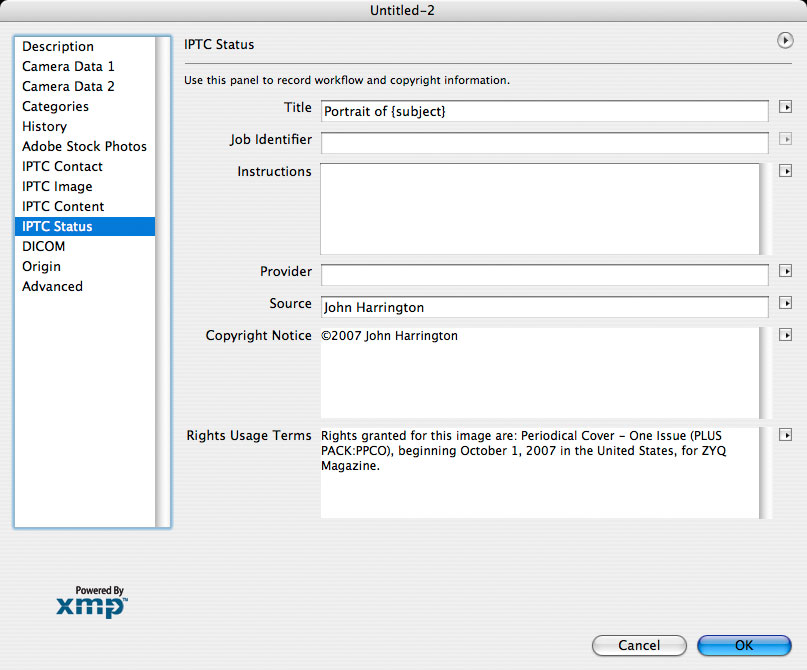
Produce one portrait of {subject} on September 1, 2007, for ZYQ Magazine cover. Rights granted are: Periodical Cover - One Issue (PLUS PACK:PPCO), beginning October 1, 2007 in the United States, for ZYQ Magazine.
(Continued after the Jump)

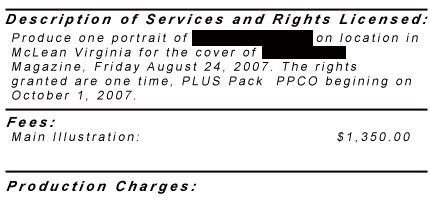
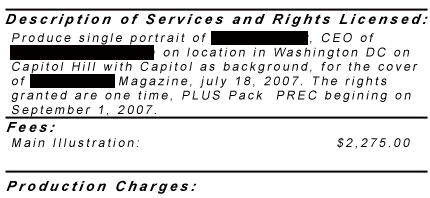
In addition to that information being on the front of your contract, under a field like "Description of Assignment and Rights Licensed", you would want to include that text into the metadata of the image you are sending them. While future metadata templates and fields will make this process easier, for now, It could well look like this (click to see larger):


Here's a screen grab of my contract for an assignment I shot last week:


In the rare case that your publication is akin to People, and People En Espagnol, your license should then include a language specification, and could then read:
Produce one portrait of {subject} on September 1, 2007, for ZYQ Magazine cover. Rights granted are: Periodical Cover - One Issue (PLUS PACK:PPCO), beginning October 1, 2007 in the United States, English language only, for ZYQ Magazine.
Suppose though, that you're assignment is for the inside of the magazine? PLUS PACK PPIO works for you:
Periodical Interior - One Issue (PPIO)

Use on an interior page of a magazine, newspaper or journal. Applies to a single printed issue of a periodical. Includes distribution of same issue on publisher's website. Allows reproduction of page for promotional purposes.

You define the following:

Duration, PLUS Region, Region Constraints, End User, Product or Service Name, License Start Date
So, your license could then read:
Produce one portrait of {subject} on September 1, 2007, for ZYQ Magazine interior story. Rights granted are: Periodical Interior - One Issue (PLUS PACK:PPIO), beginning October 1, 2007 in the United States, for ZYQ Magazine.
What if you're client's not familiar with the PLUS glossary? You could include the cross-industry accepted definition as well:
Produce one portrait of {subject} on September 1, 2007, for ZYQ Magazine cover. Rights granted are: Periodical Cover - One Issue (PLUS PACK:PPCO), beginning October 1, 2007 in the United States, for ZYQ Magazine. PLUS Pack PPCO is defined as: "Use on the cover of a magazine, newspaper or journal. Applies to a single printed issue of a periodical. Includes distribution of same issue on publisher's website. Allows reproduction of cover for promotional purposes." For more information, visit USPLUS.com.
This additional information, whether this license, or the one below, could make it more undertandable.

Suppose though, that your client is insisting that reprint rights (i.e. being able to reprint the cover story to sell to the subject of the story for their own promotional purposes) be included? After you've determined the additional fee that should apply to this extension of the rights being granted, then try then "PLUS (Rights Ready) Packs". There, you'll find:
Editorial Front Cover (PREC)
Use on the front cover of a magazine, newspaper, book or other printed material not intended for commercial or promotional purposes. Use applies to a single issue or edition and all reprints or printed versions of the original use. Image may only be used on the front cover of the publication.

you then define:

Duration, PLUS Region, Region Constraints, End User, Product or Service Name, License Start Date
So, your assignment description on your contract would read:
Produce one portrait of {subject} on September 1, 2007, for ZYQ Magazine cover. Rights granted are: Editorial Front Cover (PLUS PACK:PREC), beginning October 1, 2007 in the United States, for ZYQ Magazine.
Or, if the definition needed to be included as we did above:
Produce one portrait of {subject} on September 1, 2007, for ZYQ Magazine cover. Rights granted are: Editorial Front Cover (PLUS PACK:PREC), beginning October 1, 2007 in the United States, for ZYQ Magazine. PLUS Pack PREC is defined as: "Use on the front cover of a magazine, newspaper, book or other printed material not intended for commercial or promotional purposes. Use applies to a single issue or edition and all reprints or printed versions of the original use. Image may only be used on the front cover of the publication." For more information, visit USPLUS.com.


Here's how it looked for an assignment from two months ago for a smaller circulation trade publication:


By being specific about your rights packages, it makes it so much clearer for everyone to understand, and fewer clients will be demanding "all rights" deals, when you've given them what they need, and they pay for those needs.
Please post your comments by clicking the link below. If you've got questions, please pose them in our Photo Business Forum Flickr Group Discussion Threads.


[More: Full Post and Comments]

Monday, December 3, 2007

Safety In Numbers

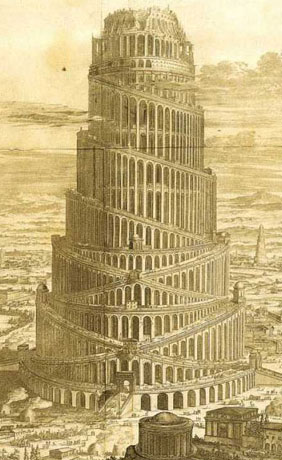
Babel was a city like no other. A city where people were unified and spoke the same language, in ancient times, a city with a tower. The Tower of Babel. The story goes that the city's occupants were cast to the wind, forced to use a fabled 72 languages, confusing all who tried to communicate with one another.
Since then, series like Star Trek have had devices like the Universal translator, and in fact, in The Hitchhiker's Guide to the Galaxy, it was the Babel Fish that provided universal translation.

The US has standardized our currency, so that we all deal in dollars, to avoid possible unknown, or illegal alternative currencies. One well known foreign currency was that issued during the civil war, called Confederate States of America Currency, as shown here.

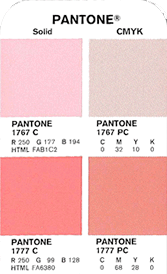
Private industry too has standardized. How, for example, do you describe pink? Is it pink skin, pink like a pig, pink like bubble gum? Is what you see as pink on your monitor and approve to have 10,000,000 widgets made the same pink that I see on my monitor? If not, who's going to cover the costs to remake the widgets when you're not happy? Pantone provided a solution, and now every designer, print shop, ink maker, and so on all operate based upon a specific Pantone #. The Pantone # I was thinking of when I said "Pink", by the way, was Pantone 1767. (adding the "C" means that the color is one coated with a finish.)
How about us photographers? Can we standardize what we do?

(Continued after the Jump)

Yes, but wait a minute, this next one's really good.

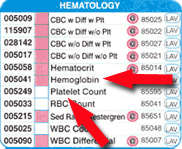
In order to save your life, the American Medical Association has created what are called CPT (Current Procedural Terminology) and HCPCS (Healthcare Common Procedure Coding System), so that when a doctor orders a Platelet Count or a Hemoglobin count, they use a series of numbers. The HCPCS codes are standardized by the US Department of Health & Human Services here, and the CPT codes are standardized by the AMA here. When your doctor places a check in the box next to "005249", the nurse knows what test to order, the lab knows what test to perform, doctor's billing department knows how much to bill, and the insurance company knows that they are paying for a Platelet count, and not a Hemoglobin test (which would be 005041 by the way).

Thus, no more mistaken tests, re-drawn blood (ouch!) because of an error, or a positive returned for high cholesterol which is seen as a positive for low white cell count. This is real life here.

So, where am I going with all this? Yes, there is safety in numbers, and a standardized system for licensing your creative works, it's called the PLUS System, and it's FREE. I interviewed the CEO of PLUS, Jeff Sedlik in a a video here at this past year's PhotoPlus Expo, and there's a great example I wrote about in Detailing Understandable Rights Packages - Editorial Covers back in August. I even wrote more about them back in April - PLUS + You + Client = Clarity and Understanding.
Check out PLUS's description of these terms and the accompanying PGID number: Collateral; or the variety of clarity needed for packaging; the ambiguity of the word advertising; and the misnomer that is advertorial.

What about the client who demands "all rights"? How can you placate that request? Try granting them (with the appropriate fees):
PLUS (Rights Ready) Packs
All Commercial Use (PRCU)
Use in any medium intended for advertising and other commercial or promotional purposes.
Be sure to specify: Duration, Region, Region Constraints, PLUS Industry, End User, Product or Service Name, License Start Date
Back in the magazine sample, I have a sample license written out with the PLUS language in it.

While using PLUS codes may not be as life-saving as HCPCS codes, they will save you (and your client) a world of misunderstandings when it comes to who can do what with your photographs.

Thus, there is safety in numbers (and standardization).

Please post your comments by clicking the link below. If you've got questions, please pose them in our Photo Business Forum Flickr Group Discussion Threads.


[More: Full Post and Comments]

Monday, June 16, 2008

Digital Railroad, PLUS, and A Stock Sale

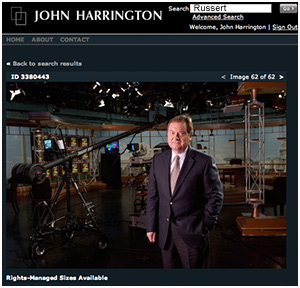
A funny thing happened on the way to a client meeting today. I had just departed my office when the phone rang. A longtime client that I hadn't heard from in years. He'd found my images of Tim Russert in the Digital Railroad marketplace, where I had forgotten I had released them after a magazine cover assignment two years ago. Along with those were images of Tim and his son Luke, at a launch party for an endeavor Luke was involved in.

The client wanted to know if I had any other images I hadn't put up.

"Yes, I do", I said.

The client said "well, we're closing the book in an hour, can we see them?"

(Continued after the Jump)

"Sure" I responded, wheeling around an intersection three blocks from my house. I knew I had about 10 minutes of buffer in my trip downtown if I was to make that meeting. I quickly located the images on my local server, using PhotoMechanic, uploaded 45 images to my archive, and sent the group of images direct to the client (and submitted the additional images to the Marketplace!). I hopped back into the truck and made my meeting on-time.

Along the way, I called the client. "Did you get the shots?"

"Yes", came the response. "I'll let you know which one the editor chose in about an hour, we are able to download them directly, I see."

Cha-ching! There's about five months worth of Digital Railroad's monthly charge covered, with one image license. And, I booked the downtown client to boot!

On another note - It's been a full 10 days for me, and one thing that came over the transom that excited me, but that I've not yet written about, is that Digital Railroad has broadly adopted the Picture Licensing Universal System (PLUS) for image licensing. They were already using it in a limited capacity, but it's now an integral part of their licensing process. (Digital Railroad Expands Its Use of PLUS Licensing Standards, 6/5/08)


I can't stress enough the importance of everyone playing by the same rule-book, and using the same dictionary. That is what PLUS is. PLUS is free to photographers to use. So to for designers who can specify the PLUS Pack they want (i.e. all commercial use, book cover, book inside, and so forth), and you know what you're licensing, and there's no confusion.

Using PLUS is so easy, ( to quote the Lenox Financial guy from his ads) "it's the biggest no brainer in the history of Earth." I am pleased to see Digital Railroad taking a leading role and joining in with the many other organizations that are bringing clarity to the Tower of Babel that was image licensing.

Please post your comments by clicking the link below. If you've got questions, please pose them in our Photo Business Forum Flickr Group Discussion Threads.


[More: Full Post and Comments]

Tuesday, July 1, 2008

Orphan Works & Image Recognition

One of the big problems with Orphan Works is how do you describe something like a dog on a beach. Are the clouds white or grey, blue sky or sunset, stormy or clear, sandy beach or rocky one? The descriptions of visuals is a huge problem, which is why there is a huge push to have the databases (sometimes called 'registries') for works that are to be considered orphaned, be required to have a way to upload the intended image, and have it reside in the registry/database, and that, in turn, the images be compared to images that visual artists have uploaded to see if there is a content match. How, on earth, would you do that?

(Continued after the Jump)

Enter services like PicScout, TinEye, Attributor, and others. PicScout was chosen to testify before Congress on the subject (see article here), and TinEye's slogan is "TinEye does for images, what Google does for text..." (check out their video here, and their blog here). Hmm, do they want Google to buy them, perhaps? Oh, but I digress....

...And, Google already does this for video. Google has what they call a "content id" (see here) where you upload a video, and whenever video that matches that is uploaded to Google Video (YouTube anyone?) the content distribution is restricted. From Google:
The digital content identification file which corresponds to a reference file (a piece of content like a movie, music or other audiovisual material). This file is generated using Google software and is also known as a "fingerprint."...The solution is very accurate in finding uploads that look similar to reference files that are of sufficient length and quality to generate an effective ID File. The system is tuned to offer the best possible automated matches while eliminating most false positive matches. We are constantly tuning the system to deal with attempts to circumvent it, therefore exact rates are not available...Google Video is committed to giving copyright owners the ability to maximize their choice in how their content is made available on the site. Content identification is the latest tool that Google Video offers content owners to more easily identify and manage the use of their content on the site.."
What does this mean for you? Well, you'd better have a digital copy of every image of yours you want protected against becoming Orphaned, so you can upload your images to TinEye or PicScout (for a fee per image, of course), or whatever future image recognition capability Google creates (which they will figure out some way to monetize), so that when people in the next few years want to use your image, they can find you. This presumes that these are the solutions that are integrated into the proposed two registries, which is where you'd end up having to upload your images to.

How much will it cost you to upload each image? $0.01? $1.00? For me, that equates to potentially tens of thousands of dollars, even once I already have them all scanned!

Of course, whichever of these companies succeeds and breaks away from the pack will almost certainly be acquired by a major player in the stock photo business, or perhaps more likely --- by Google, or Microsoft or a media conglomerate. Scary thought, as this would place the content, operation and pricing of the entire database of images from thousands of owners and competitors under the control of a single, major stakeholder. One other option would be the PLUS Coalition, which I've written about before, which is an international umbrella group that represents the interests of all industries involved in creating, distributing, using and preserving images. To protect the interests of all concerned, the PLUS Coalition is busy creating the PLUS Registry.

Actually it will be an integrated system of registries that will be operated on a non-profit basis, as a community resource, and will place the control of pricing and usage of the registry in the hands of an industry-neutral organization. The PLUS Registry will include an Image Registry, with image recognition capabilities, and given that photographers, customers and stock agencies are all participating in PLUS, the PLUS Registry is likely to become the registry of choice. It will be interesting to see which image recognition company partners with PLUS, to support what will almost certainly be the largest registry in the industry.

Please post your comments by clicking the link below. If you've got questions, please pose them in our Photo Business Forum Flickr Group Discussion Threads.


[More: Full Post and Comments]

Sunday, October 19, 2008

ASMP & Their $1.3


Much has been said (here, and elsewhere) about the windfall of funds that the American Society of Media Photographers received almost a year ago. ASMP did the right thing in putting out a call for member ideas for spending that money - "Call for Member Ideas for Furthering Industry Education and Advocacy!", writing: "The $1.3 million distribution has the potential to do much good in its areas of use, which are restricted to furthering industry education and advocacy."

ASMP has set as a deadline of tomorrow (Monday, 10/20) as the deadline for the reciept of ideas. Here are several things that ASMP should be doing:

1) Because of the importance of the case that has made its way to the Supreme Court regarding the National Geographic's use of photographers' works from their printed edition in their CD-ROM edition, I proposed ASMP utilize those funds to "fund additional counsel to aid in the preparation of {the amicus curiae} brief..." so that the rights of all photographers and this industry would benefit from the information that the ASMP would present. (Greenberg background here).

(Continued after the Jump)

2) There seems to be some movement in the possibility of being able to register with the copyright office works that are published and unpublished together, in one registration. Currently, you must register them seperately. The ASMP could fund a study into the benefits of this combined registration type, that would be of value in making the case for a combined registration. There are a great many challenges for a segment of the photography community that may not be able to determine which images meet the test of "published", and which do not. further, the ambiguity of the language in the era of the internet further confuses people. Surely, more people would register their work if this were the case. (ASMP FAQ on this here).

3) There are a great many endeavors that PLUS - the Picture Licensing Universal System cross-industry organization is working on. PLUS has recieved support from large corporations to fund the majority of it's development, and with the downturn of the economy and consolidation in the industry, PLUS is likely to face funding challenges. Because of their cross-industry consensus, the furtherance of the PLUS Licensing Glossary, the PLUS Registry (which has an significant importance in response to the expected Orphan Works legislation), are projects that, without a doubt, meet the test of "furthering industry education and advocacy", especially when facilitated by an unbiased organization like PLUS.

4) And here's the big one - fully fund an ASMP Strictly Business 3 program. I was a part of the SB2 program, and a protege of the SB1 program 15 years ago. One of the repeated messages we as presenters heard was "please repeat this more often." We were able to do just four cities, and each event was well attended. Consider a 10, or even a 20-city tour? Economies of scale would make each city less expensive, to be sure, and the ciriculum from SB2 could be utilized, further minimizing the planning necessary. I'm not plugging this so I can hit the road again (but I'd consider it), but if ASMP wanted to take my piece of the curriculum and have it used as the basis for a new presenter on those topics, I wouldn't have any problems with that. The SB2 program was open to ASMP members and non-members, but there was a price difference. Perhaps the pricing at the same level for both this go-round would resolve any concerns about benefits specific to ASMP. In fact, you could slash in half the price of the entire weekend, making it even more available; offer scholarships, or, maybe make the entire weekend free? I know, it sounds crazy, but it's worth looking into.

So there you have it - four ideas for the American Society of Media Photographers to spend their $1,300,000.00 in windfall funds. I'm sure others have been sent in. If you have your own ideas, hit this link - suggestions@asmp.org - and let them know. You have one day left to propose your ideas. As the e-mail notes - "Just be sure that your suggestions conform to the parameters of 'furthering industry education and advocacy.'"

Please post your comments by clicking the link below. If you've got questions, please pose them in our Photo Business Forum Flickr Group Discussion Threads.


[More: Full Post and Comments]

Friday, April 4, 2014

House Judiciary Committee - Orphan Works and the PLUS Solution

On April 2, 2014 - Congress' House Subcommittee on Courts, Intellectual Property, and the Internet held a hearing titled Preservation and reuse of Copyrighted Works about orphan works, and asked for insights into matters regarding the need to preserve copyrighted works.

Testimony was heard from the Library of Congress, Gregory Lukow, Chief, Packard Campus for Audio Visual Conservation, The Library of Congress (testimony PDF); Mr. Richard Rudick, Co-Chair, Section 108 Study Group (testimony .doc file); Mr. James Neal, Vice President for Information Services and University Librarian, Columbia University (testimony PDF); Ms. Jan Constantine, General Counsel, The Authors Guild (testimony .doc file); Mr. Michael C. Donaldson, Partner, Donaldson + Callif, LLP (testimony PDF); and Mr. Jeffrey Sedlik, President and Chief Executive Officer, PLUS Coalition (testimony PDF). Much of the testimony was about preservation, and the questioning of the need for new laws related to orphan works was discussed at length over the course of two hours.


Jeff Sedlik's PLUS Coalition testimony proved to be most relevant to visual artists, given the presentation of PLUS as a solution to the problem of orphan works. Prior to the hearing, Sedlik spoke with the committee chairman, Rep. Howard Coble (R-NC) (as seen below).

Below is a video that combines Sedlik's testimony from the hearing - it's well worth watching to better understand how orphan works will return to the fore, and what is being done to solve the problem.

(Continued after the Jump)

Disclaimer: I sit on the boards of the American Society of Media Photographers and the National Press Photographers Association, both of whom have provided substantial funds to support the development of PLUS. Each organizations' initial funding of PLUS pre-dates my role on the boards.

Please post your comments by clicking the link below. If you've got questions, please pose them in our Photo Business Forum Flickr Group Discussion Threads.


[More: Full Post and Comments]

Wednesday, February 13, 2008

Canon's New Patent - The Eyes Have it

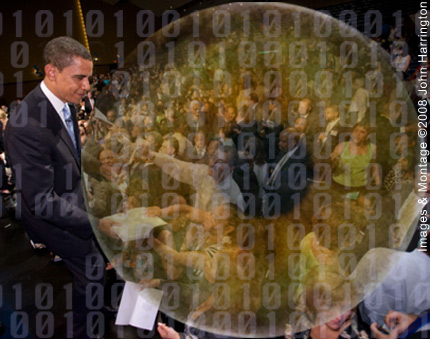
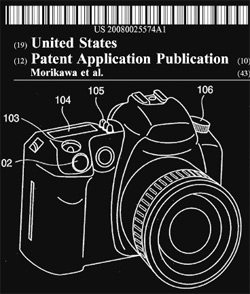
I read with great interest about Canon's new patent whereby their camera will actually take a retinal scan of your iris, and produce a biometric signature that the camera will then embed into the photographs, authenticating the images as yours, and aiding in locating who the person is that took the photograph via some form of steganography. Of course, that image, above, of Sen. Obama campaigning, is a nice photo-illustration of the concept, and not how your actual image would look!

I've gone through and dissected their patent application after the jump, and discussed some of the interesting findings.

(Continued after the Jump)

First things first, patent application reading is not for the faint of heart, and it does require some creative thinking when it comes to envisioning how a bunch of lawyers are depicting their new (and supposedly valuable) idea.

I've gone through, and pulled out graphics and text that I think do a good job of making it easier to understand (and get excited about!)

Canon posted this patent application on January 31st, and have proposed some very interesting ideas to help us cure the age-old question of "who took this picture?"

The patent application reads:
FIELD OF THE INVENTION

[0001] This invention relates to an imaging apparatus for electrically taking the image of a subject. More particularly,
the invention relates to an imaging apparatus with which it is possible to protect the copyright of the photographer.

[0004] Against this background, the necessity for imaging apparatus such as digital still cameras and digital video cameras has grown explosively.
The application goes on to say why this is necessary:
[0005] The widespread use of personal computers and the like has made the copying of digital data easier and less expensive. In addition, easier access to the Internet has facilitated and lowered the cost of distributing digital data. As a consequence, even ordinary individuals can now create and distribute copies of digital images easily and inexpensively for purposes beyond private use. Accordingly, though the handling ofdigital images does not pose a major problem so long as it involves photography for personal enjoyment, the fact that such image data can be copied and distributed easily by unauthorized individuals has not gone unnoticed by those who circulate digital images as a business.

[0006] Thus, a problem which arises is that protection of the copyright of photographers, ctc., is not satisfactory. Means for protecting copyright is strongly desired for digital image data obtained by photography.

[0007] A technique referred to as an "electronic watermark" has undergone extensive research for the purpose of realizing copyright protection of digital image data. This technique is one in which a portion of the data in digital image data or digital audio data is embedded with separate information by superposition in such a manner that the information is rendered insensible or intentionally sensible to a human being, depending upon the particular purpose. When necessary, only a user having the right or qualifications can extract or remove the embedded separate information.
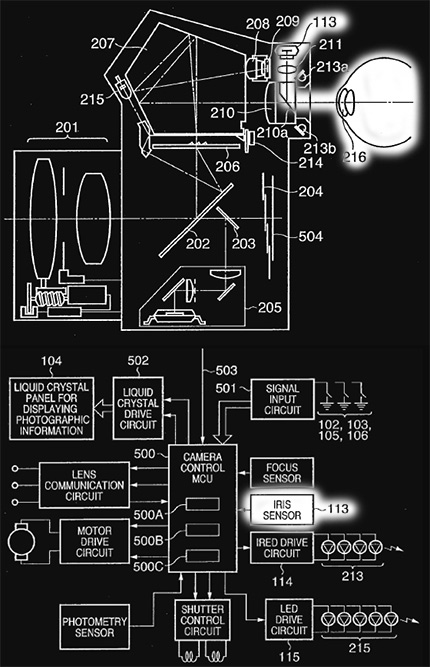
Below, you'll see just where the iris scan hardware would be placed - tucked right at the top of the viewfinder:

Above, is a graphical representation of the interaction between the iris sensor and the camera's CPU. (note, the correlation between the item identified as "113" in both graphics.

Here's how the application describes it:
[0056] An iris sensor 113, which employs an image sensing device such as a CCD, is placed so as to become the conjugate ofthe pupil 216 ofthe photographer's eye situated at a prescribed position in relation to a light-receiving lens 211. Infrared light-emitting diodes 213a, 213b illuminate the vicinity ofthe photographer's pupil. An LCD 214 inside the viewfinder, which is placed at a position where it can be observed by the photographer at the same time that the photographer observes the finder image, displays various settings information, etc. A high-luminance light-emitting diode 215 illuminates a prescribed area on the focusing plate 206.

[0057] Light from the iris of the photographer is reflected by the spectroscope 210a and has its image formed by the light-receiving lens 211 on the iris sensor 113, whereby the iris image is obtained.
Below is the flowchart for how the camera would scan your iris, while you looked through the viewfinder.

The application includes this description of the process:
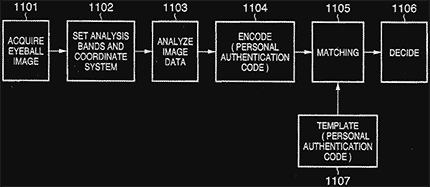
[0023] First, the eyeball image of the person is acquired by controlling illumination and focus (1101). When the eyeball image is obtained, the eyelid and eyelash are detected, the pupil-iris boundary 21 and outer boundary 22 of the iris are detected, as shown in FIG. 12, and a coordinate system is set up upon dividing the eyeball into areas 23 referred to as analysis bands (1102).

[0024] Next, image analysis (1103), which mainly entails extracting a change in shading of the analysis bands, is performed, and coding is performed based upon the result of analysis (1104). The personal authentication code generated by coding is expressed by a fixed-length array of bits indicated by "l ?s and "O"s.
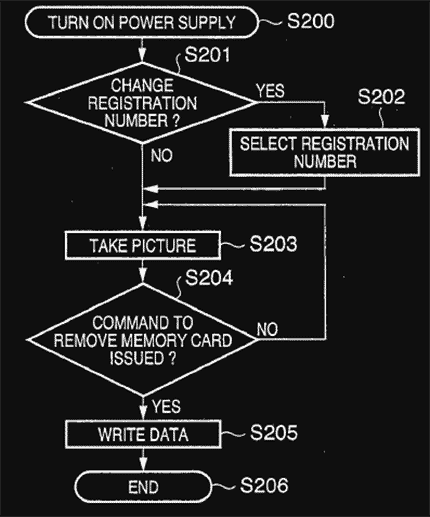
The patent goes on to say that you can register up to five iris scans, so you, and four other people can use the same camera and simply select which person is using the camera, or, and it's not clear, perhaps it would actually scan your eye and identify you.

Below, is one of the ways that the biometric information is written to the image. While this one illustrates registration selection and biometric data being written to the file when the card is removed, there are other variations, like when you power off (as it does cleaning the sensor now). Canon's concern was the delay in the data write if this biometric data was applied when the files were being written, as that could delay capture times and buffer issues. With camera buffer acceleration, in the future when this becomes real, I'd expect CPU power to be such that it could/would write when the image was captured, but for now, these are the ways - essentially when the camera is idle - when the information is written.

In response to concerns about processing power, and other potential interference with "at the moment of capture" iris scanning, the application states:
[0028] In accordance with this method, an iris pattern or retinal pattern is extracted from an eyeball image acquired at substantially the same time the image of a subject is taken, and the extracted pattern is embedded in the photographic image. As a result, the photographic image and the photographer information are placed in one-to-one correspondence and there is no way for a third party to intervene. This method is effective in that it affords a high reliability as far as copyright information is concerned.

[0029] However, the above method necessitates the task of acquiring the eyeball image at approximately the same time
that the image of the subject is taken. There are also caseswhere the method necessitates the additional task of extracting
the iris pattern or retinal pattern from the eyeball image and converting this pattern to a personal authentication code
by coding means that relies upon image processing. In a digital image sensing device such as a digital still camera, such a task coincides, sequentially speaking, with the timing at which maximum load is imposed upon processing of the subject image at the time of photography. When eyeball image processing is executed along with subject-image processing, therefore, the overall processing requires a great amount oftime. This means that the photographer must wait a while before the next photo can be taken, resulting in possible loss of photographic opportunities.

[0030] The imposition of a heavy processing load in this fashion is not limited to a personal authentication method that uses an iris or retinal pattern but is a common problem also in other biometric personal authentication methods that subject personal biological differences to authentication coding by image processing or the like.

[0031] When the eyeball image of a photographer is acquired every time an image is taken, the photographer's eye may be closed at the moment of acquisition or an eyelash or strand of hair may interfere. In view of the fact that this can happen frequently, the eyeball image may not always be acquired properly. Furthermore, since the pupil of the photographer's eye opens when an image is taken under low illumination, as is the case indoors, the area of the iris pattern becomes comparatively small and it may not be possible to convert the pattern to an accurate personal authentication code.
Below, is where it gets even more interesting:

Instead of using the biometric information from your iris, you could, instead, if you were concerned about image degradation for some reason (i.e. you were seeing degradation, because, from a steganographic standpoint, you should not see the watermark) encode a personal authentication code.

The application states:
[0016] The watermarking technique according to the above description is advantageous in that (1) the embedded data cannot be extracted without the key information used at the time of embedding; (2) since the embed component in the key information is created based upon a random number, the component is not fixed, thereby making it difficult to decode the embedded data; (3) by specially adapting the embed component, data can be embedded so as not to be sensible by a human being; and (4) the degree to which image quality declines can be controlled by changing the amount of alteration.

[0017] An "invisible-data embedding" method through which embedded data is rendered invisible to a human being has been described. As mentioned earlier, however, a "visible-data embedding" method also is available. According to this method, information such as copyright information is embedded in an original image with the intention of being made visible to a human being. This has the effect ofcausing a third party to abandon the idea of utilizing an image unjustly. For details relating to a visible-data watermarking technique, see the specification of u.s. Pat. No. 5,530,759 (Japanese Patent Application Laid-Open No. 8-241403).

[0018] Techniques for authenticating specific individuals are being researched extensively from the standpoint of protecting privacy and providing security.

[0019] A number of methods have generally been employed for authenticating individuals. Examples are a method through which only a specific person is verified by a key, card or seal in his or her possession, and a method through which only a specific person is verified by entry of a password or secret code number known only by the person. A fundamental problem with this method is that it is comparatively easy for another person to pose as the specific person by way of theft, counterfeiting or leakage of information, etc.

[0020] Accordingly, a method that has become the focus of attention as an alternative to the above method is a biometric personal authentication method that employs a physical characteristic of a specific person to undergo authentication.
This is very cool because, the PLUS Coalition is working on an artist ID/registry, whereby people could attempt to locate you if an image with your ID/biometric scan was in an image, they could go to this central repository, and find you, thus, no more Orphaned images! While this wouldn't solve old-image issues, it would be an exceptional solution moving forward!

Here's some information about the registry:

The PLUS Registry is a joint effort by and for all industries and communities engaged in creating, distributing, using and preserving images. The Registry is operated cooperatively by a worldwide coalition of organizations representing the interests of photographers, illustrators,artist representatives, stock agencies, ad agencies, designers, magazine publishers, newspaper publishers, web publishers, book publishers, museums, libraries educational institutions and others. While the organization includes all of the major photography associations in the US and many others across 30 countries, PLUS represents all industries. Within this diverse body are organizations with conflicting viewpoints on the proposed orphan works legislation. However, they have joined forces within PLUS to provide a non-partisan solution to the orphan works challenge. While the PLUS Coalition and the PLUS standards provide benefits far exceeding the scope of the orphan works challenge, the standards and in particular the Registry system provide a global, industry-neutral vehicle for the prevention of orphan works, and for connecting potential licensees with rights holders.

The Registry is operated by a non-profit, neutral organization, on a non-profit basis. It is a modular system, initially with three component registries:

Artist & Licensor Registry
Free registration to all artists, copyright owners, licensors. PLUS membership not required. PLUS-ID optional. Look up by name, company name, or PLUS ID number. Note that this is not a portfolio site or marketing vehicle for artists. This is a single, centralized location not operated by any one industry trade association, where people of all industries may search for and locate the contact information for a rights holder or authorized licensor.
License Registry
Registration and lookup of image licenses via license-ID. Allows external,centralized storage of public and private license metadata. Permissions based access to private information. Open public access to information deemed public by licensor. Licensor enters license information directly into registry or via PLUS compliant software, or via ingestion of metadata embedded in image. Licensor is issued a unique identifier. That identifier is added to the metadata of images distributed by licensor. Anyone encountering that image may then access current rights and attribution for that image via a registry lookup, again, either directly from the registry or via PLUS compliant applications. Accommodates license updates. Prevents unauthorized license metadata tampering and avoids unsynchronized embedded license information. License ID may also be embedded via Digimarc watermark as a 2nd level of protection.
Image Registry
Registration and lookup of images via image ID and/or image recognition. Users upload low resolution images and receive unique identifiers, linked to their myPLUS account. Other users may lookup the rights holder and authorized licensors for any image via image-ID lookup. For those images lacking image IDs, image recognition capability will be offered, providing a licensor/rights holder name when a low resolution copy is uploaded by a searcher.
Importantly, the Image Registry does not allow the browsing of images. Any image may be looked up, but there is no browsing the registry. Also, this is not a registry of potentially orphaned works. The latter type of registry will be a magnet for persons seeking to harvest free images that are already tagged as potential orphan works. it will be the worst scenario for rights holders, and should be discouraged. Further, any such registry is very inefficient for small business owners, as it is entirely impractical to monitor such a registry.

Also note that security measures are implemented across all registries to prevent the harvesting of email addresses and contact information by third parties. Also the registry is hosted on geographically separated redundant mirrored servers to maximize uptime.

Timeline for the registry:

The Artist & Licensor Registry is built and will be enter beta testing shortly. The License registry functionality is developed and will be integrated after an appropriate period of testing of the A&L Registry, and after that registry is populated by opt-in ingestion of trade associations members and non-members. The Image registry will be the last component, and will be tested shortly after the activation of the License registry.

Timeline for the camera?

Who knows, but it's an amazing technological advance!

Please post your comments by clicking the link below. If you've got questions, please pose them in our Photo Business Forum Flickr Group Discussion Threads.


[More: Full Post and Comments]

Monday, May 20, 2013

TIPS60 - The value of The Picture Licensing Universal System


Here is another of our videos offering tips and inisights into the business of photography. a transcript of the video is included after the jump.

(Continued after the Jump)


TRANSCRIPT:Here are a few thoughts on the value of PLUS. I'm John Harrington. PLUS or the Picture Licensing Universal System is a industry standard that allows you to license your work in a way which everyone knows about and understands what you're saying. So, if you're referring to and ad slick or you're referring to a bus back or bus shelter where your pictures being licensed. Everyone understands that what that means and there's no ambiguity because the Picture Licensing Universal System, PLUS, which is free. Check out the URL below. Really explains it, everyone's gotten together ad agencies, media, art buyers, stock photo agencies, everyone's gotten together and agreed on exactly what the licensing language is so that there's no misunderstandings. In addition PLUS is creating this registry which will help photographers and image buyers connect if someone's got an image, they're trying to find who owns the rights to that photograph, they can reach out to them and find them through the PLUS registry.


Please post your comments by clicking the link below. If you've got questions, please pose them in our Photo Business Forum Flickr Group Discussion Threads.


[More: Full Post and Comments]

Friday, October 19, 2007

PhotoPlus Expo - Day 1 - Highlights

Here's a review of the first day of the PhotoPlus Expo, in New York City.
If you'd just like to watch one segment of the broadcast, with my introduction, those links are after the jump (yeah, it seems there's a limit to the number of players that can appear on a web page from Brightcove at the same time.)

(Continued after the Jump)


Nikon
Livebooks
PLUS Coalition
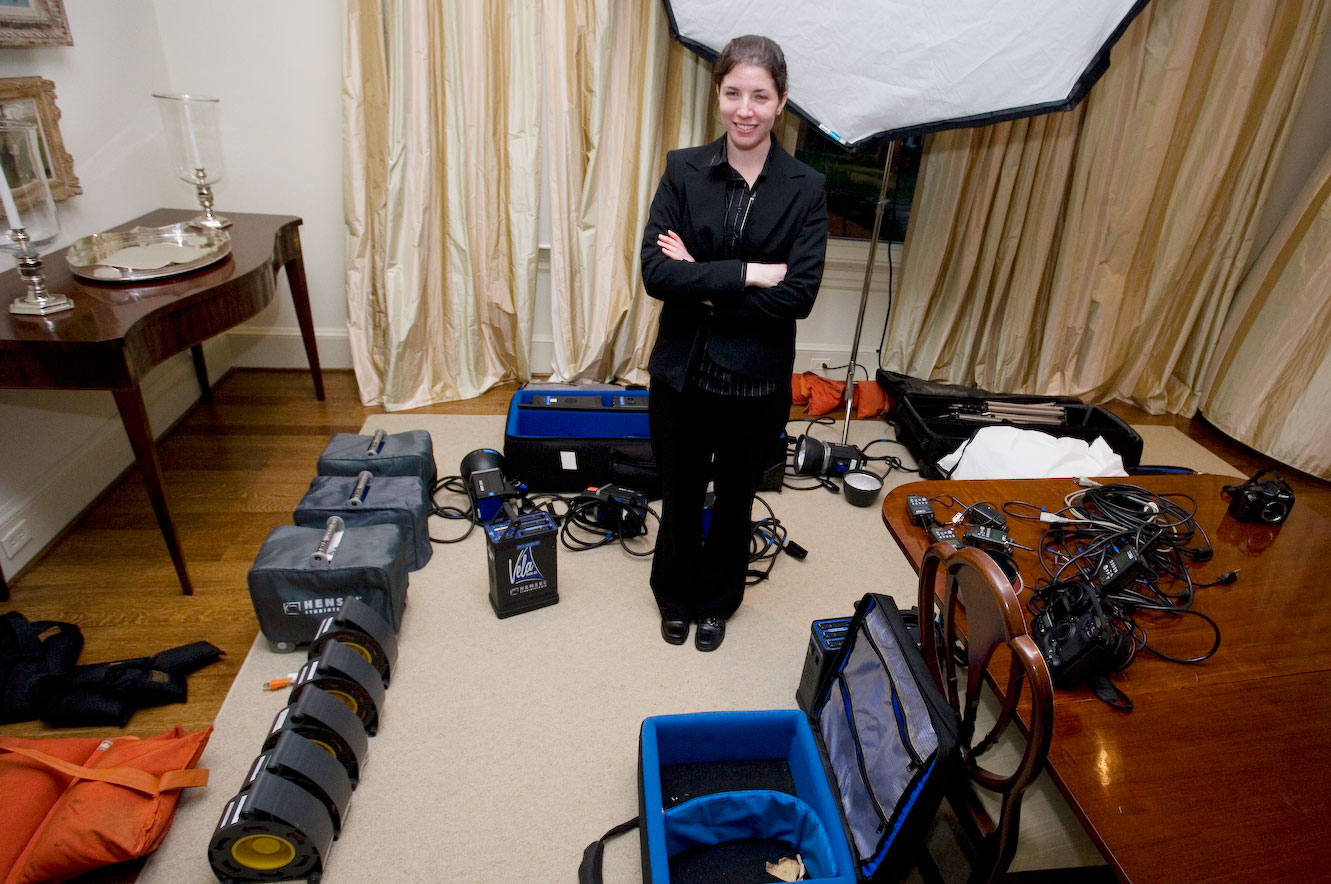
Hensel USA

Please post your comments by clicking the link below. If you've got questions, please pose them in our Photo Business Forum Flickr Group Discussion Threads.


[More: Full Post and Comments]

Friday, February 2, 2007

The Friendly Photo Editor

Consider the friendly photo editor.

They are the ones who fought for you, the photographer, so that you didn't have to be presented with a WMFH agreement. They fought for you to be paid a fair rate, and you didn't even know it.

Sometimes, they are upfront with you, and tell you that, while they know that their approved rate is low, that it is perfectly acceptable to bill for every piece of equipment as rental, since you either rented it yourself, or incurred the expense of owning it.

In some instances, these photo editors will direct you to bill prep days. They will find ways for you to arrive at their required line item maximum rates, but where your bottom line is what you wanted it to be in the first place.

Are these photo editors (the ones who tell you to hike your rate in other ways) helpful? Yes, in a way. No, in another.

For the "Yes" side, we suggest, it's the bottom line that matters. If what the publication is willing to pay equals what you want to be paid, then does it really matter how that number is arrived at? Many photographers just list:


  • Assignment Fee - $1,500.


But what about this:

  • Assignment Fee - $1,000.

  • Lighting Rental - $ 500.

Are we just assuming that the photo editor wouldn't pay that? That they assume we own the equipment? Isn't this a fair way to approach it? Some shoots are more complicated, and require more equipment, so this makes sense.

Yet, many photographers will trot out what amounts to $1k in equipment rental, and do the assignment for $750. I think that, when a good dialog exists between photographer and assigning editor, everything can be fairly worked out, for the most part.

Often, when I am speaking with a photo editor, and I ask "What budget are you trying to work within?", and following the answer, my next question is "are you including expenses, like an assistant, and equipment, post production, and so on, in that figure, or is that 'plus expenses'", and their answers are evenly split. Some say "that's including expenses", or "that's plus expenses", or, "that's plus expenses, but don't go over $X." It just depends upon how they prefer to outline the assignment.

Through this dialog, we can learn if it's a reasonable request, or not. Sometimes though, even the friendly photo editor does need a little help on this.

Consider now, the "No" side. The argument that advising you to bill for prep days, to bill for extra equipment, for a travel day when it really didn't apply, etc means that they are not completely friendly. They absolutely mean well. However, the "Yes" side is somewhat of a Machiavellian approach to assigning photography. The idea that the ends (i.e. bottom line is all that matters) justify the means. Here, for the suggestion that the photo editor is not friendly (but are well meaning I again want to emphasize) the ends should not be justified by the means. The PE should be given the leeway to sign off on whatever the specific line items are, rather than be subject to the bean counters telling them that X, Y, or Z is what is paid. Yes, yes, I know. This is supposed to be optimal, but it's not really realistic. Or is it? Is it fair? I think that if there is a range of fees, and the PE advises you that it is "plus expenses, including equipment", then I think that would work.
For me, and I think this is the best way, is to ask "plus expenses - assistant, lighting rental?" And if they say yes, then we're all set. If they say "oh, that's including everyting", then I need to see if that's fair when I add everything up. This takes the onous off of the PE, and back on us, to ask the right questions.
Please post your comments by clicking the link below. If you've got questions, please pose them in our Photo Business Forum Flickr Group Discussion Threads.


[More: Full Post and Comments]

Saturday, October 24, 2009

PhotoPlus Expo 2009 - Day 2

The second day of the PhotoPlus Expo in New York City was a little less hectic, but still very fulfilling. We were not so overwhelmed with all the things to see and people to talk to (and learn from) because we had our bearing by now. Yet, we still have a lot we want to see tomorrow, Saturday, the last day.

Below once again is the combined video of interviews with the Copyright Office, Orbis Ring Flash, Photoshelter, and we finally got some more information about the product similarities between the Sun Sniper (interviewed yesterday), and the Black Rapid company, which we interviewed today.

Following the jump are the individual videos, if you'd just like to watch one.

Combined Video (RSS readers visit here):

Photo Plus Expo Day 2 from John Harrington on Vimeo.


(Continued after the Jump)


Copyright Office interview (RSS readers visit here):

US Copyright Office at ASMP Booth during Photo Plus Expo 2009 from John Harrington on Vimeo.


Photoshelter interview (RSS readers visit here):

Photoshelter during Photo Plus Expo 2009 from John Harrington on Vimeo.


Orbis Ring Flash interview (RSS readers visit here):

Orbis Ring Flash during Photo Plus Expo 2009 from John Harrington on Vimeo.


Black Rapid interview (RSS readers visit here): 7230657

Black Rapid Camera Strap Company during Photo Plus Expo 2009 from John Harrington on Vimeo.


Please post your comments by clicking the link below. If you've got questions, please pose them in our Photo Business Forum Flickr Group Discussion Threads.


[More: Full Post and Comments]

Wednesday, February 10, 2010

Aperture v3 - Out of the Gate

With over 200 new features, Aperture 3 is a remarkable (albeit long overdue) update to it's preceding version. Let's take a look at some of the highlights (and low-lights) of the new application.

In many ways, Aperture 3 ("A3") is playing catchup like Windows is constantly playing catchup with OS X, when it comes to Lightroom.

Aperture has a very nice feature with the importing of both RAW and JPEG files. The downside to importing RAW files is that it's so damn slow, regardless of Aperture or Lightroom, and that's not the applications' fault, it's the reality of all the data being moved around as well as preview building. A3 gives you the option of importing both RAW and JPEG when you ingest, but the challenge, to date, has been that so often when speed is critical, you just handle JPEGs, but then have to go back and manually marry-up the corresponding RAW files, or just start from scratch. Now, A3 allows you to re-ingest the RAW files later, and match them to the JPEG. That's pretty slick. Further (and this is really slick) if you've applied metadata/cropping/toning to the JPEGs, you can sync these between these now re-matched files. So, for those working on deadline with JPEGs, but still shooting RAW, you're in for a real treat.


(Continued after the Jump)

Another feature that has significant potential is the ability to export a library of images to share. This way, you can send a library to a client and they can browse it. There are a few problems, however, with this. Apple (NASDAQ: AAPL) chose not to allow you to specify shared preview file sizes/dimensions, which can make libraries unwieldy. Second, of course, your client, likely working in an enterprise environment, won't have Aperture, and that's a requirement. Unlike the Filemaker application, where you can share out content to people who don't own Filemaker, or Acrobat, for people who can get a free Acrobat Reader application, you still have to have a full version of Aperture to see the images. Apple's position is that this is a feature designed to exchange libraries between a laptop and desktop, and not so much for distribution to clients, and that would more sense, and further, more beneficial.

A3's metadata interface has received a significant update and, frankly, looks better than Lightrooms'. The panel is better than Lightroom for sure, but the browsing is still better in Lightroom than A3. Further, A3 has taken a feature from Photo Mechanic, which allows you to right-click on a photo with GPS data, and show the location that the photo was taken, on a map. Further, A3 allows you to create custom data fields, which is pretty cool. As photographers move in the direction of geo-tagging their images more and more in the coming years, they will find much room to grow with A3's GPS functionality. Further, you can also reverse geo-tag, selecting, say, all images with metadata that identifies it as being shot at the US Capitol, and then assigning the GPS coordinates to the image. There is even more support in there, so be sure to go poke around all of the "geo" features.

A3's new image adjustments capability, allowing for localized editing/corrections/adjustments is a huge addition in this version, and was a required given to this version, since Lightroom has had this for some time. A3's localized editing is substantially improved over Lightroom, and one of the really interesting new features in A3 is the ability to "extend" your control of image data in curves, with an "extended curves" capability, which enhances custom recovery in, for example, highlights you think are blown.

When it comes to image recognition, it seemed also a given that Aperture would include the face recognition "Faces" capability from Omron Global that iPhoto '09 has. One of the challenges that this technology has, is that it not only gets better as you use it to identify certain people, but it might also get worse, if, say, you're identifying profile images often. While there is some anecdotal discourse on this subject, Apple seems to be of the opinion that it won't really have a big impact. That said, I can sure see a benefit to being able to use it to ID all 535 (plus delegates, I know) Members of Congress so I am not hunting for names after a shoot. Faces recognition happens on ingest, and it certainly wasn't designed for hundreds of people, but I wonder at what point the technology would bogg down if too many faces were in the system. Further, one can only hope that A3 is escaping the "Racist Camera" problem that Time Magazine reported on regarding some cameras and computers (here). Also, you can set up Faces to be a smart folder.

One really big addition is A3's ability to handle video and audio, and you can bet that the folks at Adobe (NASDAQ: ADBE) are now going to scramble to play catchup on this one. Aperture's really got some slick interfaces to let you manage video and audio, thanks no doubt to their genius with Final Cut Pro.

A3 also has some interesting slideshow themes and features. This idea came from the ease of making slick slideshows in things like iPhoto and iMovie, but one feature that temporarily made it into a previous release but then was removed is the ability to set a slideshow to a particular audio track. Now, the feature is back and in full effect. I sure could have used this when I had to do a slideshow in 10 minutes for a client recently, and the last 2 minutes of images were showing to no audio. Even better is the ability to set unique slide durations. Simply play the slideshow and hit the return key when you want the slide to change (for example, to a beat/tempo) and you are good to go, "recording" the duration as you watch. The slideshow feature has more controls and customization worth looking into, so be sure to check this out.

A3 continues to offer awesome photo book capabilities, and here is one place where total Apple integration makes Lightroom look like the poorly-abled relative. A supercharged feature is the ability to include travel maps within the book of photos. While this is a very pro-sumer/consumer feature, it's nice to have none-the-less. One of our vendors, GraphiStudio, is among the third party book producers that has a plug-in for Aperture, so you can do amazing custom albums/books. I have been hugely impressed with the quality of GraphiStudio books, so if you're an Aperture user, check out their plug-in here. To learn about the other third-party book producers, check here.

Lastly, it's now 64-bit, and that will ensure a speedy application all around. There doesn't seem to be any stated upper limit on the number of images in a library, however some users with upwards of 200,000 images are not reporting significant slow-downs, so we'll wait and see as more people get huge libraries and what the real limits are.

So, what are the downsides? Well, I'm a huge proponent of DNG - which is an openly documented format that Adobe created, and Aperture just doesn't play well with images that I have in Lightroom and might want to move into Aperture. Yes, Aperture can ingest DNG's, say, from a Leica camera that shoots DNG. However, if, I ingest a RAW file, make adjustments, and then export the DNG and build a new preview based upon my adjustments, Aperture will initially display that adjusted preview, but then on the preview build stage of ingest, will wipe it out and re-build a preview based upon the untouched data. Could you migrate to Aperture with a ton of DNGs that you've worked on? Not if you want to keep that work. You can, however, export metadata to a DNG.

Next, where is the PLUS metadata in Aperture? Why Apple would prevent Aperture users from embedding industry standard rights metadata is beyond me. What's worse, PLUS rights metadata that is present in an image file will be invisible to Aperture users, which unnecessarily creates significant liability for image users. With every trade association on the planet endorsing the PLUS standards, Apple needs to wake up, jump on the PLUS bandwagon, and add the ability to read and write PLUS metadata.

Also, Aperture is Mac only, so PC users are SOL. Let's take a long-view look at this issue. For years, creatives used Macs because they were (and still are) easier to use/maintain/etc when it comes to essentially everything under the sun. Adobe hasn't been focused on fixing things that the should have when it comes to Lightroom, and this leaves them open to a repeat of the "Premiere" debacle. For those of you not in the know on this, Adobe had Premiere, their major-market-share video editing application, that was trounced to within an inch of it's life by Final Cut Pro, just like Adobe's InDesign destroyed the defacto Quark design application that owned that market. While many people bought Macs for the abilities of Final Cut Pro, I don't see people doing the same for A3.

There isn't any clear conversion path between Aperture and Lightroom, and there should be. I know this is an oversimplification of intellectual property rights issues, but comparatively, just as you can open a Word file in Wordperfect, or Excel spreadsheets in other applications, so too should you be able to open up a DNG with corrections from Photoshop or Lightroom. I know there are proprietary issues there, but Adobe and Apple should stop acting like bratty 13-year-olds (like they still are with Flash support) and just play nice on this. I know that A3 and Lightroom render things differently.

In the end, if you're an Aperture user that was considering switching to Lightroom, don't. If you're a Lightroom user that really wants to be able to manage your video, audio, and stills in one place, then you have one heck of a migration patch with weeks (or longer) re-building your RAW files to where they looked in Lightroom. However, it just may be that you Lightroom users may have just found a really great management tool for your audio and video in a separate application. For this reason alone, I can tell you I've already ordered my Aperture 3 Upgrade to my licensed seats.

My recommendation: Buy (full version link)

(Below is my proof of purchase!)


Please post your comments by clicking the link below. If you've got questions, please pose them in our Photo Business Forum Flickr Group Discussion Threads.


[More: Full Post and Comments]
Next Posts