Showing posts with label news. Show all posts

Monday, June 7, 2010

Creative Business Wire - Do Not Pass Go

Today, Creative Business Wire, launches, billing itself here as "Creative Business Wire is a digital imagery news service that specializes in business photography, and only business: the economy, Washington D.C., leaders, trends and other business related images are produced on a daily basis by our stable of acclaimed professional photographers." On the eve of their launch, with just about 8,000 images pre-populated on their site, we talked for some time with their President and co-owner, Sandy Huffaker.

In a wide-ranging interview, Huffaker seemed to come off as hoping for the best, while not really prepared for anything else. When asked about his photographers, he said "I've wanted to get a certain number of photographers on board, which as actually been kind of a challenge...it's been hard, because it's kind of a spec agency", which is understandable. Not that he's trying to do that, but that he's having a hard time because spec agencies/models are bad. We dovetailed that question into a question about how he intends to differentiate CBW from, say, a Bloomberg. "I'm trying to sign on really talented, high quality type photographers", I want to hire these documentary photographers... and have them go out and follow around a cobbler or a fisherman...really try to mix it up..." When we asked "so, it's kind of like assignment work on spec", he answered "exactly, exactly. And I'll plan to send out a needs list every night. It'll be a little bit of redundant work. There seems to be three to five business stories a day. I want the photographers to self-generate their own assignments."

This didn't sound like a promising idea, at all.

(Continued after the Jump)

Huffaker then offerred up David McNew, one of his primary contributors. "I have this guy, David McNew, who's a former Getty staffer, he got laid off, he's in LA, editors love him." So we asked, "So, if editors love him, why would David go out and churn images to be a part of a $100 a month online all you can use service? How is that economicaly viable for him?"

"I think he believes in it", Huffaker said. "He believes in the model where, say, you get 100 subscriptions at $300 a month, that's $30,000 a month, split between 10 photographers, I think that's real income." Then, it seemed, to a degree, he realized the challenge of his argument, then offered, "I'm not crazy about having such a low subscription rate for downloads, but in my research, seeing how Getty is offering $30 editorial images, it's kind of, it's the only way I can see to do it right now."

Since photographers now have a choice of shooting their own stock, and putting them onto a platform like PhotoShelter and marketing to a group of clients, picture stories, as produced, we asked him about this, "how do you see this as different than doing this themselves with PhotoShelter, and doing their own marketing?" He answered, "I think what's going to differentiate us is it's a very hand-picked select group of people. I'm really banking on some of our name recognition. A lot of our contributors work for the New York Times and Wall Street Journal...when I go to the New York Times tomorrow, 3 or 4 of us already work for them..."

When we brought to his attention that the New York Times has their own syndication deals for images, and there are a number of images on the CBW site that have as the byline "...for the New York Times", and that this could be a contractual problem there, and further, that the NYT's contract (at least the last one we saw some time ago) precluded photographers from using the New York Times' name to promote themselves, he responded "they've never expressed that to me...I better go back and look at that, because I haven't looked at that contract in awhile."

Despite billing CBW as "specializes in business photography, and only business: the economy, Washington D.C., leaders,", and co-founder Robert Benson over on the Lightstalkers forum (here) writing "We are looking for photographers in NYC and Washington DC" for "a very specific type of imagery: business photos (economy, transportation, green, economy, jobs, energy, washington, etc)" Huffaker said of DC and political imagery "I'm not going to focus as much on the politics, you know, Washington, you know, AP, Getty, they all have full time staffers doing that. Another thing, I know if it was me, I wouldn't want to shoot that stuff on Spec...". yet CBW is asking just that of DC photographers, and marketing that as the objective on Lightstalkers.

As to overhead, Huffaker said "I don't have CEOs, no office, basically, you can do this from a computer. It was incredibly cheap to start this thing. I went through Photocore, which, they did US Presswire. It was basically $1,000, and about $150 a month to rent the storage.So, it's very cheap to start up."

When we asked "have you run any projections as far as numbers", he responded, "I think our yearly goal for the first year is 40 subscriptions, I think 100 would be great. We need to be able to produce 3-5 of these daily stories, I think, to survive."

We presented a scenario to him, off the cuff. Since it's not our role to be his accountant, we didn't have a definitive set of numbers, so we tossed out a few examples. He had said he would have two of his 10 photographers in New York City. So, we asked, keeping in mind his goal of 3-5 stories a day, and that at least one of those each day would come from NYC. So, with his two NYC photographers, that equates to 2.5 stories a week, or 10 a month. We then suggested that if they were to go the route of shooting those assignments for the AP, they'd get $2,000 a month from the AP. How much would CBW have to produce for them to get the same amount from CBW? We even walked him through the numbers:
You would have had to have sold about $5,000 of their images for them to get $3,500. That means CBW would have to generate $50,000 a month for each of the 10 photographers to see a gross revenue of $5,000, which they would then get their $3,500 from. Thus, since their model ranges from $100 to $300, a mid-point of $200 per subscriber would be reasonable for the purposes of this scenario. So, in order to get $50,000, CBW needs 250 subscribers, so each photographer can get their $3,500. When we then suggested that 250 subscribers is more than double the 100 he considered "great", that presents a problem. If 250 subscribers earns each of the 10 photographers a net of $3,500 for the month, then 100 would earn $1,40 a month ($140 an assignment), and, with an annual goal for the first year of 40 subscribers, that's $560 a month, to do 10 assignments, or $56 an assignment. It's important to note - the photographer contributing in NYC would have to do all 10 assignments, and hope that they had enough subscribers.
When we presented this scenario, and asked him if he had run the numbers in some similar type of scenario, he said: " I haven't done kind of the math as you just did...I am so in the dark right now. I think we could get anywhere between 40 and 250. I'm feeling it's almost a shoe-in we can get, we have a list of over 4,000 publications, and we have a full-time salesman who's going to be on this." He then went on, "You know I don't know if it's proven or not, we worked hours on just trying to find some kind of formula ...I have to be honest, this model isn't proven...I'm not super experienced when it comes to the numbers stuff." Well, that's certainly a vote of self-confidence, in the eve of the companys' launch.

When we asked Huffaker who would be doing sales, he responded "A photographer who's worked for Zuma, he's been in their system awhile, so I can be out shooting. His name is Jerod Harris. He's kinda new, he's done some entertainment, so I am monitoring his shooting, he's very driven. " When we asked about him being full time sales, or part times sales part time shooting, since he has images on the site himself, he said "he's going to be fulltime sales....I'll let him go out and shoot the brands, you know, we have this brands link..." So, he's going to be doing both, it seems. Certainly, from the images on the site, he's got a lot there.

He then went on about the number of photographers, "right at this minute we have five really commited people." He then pointed out "I've officially stopped accepting new photographers". Whew, I'll take that as a sign that no one else out there is going to be subjected to this bad deal. He said he cautioned everyone he's signed already, "this is something on the side of your daily assignments...don't quit your day job...I have no idea if it's going to fly or not."

I do. It's not.

Near the end of our conversation, he offerred, "Come back in a month and we'll see if this thing is going to fly or not." Ok, I'll start with your website in a month, to see if anyone other than you, McNew, and Robert Benson, are still contributing images. When Huffaker said "Im a little inexperienced, to be honest, with this", and coupled that with a comment early on in our conversation he made - "my biggest fear is dicking over photographers", I say, stop now. Do not pass go, do not collect $200 from even a single client. Use the platform to license stock on an image-by-image basis, as the subscription model only profits the agency, not the photographer. Oh, but you just opened an agency, and are also one of the photographers too. Now I see.

Please post your comments by clicking the link below. If you've got questions, please pose them in our Photo Business Forum Flickr Group Discussion Threads.


[More: Full Post and Comments]

Thursday, May 27, 2010

New York City Photo Shoot Permits - Get Over It

In New York City, the government entity that is charged with managing the city's assets on behalf of the people of New York, so that the city gets its' due for the use of city assets, and does not interfere (or if it does, you may more) with the comings-and-goings of New Yorkers, is looking to implement a fee of $300 when you are exploiting the city assets beyond what every other citizen is doing (i.e. walking around enjoying them.) This isn't some restriction on your movements, it's business, and you should get over it as some personal affront, and pony up (which you're passing on to your clients anyway!)

While $300 per shoot may be a bit excessive, and perhaps a $300 annual permit with, say, a $25-$50 per shoot application processing fee may be more appropriate, especially for the level of production that most still photographers bring to the assignment, production in the city puts a burden on the local government, and photographers should step up and recognize their responsibility to chip in. So, if you're an out-of-town photographer coming into the city and shooting on city property, you should pony up that $300 annual fee plus a the nominal shoot fee, and New York based photographers would be paying it once a year plus the per-shoot fees.

(Continued after the Jump)

Permits and permitting fees are nothing new. They are a form of a property release for the location you are working in, along with being an indicator that someone in authority has reviewed your stated intentions for doing what you propose, and acknowledges that what you are doing is proper, and does not leave it to the beat cop who nows little about what's happening, or why.

"But I pay taxes, this is my property too, why should I have to pay to use it?" This argument is about as productive as saying to a cop who pulled you over for speeding "hey buddy, I pay your salary...", to which more than one cop has pulled out a shiny penny, handed it to the driver with the issued citation, and said something along the lines of "here's your portion back." Your right to use collectively owned resources is subject to the approval of the others who also own it. It's like a restaurant deciding to use city sidewalks to make money by adding a few more tables.

What does a permit get you? In many cases, exclusive use of that space, and on larger productions, you can have a security guard (often in the form of a uniformed off duty police officer) direct your fellow citizens around the shoot area so they're not in your background, or tripping over cords. In some instances, exclusive use permits may cost more than ones that just validate what you're doing is ok.

The National Park Service has been charging for permits for several years now, and that makes sense. While it is hard to differentiate the avid hobbiest who takes his camera, tripod and long lens into a remote park to try to photograph some elusive animal, versus the photographer with a tripod who is making a living shooting stock of the same animals in the same way, so too is it difficult to differentiate the "family friend" amateur photographer who is doing bridal portraits at the Lincoln Memorial versus the $10,000 wedding photographer doing the same thing. Yet, the differentiation must be drawn when you are operating a portion of your commercial business on public property. Think about it this way - if you earn $5,000 a wedding, and do 20 weddings a year, that's $100,000. If out of an eight-hour wedding day, you shoot at the various monuments in DC for one hour, 12.5% of the time you are earning money each day you are doing so on publicly owned property. So, how much of that $12,500 in gross revenue should the government be entitled to? Well, at 2% the fee would be $250.

What about the insurance requirement that people are complaining about? Frankly, it is irresponsible for any photo editor/art director to allow a shoot to commence at their assigning without knowing that the business that employs them is protected from the accidents or errors that occur under the direction and control of the photographer they assigned. I know I can't walk into the Four Seasons Hotel, for example, to shoot a wedding reception without having provided them with a certificate of insurance proving I have coverage, nor can I do a photo shoot in the DC metrorail system without doing the same. Further, it's absolutely a poor business practice to not carry that insurance to cover yourself.

There are, however, challenges to this permiting issue. Is this effort a deceptive way to rid the streets of the paparazzi? As written, I can see that a paparazzi is engaged in a shoot for commercial gain, and thus, could they could be eradicated from the streets around celebrity apartments for not having a permit. What about news gathering? For all the altruistic statements about it, news gathering is a commercial endeavor, and thus, would news photographers be required to get a permit to cover breaking news? I know that a phlanx of 6 photographers back-walking someone in the news, or a horde of 15 still and videographers back-walking, say, Bernie Maddoff can run into granny on the street and knock her down and cause injury.

In the end, the fee is going to be imposed by New York City, and soon, other jurisdictions as well. Miami has permits and fees for the shoots that take place on public beaches too, so this is all the more reason why you should be passing along these expenses to your clients, and not complaining that it's coming out of your profits, because it shouldn't be in the fist place.


Please post your comments by clicking the link below. If you've got questions, please pose them in our Photo Business Forum Flickr Group Discussion Threads.

[More: Full Post and Comments]

Friday, May 21, 2010

Corbis' Subsidiary Files for Bankruptcy Protection


Sygma, purchased by Bill Gates' wholly owned and privately held company Corbis back in 1999, has filed for bankruptcy protection according to a report in the French press here (via Thoughts of a Bohemian, 5/21/10), with tax debts of approximately 73 million euros.

As Paul Melcher at Thoughts of a Bohemian wisely surmises, French laws are remarkably more pro photographer than if this were a case in the U.S., and further, whatever court would take on this case could also be affected by anti-American/anti-big-business sentiments.

With a pro-photographer leaning in French law, Sygma was found liable for the loss of photographer Dominique Aubert's images, with a judgement of 1,500,000 euros. Following this, property and assets owned by Sygma were seized, and the game was essentially over.

Likely many of the Sygma photographers, with digital assets already in Corbis' asset system, will migrate to Corbis proper. In the end, as someone who knew of Sygma and worked alongside their photographers in it's heyday, it is sad to see the name disappear from the bylines, but, well, business is business, and so it goes.

(Comments, if any, after the Jump)
POST JUMP TEXT.

Please post your comments by clicking the link below. If you've got questions, please pose them in our Photo Business Forum Flickr Group Discussion Threads.

[More: Full Post and Comments]

Monday, May 17, 2010

Video Compression For Still Photographers


MediaStorm is the preeminent outlet for multimedia stories by photojournalists that incorporate still images, with intermittent video, and incredible audio to tell a story in an increidbly immersive way. Brian Storm, who founded the company, has been a leader in the industry for a very long time, and also spends a great deal of time getting things right.

One of the challenges for still photographers migrating to video is how to properly prepare the final package for publication/broadcast/posting in the many different arenas. To bring understanding to what can only be descibed as a Tower of Babel when it comes to the proper settings, MediaStorm has put together MediaStorm’s Guide to iPad Compression for the Web (5/17/10) which is well worth the read. In fact, Storm's entire blog should be on your daily (ok, maybe weekly) list of blogs to check out.

(Comments, if any, after the Jump)
POST JUMP TEXT.

Please post your comments by clicking the link below. If you've got questions, please pose them in our Photo Business Forum Flickr Group Discussion Threads.


[More: Full Post and Comments]

Thursday, May 13, 2010

Getty Images and the Incredibly Shrinking Usage Fee


Everything is about business. Plain, and simple. Getty Images continues to travel on its path of corporate suicide with their latest - slashing non-exclusive stock images to what amounts to a flat rate of $50. Yes, this is somewhat of an oversimplification of the deal, but for all intents and purposes, it's accurate.

The subsciption model isn't new, but it is what is causing so many of the image providers to become unsustainable properties. They only appear to be profitable, and while revenue does come in in the short-term, in the long-term it will not survive.

More than one photographer I've been in contact with raised the concern about this deal, that essentially includes Getty, AP, and Reuters, all agreeing to $50 images for Time Warner. If this is the case, could there be reasonable concerns about anti-trust issues? Indeed, it's worth someone looking into.

(Comments, if any, after the Jump)

Please post your comments by clicking the link below. If you've got questions, please pose them in our Photo Business Forum Flickr Group Discussion Threads.


[More: Full Post and Comments]

Friday, May 7, 2010

Corbis' Copyright Registrations - Images "Not Registered" Court Finds

In a stunning move, the US District Court for the Southern District of New York, in a lawsuit has found that not only is the methodology of how Corbis was registering the copyrights to images and their database flawed, but also the registration of images by Corbis, on behalf of photographers under its contract are invalid, in it's summary judgement grantied for the defendants, Houghton Mifflin Harcourt Publishing Company and R.R. Donnelley & Sons Company, in the case Meunch Photography Inc, v. Houghton Mifflin Harcourt Publishing Company and R.R. Donnelley & Sons Company (09-CV-2669) filed May 4, 2010.

The issue at hand is Corbis' methodology for registering images, which it has been handling the same way for almost every photographer, because the contractual language has been the same, for a very long time. The problem is, Corbis relied on direction not consistent with the statues and, it seems, in direct contradiction to the intent and spirit of the copyright registration procedures, when executing their registrations. Further, the US Copyright Office approved these flawed registrations, apparently, at the urging of Corbis.

Photographers contracts included the following language, as outlined on the court's order:

The agreements "grant to [Corbis] legal title in [Marc and David Muench's] images selected and digitized by Corbis and included in the Corbis digital collection solely for the purposes of copyright registration." Id. (emphasis in original).) After registration, Corbis agreed that it would "promptly reassign legal title to [Marc and David Muench] with respect to [their] registered original film images . . . "
If you are a Corbis contributor, and If that language looks familiar to you, then the court has also just set forth a path for every copyright registration that included your image(s) you submitted to Corbis to be invalidated. I first became aware of this issue when I viewed, first-hand, several Corbis registrations, which included images from hundreds of photographers, including the iconic black-and-white image of John F. Kennedy Jr saluting his fathers casket as it processed by, made back in 1963. I later learned from the Copyright Office that the justification for the inclusion of that image by Corbis was that it was an addition to a database, and that, further, certain things (retouching/dust-spotting/metadata/etc) were the justifications for the registration. From my perspective, these additions were deminimus to the creative content as a whole, and should not have been valid grounds for a registration, and I immediately was concerned for every Corbis photographer.
(Continued after the Jump)

We have been monitoring this case because of it's long-reaching impact on the field of photography and copyright registration, and was just able to download the file from a document filing service. In the court order, the court specifically addresses the copyright registration procedures, tries where it can to defer to the interpretations of the Copyright Office, but ultimately finds that Corbis was in the wrong. In the order, the court analyzed the facts thusly:
The Court is faced with the novel question of whether the registration of an automated database--here, a compilation of photographs by different photographers--by a third-party copyright claimant that has been assigned the rights to the individual works for the purposes of copyright registration registers the individual works thereby permitting the individual photographers to sue for copyright infringement.
The court, rather than trying to interpret certain issues at hand, among many other reasons for invalidating Corbis' methodology, notes that "A plain reading of § 409 of the Copyright Act mandates that the copyright registrations at issue here contain the names of all the authors of the work..." which Corbis did not do, among other things.

Then, in the court order, the court writes:
"The Court is not persuaded by MPI/s "doomsday scenario" that by granting Defendants motion millions of copyright registrations will be voided. Nothing could be further from the truth. Because Corbis is the author of the compilation the registration of the compilation remains valid. The individual works, however, are not registered."
The order goes on:
"The Court's ruling, although a seemingly harsh result for MPI, is guided by the clear language of the Copyright Act. The Court does not fault MPI for its failed forts to comply with the registration process. Indeed, from the record presented to the Court, it appears MPI's actions were completely appropriately sought the approval of the Copyright Office to ensure compliance with the statute. Unfortunately, MPI received poor advice and is now deprived, at least at this juncture, of the ability to seek statutory damages with respect to the Images not registered by MPI."
The conclusion of the court is that:
"For the foregoing reasons, Defendants' motion for summary judgment [dkt. no. 32] is GRANTED in part and DENIED in part. Defendants' motion is granted with respect to all of the Images except those Images registered by David Muench in January 1996."
Understand - this court order is a "summary judgement", in other words, the court didn't even begin to hear the cases of both sides - the argument by the defendant was so overwhelming, that there was no reason to actually move forward with the case.

As Corbis photographers, priority #1 right now should be to quantify which of your images were accepted by Corbis (and may now have invalid registrations) and begin the process of registering properly those images, as they are the most at risk of infringement right now, since it's open season on Corbis' images. If infringed, at any time in the past, and until you submit a new registration, you may find yourself without statutory damages and attorneys fees because of the Corbis error.

Priority #2 will be to quantify how much money you will have to spend to do this, and see if your contract allows you to recoup that money, or if the best course of action is a class action lawsuit (if it can be brought, subject to the terms of the contracts signed by the individual contributors, of course.)

Here's the entire 24 page order:
Usdc Sdny 09cv2669 Order


Please post your comments by clicking the link below. If you've got questions, please pose them in our Photo Business Forum Flickr Group Discussion Threads.


[More: Full Post and Comments]

Tuesday, May 4, 2010

World Press Freedom Day - It Starts In Our Own Backyard

The President today, on World Press Freedom Day, said that "World Press Freedom Day is observed every year on May 3 to remind us of the critical importance of this core freedom...It is also a day for us to sound the alarm about restrictions on the media as well as the threats, violence or imprisonment of many of its members and their families because of their work."

Truer words on this subject cannot be spoken, yet before we encircle the world, we must mind the issues in our own backyard. Such is the case of Jonas Lara, a former Marine who served overseas, and returned to study photography, and who graduated with a degree. Lara, directed his considerable talents on documenting the underground world of graffiti artists, and has made some remarkable images during this ongoing project. (His blog can be found here).

After Lara had convinced the artists to allow him to photograph them (no small task), he recieved tips as to where they would be, and went there on his own to shoot it, in much the same way that, say, Mary Ellen Mark documented the prostitutes of Bombay (here), a photojournalist sometimes can find themselves present during illegal activities. In another example, just two weeks ago the RFK Center for Justice and Human Rights (info here) awarded Laura Bauer, Mike McGraw, and Mark Morris of the Kansas City Star an award for their piece "A New Slavery” Human Trafficking in America,”, a " revelatory series [that] exposes America’s weak enforcement system that fails to stop a modern day slave trade of thousands of victims of human trafficking." Simply being in the same place where a crime is being committed does not make everyone within a short measurable distance also guilty of that crime.

And to be perfectly clear - Jonas did not set up the shoot, did not encourage, the artists, did not paint. The artists would have been there with or without Jonas. Jonas merely documented the scene.

(Continued after the Jump)

Journalism is being redrawn before our very eyes, and simply because Lara was not working for a mainstream/well-known media conglomerate on a socially powerful human interest story (and some might suggest that the grafitti artist is a powerful human interest story anyway) doesn't mean that he's not worthy of protection as a member of a free press. Apparently, the police CONFISCATED AND searched his camera and used the images they saw to make further arrests and it seems they are suggesting that those images are evidence. I submit that those images were viewed and information obtained without a warrant, and in violation of Lara's First Amendment rights, and should not only be excluded as evidence, but (and I am not a lawyer here), but any arrests made by these "ill gotten gains" should be thrown out, as the evidence was not legitimately obtained.

Lara's public defender, David Gottesmann seems to be doing his client a disservice, if, as PDN reports (here) , "David Gottesmann, has so far refused to consider his rights as a photographer as part of the defense. “Every time I bring [photographer’s rights or First Amendment rights] up, he just laughs at me,” Lara says."

The NPPA, an organization that represents the rights of American press photographers, should be involved in this issue, for certain, as well as the Reporters Committee for Freedom of the Press. At a time when staff photographers are being let go left and right, freelance photographers working on stories on specific assignments (and accepting all liabilities for that assignment as per most contracts) or on projects that, when completed, they will propose to a media outlet or publish on their own, are the new lifeblood of the National Press Photographers Association, and as Lara is looking at a criminal conviction, someone of skill and talent defending the rights of photographers - again, especially freelancers - should be on this case, post haste.

The President closed his remarks saying "But for every media worker who has been targeted there are countless more who continue to inform their communities despite the risks of reprisal. On World Press Freedom Day, we honor those who carry out these vital tasks despite the many challenges and threats they face as well as the principle that a free and independent press is central to a vibrant and well-functioning democracy."

Amen. In the meantime, Jonas is inable to afford an attorney that doesn't laugh at his first amendment discussions or takes him seriously, so we should all step up and help him out. To do so, donate here.

Please post your comments by clicking the link below. If you've got questions, please pose them in our Photo Business Forum Flickr Group Discussion Threads.


[More: Full Post and Comments]

Tuesday, April 27, 2010

AFP and The Twitter Debacle

The blogosphere is all aTwitter over the fact that a photographer on Haiti, seemingly without options for getting his remarkable images out, opted to use Twitter to do so. (PDNPulse - here).

When Agence France Presse (AFP) published those images, and, yes, profited from their distribution as did all their subscribers, the photographer got mad, because he was not profiting from the images, as he should have. Or should he?

(Continued after the Jump)

The Terms and Conditions for the use of Twitter grants Twitter the right to redistrubute without payments to the originating party, whatever passes through their system, but apparently the photographer didn't read the terms for the service he used? Instead, the photographer should have built up the necessary infrastructure and had it at the ready (Sat phone, anyone?). For example, I have the necessary equipment to traverse a blizzard, get around during the aftermath of a hurricane, and reduntant communications systems both in the office and on location in the event of system outages.

Arguments by the photographer that he didn't read the terms of service should fall on just as deaf a set of ears as the arguments that are made by clients who say they shouldn't be held to the terms of our delivery memos, contracts, or embedded-metadata restrictions on our images. "Officer, I didn't see the speed limit posted..." is not a valid excuse.

It's unfortunate here, but just as most photographers don't read the heinous wire-service contracts that freelancers are signing because they're non-negotiable, so too, are they making mistakes when posting images on free services with onerous terms and conditions.

Please post your comments by clicking the link below. If you've got questions, please pose them in our Photo Business Forum Flickr Group Discussion Threads.


[More: Full Post and Comments]

Wednesday, April 14, 2010

AP Hires out Staff Photographers

The good folks over at PDNPulse (here) wrote about the AP hiring out their staff photographers for freelance work.

From one point of view, it sounds like a good idea. From another, a bad one.

(Continued after the Jump)

On the good side - the AP invests a great deal of money, time, and infrastructure to have their cadre of staff photographers. However, in some instances, those photographers are idle, and/or not used to their fullest potential. Why not allow another news organization to book them for an assignment? It is a smart way to maximize their assets (yes, a photographer is an asset of an organization) to maximize revenue and yield.

On the bad side - once this program goes well (and it likely will), there is no reason that the AP cannot task a freelancer who earns $200 a day, and grants all rights to the AP, to an assignment that would be done for a corporate/commercial client for $2,000 or more. Heck, WireImage charges $5,000+ and hires a photographer for a few hundred dollars for the same deal and then post the images on their site, why not the AP? But, where's your piece of that higher dollar? Nowhere, if you signed their contract!

So, it's good, and it's bad, but in an era where every outlet is trying to stay profitable, I can't say it wasn't expected.
.

Please post your comments by clicking the link below. If you've got questions, please pose them in our Photo Business Forum Flickr Group Discussion Threads.


[More: Full Post and Comments]

Sunday, April 11, 2010

iDisplay - Wireless Client Viewing on Shoots

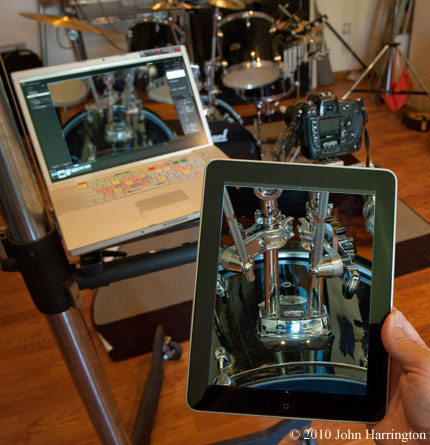
When I first saw the iPad, I thought it was pretty cool, but essentially an oversized iPhone. It wasn't until I was chatting with a friend who was a bit in the know, that I realized that it could be used as a second screen with my laptop, on shoots in either the studio, or on location, and that sold me.

The application to use is iDisplay, which is pretty slick. Below is an example of how it can be used for wireless viewing by the client, while the laptop and camera are tethered


(Continued after the Jump)


Often I take the laptop digital workstation on shoots and have a 30" monitor next to the workstation but that means that the client is peering over my shoulder, or the shoulder of my digital tech. Instead, the client (and their client in many cases) can be away from the shoot, and watching the images as they are coming in.

The downside is that there is a bit of lag-time, but not too much. If you're shooting fast and furious, it may not be the best, but if you are shooting at a more deliberate pace, it would be no problem at all. The only other downside is that while the monitor is set to vertical only, the current version of the software doesn't allow you to rotate the iPad, so horizontal images are only viewable vertically, meaning they show up smaller (but still full image area), within the iPad when viewed vertically. The company tells me that the next version should allow you to hold the iPad horizontally to view horizontal images using the full screen of the iPad too. for $4.99 on iTunes, it's a small price to pay for this functionality!

Please post your comments by clicking the link below. If you've got questions, please pose them in our Photo Business Forum Flickr Group Discussion Threads.


[More: Full Post and Comments]

Friday, April 9, 2010

Who Gets Paid What? Getty & Corbis Edition

Paul Melcher, over at Thoughts of a Bohemian, writes about the salaries of staffers of Getty and Corbis in this article, and I strongly encourage you to read what your "support staff" is getting paid, if you work for one of those companies. Moreover, if the "support staff" for a photo organization gets paid over $100k, for example, shouldn't the talented photographers who are actually creating the stuff that is being sold (and thus, needs support!) should be getting paid more?!?!

(Continued after the Jump)


As of right now, there are 330 jobs listed on Monster.com for "photographer" here, including staff photographer jobs for Diapers.com (here), and Amazon.com (here), but what I just don't see is Monster.com (or any other service for that matter) listing photographer jobs for the staff positions at Getty and Corbis, because they likely pull from their contractors, or get photographers via world-of-mouth. Would it ever be that a support staffer for a major sports league get paid more than the players on the field that are in the game? Why isn't this same mentality applied to the creative talents of staffers at Getty and Corbis?


Please post your comments by clicking the link below. If you've got questions, please pose them in our Photo Business Forum Flickr Group Discussion Threads.


[More: Full Post and Comments]

Thursday, April 8, 2010

ASMP et al v. Google - Battle Royale for Image Rights

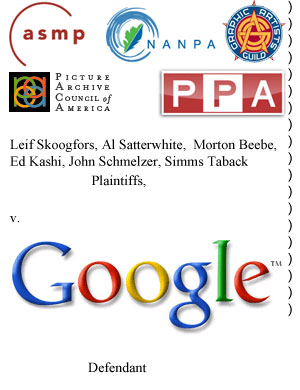
"The American Society of Media Photographers (ASMP), joined by the Graphic Artists Guild, the Picture Archive Council of America, the North American Nature Photography Association, Professional Photographers of America, photographers Leif Skoogfors, Al Satterwhite, Morton Beebe, Ed Kashi and illustrators John Schmelzer and Simms Taback, has filed a class action copyright infringement suit against Google, Inc. in the U.S. District for the Southern District of New York", reads the first paragraph of the press release.

These organizations "decided to file the class action after the Court denied their request to join the currently pending $125 million class action that had previously been filed primarily on behalf of text authors in connection with the Google Library Project. The new class action goes beyond Google’s Library Project, and includes Google’s other systematic and pervasive infringements of the rights of photographers, illustrators and other visual artists."

I will say that I was concerned that photographers had been excluded from the class action suit in connection with the Google Library Project, but at the same time, I am glad that the photo trade organizations have the wherewithal and mettle to pursue this, since nothing less than the future of image valuation is at stake. Further, this suit can learn from the mistakes (if any) from the first class action suit, and also possibly ride on the coattails of that decision.

I commend these trade organizations for taking a stand on this important issue. Yahoo News reports on it here, and we reported on the book scanning technology that is being used here, which included a number of links to Google's patents and other related stories on this subject.

(The full release, after the Jump)

The full release:
The American Society of Media Photographers (ASMP), joined by the Graphic Artists Guild, the Picture Archive Council of America, the North American Nature Photography Association, Professional Photographers of America, photographers Leif Skoogfors, Al Satterwhite, Morton Beebe, Ed Kashi and illustrators John Schmelzer and Simms Taback, has filed a class action copyright infringement suit against Google, Inc. in the U.S. District for the Southern District of New York. The suit, which was filed by Mishcon de Reya New York LLP, relates to Google’s illegal scanning of millions of books and other publications containing copyrighted images and displaying them to the public without regard to the rights of the visual creators. ASMP and the other trade associations, representing thousands of members, decided to file the class action after the Court denied their request to join the currently pending $125 million class action that had previously been filed primarily on behalf of text authors in connection with the Google Library Project. The new class action goes beyond Google’s Library Project, and includes Google’s other systematic and pervasive infringements of the rights of photographers, illustrators and other visual artists.

This action by ASMP and its sister organizations was taken in order to protect the interests of owners of copyrights in visual works from the massive and organized copying and public display of their images without regard to their contributions and rights to fair compensation. According to ASMP Executive Director Eugene Mopsik, “Through this suit, we are fulfilling the missions of our organizations and standing up for the rights of photographers and other visual artists who have been excluded from the process up to now. We strongly believe that our members and those of other organizations, whose livelihoods are significantly and negatively impacted, deserve to have representation in this landmark issue.” ASMP General Counsel Victor Perlman said, “We are seeking justice and fair compensation for visual artists whose work appears in the twelve million books and other publications Google has illegally scanned to date. In doing so, we are giving voice to thousands of disenfranchised creators of visual artworks whose rights we hope to enforce through this class action.”

Founded in 1944, ASMP is the premier trade association for the world’s most respected photographers. ASMP is the leader in promoting photographers’ rights, providing education in better business practices, producing business publications for photographers, and helping to connect purchasers with professional photographers. ASMP has 39 chapters across the country and its 7,000 members include many of the world’s foremost photographers. More information is available at http://asmp.org.

The Graphic Artists Guild is a national artists union that embraces creators at all levels of skill and expertise, who create art intended for presentation as originals or reproductions. The mission of the Guild is to promote and protect the economic interests of its members, to improve conditions for all creators, and to raise standards for the entire industry. Its core purpose is to be a strong community that empowers and enriches its members through collective action. More information at http://www.graphicartistsguild.org.

Founded in 1951, PACA, the Picture Archive Council of America, represents the vital interests of image archives of every size, from individual photographers to large corporations, who license images for commercial reproduction. PACA leads advocacy, education, and communication efforts on copyright and standard business practices that affect the image licensing industry. More information at http://www.pacaoffice.org.

NANPA, the North American Nature Photography Association, is the first and premiere association in North America committed solely to serving the field of nature photography. More information at http://www.nanpa.org.

PPA, the Professional Photographers of America is the world’s largest not-for-profit association for professional photographers, with more than 20,000 members in 54 countries. The association seeks to increase its members’ business savvy as well as broaden their creative scope and is a leader in the dissemination of knowledge in the areas of professional business practices and creative image-making. More information at http://www.ppa.com.


Please post your comments by clicking the link below. If you've got questions, please pose them in our Photo Business Forum Flickr Group Discussion Threads.


[More: Full Post and Comments]

Tuesday, April 6, 2010

Reuters Photographer - In the Crosshairs

As someone who has been overseas (albeit not in a bonafide war zone) and had my life at risk by thugs at gunpoint (once), seeing video of the actual death of a photographer turns my stomach and should make you realize just how dangerous being a photojournalist is these days.

(Continued after the Jump)

Photojournalists risk their lives everyday, around the world, to bring back the news. When they are employees of a company, they have the full support of the organization they work for, including medical, (sometimes mental health coverage), disability, and life insurance, not to mention coverage for all their equipment.

When a news organization hires a freelancer, and pays them a few hundred dollars for the day (usually not enough to cover the rental charges on the gear they would bring to an assignment, let alone their talent) the freelancer is responsible for their health, disability, and life insurance protections. According to WikiLeaks who broke this story (and PDN here), the photographer and driver were Reuters employees.

As a freelance photographer, whomever you work for, make damn sure that you have full medical/disability/life insurances, because while you are likely to not be shot from a helicopter, you could crash on the interstate, and you need to be able to get on with your life - and value it.


Please post your comments by clicking the link below. If you've got questions, please pose them in our Photo Business Forum Flickr Group Discussion Threads.


[More: Full Post and Comments]

Friday, April 2, 2010

Digital PhotoPro - Misinformation indeed!

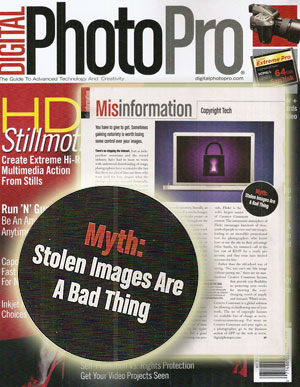
There are plenty of purveyors of misinformation on the web, and to be sure, in print too. Yet, I was shocked to find one whose core readership are DIGITAL PHOTOgrapher PROs (hence Digital PhotoPro) telling photographers that it is a myth that "stolen images are a bad thing." What kind of idiotic advice is that, anyway?

The article, Misinformation - Copyright Tech, on the last page of the magazine (pg 118) itself espouses the notion that you can gain notoriety if your images propagate over the internet, and are appreciated by "...a lot of fans out there who want stuff for free." (I'll address that one later).

The article then says "The fine line between good publicity and outright thievery is a matter open to debate." No - that's idiotic line #2.

The article then suggests that Creative Commons is a good solution for photographers who want to share their work. Let's get this straight - Creative Commons is a mechanism for conveying a license (i.e. permission) for end users that is set by the photographer. Most people who use CC licenses are granting broad rights, often seeking only photo credit, or allowing for all uses except commercial. This - CC is a manner of granting PERMISSION to do something.

(Continued after the Jump)


There is all manner of PWC (person with camera) in the world who doesn't give a damn if they ever make a dime of their photography. Their "payment" is photo credit, an atta-boy, or bragging rights amongst their PWC peers. However, images that are "stolen" are done so without anyone's permission. If you leave a broken toy on your front lawn and it gets stolen in the night, you may not care enough to call the police, and in fact, might thank the unknown thief for taking something you were going to throw away. Yet, in the end, not only is it still theft, but you are also telling the thieves that in your neighborhood it's ok to steal, and the next thing to go will be items of value. Teaching a community that theft is ok is just plain wrong. Telling a readership of photographers that they should get over it, and evolve from "...the old-school way..." The article then suggests that CC "...provides you flexibility in protecting your works for meeting the ever-changing world of supply and demand." So, DPP editors - which is it? It's a "Myth [that] stolen images are bad thing", or, you should use CC to protect your work? You CANNOT have it both ways.

The article suggests your work will be appreciated by "...a lot of fans out there who want stuff for free." Guess what? Fans who want stuff for free is a growing audience that...wait for it...won't want to pay you. So, you can grow an audience of people who want to free-load off your creative works, which will not pay your bills.

I looked to see who wrote the article, or generally writes that column - but I couldn't find a name. Perhaps no one was willing to put their name behind the piece? Perhaps it was written collectively by the editorial staff. Among the "professional advisers" on the masthead are Jeff Schewe, Doug Sperling, and Ryan Stevens, alongside contributing editors John Paul Caponigro, Robert Hawk, Michael Guncheon, and William Sawalich. I am pretty sure that most if not all of them would NEVER want their images "stolen", let alone endorse the notion that stolen images is an idea that should be spread around. Some might want a broad CC license granted to their work, but that's a license/permission, not a promotion of the attitude that theft is ok.

In addition, a CC license extends to every single person on the planet, is perpetual and irrevocable. Further, CC does not clearly distinguish between commercial and non-commercial use either. Lastly, when applying a CC license you FOREVER forfeit the right to issue an exclusive license to anyone who approaches you to use that image. CC is a great means of destroying your exclusive rights and sapping nearly all of the value out of an image.


Please post your comments by clicking the link below. If you've got questions, please pose them in our Photo Business Forum Flickr Group Discussion Threads.


[More: Full Post and Comments]

Sunday, March 28, 2010

Google SEO Antics - Revenge of The Algorithms

Well, Google's at it again! Back in September of 2008 (here), I wrote all about how the good people in the bowels of the Googleplex, in an effort to improve peoples' search results, had tweaked the algorithm just enough that a number of photographers websites fell off the radar. This was happening to a number of photographers across providers, platforms, and hosting companies. This is akin to a "rolling blackout" where whole areas of a geographic region get hit with a loss of power, in a coordinated manner to reduce the load on the power grid. However, in this case, entire sections of the web are getting lost in Google purgatory while the algorithm experts decide if you should return to your "little spot of heaven" or be banished to the hell that is beyond page 3 in the search results.

If you're in that purgatory right now, you're feeling the heat in the form of a fear that you will lose clients, and perhaps never return to your previous search-engine-return-position (SERP). Know this - you are not alone, it's just your time to feel the pain of the "rolling blackout" of Google's dominance.

(Continued after the Jump)

Make no mistake, friends, about you marketing efforts - SEO is definitively not a "set it and forget it" effort. Get out there and build quality links from relevant places to your website. Switch out your images with new ones - all of these things (and others) are what makes Google happy - fresh content that has inbound links from trusted sources.

If you did a half-hearted SEO effort with your provider, regardless of who they are, and have just let it go - you have little to blame but yourself. If you did a decent SEO effort, realized the results, and rested on your laurels - you have little to blame but yourself. SEO is an ongoing effort that you must stay on top of if you are to experience good results over the long term. Blaming Google or your provider isn't a solution. Am I aware of users of certain providers (NeonSky, liveBooks, etc) experiencing this? Yup. Are they to blame? Nope. Just like some crappy self-built-by-your-college-age-nephew website can rank #1 and then fall off the map, so too, can a $3,000 premium-brand website that was ranked #1 vanish. Your success is up to you.

Since both Rob Haggart's sites, along with those of liveBooks (disclaimer - liveBooks advertises here on PBN) have "shadow" sites showing an HTML edition to be more easily spiderable than a Flash site, let's discuss the concern about what some are worried about called Google's "duplicative content" penalty. On the face of this, it's a flawed argument, because if Google could spider the Flash edition of the site, then there would be no need for the HTML version, right? Thus, Google is blind to the Flash version of a tricked-out site and only sees the HTML version, so how can Google see, for example, celebrity portrait photographer Brian Smith's flash site (here) when it can only read his html version of his site (here)? The answer is, they only see the HTML version.

If you're looking for someone to handle your SEO for you, I encourage you to contact two people I trust on SEO matters, William Foster (a Sacramento-based photographer who does SEO consulting), or Blake Discher (a Detroit-based photographer that also does SEO consulting).

Lastly, unless your name is Richard Avedon, Annie Liebovitz, or some other celebrity photographer, no one is searching for you by name - they are searching for you by geographic region/area, or by your specialty - maryland portrait photographer, or maryland wedding photographer, for example. So, don't go gauging your visibility by a vanity search, unless you're vain.

Related:
Search Engines And Your Website (9/26/08)

It's Google's World, You're Just A Small Part Of It (11/28/07)

SEO - Wild Wild West or Reason and Logic? (3/4/08)


Please post your comments by clicking the link below. If you've got questions, please pose them in our Photo Business Forum Flickr Group Discussion Threads.


[More: Full Post and Comments]

Tuesday, March 23, 2010

Deliberate Practice With the Intent To Fail

Today on an assignment, I had a chance to hear David Shenk talk about practicing your craft to succeed. Shenk, author of the new book, The Genius in All of Us: Why Everything You've Been Told About Genetics, Talent, and IQ Is Wrong, talked about cellist Yo Yo Ma, and his path to success. The importance of the 10,000 hour rule should not be under-estimated, but Shenk had more to say.
(Continued, after the Jump)

Shenk talked about the notion of practicing with an intent to push yourself to the point of failure so that you can embrace and learn from failure, and what it feels like. Further, you can press on, and perhaps not fail at the same point, the next day, or the next day after that. Eventually, much like the pre-concieved notion that no human could run a mile in under four minutes (here) you can break through and past failures, to succeed like no one else has before.

So, just when you think that you have practiced you craft (whether lighting, negotiating, framing an image, and so on) hard enough, press on. Know that there are other photographers out there, pressing on, again, and again, and again. When you're practicing push, push, push. That said, when it's show time (on an assignment for example) is not the time to push to the point where you fail in your deliverable. However, once you've got the deliverables you promised in the bag, there's nothing that says you can't take some additional time to do something even more fabulous than you had previously produced, and maybe blow the client out of the water.


Please post your comments by clicking the link below. If you've got questions, please pose them in our Photo Business Forum Flickr Group Discussion Threads.


[More: Full Post and Comments]

Monday, March 8, 2010

First Amendment - Highly Overrated?

Below is a video clip that's 22 minutes in length, but don't bother watching it all. Advance to 15:37 and watch 5 seconds of it, where White House Chief of Staff tells a reporter for Washington Life Magazine "The First Amendment is highly over-rated" while he arrived at The White House Correspondents Association Dinner in 2009. Over-rated? Really? Was Rahm joking, or is this what he really believes?


(Apologies that apparently you have to wait for the entire video file to load before you can advance to that point in the video.)

(Comments, if any, after the Jump)


Please post your comments by clicking the link below. If you've got questions, please pose them in our Photo Business Forum Flickr Group Discussion Threads.


[More: Full Post and Comments]

Saturday, March 6, 2010

Reminder: NPPA's Northern Short Course THIS WEEK!

For the last decade, I've supported the National Press Photographers Association Northern Short Course as a presenter. This year, for three days, we'll be in New Brunswick, New Jersey (exit 9!) March 11th through 13th. I present on, what else? - the business of photography. Here's the entire program, which includes William Foster on social marketing/websites, Paula Lerner on multimedia, Tom Sperduto on lighting, courses on audio, Final Cut Pro, and portfolio reviews, and more!. Check it out! (I blogged about it last year too here).

Come for a day, or really treat yourself and come for all three days - it is, HANDS DOWN, the most cost-effective solution to learn all about lighting/multimedia/Final Cut/etc.

(Comments, if any, after the Jump)


Please post your comments by clicking the link below. If you've got questions, please pose them in our Photo Business Forum Flickr Group Discussion Threads.


[More: Full Post and Comments]

Thursday, March 4, 2010

World Press Photo - Disqualification of Image

For World Press Photo 2010, the bar has been raised to a high level with the new requirement of the submission of RAW image files for review alongside any image that the judges suspected were excessively manipulated. Below is the collection of images for review:

The DQ'd entrant, Stepan Rudik wrote over at PetaPixel (here) in part "...I do NOT argue the decision of the jury...." and then he goes on to attempt to justify the alteration he made, and then hopes " I believe this explanation is important for my reputation and good name as a reportage photographer."

(Continued after the Jump)

Doubtful.

A quick search on Google for "Stepan Rudik" turns up all manner of listing regarding this issue, so, good luck getting your good name back.

Rudik cannot hold out this image as reportage, but rather, as an illustration. He created digitally what he wanted to see and not what was actually captured. Did the manipulation change the content of the image? No, I think that the crop did (yes, allowable), and he really mis-treated the image with the excessive vignetting, over-contrast, and so on. Frankly, I think he did more of a disservice to the honesty of the image with the over-manipulation than he did with the removal of the shoe, but, unfortunately, that over-manipulation seems to have been allowable.

Rudik damaged not just the integrity of the image, but of himself and his honesty, but also the integrity of photojournalism.

Digital manipulation is going to be a very slippery slope, and the honesty of what we capture must be a paramount consideration, not chasing the self-aggrandizement in a photo contest.


Please post your comments by clicking the link below. If you've got questions, please pose them in our Photo Business Forum Flickr Group Discussion Threads.


[More: Full Post and Comments]

Friday, February 26, 2010

Getty Images CEO Jonathan Klein - Delusional, Deceptive, or a Liar?

Yesterday, Getty Images CEO Jonathan Klein was interviewed for almost four minutes about the Getty deal with the Olympics on CNBC. At about 2:28 into the interview, the issue of the Tiger Woods image made recently was raised (see link in 'Related' at end of article), and at approximately 2:47, Klein says "... we don't do paparazzi images..." and I about fell off my chair. In fact, when I read it over on Paul Melcher's Perception Management blog post, I couldn't believe it, I had to watch it myself, so, before I go any further, and to avoid and suggestions about taking something out of context, here's the video to watch for yourself:


(Continued after the Jump)

Now, let's just take one more precaution here, and get the definition of Paparazzi:
pa·pa·raz·zo (pä'pə-rät'sō)
n. pl. pa·pa·raz·zi (-sē)
A freelance photographer who doggedly pursues celebrities to take candid pictures for sale to magazines and newspapers.
(Source: Dictionary.com)
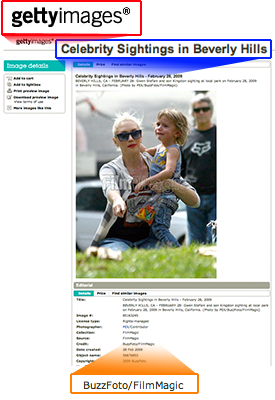
Ok, with that established, I'll encourage you to head over to Paul Melcher's blog (here) and look at several of his examples of paparazzi candid photography that Getty has. As we wrote here - Getty Images And Paparazzi Pictures (3/9/09), Getty's site is replete with images that are paparazzi images, celebrities captured in unguarded moments, intrusive actions by photographers to get "the picture", and so on. At right is a previous example of a paparazzi image that Getty Images had on their website - in other words, this image is proof positive that Getty Images is in the business of profiting from paparazzi images, whether or not they shot them, but their photographers do shoot them as well.

With all of this, the question about JDK's World and what increasingly seems to be some form of an altered reality arises. The proof is on his own website, so is Jonathan Klein just delusional because he doesn't peruse his own content? Or, is Jonathan Klein trying to deceive the public so they think that Getty Images is pure as the driven snow? Or, is Jonathan Klein telling a bold-faced lie with a straight face? Without knowing if he looks at his own content, which, arguably is in the tens of thousands of images in any given day, there is a fraction of a chance he doesn't know and thus, can't be lying, but then what does that say about his knowledge of the business he co-founded?

Related:

Please post your comments by clicking the link below. If you've got questions, please pose them in our Photo Business Forum Flickr Group Discussion Threads.


[More: Full Post and Comments]
Older Posts