Thursday, September 18, 2008

Zen and the Art of Photography

A lot goes into that first call. Not the call you make, but the call you earn. Before your phone rang, lots of things had to happen - the client had to decide they needed a photographer, and where there's an ad agency, PR firm, or design firm involved, they had to convince their client they needed photography. Then, they had to decide on candidates for the assignment.

And that's where you come in.

(Continued after the Jump)

There are five stages that your clients go through during the entire process:
1. Anticipation
2. Trepidation
3. Inspection
4. Fulfillment
5. Evaluation
Lets look at those closer.


Anticipation:
A prospective client is anticipating that you can deliver, based upon your marketing materials - portfolio, website, business card, presentation in person, phone skills, and the appearance of your contract. Based upon this, they book you.

Trepidation:
Depending upon how you did in the Anticipation phase, the degree of trepidation can vary. Were you a yellow pages or search-engine find, a referral from a trusted source, or had they used you in the past? Even so, there is a period where the client is worried about the quality of the end result, even when you are a repeat vendor for them.

Inspection:
During the shot, and afterwards, they look through your results, contemplating the circumstances that went into the shoot, and thus, the results. Was it a rainy day when the shoot called for blue skies, but you had to shoot anyway? Was the model late? Were the VIP's that were the cornerstone of the event absent, and so the client-handshaking with a VIP is missing from the event images? Or, did everything go smoothly, and the client has the highest of expectations after the fact relative to their expectations beforehand?

Fulfillment:
Did you deliver as promised? Are they satisfied with the results? Is their client satisfied with the results? Did what you do meet - or better yet - exceed expectations? You should always strive for a "that photographer sure exceeded my expecations" response. You need to win over even the most critical of clients, so they may become your staunchest advocates.

Evaluation:
Would they hire you again? Would they casually recommend you to a colleague? Would they enthusiastically recommend you to a colleague? Or, in the best of scenarios, without provocation, would they go onto their listserv and shout your name from the treetops "...boy, I just finished this shoot with John Harrington, and if you ever need a photographer, he should be on the top of your list of people to call..." ? Wouldn't it be great to have an evangelist like that? They do exist. Have you experienced it yet?

Take a piece of paper, and print out those five words, and place them in a prominent place near your desk. By understanding the phases of a client experience, you can ensure that you are firing on all cylinders and meeting and exceeding expectations in each phase.

Please post your comments by clicking the link below. If you've got questions, please pose them in our Photo Business Forum Flickr Group Discussion Threads.


[More: Full Post and Comments]

Wednesday, September 17, 2008

On Jill Greenberg - "I don’t think what she did was wrong"

I read, every day, Leslie Burns-Dell Acqua's blog - Burns Auto Parts. Leslie, a consultant that helps photographers market themselves and grow their businesses, has a lot of good advice, and she and I traveled the country as a part of the ASMP Strictly Business 2 seminar series, and I think she gave good advice.

When Leslie wrote:

  • "Ms. Greenberg is entirely clean in this"
  • "Ms. Greenberg more than fulfilled her obligations to her client. I don’t have a problem with her making her own art on the side. As for how she has handled the press herself, I really don’t think that matters too much. She will be, at most, a blip in this election"
  • "the act itself, I don’t think it’s half as bad as some think"
  • "Read what I have written again–I have said that I don’t think what she did was wrong"

I thought that Leslie had gone off her rocker.
(Continued after the Jump)

Please read Leslie's posts - IN FULL - Greenberg; and when people began critisizing her position, penned "What I Represent"; and then again today "Creative Freedom". While she makes some relevant points in there, she maintains her positions on Greenberg - it seems.

Daryl Lang over at PDN, in his piece "Fallout From Jill Greenberg's McCain Images" asked "Who wants to come to Greenberg's defense?", and I doubt you'll get any takers, save for Leslie - and she's narrowed her defense and isn't wholly defending everything Greenberg has done. The extent to which I would defend Greenberg would be to say she had a right to make two setups, and license that image separately from her Atlantic work, provided it's within the parameters of the contract she signed. yet, that's where my defense ends. As I said in my first piece - "one for thee, one for me", is often the way a photographer tries out new styles, but that wasn't what Greenberg was doing. She appears to have had malice and forethought in her actions - and didn't leave it at that - she appears to have had malice and forethought in her statements to the press not only of McCain, but of her client.

I can't square all that with the position that Leslie has taken, and is maintaining - "I don’t think what she did was wrong."

What do you think?

Please post your comments by clicking the link below. If you've got questions, please pose them in our Photo Business Forum Flickr Group Discussion Threads.


[More: Full Post and Comments]

Tuesday, September 16, 2008

Know Your Dusters

Today, I am on assignment in New Orleans, and after the scout and with some down time, we found ourselves wandering the Canal Street Mall. Not much to see. In fact, it looks like every other mall in America - a Saks, movie theater, Kenneth Cole, and, yes, a Brooks Brothers.

So, looking to kill some time, I walked in, and asked if they had something close to a duster.

(Continued after the Jump)

The sales clerk - was a well dressed young man, early to mid-30's. He walked us to and fro, showing me things that clearly were nowhere near a duster. I was, you see, looking for something that wasn't a trench coat, and also not a sports coat, but something in-between both length-wise and weight wise. The clerk in this fine mens' clothing store, kept showing me the wrong things. So I, and my first assistant left.

It was a few moments later, that my second assistant, who was outside on a call, came looking for us (we had left to wander aimlessly), and overheard the clerk who had been assisting us, asking his colleague "what's a duster?" And, the colleague gave him the answer, as was reported to me when she caught up to us elsewhere in the mall.

I was shocked. Honestly. It wasn't like I had walked into a TJ Maxx, or a Marshalls, and asked for a duster. I walked into a store that specialized in fine mens' clothing (and outdoor clothing as well). Who sells all sorts of books about the nuances and details of mens' clothing. And this clerk didn't know what I was talking about. Nor did he ask me what one was - he just acted like he did as he walked me back and forth the length of the store several times.

There is a lesson in here.

You too must know your product and service - photography. Backwards and forwards. Do you know what circles of confusion are? Why an 85mm f1.2 looks better at f4 than an 85mm f2.8 at the same aperture? Do you know what flash duration is? What about Scheimpflug? Ok, let's try something easier - what is the color temperature of Tungsten? What about guide numbers? How are they calculated?

Ok - a little too bookworm-ish?

When a client says they want a "high key" image - do you get it?

When a client says we pay "2/10 net 30 are you ok with that?" What will be the impact to you on a $500 invoice? a $9,800 invoice? (and show your work.)

When a client asks if you have a COI, what do you answer?

There is a lot to learn, and the truly wise man knows he knows nothing. Yet, I am not asking you to cite Newton's Law, Einstein's Theory, or even Murphy's law. I am asking you questions about the nuances and details of your profession. Knowing these things can define you as a true professional, a craftsman. Not these answers alone, of course, but they do contribute to the overall benefit and knowledge-base you bring to a shoot, and how your value is established.

Please post your comments by clicking the link below. If you've got questions, please pose them in our Photo Business Forum Flickr Group Discussion Threads.


[More: Full Post and Comments]

Business Week - Stickiness

Previously, I wrote about the value of the Jack & Suzy Welch Column in BusinessWeek - Diversification and A Variety of Clients, (2/11/07), and this week's mail brought in another gem by them - The Importance of Being Sticky. In the column, they talk about many of the points that Malcolm Gladwell goes into in the book that's on my book list at the right - The Tipping Point.

So, how does a job that generates $1,000 in revenue produce $30,000+ in revenue?

(Continued after the Jump)

Simple - stickiness. That is - you being sticky in the clients' mind, and being the first person they think of when they think they need a photographer. Over time, that client, with their repeat business, will earn you so much more than just that one job. And, conversely, losing that client will also cost you that much over your career.

It takes time and energy to earn a client. Building a track record with them, ensuring that they are well attended to, and so forth. I touched on this a bit on "The X Factor" (9/9/08), but Jack and Suzy do a nice job of hitting the point home:
  • "Perhaps, not surprisingly is good old-fashioned service. What is surprising, however, is how exceptional and inventive customer service needs to be to stand out these days."
  • "Almost all companies can create stickiness by sharing knowhow."
  • "Organizations must come to see the world through customers' eyes."
I was having this conversation with a colleague the other day. It used to be that if you could use a manual focus lens to follow-focus a pro football player running towards you in the field, you could be the biggest jerk in the world, and still get work. If you could do that and adjust exposure as he transitioned from shadow to sunlight, you could be a total jackass, and still get work. And, if you could do it using slide film, you could even skip showers and smell like a homeless man for a week and still, your phone would ring.

Those times, thankfully, are gone. Those photographers, either on disability, retired, or they have literally cleaned up their act. As making images becomes technically easier, it will have to be things like creativity and customer service that keeps them coming back, and things like a daily shower will (thankfully) be a given.


Please post your comments by clicking the link below. If you've got questions, please pose them in our Photo Business Forum Flickr Group Discussion Threads.


[More: Full Post and Comments]

Monday, September 15, 2008

ASMP, Orphan Works, And Agendas

As Orphan Works is set to die this session of Congress, it is time for creatives to re-group, and consider our strategies, alternatives, and with whom we may align ourselves when it rears its ugly head next session of Congress, that begins in January. More importantly, we need to know who we can trust for advice and counsel.

ASMP has, for a very long time, done many good deeds for photographers, and I in large part, support what they're doing and continue to do so. Yet, as we all love Apple Computer and the wonderful things they do, we still are upset with them over their $14m they had to pay in settlement of their back-dating of their stock options. So too, I (and many others) are fans of ASMP, but are concerned about the issues I'll outline below. Thus, it is of value to open these concerns up for discussion and debate. I am of the opinion that there needs to be much more transparency in what ASMP is doing - towards and with its' members, and their communications with the community as a whole.

One of the things that I have problems with, is impropriety. Another, is even the appearance of impropriety. And, when ASMP came out and were vocal in their SUPPORT of the House version of the proposed Orphan Works legislation, the news of that caught me off guard. In fact, it threw me for a loop. Why, would they do that? Why not take a position of neutrality? What was their motivation?

Their stated motivation was that if we didn’t accept the current version, next session’s version was going to be worse. They argued, that it was the best we could hope for. Then, during my discourse with ASMP’s General Counsel Vic Perlman on stage during the Microsoft Pro Photo Summit, I outlined a few of the big problems I had with the version that ASMP said couldn’t get better. Then, Vic spoke, and said that a number of my concerns would be resolved during the next markup.

Come again?

The version you said couldn’t get better, and thus must be supported, now is better, somehow?

Yet, ASMP continued to support a bill that every other creative trade organization either was against, or neutral on. How could this be? Why?
--------
Editorial Note: We provided ASMP with an advance copy of this article just under a week ago, for the purpose of their providing an adjacent response to these concerns. Their response follows at the end of this article.

(Continued, with ASMP's response, after the Jump)

ASMP’s reputation, in my mind, was tarnished a bit this Summer when it came out that they had not only received a $1.3 million windfall of revenue paid on the backs of artists’ copyright licensing income but that the only reason they revealed it was because of a pending news article by Photo District News. This was, to me, at least an appearance of impropriety. This windfall of revenue came about right during the time that ASMP was making the case for a higher dues to it’s members. The argument they made was that the windfall couldn’t be used for organizational purposes, but for efforts that benefited all photographers, ASMP member or not. This would include, for example, educational programming that was open to all comers, and which ASMP has been trying to make an increased effort to produce. However,, as ASMP’s annual budget includes funding for educational programs and other activities that will now be funded instead by the windfall, it would seem that the basis for the dues increase no longer exists. For this reason it is troubling that asmp quietly received, deposited and held these funds for many months, while at the same time pleading poverty to its membership. Seeking a dues increase from financially stressed professional photographers while sitting on a giant pile of money just doesn’t seem right.

A month or so back, I wrote about UPDIG – an ad hoc group of photographic organizations. (UPDIG - Why It Is Important, 7/19/08) Yet, it seems that ASMP’s position has changed on UPDIG. At first, they were a member of the ad-hoc consortium, then they took the position that UPDIG isn’t a working group, it’s just a paper, a report.

And the answers are not yet forthcoming, about why ASMP would take a position so contrary to photographers’ best interests in supporting Orphan Works.

Then it came to me.

ASMP submitted a request for funding to the Library of Congress:

“Request for Funding Under the Preserving Creative America: Digital Content in the Private Sector program, The Library of Congress”


In it, they essentially wipe out of existence every other organization that participated in the UPDIG group, when they wrote in the request:
“The American Society of Media Photographers' (ASMP) Digital Standards Committee has developed and released a set of best practice guidelines for digital photography, the Universal Photographic Digital Imaging Guidelines (UPDIG).”
Really? ASMP did that wholly on their own? According to the ASMP website
“This project is building upon the Universal Photographic Digital Imaging Guidelines (UPDIG) developed and maintained by the UPDIG Coalition, a group of representatives of the signatories to UPDIG. UPDIG is a worldwide consortium of digital-imaging professionals, trade groups, and manufacturers dedicated to the development of standards for commercial digital photography”
, and the UPDIG.org website – “The Member Associations of UPDIG Welcome You” followed by a list of them all.
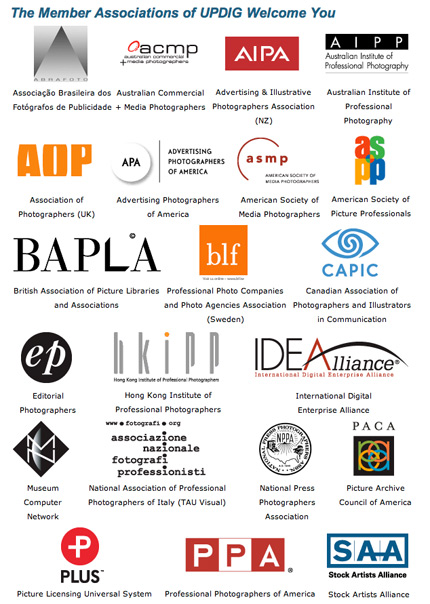

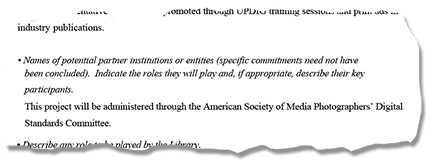
Again, the appearance of impropriety turns up. In this instance, that the ASMP has taken a position that the work product of the collective group of UPDIG is wholly their own, may place them in legal peril of having to share the award with the other organizations who also contributed to the guidelines, and who will surely contribute to future evolutions of the guidelines. No where do they refer to any other partner organizations:

Then, I hit a full-stop when I read the following part of the original request:
Proposal:
The purpose of this project will be to expand the UPDIG standards with the goal of determining and developing refined production workflows, archiving methods, and best practice guidelines for digital photography based on image usage and capture methods.

Included will be an examination of the following:
  • Current methods of archiving digital photographs.
  • The compatibility of various RAW and digital photographic software and their ability to read, write, and preserve digital photographs and their associated metadata.
  • The advantages and disadvantages of various consumer and professional digital asset management applications.
  • The advantages and disadvantages of different professional digital camera systems including capture formats, raw file processors and storage methods for digital photographic assets.
  • The capacity of these workflows to work within studio and location photography environments.
These revised and expanded UPDIG guidelines will be published as a website open to the public. The adoption of the guidelines will be promoted to the public through programming at industry trade shows and a nationwide series of training events at ASMP chapters, trade shows, and educational institutions.

Additionally, this project will work towards the development of an online national copyright registry of digital images which will be integrated as part of UPDIG workflows. The copyright registry will be established via a series of meetings with the U.S. Copyright Office and industry representatives, and will be promoted through UPDIG training sessions and print ads in industry publications.”
Come again? ASMP, in it’s proposal for funding, states they will establish a registry? A registry that is a part of the bill in Congress they are promoting heavily? In fact, ASMP, and PPA asked all other trade associations to allow ASMP to speak on their behalf in extended closed door negotiations with legislators and with the proponents of orphan works legislation. All other organizations were shut out of the process and were thus kept unaware of the proposals and compromises made by ASMP, in negotiating the resulting legislation.

The proposal concludes with the timeline – Development of an online copyright registry will take place throughout the project timeline, with one year devoted to negotiation and meetings with the US Copyright Office and selected industry representatives and 2 years of aggressive promotion of the registration program in various industry journals and periodicals.

(note: coloring of text red added for emphasis)

Yet, how is it that this language (the language regarding a registry) is missing from the proposal that ASMP is circulating to other UPDIG members when they ask for a copy? (http://www.asmp.org/pdfs/NDIIPProposal.pdf) It is also missing from what they provided to their own board. We have learned that the Library of Congress’ feedback to the ASMP was that they would not, or more likely, could not, participate in funding the registry that ASMP proposed. Thus, the proposal was granted, without funding for the registry.

Here’s the language that ASMP is got funding for (it's a part of the full document, linked above):
Proposal:
The purpose of this project will be to expand the UPDIG standards with the goal
of determining and developing refined production workflows, archiving methods, and best practice guidelines for digital photography based on image usage and capture methods.

Included will be an examination of the following
  • Current methods of archiving digital photographs
  • The compatibility of various RAW and digital photographic software and their ability to read, write, and preserve digital photographs and their associated metadata.
  • The advantages and disadvantages of various consumer and professional digital asset management applications.
  • The advantages and disadvantages of different professional digital camera systems including capture formats, raw file processors and storage methods for digital photographic assets.
  • The capacity of these workflows to work within studio and location photography environments.
These revised and expanded UPDIG guidelines will be published as a website open to the public. The adoption of the guidelines will be promoted to the public through programming at industry trade shows and a nationwide series of training events at ASMP chapters, trade shows, and educational institutions.
This is the language that has been delivered to members of the ASMP Board, and, I am told, begrudgingly to ASMP’s fellow UPDIG members. It seems to me that the UPDIG group should be getting this grant revenue? But how much?

Apparently, reports to the ASMP board of these discrepancies, as well as the monies involved, has redacted the amounts. Yet, we have received those amounts, which involve mostly ASMP’s “in kind” contribution of time for hours worked.

Their response in their request:
Project budget estimate and relative share of project costs among project participants to include the Library of Congress, if applicable.


Lists the following:

Funding:

from NDIIPP

ASMP & In Kind

UPDIG Research: Software

$20,000


UPDIG Research: Hardware (Up-to-date computer systems, monitors, hard drives,

peripherals, etc.)

$20,000


UPDIG Research: Labor

12,000 hours @ $60/hour ($40/hour in kind)

$240,000

$480,000 in kind

Administrative Offices & Time


$20,000 in kind

Travel

$30,000


Final UPDIG Website Design & Hosting

$10,000


Copyright Registration Effort (3 face-to-face meetings with the Copyright Office and industry

reps. Approximately $1,100 per person, per meeting)

$12,000


Promotion: Copyright Registration Effort and Registry development

(Print ad development, artwork, and space)

$50,000

$50,000

Promotion: UPDIG booth at PhotoPlus 2007 & 2008 (Booth, artwork for booth, promotional items, travel expenses for 2 people for 4 days)

$20,000


Education & Training:

10 day & 10 evening events

($3,500/evening, $4,500/day)

$80,000


TOTAL BUDGET

$482,000

$550,000


Total request for funding from NDIIPP

$482,000


Take special note of the lines about the Orphan Works/Registry:

Copyright Registration Effort (3 face-to-face meetings with the Copyright Office and industry reps. Approximately $1,100 per person, per meeting)

$12,000

Promotion: Copyright Registration Effort and Registry development

(Print ad development, artwork, and space)

$50,000

$50,000


What remains to be learned, is why then, since ASMP couldn’t use their $1.3million windfall for the organization directly, why they didn’t use it to benefit all photographers, by, say, properly fighting Orphan Works? It can only be hoped that they will do so next session, unless they remain committed to using it for a registry for all photographers, since the Library of Congress award can’t fund that.

As we lick our wounds during the sunset of this second round of the ongoing Orphan Works battle, we must look carefully at our allies and those who may have ulterior motives. I am having a really hard time figuring out which side of that equation ASMP falls on, given it’s track record on this issue in recent months. Moving forward, transparency of their actions and plans will go a long way towards clearing the air with those leery of ASMP's plans and efforts on the three points I've highlighted.


ASMP Responds:

ASMP appreciates the opportunity to respond.
The basic points are listed below. More detailed information can be found at www.asmp.org/thefacts This link will be active by 10am Monday, September 15th.

Regarding an image registry - ASMP has no intention of building an image registry. The idea to develop an UPDIG Workflow that would feed into a searchable image registry was part of the original proposal made in late 2006 as an effort to promote copyright registration and facilitate Orphan Works identification. The Library of Congress chose not to fund this effort and it was removed from the accepted proposal in March of 2007. Orphan Works legislation was introduced on May 10, 2008. ASMP has consistently referred proposals of a registry to the PLUS Coalition (www.useplus.org)

Regarding Orphan Works – ASMP is an opponent of the Senate Orphan Works Bill and considers the current House version supportable because of its additional protections afforded photographers. Any changes in the current version will dictate a reappraisal of our position. Go to www.asmp.org/orphanworks for more information.

Regarding the Authors Coalition – The use of this escrowed distribution is legally restricted to advocacy and education for the benefit of the wider industry. The ASMP board of directors is currently examining potential uses. Your input and suggestions are welcomed at suggestions@asmp.org. To read the press release go to www.asmp.org/news/press.

Regarding UPDIG – The final award submission and press release are on the ASMP Web site at www.asmp.org/pdi. There is no reference to an image registry in the ASMP/PDI proposal accepted by the Library of Congress.


Your turn. What do you think about the transparency issue? Did ASMP address or resolve the concerns outlined in the initial piece? Please comment below, and review the links that ASMP has provided in their response before formulating an opinion or making a comment.


Please post your comments by clicking the link below. If you've got questions, please pose them in our Photo Business Forum Flickr Group Discussion Threads.


[More: Full Post and Comments]

Friday, September 12, 2008

UPDATED: Jill Greenberg: Open Mouth, Insert Foot

Jill Greenberg makes some pretty interesting pictures, to be sure. Yet, if she wanted to commit professional suicide by slamming her clients, she should have just kept mum. In the David Walker's PDN Piece How Jill Greenberg Really Feels About John McCain (9/12/08), Greenburg is reported by PDN to have "rubbed her hands with glee" at the prospect of a portrait session of John McCain, since she's a hardcore Democrat.

Greenberg followed the "one for thee, one for me" approach, shooting her trademark style (see cover above), and then setting up (literally) McCain in another lighting setup (see the PDN piece for that image). PDN quotes her as saying

"He had no idea he was being lit from below,” Greenberg says. And his handlers didn’t seem to notice it either. “I guess they’re not very sophisticated,” she adds.
I say "Damn, she's not very bright to be admitting that. Good luck with your future high-profile portrait subjects who will now look at you with skeptical and critical eyes, Democrat OR Republican, since you're bringing your agenda to the shoots you do."

Here's where I bristled at what she had to say:
(Continued after the Jump)

Given her strong feelings about John McCain, we asked whether she had any reservations about taking the assignment in the first place...“I didn’t,” she says. ...Some of my artwork has been pretty anti-Bush, so maybe it was somewhat irresponsible for them [The Atlantic] to hire me.”
Really? Are you really that dense that you would call your client "irresponsible"? What were you thinking? Surely, not that the Atlantic, or that art director wherever they end up, or other art directors who will be concerned about the activist approach you bring to your work, will hire you again.

Next time, you might want to follow the "engage brain, THEN engage mouth" approach. Oh, and good luck on that audit.


UPDATE:
Greenberg's client has weighed in (via the New York Post):
"We stand by the picture we are running on our cover," said Atlantic editor James Bennet. "We feel it's a respectful portrait. We hope we'll be judged by that picture."

But Bennet was appalled by Greenberg saying she tried to portray McCain in an unflattering way.

"We feel totally blind-sided," he said. "Her behavior is outrageous. Incredibly unprofessional."
More images and commentary: Out-Takes: Behind The Atlantic's McCain Cover

The author of the story weighs in here:
"I don't know Greenberg (I count this as a blessing) and I can add nothing to what James Bennet told the Post except to say that Greenberg is quite obviously an indecent person who should not be working in magazine journalism. Every so often, journalists become deranged at the sight of certain candidates, and lose their bearings. Why, this has even happened in the case of John McCain once or twice. What I find truly astonishing is the blithe way in which she has tried to hurt this magazine."
And the PR Agency for the magazine issued yet another statement by the editor:
We were not aware of the manipulated and dishonest images Jill Greenberg had taken until this past Friday.

When we contract with photographers for portraits, we don't vet them for their politics--instead, we assess their professional track records. Based on the portraits she had done of politicians like Arnold Schwarzenegger and her work for publications like Time, Wired, and Portfolio, we expected Jill Greenberg, like the other photographers we work with, to behave professionally.

Jill Greenberg has obviously not done that. She has, in fact, disgraced herself, and we are appalled by the manipulated images she has created for her Web site of John McCain.”


RELATED: On Jill Greenberg - "I don’t think what she did was wrong"


Please post your comments by clicking the link below. If you've got questions, please pose them in our Photo Business Forum Flickr Group Discussion Threads.


[More: Full Post and Comments]

Thursday, September 11, 2008

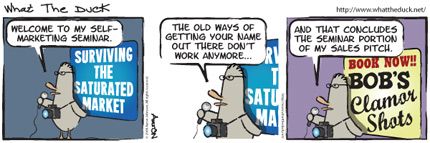
Is Your Seminar Really A Sales Pitch?

Aaron over at What The Duck is spot-on here. I can't tell you how many programs I've PAID to attend that become 55 minutes sales pitch, 5 minutes useful information.

Now, I'm not saying that if I wasn't already going to use the product, the 55 minutes of demonstrating how great the product (or service) is, but when a program is billed as "Learn how to retouch" and then the entire session is a sales pitch for a set of photoshop actions, or a program is billed as "learn how to light" and the entire program is a sales pitch for a brand of lights, that's just plain wrong.

More than once I've attended organizational chapter meetings where it was a sales pitch for a lab, when it was supposed to be about how to color manage, or it was supposed to be how to develop a great website and it ended up being "here's how great our website service is".

Be darn sure you know who is presenting, and who they may be schilling for. The common refrain "know before you go" applies here.

(Comments, if any, after the Jump)


Please post your comments by clicking the link below. If you've got questions, please pose them in our Photo Business Forum Flickr Group Discussion Threads.


[More: Full Post and Comments]

BREAKING: PhotoShelter Collection To Shut Down October 10th

As the sun rises on the West Coast, the news is not good - PhotoShelter, in an effort to sustain their PhotoShelter Personal Archive is closing the PhotoShelter Collection October 10th, according to sources. They will be making a formal annoucement shortly with an expanded explanation about PhotoShelter's plans moving forward.

(Continued after the Jump)
This impending announcement comes on the heals of a rough industry situation as both Getty Images and Jupiter Images are suffering losses, and the promotion of all-you-can-eat subscription models that are squeezing every bit of profit out of the market. PhotoShelter has always championed the interests of photographers - seeking to be an advocate and a true representative (that is - looking out for the best interests of those they were representing) and when it came to pass that a change in the business model (i.e. a higher percentage to PSC, or a lowering of per-image pricing to compete with Getty/et al) was the solution, PhotoShelter opted to close the Collection rather than act to diminish their service to photographers.

This shuttering of a division of PhotoShelter Inc, will have no effect on their monthly PhotoShelter Personal Archive, which I use on a regular basis to service my clients and I think is the client-image-delivery-platform of the future, as the concept of shipping CD's to clients becomes an antiquated one. In fact, with more time on their hands, they will be able to be more focused on growing that product, which is, according to sources, a key part of their plans moving forward.

More information as we get it.
-------
Update: Official statement here.


Please post your comments by clicking the link below. If you've got questions, please pose them in our Photo Business Forum Flickr Group Discussion Threads.


[More: Full Post and Comments]

Wednesday, September 10, 2008

ASMP - Creating Chaos? (It's A Good Thing)

With the historic Presidential election less than 60 days away, you can expect there will be a great deal of chaos and consternation in the great state of Florida come election day. Will there be more hanging chads? More recounts? Who knows.

One thing though, is for certain, before the real chaos begins, there will be some creative chaos happening in the sunshine state - thanks to the ASMP Central Florida chapter and a whole host of sponsors - from AdWeek to Emma email marketing, Mac Papers, to LexJet. But it's not just about photography, it's about video, printing, and so forth.

In the line-up are ASMP national speakers Peter Krogh and Blake Discher, talking about the newly evolved workflows/image storage and search-engine-optimization respectively. (I don't need Florida SEO - check this link to see who's listed first for Miami Photographer). But if you do, and I'm betting you do, Blake will tell you all about it. So, if you're not planning to fly to chilly New York City a few days later for PhotoPlus Expo, (Blake's Is Your Web Site Doing All It Can to May Your Money?", or Peter's Practical Image Storage) heading to sunny South Florida will be your best bet to catch these programs that will earn you more money (i.e. more assignments, thus more money), and save your sanity (i.e. redundant safe storage equals piece of mind).

(Continued after the Jump)

This is a collaborative conference - check out the other aspects of it:
  • The Pixel Conference – The Photoshop Conference for Designers...The Pixel Conference only focuses on the issues/topics that pertain to designers!
  • The Web Design Conference – What Designers Need to Know to Make It on the Web!
  • Motion Graphics Festival (MG Fest) is an innovative industry event showcasing creative motion picture design.
  • Create Chaos Job Fair - Brahn Awards & Events, producers of Create Chaos, has partnered with CreativeHeads.net to produce a best-in-class job fair...
  • Printing, Paper & Packaging Design Conference: This show is for designers, art directors and marketing professionals looking for new and creative solutions in the world of printing, paper and packaging.
  • STASH Theatre is a showcase of animation, VFX and motion graphics packed with outstanding commercials, broadcast design, branded content...
  • The Vector Conference – The how-to Illustrator and Flash conference!
Damn, what a confab! So check out the schedule, and make time for what your ASMP Central Florida has to offer!

Please post your comments by clicking the link below. If you've got questions, please pose them in our Photo Business Forum Flickr Group Discussion Threads.


[More: Full Post and Comments]

Tuesday, September 9, 2008

The X Factor

I was passing the time during a shoot doing my morning reading. After reading about the repeated screw-ups with Bloomberg over the inaccurate reporting of Steve Jobs' death, and the false reporting of the bankruptcy of United Airlines, I was making my way through my own blog roll, which includes Chase Jarvis' blog. Chase' piece for today is "What You Can't See Matters", and it's worth a read.

To that end

(Continued after the Jump)
I want to echo what Chase has written. I can't tell you the number of times that I got the job because I was easy-going, friendly, I deliver all the time on time, or some other matter totally unrelated to my creative vision, talent, technical expertise, and so forth. In other words, all those things that we worry about - "prime lens, or zoom"; "iso100 or 400 to get a smidge more depth of field"; "3200k or 2900k"?

The shoot I am on now, is a prime example. We have a client that needs (and is happy to pay the surcharge for) same day rush delivery of images. Someone prior to me lost them as a client because they failed to deliver when they said they would.

Previously, we wrote "Wise Words for your Client Dialog - When there's a problem or Question" about the importance of client communication and customer service, Awkward Moments, which continues the point about how to be more effective in your communications with clients.

On top of that, there's the client who came to you and then left for someone else, only to return. I call them the "Prodigal Client", and wrote about them here, and they're coming back for ease of interaction, oftentimes.

We also wrote - Collaborate or Suffer The Consequences - in response to Rob Haggart's A Photo Editor blog -

"just because you are a phenominal photographer, with a great style, doesn't mean clients will want to work with you. And, if you make it worse, you make it so that you can't take direction. This is a recipe for a lot of one-off clients, with little repeat business."

I also wrote - "If I said to you, after you botched a job, or just were laxadasical about your service/followup component of an assignment, that you would loose well over $10k, would you handle things differently?" in this article - Lost Income - Over the long term. And that is a cautionary tale about just how much losing a client will cost you over the life of your business.


Please post your comments by clicking the link below. If you've got questions, please pose them in our Photo Business Forum Flickr Group Discussion Threads.


[More: Full Post and Comments]
Newer Posts Older Posts