Tuesday, January 19, 2010

SpiderPic -How Stupid Can Photographers Be?

Let's get the upside out of the way here - SpiderPic is a great solution for the photo buyer, in the short term. SpiderPic is an aggregator that brings together search results across microstock sites, showing you your results, and in examples like at right, where there are identical images - which place has the best price. Paul Melcher, in his piece - A Microstock Price War? - has a good analysis of this service, and was where I first learned about it.

I have not delved deep into the ownership of SpiderPic, but what I have learned is that their revenue is from referrals to each of the microstock sites, where they take a piece of each transaction. Melcher is right - this will create a price war. Further, guess what - the loser will be - that's right - the photographer.

But how stupid can these photographers really be?

(Continued after the Jump)

If you are one of the many photographers who are selling the exact same image in different portals, at difference rates, for the same exact usage, then you need to re-think your common sense - not to mention your business sense.

Do I blame SpiderPic for facilitating this? Yes, and no. First, they are just making it easier to do what someone previously had to do manually, and so, for that service, they get a piece. However, as creative budgets get slashed by these low prices, budgets will make it all but impossible to create fresh content for assignments, and that's bad long term.

Now all the microstock photographers can pile on here in the comments, with sentiments like "I just want to see my photo in print, who cares about the money..." and "...for some of us it's not about the money it's about the fame..." and other equally idiotic sentiments. go ahead and subsidize multi-national corporations and mega-corporation quarterly reports with your EOS Rebel or D90 photos. Some day, you'll tire of all the work and the market will be so flooded you'll lose interest. Go ahead - I'll wait.....that's right, patience is a virtue, and while I have more than I need of it, clearly one "virtue" of these microstockers is that they couldn't care less about the profession of photography as a sustainable endeavor. SpiderPic's results demonstrates just one more manifestation of that.


Please post your comments by clicking the link below. If you've got questions, please pose them in our Photo Business Forum Flickr Group Discussion Threads.

[More: Full Post and Comments]

Monday, January 18, 2010

Charitable Giving - Do's, Don'ts, And Cautions

Charitable Giving is a cornerstone of a compassionate citizenry. Yet, it's very important that you know what you can, and can't give, and how to best give.

First - legally, if you designate a specific disaster (for example, Haitian relief) the organization is obligated to spend those funds on Haiti only. Guess what? In a few weeks, there will be another disaster, and if the organization recieves an excess amount of funds earmarked for one disaster - so much so that they can't spend it (guess what - this happens a lot!) they can't transfer those funds to other needs, so don't earmark your donation for a specific incident, let the charity manage their funds as they best can.

Second - your time is NOT a tax-deductible donation. Even if you have an hourly rate of $100, or a rate for an assignment for a charity documentary project of $750 for each day you are doing that type of documentary work, you cannot donate your services and take a deduction for that. If you incur airfare/hotel/food/shooting expenses during the trip, those you can deduct. (For more information on what is, and is NOT deductible, check out IRS Publication 526 - page 6 is where is says "You cannot deduct as a charitable contribution - 4. The value of your time or services,...")

(Continued after the Jump)

Third - make sure your donation is to a true charitable organization, and check them out! For example, making a donation to the Government of Haiti is NOT a tax deductible donation! Further, while everyone from the First Lady to Price Club are encouraging you to donate to the Red Cross, here are a few facts about them you should be aware of:
Red Faces At The Red Cross - In the hours after the Sept. 11 attacks, a record-breaking amount of donations started pouring into more than 1,000 local American Red Cross chapters. What donors didn't know was that some of the chapters entrusted with all that money had been identified by Red Cross headquarters just a few weeks before for having poor accounting procedures, inaccurate financial reports and for keeping national disaster contributions that should have been sent to headquarters in Washington.

Red Cross defends handling of Sept. 11 donations - "Don't confuse us with the 9/11 Fund in New York. Don't confuse us with Habitat for Humanity. Don't confuse us with the scholarship in New York for the victims. We have to get that out," [Healy] said. Controversy over the Liberty Fund was one reason Healy decided to resign at year's end.

Red Cross Blinks - The Red Cross had planned to use about half of the Liberty Fund to build up blood supplies and prepare for possible future terrorist attacks...The public responded with outrage to the disclosure that not all of the donated funds were being spent on victims of the attacks. "I donated money three times for the people directly affected by the attack on America, Sept. 11th. I did not donate money for the Red Cross to use as they wished.
It may be that your local church group, or a specific group, like the one photographer Cameron Davidson supports both with his time and money - The Community Coalition for Haiti, are a better destination for your donations. Just because everyone is championing one cause or another, doesn't mean you should take the easy path and do the same - figure out what you want to give, and how to best do it. Experts are saying that financial donations are best because if you, for example, donate bags of food or clothing, they may not only not be needed, but also, the costs to get them down there could be quite high.

It is important too, to realize that most people have a mindset of "I can give $x amount this year to charity..." and when they give that much, they don't give again for awhile. In the year after September 11, 2001, charitable organizations were reporting sharp drops in donations, because much of what people had planned to give to, say, research for a specific disease, or homelessness, was instead given to 9/11 charities. So, as you give for the current disaster - Haiti - remember your other charitable giving and don't make it an either/or - do both, if at all possible.

Please post your comments by clicking the link below. If you've got questions, please pose them in our Photo Business Forum Flickr Group Discussion Threads.


[More: Full Post and Comments]

Friday, January 15, 2010

Surprise! It's NOT All About The Pictures!

Over at Rob Haggart's A Photo Editor, his article - Good News In Photography - Points out something quite interesting, which I've re-arranged for the sake of discussion:

Here are other key points to why my business is growing:
NON-Photo/Creative Related:
  1. Easy To Work With
  2. Flexible
  3. Honesty
  4. Be Polite
  5. Marketing
  6. Surround Yourself With Good People
Creative-Related:
  1. People are really responding to my vision
  2. Being a true part of the creative process
  3. Personal projects


There's a lot more insight into each of those points in Rob's piece, but I want to make sure you understand that succeeding is often not about great photos, but about all manner of other things!
(Comments, if any, after the Jump)


Please post your comments by clicking the link below. If you've got questions, please pose them in our Photo Business Forum Flickr Group Discussion Threads.


[More: Full Post and Comments]

Monday, January 11, 2010

PhotoShelter - Advice For The AfterStaff Circumstance

The good folks over at PhotoShelter called the other day to ask what 10 things a current staffer should do to prepare for their inevitable "switch" to freelance, and also the 10 things a newfound freelancer from the "Staff World" should do, so I gave them a few ideas, contemplated after a long spell in the shower, and I encourage you to head over there to check them out -

THE 10 THINGS ALL STAFF PHOTOGRAPHERS
MUST DO RIGHT NOW

This advice applies if you are:

  1. A freelancer welcoming the former staffer now newfound freelancer into your community (help them and welcome them, dammit, don't be a selfish jerk)

  2. A staffer who thinks your staff job is safe (it's not - REALLY, IT'S NOT)

  3. A staffer who just was forcibly "switched" to freelance by your (now former) employer

  4. The spouse or partner of a freelancer who is now worried about healthcare, rent/mortgage, and small things like where the next meal is coming from, and wants to know how to kick their freelance spouse back into gear and out of their malaise, and otherwise help.


So, go read, and be enlightened, and be thoughtful - it's a good thing for your karma.
(Comments, if any, after the Jump)


Please post your comments by clicking the link below. If you've got questions, please pose them in our Photo Business Forum Flickr Group Discussion Threads.


[More: Full Post and Comments]

What's In a Picture? Apparently NOT Mr. Hero to "0"!

Gilbert Arenas, known by his jersey number "0" seems to have gone from hero to a REAL zero, and then (at least temporarily) non-existent. Arenas, after apparently breaking the law by not only possessing handguns in Washington DC, but, if some reports are to be believed, brandishing them, is, according to NBA Commissioner David Stern, "...not currently fit to take the court...", then while it would stand to reason that the NBA wouldn't want the bad publicity, why would Getty Images - take down the images? Getty's "editorial policy" (here) states, in part, "...Images illustrate and reflect the events of our world today and therefore have a responsibility to be delivered to the customer with accuracy and impartiality." If this, which is an obvious follow-on to the censoring of the images from the NBA brawl (more here where Getty Images surprisingly had no images to show of the brawl), doesn't demonstrate that Getty Images is, in many ways, NOT an impartial wire service, then I don't know what would. Getty co-mingles images from their commercial clients, and those that are truly editorial/independant, with seeming reckless abandon. Getty Images is a commercial conduit in almost all manner of speaking. Try calling the AP, Reuters, or AFP, and getting them to take down a photograph "because it makes us look bad". Wouldn't happen. The only way I've ever seen a true wire-service photo taken down was when it was demonstrated that the distribution of the photo was in violation of someone elses copyright (as with JonBenet Ramsey, here) or if the photo was manipulated, as with the Reuters "picture kill" (here).

(Continued after the Jump)

The New York Times (here) raises questions about this relationship, and rightly so. I have no problem with Getty being a conduit, but I do have a problem when their content is held out as independently as AP/Reuters/AFP/UPI/Bloomberg. In many cases, it's not.

As an aside, the image of Arenas (as seen in the NYT piece) seems to be a large part of what is responsible for Stern's suspension of Arenas, putting in jeopardy a $111,000,000 contract. Per game suspended, Arenas will lose $147,000 - that's a lot of money to lose over being a tough guy, seemingly full of himself but clearly not man enough to be able to defend his gambling positions with his own force alone, relying on the cowardly weapons that street thugs do. Yet, it is the power of a single photograph, capturing a few seconds of an interaction, that likely filled his cement shoes and sent Arenas packing.

Thus, the power of a photograph.

Please post your comments by clicking the link below. If you've got questions, please pose them in our Photo Business Forum Flickr Group Discussion Threads.


[More: Full Post and Comments]

Friday, January 8, 2010

Obama - Rights of Privacy and Publicity

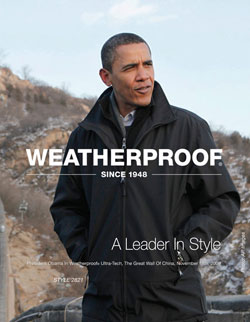
Much has been made of the controversy surrounding the use by PETA and the company Weatherproof of their use without permission of the likenesses of the First Lady and President respectively.

No less than The Washington Post (PETA latest to use an ad with an Obama without permission, 1/8/10) and The New York Times (Coat Maker Transforms Obama Photo Into Ad, 1/8/10) have weighed in on this, along with countless other news outlets, and blogs. The image at right is one in question, of the President in a Weatherproof jacket in China, in this case, what seems to be a catalog page, which is a part of the larger objection to the Times Square billboard, which you can see in context in the Washington Post and New York Times links above.

The law is pretty clear - in order to use someone's likeness in an advertisement/endorsement, you need their permission. Celebrities make untold millions leveraging their likeness for all manner of product, and that is good, right, and fair, since the corporations are profiting, why shouldn't the celebrity get a piece of that when they put their good name on a product or service? Not since prior to the dawn of the internet age have we had a President so primed to be used, given their heroic status. President Clinton was the last real candidate for these types of shenanigans, and the White House had to fend off more than one use, including the use of his likeness to promote a popular sub chain in the DC area - Jerry's Subs and Pizzas, which their Big Bubba sandwich. While the family of Martin Luther King was successful in the case of Martin Luther King, Jr., in the case Center for Social Change, Inc. v. American Heritage Products, Inc., 250 Ga. 135 (1982), it is, in large part, because MLK was a private citizen, and not a public official.

(Continued after the Jump)

Finance companies have used the President's image in video ads, and the President's voice has been used countless times in commercials on radio. Immediately following the Presidents inauguration, Bloomberg published a piece about White House efforts to quell the use of Obamas' likeness (White House Lawyers Look to Limit Commercial Use of President, 1/30/09) and they list a number of uses of the Presidents image and voice which are worth looking at. Of note is the suggestion that "Appropriation of a president’s face and voice, to a large degree, come with the territory, said Princeton University historian Fred Greenstein." Even the first daughters are not immune - when Ty - the makers of Beanie Babies came out with dolls with their names on them, and their names were evoked in ads looking to raise awareness for school lunch programs.

It is important to note that rights of publicity that would govern these issues is a matter of state law, and varies from state to state.

In point of fact, Shepard Fairey's original poster campaign of then Senator Obama, from which Fairey generated a great deal of revenue (which is has publicly stated he re-invested in other Obama-supporting efforts) did not have a release. While a single piece of art (or even a limited edition series) would likely not require a release, a poster campaign with tens of thousands of posters would. Perhaps when Fairey was later commissioned by the campaign to do a poster from a legally obtained image, that contract provided retroactive protections for the previous poster, or then again, perhaps not. However, picking and choosing which battles to fight can be problematic if a case goes to court.

In the end, even if the billboards come down, Weatherproof has gottten their moneys' worth out of the campaign.

Please post your comments by clicking the link below. If you've got questions, please pose them in our Photo Business Forum Flickr Group Discussion Threads.


[More: Full Post and Comments]

Jim Mathis School of Photography - Teaching Wrongs about Rights

It appears that Jim Mathis is teaching really bad business management skills if the message he is delivering to his students is that the price for an image should be the same whether it's a family down the street, or a multi-national corporation looking to use the image as the icon of its business for years.

In response to my November interview in Photo District News about establishing your pricing, Mathis wrote in here and suggested that his studios' establishment in 1973 and immediate price list publication somehow gives him some air of authority, when he says of me "His is the type of attitude I have been fighting for years." Really? Really! Really?

(Continued after the Jump)

Wrong-way Mathis then suggests that my methodology is that of "sizing up the ''schmuck' and charging whatever we think they will pay..." and the only thing more wrong than that opinion is how he uses a portrait of himself with a Nikon F in his article about "digital resolution", where he incorrectly states "In reality, a five-meg, or 5 million pixel camera, is about equal to 35mm film in resolution." No, Jim, that's impossible. The actual megapixel comparison is closer to 21 megapixels.

Fortunately for all, Mathis seems to be standing alone. PDN sought out two industry leaders for their thoughts. Susan Carr, past ASMP National President and current Education Director, wrote here "Pricing photography assignments cannot fit into a one-size-fits-all hourly or day rate system." Carr then goes on to provide several other worthwhile insights on this subject. Next PDN presents the learned thoughts of Jeff Sedlik, former National President of the Advertising Photographers of America, here. Sedlik suggests that some photographers "opt to spend their careers emulating plumbers". I suggest that Mathis has much to learn about his own business. Yes, being paid by the hour regardless of client type is really a day-laborer mindset best left for the picking fields.

Mathis touts his membership in the "International Photography Hall of Fame", on his website here and I submit that he should be the poster child for the International Hall of Photographic Shame for his really really bad photography advice.

Please post your comments by clicking the link below. If you've got questions, please pose them in our Photo Business Forum Flickr Group Discussion Threads.


[More: Full Post and Comments]

Wednesday, January 6, 2010

PETA, Michelle Obama, and Rights of Publicity

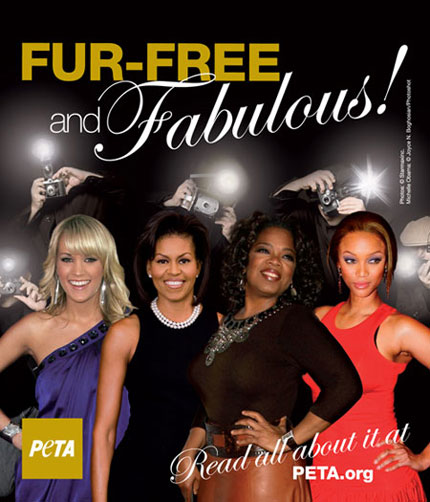
When does "saluting" women in an ad become an endorsement? When the anti-war groups used an image of Gen. Petraeus in their ad (here) being critical, was that fair to do without his permission? How about an and that is positive, saying "Fur-Free and Fabulous!" and directing people to the PETA website to "Read all about it"? It doesn't come across, per se, as an endorsement, however, it seems to come very close to crossing a line - but did it cross the line? ExtraTV reports here that the White House is upset about this.

Here's the ad:


PETA's President, Ingrid Newkirk is quoted as acknowledging they didn't get permission because they knew it couldn't be done, however said "the fact is that Michelle Obama has issued a statement indicating that she doesn't wear fur, and the world should know that in PETA's eyes, that makes her pretty fabulous."

What do you think?

(Comments, after the Jump)


Please post your comments by clicking the link below. If you've got questions, please pose them in our Photo Business Forum Flickr Group Discussion Threads.


[More: Full Post and Comments]

Monday, December 28, 2009

Privacy Rights, Cellphone Searches, and Photographers


What right of privacy do you have to your cell phone? Well, for starters, what about your rights when a search warrant is presented? Most search warrants read something like this:

You are therefore commanded to search:
The Premises and building known and designated as and commonly called:
1234 Main Street, Anytown USA, more specifically described as a brown single-story detached home.
including all rooms, attics, and other parts therein, garages, storage rooms, and outbuildings used in connection with the premises or located thereon and in any receptacle or safe therein;
What's missing from this?

Why, it's items on your person - including things like your cell phone, camera and/or camera bag, briefcase, or backpack, provided of course, that they are on your person.

Thus, a separate warrant, or, more than likely, a warrant that includes what is called a "container search" would need to be included as a part of the warrant. There is a "physical possession test" and a "relationship test" that are applied to ascertain the constitutionality of a container search (more here in PDF form).

Ok, so how is this news, and how does it apply to photographers?
(Continued after the Jump)

It's news because, at least in Ohio, it has just been reported that cell phones cannot be searched without a warrant, according to the states' highest court. The court stated that cell phones are "capable of storing a wealth of digitized information" and therefore they should be considered private. The New York Times writes on it here, and here is the PDF of the ruling.

How about photographers? Well, it is often reported that photographers have had their cameras seized, and either files have been reviewed and then deleted (not only easily provable, but also easily recoverable) and this ruling could be - with little effort - carried over to the privacy of digital cameras, whether or not there is a first amendment issue in play. Carlos Miller writes on his blog Photography Is Not A Crime (here) about the legality of seizing your camera, with an interesting perspective. Miller has been in an ongoing legal battle with the Miami police since 2007 over his rights on this subject. Miller does a great job of summarizing the past year today in his post - 2009: The Photography is Not a Crime year in review. There there was this video where the LA police threaten to submit a photographer's name to the FBI "hit list."

It is, however, important to note that our first amendment rights and our fourth amendment rights, while guaranteed under the constitution, may not necessarily be top-of-mind for those hoping to usurp those rights, even while wearing a badge. Now would be a good time for you, dear reader, to take a few minutes, and not only get the name and both regular and emergency contact numbers for a good first amendment-savvy attorney, but also to put those numbers into your cell phone - the one that's now decreed (at least in Ohio) as private, but also give to someone you might have to call should someone in law enforcement attempt to trample on your rights.

Here's a reminder - that badge they are wearing is what requires them to protect you while protecting others - and that includes protecting you and ALL your rights, including those guaranteed under the 1st and 4th amendments. If you are a staff photographer, be sure you have not just your photo desks' phone number programmed in, but that of your organizations' legal team too. Doing so could well limit your time in a holding cell.


Please post your comments by clicking the link below. If you've got questions, please pose them in our Photo Business Forum Flickr Group Discussion Threads.


[More: Full Post and Comments]

Thursday, December 24, 2009

Twas The Night Before Christmas

Twas the night before Christmas, and all through the house,
not a client was stirring, not even to grouse.

The CDs were burned and shipped with consideration,
in hopes that the photos would earn remuneration.

The staff they were nestled all snug in their homes,
with visions of days off, reading their tomes.
and I wearing both the kerchief and chaps,
had just settled down to write about business mishaps.

When out in the studio there arose such a clatter,
I sprung from my desk to see what was the matter.
Up the stairs that I took, two at a time,
I arrived in the studio with a curious find.

When what to my wondering eyes should appear,
but a colleague with keys and access so clear.
A studio strewn with clothes near and far,
and this colleague, why, they were shooting boudoir!

Boudoir in my studio, it just can't be,
I thought in my head as I looked on intently.
This studio is for food, and head-shots and such,
but I guess with that figure I don't mind very much.

The subject was beautiful, in their own very way,
and the scene quite professional, I certainly must say.
Nothing tawdry or lewd, just art being made,
the capturing of beauty before age makes it fade.

I thought of the scenes of products that sell,
that had been previously shot there, and shot quite well.
Yet nothing compares to the body, the form,
and the expression of a face, looking forlorn.

The focus was true, the light was just right,
the drive of my colleague was set to for a full night.
I knew that the work was not to diminish,
so I left my studio so the colleague could finish.

I considered my art, my creative fruitions,
yet my skills were lacking, I didn't know those positions.
I knew that some art was best left to others,
even if I had my own chaps, and my own druthers.

Late in the night, almost the morning,
I knew they were working on nothing boring.
As the sun rose, on the next day,
I decided there was little else I could say.

Yet an urge called for me, to say something,
as they packed up their props and their holiday bunting.
and all that there was that I think there to say,
I said to the colleague - "have a great day!"

You see, it's the truth, photography is art,
your present this Christmas day should be to give it a start.
Whether food or people, weddings or news,
Not following your passion could give you the blues.

So make tomorrow your day to begin,
not following your passion I think is a sin.
Yet focus on its' business all throughout,
and your spouse will have no reason to pout.

For you see it remains a reality you shouldn't flounce,
that your bills must be paid, or your checks they will bounce.
The business of art, it can be quite fickle,
but be careful or you'll get caught in a pickle.

(Continued after the Jump)


- With apologies to Clement Clarke Moore (the original author of Twas the Night Before Christmas), and to you, dear reader, for the light number of postings this month. Merry Christmas and Happy Holidays.

- John


Please post your comments by clicking the link below. If you've got questions, please pose them in our Photo Business Forum Flickr Group Discussion Threads.


[More: Full Post and Comments]
Newer Posts Older Posts