Thursday, March 6, 2008

Making the Most Of Your Situation

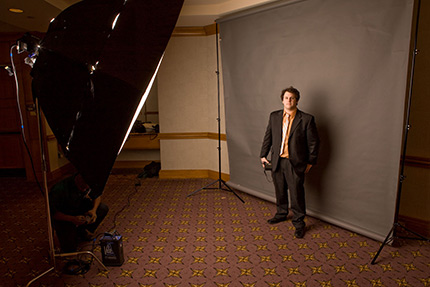
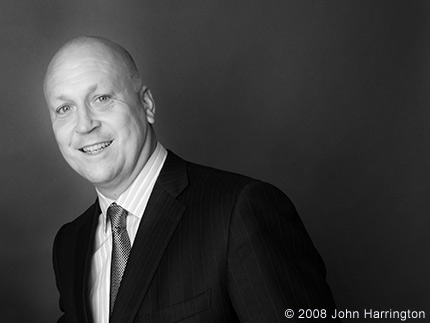
Yesterday, while on a fairly straightforward assignment for a corporate client covering their day's conference, the day was scheduled to include a brief meet-and-greet with the legend Cal Ripkin. I'd originally intended to do this with on-camera strobe, but the client wanted me to bring a background. So, I selected my favorite - Thunder Grey. It wasn't until we were pulling the seamless from the car, that I got a thought:

"I am about to photograph a legendary baseball player infront of a seamless. What can I do to make this better?

(Continued after the Jump)

So I pulled out my Chimera 57 and set it up as a 7' softbox. We had it in the car from the day before, doing a magazine cover shoot, and hadn't offloaded the equipment because of the late wrap-time the night before, and a 6am call time for this shoot.

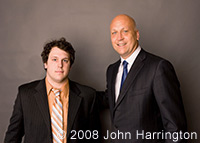
We moved through the group photos fairly quickly (at left is an example), and working with Cal was an illustration of the height of professionalism. I'd worked with him several times before, doing official portraits (lights and all) for other endeavors he's involved in, but never with a seamless, which I'd wanted to do for some time. People were immediately put at ease by him, and even though people knew they were coming to have their image made with him, and he knew he was there for that reason (before giving a presentation) he still asked each of them "would you take a picture with me?" which put each of those being photographed with him at ease, and facilitated the process in a very efficient manner. Further, I had just the light I wanted to have Cal in for him against the seamless.

In the end, I had an expedited shoot thanks to Cal's making it smooth as people entered and exited the portrait area, a very happy client, and, for me, a portrait that I'd wanted to make for some time.

Please post your comments by clicking the link below. If you've got questions, please pose them in our Photo Business Forum Flickr Group Discussion Threads.


[More: Full Post and Comments]
Tuesday, March 4, 2008

Taxes & Artists: Taking a Time & Services Deduction

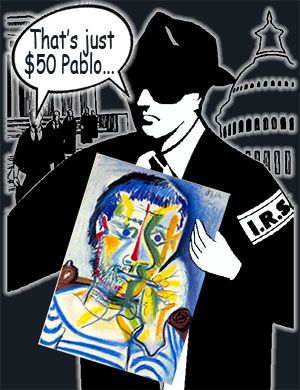
Awhile back, we wrote about how you CAN'T donate your time and services and claim fair market value for such as a deduction (An Original Picasso for $50? That's what they say..., 2/10/07), and one potential solution that could get you a bit more credit for your donations, when you do (The Non-Profit Challenge, 11/19/07), but once again, there is a bill winding it's way through Congress that would allow:

"...artists to take a fair-market value deduction for works given to and retained by nonprofit institutions. The U.S. tax system accords unequal treatment to creators and collectors who donate tangible works (e.g., paintings or manuscripts) to museums, libraries, educational or other collecting institutions. A collector may take a tax deduction for the fair-market value of the work, but creators may deduct only their "basis" value—essentially the cost of materials such as paint and canvas."
If you can enter your name and address, and click the "send" button, in less than two minutes you can actually send an e-mail to your elected official that represents you, through this very cool system. Americans for the Arts has their Advocate for the Arts website and all you do is enter your address, and they will automatically route your sentiments to your Senator or Member! If you'd like to her Senator/Photographer Pat Leahy (and the bill's sponsor) in an NPR interview on the subject, click here.
(Comments, if any, after the Jump)


Please post your comments by clicking the link below. If you've got questions, please pose them in our Photo Business Forum Flickr Group Discussion Threads.


[More: Full Post and Comments]

PhotoShelter & Flickr: Intertwined (For Your Benefit)

A brief note that now you can export from Flickr directly into PhotoShelter, and also export from PhotoShelter directly into Flickr with watermarks and all sorts of other protections, ensuring that you're not one of the many people who have had their work stolen from Flickr. This Wired story - PhotoShelter Protects Your Images From Would-Be Flickr Thieves (3/4/08), which reads, in part:

PhotoShelter takes a different approach to image sharing than Flickr, one that’s more suited to the professional photographer. Rather than simple image sharing, PhotoShelter offers the ability to overlay a personal watermark on all your photos, and web galleries can be password protected to limit access to clients...PhotoShelter is not a Flickr alternative, but is geared at the pro photographer looking to catalog, store and sell their images online. That said, some Flickr users who are getting more serious about their images and are considering a possible career shift might want to have a look at PhotoShelter.

And thanks to the new Flickr Importer, using both sites at the same time is a snap.
Thus, the innovations by PhotoShelter continue, with outside-the-box thinking. I wonder what will be next? Automated copyright registration solutions to further protect your images?

(Comments, if any, after the Jump)


Please post your comments by clicking the link below. If you've got questions, please pose them in our Photo Business Forum Flickr Group Discussion Threads.


[More: Full Post and Comments]

SEO - Wild Wild West or Reason & Logic?

Today (actually, yesterday, as you are reading this) I was traveling with my post-production person and my intern and we were crossing a state-line or two en-route back to DC after an assignment. About half-way back to the office, my post-production person asked "so, explain to me what SEO is." And the conversation started. And continued. And continued. You see, one of the things I am learning as I present at ASMP's Strictly Business 2, is that (at least it seems) more people want to learn how to get their websites to rank first on the search engines, than they want to get their contracts and business paperwork in order, if consultations and workshop attendance are any indicators, and my friend and colleague, Blake Discher has started a business aimed squarely at photographers, called GO-SEO, and he's doing (and has been) sold-out consults at SB2 and his Sunday presentations (Workshop D -- Is Your Website Doing All It Can to Get You Work?) there have been major hits.
We continued our conversation until we were almost back to the office, and we had barely scratched the surface of what SEO is. Don't know what it is yet? SEO stands for Search Engine Optimization, and as you can see from this link , there are far far to many "know-it-alls" out there who don't know anything about SEO. Test #1 - if your proposed SEO person tells you that Flash websites can't rank, hang up on them. Really. Do not pass go, do not collect $200, go directly to Loserville (and while you're there, say hi to JDK for me.) It really is the wild wild west, and people like Blake, and also the newly announced upgrades to liveBooks, bring reason and logic to the SEO world as it pertains to photographers.

From liveBooks' ability to read and auto-enter your metadata, to page-by-page statitics of Google Analytics, enhanced improvements to the auto-generated html pages, and so on, this upgrade is a significant enhancement to their already stellar offerings.

(Continued after the Jump)

For those of you who might think that I'm posting this because they're an advertiser, think again. No other solution gives you this much control over the back-end of your website and how it's seen by the search engines. I previously wrote It's Google's World, You're Just a Small Part of It, and after that, there were some interesting statistics I cited when liveBooks came on as an advertiser (Effective SEO - Please Welcome liveBooks, 2/20/08), that you might have missed.

So, let me direct you to an amazing report on how people look at web pages. This study, (F-Shaped Pattern For Reading Web Content), and the well-respected Jupiter Research reports that the majority of searchers - 62 percent of search engine users - click on results on the first page of search listings. Further, and this is where it gets critical - 90 percent of users never go beyond the first three pages. Where do you fall?

I want to reiterate something that may have gotten lost when I posted it in the comments - we all evolve over time as it pertains to websites and investments in them. I've looked at the underlying code of my friend Mark Finkenstaedt's website. Mark is an amazingly talented photographer - dare I say - more talented than me, and he's got great content there. I gave him a bit of help early on, encouraging him not only to have MarkFinkenstaedt.com, but also, since people naturally have a hard time with his last name, to get mfpix.com. He did that, and he's done the requisite keywords and descriptions metadata, but you can't find him in the first 100 pages of Google for any of his search terms. How do I know what his search terms are? I asked him. (and I asked him if I could put him up as the poster-child for poor SEO, and he said I could.) Further, despite his purchase of a gallery site for several hundred dollars, there's nearly zero coding that is search-engine friendly. What this translates into, is in fact, lost revenue. This is, because, on several searches I performed, the only one where he gets to Google's first page is when I search for his name. While that's good when people are searching for him, the real benefit of being findable on the search engines that the search (and finding of you) will result in revenue because he is findable. To make matters worse, Mark headed into the wasteland of the wild west and spent $500 a month for six months with a "placement agency" without a single assignment to show for it. "money wasted" he said, and canceled his efforts with them.

So many people will set a limit of $500 or $1k for their site, not realizing how much it costs them in lost assignments because they're not being found! I suspect that Mark will (or at least should be!) looking into the new liveBooks offering.

Please post your comments by clicking the link below. If you've got questions, please pose them in our Photo Business Forum Flickr Group Discussion Threads.


[More: Full Post and Comments]

Monday, March 3, 2008

Chase Giveth, And Giveth Some More!

Chase Jarvis has done something extraordinary - out of the blue, Chase is giving away a FREE trip and conference registration to SB2, airfare included! Check out WIN a FREE Trip To ASMP Strictly Business 2 - Chicago for the details.
If you're reading this blog, you should be there! (and you also will know that this is a repeat of my call for Atlanta!) The third of what will be a total of four stops (Chicago is the last stop, the destination for Chase) takes place starting this Friday, March 7, in Philadelphia. If you missed LA, I did a video report on it (here) and it has been widely reviewed as a success, with people traveling to LA from as far away as Alaska and Florida. So, this isn't something that you should be saying "oh, it's not near me, I'm not going." Planes, trains, or automobiles - it doesn't matter how you get there, because this is worth traveling for! It is going to be a remarkable weekend that will either get you started right, or bolster your existing business skills.

At this program you won't learn lighting, or video, or any other skill-set except how to run your business better and more efficiently. Beginners have come away with massive amounts of information and exceptional resources, while long-time photographers have taken away new tools and refined their current business practices to be better and more efficient in how they run their existing businesses.

Need to know about marketing? ASMP has brought in Leslie Burns Dell'Acqua to give you real tools to use to begin to market yourself, or to evolve how you marketing into the new era that is e-mail and the latest in marketing trends, helping you to reach your intended audience.

Blake Discher is also on hand to discuss the great unknown that is client negotiations and gets you thinking in the right direction about how to price your work so you stay in business.

Don't know how to store, archive, and deliver your work safely? ASMP's President, Judy Herrmann will set you straight about how to protect yourself from the inevitable hard drive crash, and deliver clients images when they want, and how they want them. Judy knows a great deal on the subject, and listening to her is like pouring pure octane into your gas tank - you're getting so much fast-burn information, every tidbit is valuable.

Further, and what is the starting point, Richard Kelly and Susan Carr start off with the basics, and make sure we're all on the same page, establishing baselines and foundations so we all are on the same bus together.

(Continued after the Jump)

Oh, and I'm also there talking about the critical tools for your photography business. It's like this blog, come to life, with a bit more restraint and carefully chosen words than you might find here, except the information I'll be presenting is, as it's titled, critical to your business, including copyright registration, dealing with contracts (both yours and the clients), and so forth. As I said before, if you're reading this blog, you should be there.

But it doesn't stop there, because that was just DAY ONE!

Ready for day 2? We spend the morning training you to negotiate better. We show you how we do it in several situations, role-playing, and then we break up into small groups, and guide these groups of 15 or so through the process, pausing and refining, and everyone else gets to chime in - it's all very interactive.

After lunch (included, on both days!), there are smaller workshops, delivering more details and specifics on Marketing to Move Your Business Forward; Business Workflow to Bring You Profits; Taking Control of Your Career; and Is Your Website Doing All It Can to Get You Work?. Don't worry though, they are repeated, so you can take two of the four.

Not enough? You're crazy then, but, well, ok - how about we have Joyce Tenneson give the keynote on Saturday night, before the free Digital Railroad reception that's included?

Register now, figure out how you'll get there next!

Please post your comments by clicking the link below. If you've got questions, please pose them in our Photo Business Forum Flickr Group Discussion Threads.


[More: Full Post and Comments]

Saturday, March 1, 2008

Xerox - "MyShot" Takes Aim At Unsuspecting Students

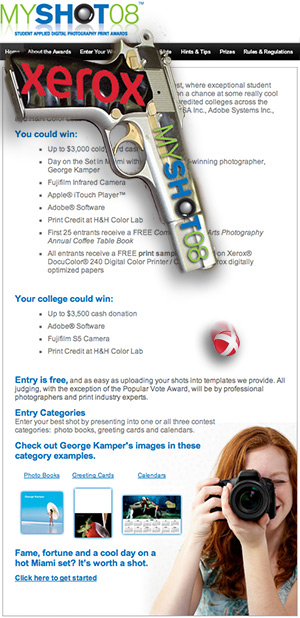
Xerox (NYSE: XRX) seems to have a problem with a healthy respect for photographers copyrights. Namely, if you are a student, they want yours. I've been watching this latest in photo contest rights grabs. At first, Xerox wanted ownership and unlimited use of all entries, by both Xerox, and their undefined "designees", and they wanted to use all entries (not just the winners) for any and all marketing purposes, and furthermore, they wanted to prohibit you from using your own work for anything but self promotion for 5 years. The fine print of the contest rules adds insult to injury, stating that all entries (not just the winners) are owned by Xerox.

Yikes!

Recently, Xerox inserted an explanatory text box on the rules page, with a carefully crafted statement that on the surface, appears to indicate that their usage is limited to “winning photographs” for an 18 month period. A careful reading of this new text reveals that Xerox merely limited the period of exclusivity, and not the usage period. The fine print still provides Xerox with ownership and unlimited usage of any and all entries, including non‐winners, for an unlimited time, in all countries, throughout the world. Rather than limiting usage of the photographs to promotional use related to the contest, the rules provide Xerox with the unrestricted right to use winning photographs for any and all advertising, promotional and other purposes without further compensation to the student photographer. Apparently, someone at Xerox got the bright idea to use a photo contest to source images for their ad campaigns. Scoundrels!

But it gets worse.

(Continued after the Jump)

What makes this contest particularly egregious is that Xerox has set their sights on unsuspecting student photographers, who are often eager to see their work in print, and are unlikely to read the fine print, and do not yet understand how to protect their rights. Further, they are using the schools and faculty members, many of whom might not read the fine print, to draw students into the contest.

And there's more:

Each winner is required by the rules to certify that they will "hold harmless" Xerox in the event that any third party sue sues Xerox as the result of their use of the photographs in their advertising. Nice - Let's take a billion-dollar company and transfer millions of dollars in liability to a student contest entrant who is already weighed down with student loan debt and is about to enter the profession during one of the most challenging periods in the history of photography. While it may be reasonable for Xerox to require that students certify that they are in fact the copyright owner of an entry and have obtained proper model releases from pictured subjects, Xerox steps over the line yet again by limiting the entrant's ability to sue Xerox in the event that Xerox oversteps it's already egregious boundaries for use of the photos, essentially eviscerating the rights of the entrant.

Further, the language of the contest rules would confuse even an experienced, seasoned professional photographer.

Oh, and one more thing - if you're "lucky enough" to be a winner, you have to sign a separate, as yet undisclosed contract with Xerox. It probably has something in there about giving away your first born or something. To an aspiring photo student, it feels the same way to do so with your first, best, images.

This contest (and others) should be about who took the best picture, not about who can screw unsuspecting students and photographers out of their rights. Xerox, time to get the white‐out. and Limit your usage to winning entries only, and only to promotion of the myShots contest. Remove the terms providing Xerox with ownership of entries. Revise the “hold harmless” clause to remove any liability placed upon the students, other than for falsifying their copyright ownership information. Limit the exclusivity clause to Xerox competitors only, and apply this only to the more significant prize winners. Allow students to make use of their own photographs during the exclusivity period, provided that they do not license usage to Xerox competitors. Provide students with approval rights and market‐rate compensation in the event that any winning image is selected by Xerox for usage other than promotion of the contest. Respect the rights of students and photographers. Do the right thing.

If you want to read the rules, check this link. MyShot08 contest rules.

After choking back the bile, send an e-mail to these folks:Be sure to take note of the folks who have signed on as sponsors of this contest rights grab, whose organizations are photo-centric and should know better by now:
  • Adobe (NASDAQ: ADBE)
  • Fuji Film (NASDAQ: ADR)
  • H&H Color Lab
This is just getting silly. If your company relies on photographers, before you agree to sponsor contests/events, you should have as a requirement that you get to read and sign-off on contest/event rules so you don't reap the ire of the photo community!


Please post your comments by clicking the link below. If you've got questions, please pose them in our Photo Business Forum Flickr Group Discussion Threads.


[More: Full Post and Comments]

Friday, February 29, 2008

Free Photos and Artistic Vision - A Contrary Position

My friend and colleague, Chase Jarvis, wrote on his blog, and article titled Free Photos and Artistic Vision, and, it's worth a read. However, where he posits the notion for pondering that, possibly:

The future of earning a living as a photographer lies not in your old pictures, but your next pictures. Sure, one-of-a-kind historical, documentary pictures will always have their earning potential, but the successful professional of the future -- just like the successful professional of today -- will make their money getting hired to deliver their commissioned, artistic vision for the newest product, trend, or photo of the moment, NOT to deliver the ones and zeros from yesterday's digital file.
He is promoting the 'sell once and forget it' approach.

In other words, get as much for it now as you can, and don't plan to, or choose the option that allows you to monetize that asset over time. At first blush, that seems fine, however, there's a problem with that idea.
(Continued after the Jump)

It suggests the conveyance to the client of all rights so as to eliminate your ability to earn more on those images from that client. There are a number of issues with that:
  • The clients will seek lower and lower figures for these all rights packages. They already are getting them now, for pennies of what they are reasonably valued at.
  • You'll get the client who hires you for a brochure, and then uses the images in a national ad campaign. Happens now all the time by unsuspecting photographers who buy the "we're only going to use it in a small print-run brochure..." line, and then signs away all rights.
  • You'll get the client who hires you once for $10k, and then, when they would have had to pay you another, say, $8k the next year to re-use the images, or perhaps another $10k shoot instead, decides they'll re-use the images under the proposed model, and would not have to pay the $8k, nor commission the new $10k. This will have a trickle-down effect.
  • These clients may, in turn, re-license them through a stock portal themselves.
There are, of course, other problems, with the all-you-can-eat buffet approach to photography.

I recently had a prospective client (a purported magazine) call me to photograph 60 portraits - individual portraits around DC. They wanted to pay $1k per portrait. At first blush, this seemed like a boon. Upon reading their contract, they took all rights, including reprints. I did a little research, and found that these portraits - of lawyers - were being done and then the lawyers, because they were featured in this "magazine" which was a "special edition" titled "Washington's Best Lawyers" and moreover, each firm could (read, was asked to) advertise in the publication, and then they sold reprints for $3k for an inside piece, and more if the cover was "redone" for the lawyer or firm. In essence, it was a disguised brochure, and I was the $1k guy that would have turned over all that income to the "magazine". Further, the firm could - for a fee - get the digital file for their own uses. There was no movement on the price, or a renegotiation on the reprints issue, and when I noted that they were charging for the reprints of my work and thus, earning a substantial income from essentially reselling my work, and I queried further "is that your business model", they said it was, and they were doing it all over the country.

While I know that Chase has a true and nearly as complete as possible understanding of the value of the images he produces, I submit that, to the vast majority of photographers who don't get signed contracts from clients before beginning work, roll over on rights grabs without additional compensation, and have no idea what their CODB is, letting the levy breach whereby "all rights forever" and WMFH are allowed to roam free and fester in the land of acceptable business models for freelancers, is a recipe for disaster.

Chase does put forth the question "IF (capitalized for emphasis) this is the case," and so, I think he may well disagree with this notion, but he puts it forth, and ends with "Scary to some, exciting to others. You just need to decide on which side of that fence you're going to sit." I submit that that last word has a misspelling. It needs an "h" between the "s" and the "i".

Please post your comments by clicking the link below. If you've got questions, please pose them in our Photo Business Forum Flickr Group Discussion Threads.


[More: Full Post and Comments]

Wednesday, February 27, 2008

Rights: Yours, Mine, and Theirs

There are lots of topics on the subjects of rights I could discuss, though this wouldn't normally be one. But as it deals with the business of being a photographer, it deserves our attention. It's when a photographer is alleged to have violated the human rights of someone else.
What's that you say? Aren't we supposed to be the defender of the downtrodden, the under-served, the discriminated against?

Yes, one photographer has been taken to task for alledgedly discriminating against the rights of another, a prospective client, for religious reasons - the photographer's religious reasons.

(Continued after the Jump)


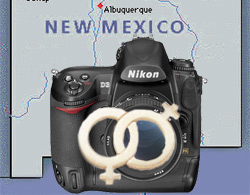
The Washington Times reported (Artist hit for refusal on beliefs, 2/25/08) that an evangelical Christian photographer is being charged with violating the rights of a lesbian couple who wanted to have Elaine Huguenin, who is based in New Mexico, photograph their commitment ceremony.

Now, before I continue, let me say one thing - at no time in this article am I (nor should you) going to take a position on the issue of Huguenin's religious beliefs, nor on the couple's ceremony. If you decide to make this about that in the comments, not only are you missing the point of this piece, you're comments will be subject to deletion. I was going to turn on moderation of comments, but thought better of that.

Had the photographer - who is in the business of providing photographic services to couples - simply decided, in her own mind, that she objected to these specific types of ceremonies, simply said "I don't think I would be a good fit for your ceremony", or even said she had other obligations, that would have been the end of it. Instead, the photographer opted to leave a paper trail, of sorts, in the form of an email to the prospective clients, regarding her religious objections to a same-sex ceremony, and thus, indicated that her intention to not provide professional services to this couple was based upon this position. A statement that, in many jurisdictions, can be interpreted (and has successfully been, in courts-of-law) as discriminatory.

Are there many, many other photographers in the Albuquerque area that could provide as good as, if not better, services than Huguenin? Surely that's the case. Why did this couple decide to bring this case before a state tribunal? Because refusal of service could very well be discriminatory, when made by the owner of a business.

Yes, you're a business, just like the malt shops who wouldn't serve blacks in the 60's - they were in the wrong. You're a business, just like those that might refuse an interracial couple from enjoying a romantic dinner in their restaurant. Those that would do so would be found to be in the wrong. You're a business, just like those that would refuse a muslim service after 9/11, they were found to be in the wrong. Federal laws have jurisdiction over civil/human rights issues, where people are discriminated on the basis of race, color, creed, religion, and sexual orientation.

The defense's position, according to the Times, is that "Elane Photography is basically a husband-and-wife small, little commercial photography business" run by "devout Christians who have a variety of things they don't want to take pictures of." This is acceptable where, say, they don't want to do boudoir photography. Or, perhaps, produce pictures which depict a burning cross, and so forth. But is it, in this case? The defense goes on to suggest "...'the First Amendment protects artists like Mrs. Huguenin from being compelled by the state to engage in expression that violates their religious convictions.' The First Amendment 'is pretty clear that Christians should not be penalized for abiding by their beliefs,'...", and so, an interesting twist is added when we begin to discuss the compelling of an artist to make expressions that they believe violates their religious convictions.

This isn't, in the end, the same as the sale of a tangible product like a chocolate malt, or an appetizer and main course.

Remember - you are a business. And, your business falls under anti-discrimination laws just as any other "small, little commercial photography business" falls under laws that preclude the dumping of film chemicals down the drain into city water, or handicap-access to your storefront studio in that quaint downtown shopping district in Anytown USA.

Does the state have a case? Maybe, with the laws written as they are, and precedents set where other businesses have been found liable for discriminating. If the state's position is that refusal of service is comparable when made on racial grounds, as it is when made against a homosexual couple, then it's not a maybe-they-have-a-case, then they do. And it's one which will drag out in the courts for years, or get settled for a significant dollar figure. Will this photographer spend a great deal of time defending her religious position? Yes. In the end, will the photographer prevail? I don't know.

Please post your comments by clicking the link below. If you've got questions, please pose them in our Photo Business Forum Flickr Group Discussion Threads.


[More: Full Post and Comments]

Membership Has It's Privileges

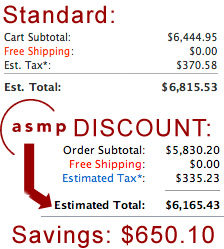
Yesterday was the day I had been waiting for for months years (well, 18 months to be exact). It was finally time to upgrade my Macbook Pro, as Apple finally delivered their overdue refresh of the product line. I'd done some shopping around, and the price for the one I wanted - 17", 250GB HD 7200rpm, 2GB ram, 2.6Ghz processor, was $3,199. No problem, I could swing a sweet deal and pay just $2,943 - a $256 savings, through my connections. (Note, it says "order subtotal" on the savings section, and "cart subtotal" when I was doing my research.)

A little-known secret - when you buy a screen with a CPU (and a laptop qualifies as a CPU, even though it has a screen) that screen is covered by Applecare. Buy it a day later, and it's not. So, I added in a 30" monitor. Add in the Aperture 2 upgrade, a Time Capsule, AppleCare, and Microsoft Office 2008 (another secret - its cheaper to buy Office with a CPU than standalone), and I would have been paying $6,815.53, but with my connections, I saved $650.10, and am paying only $6,165.43.

Sweet!

You too can have these connections - mine comes from my membership in ASMP, which was more than paid for for a year - almost two, with this one purchase alone, and they have countless other benefits and discounts, to see the benefits, click here, and to join for this, and many many other reasons, click here!

(Continued after the Jump)


Please post your comments by clicking the link below. If you've got questions, please pose them in our Photo Business Forum Flickr Group Discussion Threads.


[More: Full Post and Comments]

Tuesday, February 26, 2008

Getty Images - A New Beginning?

I spent a good portion of yesterday, the day that the Getty Images (NYSE: GYI) sale to Hellman & Friedman was announced, contemplating the ramifications. In between assignments, I fielded (and made) a number of calls about the aquisition.

My first inclination was "oh, they'll break up the company", and then, I started doing some serious thinking. Daryl Lang disclosed/revealed (PDNOnline: Getty Images Board OKs Private Equity Sale, 2/25/08) H&F are part owners of their parent company, AND, several respected advertising agencies and media properties. Thus, these people know the value of visual assets.

Prior to reading this revelation, I reached a similar conclusion to Daryl's - taking the company private would diminish the bean counters' grip on it's quarterly performance. I can only surmise that some degree of the decisions that were made about pricing models and so forth were done to prop up ailing bottom lines to hit Wall Street expectations. It has long been known that the bean counters are a poison pill for the creative community, looking to squeeze in places that are detrimental. While surely H&F will want quality performance and revenues (more on that in a minute), there will be much less pressure to perform like a circus monkey to make the traders happy and entertained.

I expect that JDK will remain on board for the short term, and then leave when H&F feels they have taken the reins, in a smooth transition. He's surely made more than his fair share of bad decisions, highlighted by the bright light that is required of publicly traded companies, and I was (and where applicable, will continue to be) highly critical whenever they are bad for the long term good of the creative community.

So, what changes might we see? More than one person I spoke with concurred that the Getty "wire service" is ripe for the chopping block, which was my thinking as well. One need only look at the history of United Press International, the once famed photo wire, and compare it to where it is today. The Associated Press' photo wire service, over the years, has had it's struggles, and, as a standalone entity not been viable, but, bolstered by the combination of text and photos, has survived, in large part, because it is a co-operative, owned essentially by it's member papers. Last May Reuters reported on it's own sale to Thomson (Thomson, Reuters to forge global info leader) for 17.2B.

Getty's "always gotta be there" mentality may be stretching this underperforming department thin. With WireImage's acquisition, they have made covering celebrity events profitable (to a degree), where the $100 an event schmucks that turn up with their consumer-level equipment with pop-up flashes and 24-300mm f4.5-f8 zooms have had a detrimental effect on celebrity coverage. When WireImage can charge, say, a perfume company $5,000+ to cover an event in NYC, pay the photographer $250, own all the rights, sell the images worldwide, and reap the profits from what used to be images that were handed out freely, that's a profitable paradigm. If only those photographers would take the $250 as a guarantee against future sales, and be a party to that income stream, or, get more of the $5k that WireImage is charging (and make no mistake about that, that IS a real figure) for these types of events, that would be fair. Getty has also secured profitable arrangements with sports leagues, and while not wholly journalistic in nature (i.e. looking for images that put a league in a dim/bad light, like fights, and you find slim pickings), they (the new buyers, who own a few ad agencies) also know that providing services to advertising clients with discriminating tastes and demands (read: profitable) is where the money is. So, I'd look at their wire-service like coverage and staffing to be under a serious microscope in the coming year.

As an interesting anecdote, taking the 70 million image that Getty reportedly has in it's collections, and doing some simple math, you arrive at $34.29 per image for a $2.4B acquisition, valued at $34 a share. Coincidence? Yes, but an interesting observation none-the-less.

They jury is still out on this, and I look with a questionable eye at many of the decisions that Getty has made over the past few years. However, this may well be a new beginning. I'm not holding my breath, but I am holding out hope that it could be a good thing.

(Comments, after the Jump)


Please post your comments by clicking the link below. If you've got questions, please pose them in our Photo Business Forum Flickr Group Discussion Threads.


[More: Full Post and Comments]
Newer Posts Older Posts