Saturday, April 7, 2007

The Business of Colorspace

What colorspace to deliver in ?

Every photographer has an opinion, and there are about 30 experts for every different colorspace. Some swear by sRGB, others swear by ColorMatch, still others insist on Adobe 1998, and then there are the clients who insist on CMYK, and then when you ask them what profile, they haven no idea what you're talking about.

Realizing, however, that it is now your responsibility to handle colorspace issues means you are at step 1. This also often means that the client will lay the blame on you when the image doesn't look the way it should.

First things first through - what colorspace is your camera capturing images in when it's capturing raw images? Answer: It's not. Capturing images in raw, means that no colorspace is defined. The colorspace is chosen and assigned by the raw conversion software, like Camera Raw, Capture One, and so on. The colorspace set in the camera when you're shooting raw is just a tag, the raw data is not diminished by your choice. The raw data from the sensor is just that, raw light values coming from the sensor.

ProPhotoRGB has colors in it that are not in Adobe 1998. Adobe 1998 has colors in it that are not in sRGB. When you are making your conversions in your raw converter, and making your general corrections there as well, having the widest gamut will serve you best to make your corrections and adjustments. However, can the client handle that? You need to know, or risk a client who feels you underserved them.

So, what clients get what colorspace?

Well, many photographers point to ColorMatch as the one which most closely resembles CMYK, and when your work is going to a CMYK printing output, what you deliver, when delivered in the ColorMatch colorspace, will yield results as close as possible to what the final output will look like.

If your client is outputting to a premium grade press, with six color output, the images will appear best in a broader gamut colorspace like ProPhotoRGB, or BruceRGB. You'll know these clients though. They are spending a lot of money on their output, and they will make you aware of details in a very specific fashion, talking about setting your white point to something like 246, and your black point to 11, and they will be asking for uncompressed TIFs, at a very specific DPI, which will NEVER be something as generic as "300". The likelihood is that most of you will encounter only one of these clients a year. And these are the clients, more often than not, that are not bickering with you over post production charges, and you were likely paid a premium creative fee and fairly priced licensing.

If you are expecting your client to send your files to a Fuji Frontier, Noritsu, or other one-hour-type lab, your safest bet is going to be sRGB. Sending these clients file in a wider colorspace like Adobe 1998 will mean, when they send it to the lab straight from your CD, almost always the files will come out looking milky.

If your client is going to have your images on the web, again, delivering the final files to them as sRGB is going to be safest. They (or their web team) will most likely not convert it themselves.

For about 80% of my clients, they do not know what colorspace is, let alone, what colorspace they want. For these, after I optimize the files in my editing suite, I convert them to sRGB, and burn them to a CD as JPEG's.

For clients who INSIST on a CMYK colorspace, but won't tell me which one, or provide a profile to convert to, it's SWOP v2. Period. However, I ALSO provide them with a file in ColorMatch, and advise them:

"Enclosed is the final file, converted to CMYK, as you have requested. Because we did not recieve a specific colorspace or device profile specification, we have chosen a standardized CMYK colorspace, SWOP v2. We have also provided the same file in an RGB colorspace called ColorMatch. This colorspace most closely resembles CMYK, but has not been converted. If you, or your printer, has a color profile for the printer your are outputting on, we recommend a conversion from that ColorMatch RGB file to your device-specific CMYK profile for optimum results."
This notice not only provides our clients with the maximum amount of information and flexibility, but also conveys to them the level of attention to detail we give to every project and to the clients needs.

You may have a difference of opinion about the specifics of the above, but what should not be in dispute is your very real obligation to be responsible for the proper colorspace for your client. Understanding colorspace, and how to best serve your clients through it, is but one reason why not only do we never deliver raw files, we have solid justification for our post-production charges.
Please post your comments by clicking the link below. If you've got questions, please pose them in our Photo Business Forum Flickr Group Discussion Threads.


[More: Full Post and Comments]

Friday, April 6, 2007

Service Contracts

Do you have a service contract for anything? Do you know what one is?

A service contract is essentially a variation on an extended warranty. Apple Care is one that is immensely valuable. For a few hundred dollars, you get protection on your laptop in the event that your machine dies, almost for any reason. Repairs too.

Also from from Apple is Pro Care, which, for $99 a year, means you can not only schedule time to go into an Apple store to get expert help for your machine, and expedited repairs, but you can also get free training for many of the applications you use, and if you've found the Apple Store Genius Bars filled to capacity whenever you try to schedule an appointment the day of, you know that you'd love to schedule it days in advance -- when it's most convenient for you, not when there happens to be an opening.

For my home office, I have a type of service contract called a preventative maintenance agreement with my heating and air-conditioning company. For $250 a year, they come out and check my system and properly set it for Winter and then again for Summer. If it needs replacement parts, Freon, or other non-major work, they cover it. If my condenser or central unit goes down, they put me in priority line to get it replaced at a discount, and the labor charges to do so are included. When that happened, I checked, and the price they were charging me for the unit alone was less than I could find it at Home Depot, and the vendor's charge included the install. I also pay a fee every month to my security system services provider so that whenever there is a problem with a sensor, they come out - for free - and repair it, or replace it.

Adobe offers a two year maintenance agreement as a part of their Transactional Licensing Program (TLP) that allows you to pay one price and secure maintenance releases and however many upgrades occur during the term of the agreement. It's available through whomever is your preferred Adobe partner.

When you have tools that you cannot operate without, having coverage and cost controls to limit your losses and expedite the return to normal operations can make a world of difference.


Please post your comments by clicking the link below. If you've got questions, please pose them in our Photo Business Forum Flickr Group Discussion Threads.


[More: Full Post and Comments]

Thursday, April 5, 2007

Hail Early Risers!

My office opens at 10am, (but I do take calls if they come in earlier than that), and stays open until 6pm. I frequently stay up late to do paperwork, and every once in awhile I get a call from the west coast at 9pm where the caller is surprised to reach me, saying "oh, I was expecting to get voicemail...".

Why does my staff arrive at 10? Because I am usually up late the night before, and thus "sleep in", and it's an easier commute for them, so everybody wins. Of course, I get up early when an assignment calls for it, but when asked about scheduling a shoot, my first effort is to arrive on site by 11am, and begin shooting at noon.

Yet, I am inspired by a line I read from a William Blake poem:

"Think in the morning, act in the noon, read in the evening, and sleep at night."
Perhaps I could be more productive during the morning, and thus be able to accomplish more throughout the day.

Check this blog entry - Two Ways to Use Your New Found Early Morning Hours, which suggests, 1) The first co-strategy is that of making sure that the last half-hour of the day prepares us to “hit the ground running” the next morning, and 2) The second strategy is to choose appropriate tasks upon which to work the following morning. Read the rest of the blog for more details, but it sure looks like a good idea.

Now, the trick will be convincing the folks in the office here to arrive earlier. Wish me luck.
Please post your comments by clicking the link below. If you've got questions, please pose them in our Photo Business Forum Flickr Group Discussion Threads.


[More: Full Post and Comments]

Monday, April 2, 2007

USA Today

As USA Today's freelance photographers toil away, chasing the newly minted boys of summer, look for an angle during the NCAA playoffs, or carefully lighting the latest celebrity for the front page of Life, the penny-pinching tighwad bean counters have foisted upon the desk editors of the "Nation's Newspaper" the latest rights grab that has riled up many a photographer. I've had several requests -- "John, you gotta comment on this...".

Mind you, I hold little ill will against the assignment editors, and other folks of the photo department out in the newly built tower that overlooks some of the most expensive real estate along the Dulles Corridor towards Tysons Corner and Silicon Alley, where AOL makes it's headquarters (but not for long). Someone, somewhere deep on a sub-level, looking to buck up to an office with a window, got a new CPU that could handle the more advanced features of Excel, and tweaked a formula that said that the chain could save untold dollars just be changing a few lines in their photographer's contracts. Now, this accountant trainee is hoping to see some daylight. Have we not forgotten about how the accounting departments of the likes of Enron, WorldCom, Tyco, brought scandal and disaster to their name? Not all brilliant ideas put forth by the accounting department result in things that are good for the company. This latest one - stripping revenue from photographers, and failing to account for increases in expenses over the last decade, is just the latest idea that they dreamed up to avoid being outsourced to India, and justify their existence. The latest contract language is about as good an idea as throwing a cross-stitch across your rectum.

I've seen more than an image or two of mine grace the pages of USA Today, and USA Weekend, and I've read the contract, and here seems to be a few sticking points:

In over 20 years, USA Today's only increased their assignment fee from $225 to $375. Wahoo! Who's shooting those assignments? I'd guess people who expect revenue on the back end from stock. No more.

It used to be that the compensation for transmitting made sense, since we were scanning and transmitting. However now, it's $25 for however many images they want. Does that justify a high speed wireless card, and your time to do so? Well, there's a problem, because you have accepted "day rate", as your mode of business, meaning they have you for eight hours. So, when you cover an assignment goes an hour, or six hours, they still have you (in their minds) until the end of an eight hour day. So, the $25 is not a compensation for your time, but rather, a subsidy of your equipment costs to do so. In their cover letter, they continue the misuse of the term "day rate". It should be described as an "assignment rate". Being "on assignment" means making photos, or travelling to make photos, or back from making photos. Doing post-production isn't the same in my book. It should be seperate.

Gannett also wants all rights, forever, and can use your images in not just editorial, but also advertising, without additional compensation. Anything Gannet deems they want to use it for. So, when USA Today wants to use your photos, either in context, or as a stand-alone image to advertise it's paper in an elevator on the screens there, in airports on billboards, on buses, transit terminals, and so on, you're SOL.

You grant them a 30 day exclusive. And, if you shoot RAW, you MUST ALSO send those, along with JPEGs. That's gona bog down your high-speed connection!

You're also subject to a half-day rate of $250. And, while a half-day MIGHT work for an 8am-noon assignment, or a 6pm-10pm assignment, when that midday assignment from 10-2 comes about, you're doing a half-day that precludes you from actually doing a full day for anyone else. Nice! I do hope that our friendly photo editors don't hand out too many of those half-dayers and instead opt for all full day assignments. I guess it all comes down to how you clock your time. I'd say that, like a plummer, you clock door-to-door. Meaning, that once you leave your home, the clock starts, and it does not end until you are home safe. 4 hours and 1 minute? Yep, that's now a full day in my book.

The contract also states: "you agree to provide USA Today with ALL of the Works you take while on assignment regardless of the form of those Works (e.g. photographs, video, audio, digital files, negatives, transparencies), so that when you begin capturing audio and video for them, you have to manage all that as well (for no more money), and that time is coming sooner rather than later.

Wait, though. If you're a staffer, keep reading. This is where it goes south for you. If enough of the freelancers sign this thing, that's gonna make your lifespan as a staffer that much shorter. Some other bean counter is cross-comparing that nice salary, gear allowance, and your vacation/401k/health insurance against the daily cost of a freelancer, and these cuts affect you. Believe it.


Wait, though. If you're an editor, keep reading. It's going to get harder and harder to find consistently qualified photographers. Maybe not this year, but with $5k camera expenses needing to be made, how long before your photographers are shooting with outdated equipment, and you're then forced to go to your pals at the agencies to get those images that everyone else is getting, making your paper look that much more like the rest of the newsprint out there? What when your freelance pool becomes a puddle, and then you can't get assignments covered?

I know that if the editors received well written letters of objection from it's freelancers, en masse, they'd carry your water the rest of the way. They'd take those objections to their superiors, who would push back at the sub-level accountant trainee's boss, saying "hey, this won't work. We are getting too much push back from our vendors." However, are you willing to push back? If not now, then when? Your letter must outline that the changes to the terms of the contact are unacceptable, and push your income level below cost, and, as such, you cannot continue to work for them, and then you must mean it. It must be a personal e-mail, professionally presented, and not some cut-and-paste job from something someone else wrote.

Let's applaud USA Today where it's deserved. They are not demanding copyright. But, well, that's like being a victim of spouse abuse and saying to the judge during a trial - "but he only beat me where I could hide it with clothing." You should not be thankful for copyright retention, it should be a given. You should be able to be a spouse with the given that you're never beaten. Even if every other news organization doesn't demand copyright, that does not mean USA Today's not demanding it should be cause for celebration. In the middle east, it's normal for men to beat their wives, but that doesn't make it acceptable by any stretch. So, one-handed applause from me on copyright retention.

If photographer's don't stand together, then we will fail alone. As I cited in a pervious post recently, you can either be a good example of a horrible warning.


Please post your comments by clicking the link below. If you've got questions, please pose them in our Photo Business Forum Flickr Group Discussion Threads.


[More: Full Post and Comments]

Billability Reaches New Heights

Everyone's got an angle to the Anna Nicole Smith story, and I mean everyone. One of the "trashy" blogs I read to keep up instead of buying the National Enquirier during checkout is TMZ.com. Here's an article about how much the baby's daddy is being billed for an attorney. The final bill?
In all, the packet of bills Birkhead received today totaled 112 pages. Opri offered Birkhead a bargain: Instead of the $620,492.84 bill, she offered him a discount at $511,365.09, but only if he accepts immediately. Opri wrote, "I'm still willing to accept the discounted billing at this time, but only without further discussion."
Now THAT'S one helluva bill, and a very nice 18% discount for timely payment.

Why do I point this out? Because one of the most methodical professional services providers I know of is the attorney. They bill per copy, and use a copier's built in capability of tracking copies, per client. Many bill in quarter hour or sixth-hour (that'd be every 10 minutes) increments. Check this article out for an explanation of how attorneys bill, and how to handle the initial negotiations with an attorney.

You do have an attorney, don't you? If you don't, you should establish a relationship with one at your earliest convenience. Not to begin a billable relationship and start paying them, but to know one, and know what they can do. Perhaps though, you have a contract you are using (or would like updated). That would be a fine way to begin a relationship. And, for most attorneys, when you sit down with them, to explain what you need, that visit is free. The rest, you pay for.

Your photography should, in a tangential way, compare to a lawyers. Pre-production meetings, pre-production, conference calls, assignment fees, travel fees (often 50% of your per-day assignment fee) and post-production, cell charges, couriers, duplicate CD's, shoot permits, and so on, and so on, and so on. Whenever you are working on behalf of a client, you are either eating the cost of that time, or properly billing for it.
Please post your comments by clicking the link below. If you've got questions, please pose them in our Photo Business Forum Flickr Group Discussion Threads.


[More: Full Post and Comments]

Sunday, April 1, 2007

Promote Your Product or Service

Promote Your Product, Service or Website to over 60,000 visitors each month.

Now, you can economically promote your company or organization to photographers all around the word in a single step. Advertising on Photo Businews News and Forum is easy, reasonably priced and effective.

Here are some of our statistics:
Over the course of a month, Photo Business News & Forum gets about 60,000 page views, and is read via RSS by approximately 1,500 people each day, for an approximate viewing total of 95,000 impressions.

Our readership is primarily English-speaking, with 70% coming from the United States, 8% from Canada and 5% from the UK. The other 17 percent are spread around the world, mostly in Western Europe and Asia.

Our readership is made up of photographers who are running a photographic business well and looking for pointers, or aspiring to run one well, and looking for wholesale information. If your products or services are geared towards solving workflow or equipment solutions to a market segment that can afford quality products, then this forum is for you.

Prices for image-linked ads are as follows:

Rectangles:
  • 300p X 250p (Medium Rectangle) above fold: $2.00 CPM
  • 240p X 400p (Vertical Rectangle) above fold: $2.50 CPM
  • 336p X 280p (Large Rectangle) above fold: $2.50 CPM
  • 180p X 150p (Rectangle) above fold: $1.50 CPM
  • 300p X 250p (Medium Rectangle) below the fold: $1.50 CPM
  • 240p X 400p (Vertical Rectangle) below the fold: $1.50 CPM
  • 336p X 280p (Large Rectangle) below the fold: $2.00 CPM
  • 180p X 150p (Rectangle) below the fold: $1.25 CPM
Banners:
  • 728p X 90p leaderboard, top, when available: $5 CPM
  • 88p X 31p microbar: $1.25 CPM
  • 120p X 240p (Vertical Banner): $1.75 CPM
  • 728p X 90p leaderboard, bottom: $2.25 CPM
Skyscrapers
  • 160p X 600p (Wide Skyscraper): $3 CPM
  • 120p X 600p (Skyscraper): $2.50 CPM
  • 300p X 600p Half Page Ad: $6 CPM

(CPM = Cost per 1,000 page views)


Photo Business News & Forum welcomes inquiries about exclusive parternship marketing and advertising arrangements for specific market segments. Please feel free to inquire.
Please post your comments by clicking the link below. If you've got questions, please pose them in our Photo Business Forum Flickr Group Discussion Threads.


[More: Full Post and Comments]

Saturday, March 31, 2007

Taxes, Taxes, Taxes (Federal, State, and Self-Employment)

Today is April Fool's Day, but it's also exactly 16 days from when you either must file your taxes, or obtain an extension, and joking around with your tax obligations can get you in hot water.

It's a sad fact that most people don't recognize -- the government, in one form or another, takes about 50% of your profits. I'd love to see the day taxes are due as the week before election day each year, but alas, our elected officials have put it as far away from that date as possible.

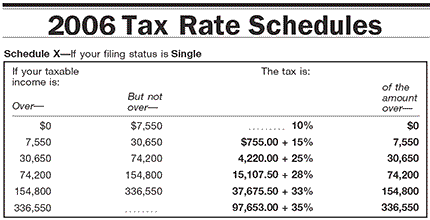
Just how does our taxes add up to 50%? Well, if you only earned a profit of $20k, your taxes as a single person are $2,600, or about 13%, at $50k, your taxes are $9,000, or about 18%.


The above tax table for 2006 shows the range from 10% to 35% for your federal obligation only. Since the disbelievers of the 50% total tax liability tend to be young, and single, I am showing just this tax table, but the entire schedule can be seen 2006 Tax Rate Schedules (http://www.irs.gov/pub/irs-pdf/i1040tt.pdf?portlet=3) on page 84 shows the summary for the various filing statuses.

You can't survive long with just a $30k taxable income (i.e. that's what's left over for you once you have paid all your expenses) but even at that figure, your federal taxes are 25%, at $62,000 you pop up to a 28% tax.

State taxes - beware! It's not just the various state income taxes (http://www.retirementliving.com/RLtaxes.html) that will cost you. Many states with seemingly low income tax rates more than exceed other states with personal property taxes. Virginia, for example has a range for income taxes of a low of 2% to a high of 5.75%. Since the 5.75% rate applies at a taxable income total of just 17%, allmost all tax payers who are photographers will be at this rate (actual taxes are $720 + 5.75% of the amount over $17k). Yet, Virginia, like many other jurisdictions charges personal property taxes. For example, living in Fairfax County, in Northern Virginia near Washington DC, both personal property and business personal property is taxed (http://www.fairfaxcounty.gov/dta/tax_rates.html) - per year - at $4.57 per $100, or 4.57%, so each year you pay 5.75% + 4.57% based upon the value of your cameras and computers and vehicles, and such. In other words, you're paying more than 7% to be sure. So, with that in mind, let's add that arbitrarily (but reasonably arbitrarily) arrived to 7% with the 28% federal, and you're now at 35%.

What then, is the next 15%? Well, if you're familiar with your cryptic friend FICA, from your days getting a semi-steady check from your desk job where FICA kept taking money from you for no apparently reasonable reason, then you're familiar with Social Security, also known as Self-employment tax, for those of us who are, well, self-employed. They are the same thing, just different names. And, in the case of FICA, you only pay 7.5%, and your employer is responsible for the remaining 7.5%. When filing as self-employed, you are responsible for the entire 15%. Here's a nice descriptive page - (http://www.irs.gov/businesses/small/article/0,,id=98846,00.html) Self-Employment Tax. According to the site "SE tax rate. The self-employment tax rate is 15.3%. The rate consists of two parts: 12.4% for social security (old-age, survivors, and disability insurance) and 2.9% for Medicare (hospital insurance)."

See? 35% + 15% equals 50%, sadly, it's that simple. So, be sure to save every receipt that is business related. For every $100 business expense you have a receipt for, you are reducing your taxable income by $100, and thus, preventing you from having to pay $50 out of your pocket. In other words, for every $1 as a valid business expense, you save $0.50.

Of course, I am not an accountant, so take this as just an eye-opener and an inspiration to seek professional tax advice from someone who is actually licensed to do so -- I am not!


Please post your comments by clicking the link below. If you've got questions, please pose them in our Photo Business Forum Flickr Group Discussion Threads.


[More: Full Post and Comments]

Friday, March 30, 2007

So you wanna be a photographer?

The other day, one of you readers posited this:

Hi John,

I have a simple question for you, one I'm sure you get a lot.

How do you go about building a portfolio when you are starting out without undercutting established photographers for a certain time period, even if you intend on staying in the business long term? It seems a catch-22. Without charging less why would a client go to an unestablished, unproven photographer when there is an established one charging the same price?
Consider, for example, Heather Drake, whom I met recently at an Advertising Photographer's of America meeting here in DC this past Tuesday. Heather has a full time job, is taking classes at the Art Institute of Washington, and, she - STEP 1 - Has a website, STEP 2 - has not let the fact that she doesn't have many assignments keep her from making great images in the style and type of work she likes.

Of course, her site's not finished (check the Fashion, Beauty and Celebrity sections), but she's headed in the right direction. She has taken the first few steps. She also has the financial backing (i.e. she has a job that pays the bills, even if she would rather be doing photography) so she's not forced to take the jobs that undercut what she's worth. Yes, her website will improve, get finished, but she's moving down the path, not stationary, paralyzed by her own inaction.

Before someone will give you a paying assignment (worth having), you have to proove you can complete an assignment. Yes, I know, seems a catch-22, as suggested. Yet, it's not. Give yourself an assignment! It's called....self assignments! Read the paper, find out about the latest parade in your area. Go to high school or small college sports, and practice. You want to be a wedding photographer? Offer to cover a friend's wedding as a guest that will not cost them anything as you won't eat, or if you are a guest at a wedding, cover it as if you were working. After two or three, you'll probably have the beginnings of a portfolio that you can use to get paying work. Portrait photography? Offer to make portraits of friends and family, and then use those in your portfolio.

Once you have a portfolio - and by that I mean a website - where your work is displayed, once a client determines, based upon a review of your work, they they want to give you their assignment, then they have deemed you worthy of the work, and capable of completing it. Period. At that point, it's all about what that assignment is worth. If you don't know, start looking around for guidance. Ask the question "What budget are you trying to work within?" See where they are coming from. Tell them you'll work on the paperwork for the assignment, and then do so. Call a few other photographers and ask them what they'd charge. Post a message on a photo forum that has professionals on it that have done assignments like the one you're being asked to do. Be thoughtful about the estimate, and then put it in writing, including the proper rights package, and then send it along via PDF attached to a cover-letter-type e-mail.

If they said their budget was $200, and everyone you got counsel from said it was an $1,100 assignment, send the estimate near that knowing you may not get it, and chalk it up to good practice. And, as it says on the back of the shampoo bottle, "lather, rinse, and repeat." Eventually, fair budgeted assignments will come your way, and you will (slowly) grow your clientele to be fair paying. If you take every $200-job-that-should-have-been-$1,100 at $200, you'll never have the fair paying clients, or, at the most they will be few and far between. Further, you'll be surprised at how many people tell you $200 and then approve your $1,100 estimate. Sometimes, they are just trying to be cheap, but know what they really have to pay.

If being a professional photographer was easy, everyone would be one. Many many people are photographers, or hang out their shingle and call themselves one, yet are not among the professionals, nor are they even aspiring professionals. They are just stepping in and dilly-dallying around, not being serious about it as a sustainable profession. About 2% of actors actually earn their living as actors. I submit that less than that are professional photographers.
Please post your comments by clicking the link below. If you've got questions, please pose them in our Photo Business Forum Flickr Group Discussion Threads.


[More: Full Post and Comments]

Wednesday, March 28, 2007

The Value of Post Production

I've just posted over at my agency's blog - Black Star Rising, an article on the Value of Post-Production, a little insight into what I charge, and so on, as promised in an earlier post this week Cost Justification Time.

Long gone are the days where we made the last frame, and sent it to the lab via courier, and it returned to show us the glory of our work (or where we’d made a disasterous error.) Yet, this “ship and forget” system meant more time shooting, doing what we love (and hopefully are most talented at.)

Today, a photographer’s time is spent far differently. The biggest leech of our creative time is that of post-production. The time from final capture, to ingest, process from raw to TIF/JPEG/DNG and the necessary noise reduction, metadata application, and proper redundant archiving.

(Continue Reading)


Please post your comments by clicking the link below. If you've got questions, please pose them in our Photo Business Forum Flickr Group Discussion Threads.


[More: Full Post and Comments]

Tuesday, March 27, 2007

The Reality of One's Future

Why must we stand by and somehow accept what other photographers are doing to the detriment of our profession? Why must we simply sit back and say "heck, go ahead and do RF!", or "wow! You just took an assignment for $75, using $250 worth of equipment if you had to rent it all. You go girl!", or "wahoo! You just got a photo credit for your work! Congrats! It looks great next to the full page ad that the advertiser paid $50k for! That's awesome!"
I was listening to the radio on the way home tonight, and heard this story. British General and Commander-in-Chief in India in the early 1800's, Sir Charles Napier, became famous when he was confronted with a terrible Indian (and that's India's Indian, not American Indian) ritual, called "suttee". It's a horrendous act, whereby when a man dies, as they are burning his body in a ceremonial fashion, the now widowed woman is tossed on the fire to burn to death. Napier, in charge of India, governed by British Authority, confronted the Indian seeking to do this, and stated to him:

"You say that it is your custom to burn widows. Very well. We also have a custom: when men burn a woman alive, we tie a rope around their necks and we hang them. Build your funeral pyre; beside it, my carpenters will build a gallows. You may follow your custom. And then we will follow ours."
Which brings me back to my point. Why must we stand by without making an objection as another photographer stands before us and says "man, I just think it's so cool that I made $25 off that photo." Why must we feel compeled to say, "It's ok that all you got for your hard work was a photo credit." Why, somehow, are we to listen while someone says "oh, my full-time job is X, so I'm not worried about how much I get for my photographs." Or, from our fellow photographers who are full time staffers, who say "oh, my freelance work is gravy to me, it's an extra few hundred bucks or so. It's no big deal to me."

I don't know. I suppose, there are several ways to confront someone. One is to yell at them. One is to try to convert them by citing how wrong what they are doing is. One is to toss a glass of water in their face and walk away. Trust, me, all of these are thoughts I have had. Really.

Napier, of course, had a bit more authority. He could actually jail, hang, or otherwise punish wrongdoers. What he did, though, was reason with the man.

What, then, should we do? Well, for one, not be silent. Yet, take a positive approach as you do respond. Stock licenses still cost good money. Just yesterday, I licensed an image for $1,800. That was fair for this company to pay. There is clearly a bottom, and it's free. I can't concieve of anything I'd ever endeavored to produce should ever be given away for $1, or less.

Perhaps ask a few questions, like: "do you want to do this for a long time, or just a few months?" "Do the people who hire you have health insurance and a 401k? Can you concieve that you'll have that in the (near) future? Is that fair?" "Do you think you could afford a family, or to eventually make mortgage payments at a revenue level that is about $200 a day?"

Try helping people to see the reality of their future. Suggest that they may look back at this year and next when they are five years down the line, and realize that all the work-for-hire deals they signed means they have nothing to show for their hard work back then.

Noted novelist Catherine Aird said it best:
"If you can't be a good example, then you'll just have to serve as a horrible warning."
That's pretty damn succinct. Thanks Catherine.


Please post your comments by clicking the link below. If you've got questions, please pose them in our Photo Business Forum Flickr Group Discussion Threads.


[More: Full Post and Comments]
Newer Posts Older Posts