Showing posts sorted by relevance for query microstock. Sort by date Show all posts

Monday, November 23, 2009

Microstock Creates New Markets? - No, It Devastates Existing Ones

I hear all to often that "microstock creates new markets". Ok, so let's take that statement at face value, and agree with it, but break it down to see what monster has actually been "created."

Dictionary.com defines market in several ways, the most applicable to this statement is "a body of existing or potential buyers for specific goods or services."

To say "microstock creates new markets" makes it appear is if this is a good thing. However, not all markets are good, or even legal. "easy access to Pseudoephedrine creates new meth markets", or "the decline in police patrols created new open air drug markets." The cash-for-clunkers program grew the market for new cars. Yet, that program not only damaged the used car market for buyers who could never afford a new car and now have fewer used cars to choose from (thus raising the prices of those still available) but also spiked the new car market in the early part of the year at the expense of later-in-the-year sales, according to some reports.

(Continued after the Jump)

Microstock didn't come into the market to serve high school children who need school report images, or even the mom-and-pop corner store. They came in like a drunk bull in a china shop with careless regard for the devastation on the existing market. Jonathan Klein, co-founder of Getty Images, on justifying the acquisition of iStockphoto, suggested all the new markets they could go into. Yet, iStockphoto is going to kill off the golden egg goose that was Getty Images. Sources suggest iStockphoto will be spun off in 2010 and go public.

Microstock has taught image buyers that most photography is worth pennies on the dollar of what it used to be worth. Yet, time and time again, normally responsible buyers get burned by the use of microstock and create confusion when the same image they chose is one that the competition is using (or has already used.)

Every time an entrpreneur turns around with some hair-brained idea, they have usually surmised "there's a market for X", and then proceed to demonstrate how they can actually serve that market. Yet, the reality is that the market must be sustainable. The dot-com boom era is a wasteland of non-sustainable markets where billions were lost. The money in the gold rush was not in the actual gold, but the suppliers of the tools and equipment that the miners used. The money in microstock is not in the images, but in aggregating the content of people who don't care about getting paid, and then taking a fraction of a dollar for the image license. The profits in microstock are like end products where the pollution dumped into fragile eco-systems as a part of the process is simply disregarded. Today, countries like China who don't give a hoot about their environment or worker satisfaction are polluting the skies and streams with the post-manufacturing waste, and living wages are not paid to workers there either. As a result, US manufacturing can't compete, and irreversible damage has been done. In the same vein of thinking, microstock photographers have little to no regard for the damage they are doing to the photographic environment, causing immensely talented photographers to close up shop. A few pennies for a book cover or national magazine cover is just enough for a latte, and beyond that, the digital-camera-toting enthusiast couldn't care less.

Stop saying "microstock creates markets" and instead try "microstock markets are devastating existing profitble markets."

Please post your comments by clicking the link below. If you've got questions, please pose them in our Photo Business Forum Flickr Group Discussion Threads.


[More: Full Post and Comments]

Thursday, July 30, 2009

The Tax Man Cometh - Microstock Edition

You can always spot the least liked person just off stage at every presentation of lottery winnings. They are the people who are not outwardly smiling, likely wearing a dark suit, and carrying a briefcase of some sort. This is the IRS agent, cooly waiting to advise you of the taxes you now owe, and you owe them now. (IRS regulations here). Your 25% or so goes straight to the tax man. So, that $100k oversized check? Actually not cashable. The real check will be just $75k, since the lottery payor has to withhold those winnings. Why? Because many lottery winners squander all their winnings, and then when it came time to pay the taxes, they had no money.

For some time, I have been trying to get into the heads of microstock photographers that they are running a business, whether they think they are, or not. No more 1040EZ forms, you must report that money you got when it was reported and you got a 1099. A rude awakening comes for the microstock photographer who sold 2,000 five-dollar-downloads, and collected their 20%, or $2,000. You'd think that was a sweet deal, until you had to pay half of it to the government, leaving you with $1,000. But, well, it seems that maybe more than a few micro-stockers are not paying their taxes properly, perhaps? Foreigners, who have been getting the full payments are - gosh, the shock! - not paying taxes on the income?

(Continued after the Jump)

According to the IRS website (here), "U.S. source income paid to foreign individuals amounts to $140 billion each year. Most types of U.S. source income paid to a foreign person are subject to a withholding tax of 30%." Here's the big kicker - "The person making the payment is considered to be the withholding agent. You are a withholding agent if you are a U.S.or foreign person that has control of any item of income of a foreign person that is subject to withholding....As a withholding agent, the payer is personally liable for any tax required to be withheld, independent of the tax liability of the foreign person to whom the payment is made."

YIKES!

This is likely to mean that if there are several thousand micro-stockers who are foreigners and have recieved payments and - (again) gosh the shock! - not paid their taxes, the microstock company could be liable for that tax. Uh oh. The IRS stipulates "The penalty for not filing Forms 1042-S and1042 when due (including extensions) is usually 5% of the unpaid tax for each month or part of a month the return is late, but not more than 25% of the unpaid tax. Additional penalties apply for failure to provide complete and correct information or if you fail to provide a complete and correct statement to each recipient. The maximum penalty is $100,000 per year."

I guess maybe a few microstock agencies will be looking at a few $100k bills for the past few years, perhaps?

According to Microstock Diaries (here), "Shutterstock have announced that they’ll be withholding 30% tax for non-US contributors in order to comply with US tax laws."

Microstock Diaries characterizes contributor reactions by saying "Affected contributors are understandably upset." Then they outline several of the complaints (followed by our answers):

Q: taxes haven’t been withheld before, so why are Shutterstock starting now?

PBN&F Answer: Because it's the law, and they were not in compliance with the law, which will cost them a lot of money.

Q: other agencies don’t do this, so why is Shutterstock doing it?

PBN&F Answer: Because other agencies are making the same mistake, and just like everyone is now charging for a paper airline ticket, and checked baggage, the rest of the microstock agencies will fall in line.


Q: why do I have to pay tax to the US government when I have nothing do to with them?

PBN&F Answer: Because your assets earned money on US soil, among other reasons.

Q: why do I have to give personal information to the US government?

PBN&F Answer: Because a US company is paying you money, among other reasons.

Q: can’t Shutterstock pay for this themselves and not penalize foreign contributors?

PBN&F Answer: Because this is the tax on YOUR portion of the income, that YOU owe! Shutterstock will be paying their own taxes on their profits as well. You are not being penalized - you are paying what you owe, fair and square.

Microstock diaries then takes a slight (albeit deserving) swipe at the contributors, when they say "The demonstrated gaps in understanding of international business in these complaints extended to misdirecting blame and anger toward Shutterstock." And here, they are right. Shutterstock is not doing anything wrong here - in point-of-fact, they WERE doing something wrong in not withholding, and now they are getting in compliance.

Many members are apparently deleting their portfolios from Shutterstock. Good. A few thousand less images there means fewer $30 Time Magazine covers.

Microstock Diaries characterizes contributors thusly - "Most microstock contributors are in business so they’re used to doing things like filling out forms and paying taxes. However, a not-so-small number of contributors, it seems, are not so comfortable with this change."

I believe that if you look at the number of microstock contributors who actually earn a full-time living off of microstock versus those that just get their kicks from seeing their images in print and whose income cannot support them full-time, you would find that the vast majority of them are running their businesses very poorly - essentially at a net loss.

Oh, and one more thing - you can run your business at a loss, but not forever.

The IRS, (here), states:
An activity is presumed carried on for profit if it makes a profit in at least three of the last five tax years, including the current year (or at least two of the last seven years for activities that consist primarily of breeding, showing, training or racing horses).

If your activity is not carried on for profit, allowable deductions cannot exceed the gross receipts for the activity.
Welcome to the real world my fellow photographers.


Please post your comments by clicking the link below. If you've got questions, please pose them in our Photo Business Forum Flickr Group Discussion Threads.


[More: Full Post and Comments]

Sunday, January 13, 2008

Ahh, the Joys Watching Maturation Happen

A colleague forwarded to me Lee Torrens' post - Microstock Full Circle, from last week.

What's remarkable is just how two-faced microstock photographers can be. The refrain that is laughable on it's face and just plain insulting when contemplated even for a minute, is the notion that microstock photographers don't do it for the money, they make pictures so they can see their work in print, and maybe their name as a photo credit, but now they're complaining because prices are getting too low. (as if $0.20 net per image isn't already too low!)

Idiots.

(Continued after the Jump)

Torrens' article is insightful, and talks about petitions being signed by some microstockers to opt out of the models that microstock agencies have turned to - subscription models, because they wanted to differentiate themselves. What used to be $1 per image, can now be silly prices like $150/month for "all you can eat" use, meaning those earning $0.20 per image are now maybe earning a few pennies.

And I am supposed to feel bad about it? Not likely.

Torrens makes the point that silly petitions won't make a difference, and he's right.

In the end, differentiating yourself as a photographer from the rest of the pack is going to win you more clients, more repeat business, and insulate you from the "everyday photographer" and their downward spiral.

Torrens does make one flawed argument, with bad numbers:
If you're in the business of selling photos, you'll be equally happy with an agency that sells 50 photos for $100 as one which sells 300 photos for $100.

However, if you're in the business of improving the industry for the benefit of your fellow photographer, that's very noble of you. You'll likely drop the second agency as they're not paying you as much per sale - they're not paying 'fair' prices. But will this help your cause? Not likely. One of the other 29,999 microstock contributors will get your sales.
The problem here, is that where images are priced at either $2, or $0.33 per image, it's not about the $100, it's about the fact that the license that both models promote is an extensive rights package for next to nothing per image. I'd much rather license one image for $100 than even 20 for $5 because I know that, over time, I will earn more per image because the person who licensed one once will need to come back again for a license to extend or expand the license.

That discrepancy aside, I enjoyed his piece. In fact, I enjoyed even more hearing whiners complaining about prices getting too low. Next they will be called pennystock, because you'll be first able to get an all rights package for $0.05, then $0.01. Next up will be agencies thinking that if they can get images "placed" in certain places, they will pay for that opportunity.

What then, about side deals? Consider you have great pictures of people using bicycles. It would be really easy for someone from say, Schwinn, or Huffy, to locate all their bicycles in an agency, and then offer a placement deal to the agency where by, whenever those images get used, the bicycle manufacturer pays the agency a placement fee. In turn, the agency offers to incentivize possible clients to use the photos, so any search for bike/bicycle returns these images to the top, offering them for, say $0.01 when the standard price is $1. The fee the microstocker gets is 1/20th of a penny, because they are only entitled to their percentage of the license. The fee that the bicycle manufacturer pays the agency is not a part of what the photographer gets.

Movie companies have done this forever, with proactive product placements. How likely is it that there are, say, coke cans in photos? Coke could cut a deal to get those images placed higher up, and thus, placed more. This could be done with logos on shirts for Nike, Adidas, and so forth - any branding opportunity could benefit the agency and not the photographer, and the photographer not only would not be entitled to a piece of the deal, but they would never know about it!

Enjoy continuing to be taken advantage of microstockers. Don't bother to read your contracts, they're non-negotiable, and however they read, those who own the servers where your images reside will do everything they can to preclude you from profiting from your efforts.

Happy Shooting!

Please post your comments by clicking the link below. If you've got questions, please pose them in our Photo Business Forum Flickr Group Discussion Threads.


[More: Full Post and Comments]

Tuesday, January 19, 2010

SpiderPic -How Stupid Can Photographers Be?

Let's get the upside out of the way here - SpiderPic is a great solution for the photo buyer, in the short term. SpiderPic is an aggregator that brings together search results across microstock sites, showing you your results, and in examples like at right, where there are identical images - which place has the best price. Paul Melcher, in his piece - A Microstock Price War? - has a good analysis of this service, and was where I first learned about it.

I have not delved deep into the ownership of SpiderPic, but what I have learned is that their revenue is from referrals to each of the microstock sites, where they take a piece of each transaction. Melcher is right - this will create a price war. Further, guess what - the loser will be - that's right - the photographer.

But how stupid can these photographers really be?

(Continued after the Jump)

If you are one of the many photographers who are selling the exact same image in different portals, at difference rates, for the same exact usage, then you need to re-think your common sense - not to mention your business sense.

Do I blame SpiderPic for facilitating this? Yes, and no. First, they are just making it easier to do what someone previously had to do manually, and so, for that service, they get a piece. However, as creative budgets get slashed by these low prices, budgets will make it all but impossible to create fresh content for assignments, and that's bad long term.

Now all the microstock photographers can pile on here in the comments, with sentiments like "I just want to see my photo in print, who cares about the money..." and "...for some of us it's not about the money it's about the fame..." and other equally idiotic sentiments. go ahead and subsidize multi-national corporations and mega-corporation quarterly reports with your EOS Rebel or D90 photos. Some day, you'll tire of all the work and the market will be so flooded you'll lose interest. Go ahead - I'll wait.....that's right, patience is a virtue, and while I have more than I need of it, clearly one "virtue" of these microstockers is that they couldn't care less about the profession of photography as a sustainable endeavor. SpiderPic's results demonstrates just one more manifestation of that.


Please post your comments by clicking the link below. If you've got questions, please pose them in our Photo Business Forum Flickr Group Discussion Threads.


[More: Full Post and Comments]

Saturday, December 5, 2009

Monkey Business & Photography

Q: Why is a monkey smarter than 98% of all microstock photographers?

A: Because the monkey can feed herself by taking photos.

Sadly, this isn't a joke, it's the truth. Paul Melcher, over on his "Thoughts of a Bohemian" blog (here), shares the news that a 33 year old Orangutan earns a raisin for every photo taken.

Let's see - why don't we do the math: reports from some photographers suggest a ratio low ratio of images "snapped" to images "accepted", and it's not unreasonable to believe that 100 or more images are taken at a shoot. So, you shoot, say, a gross of 500 images and get, say, 10 accepted. Your monkey competitor has earned 500 raisins. That's about equivalent to 9 15 oz boxes of Sun-Maid raisins. A 15 oz box of Sun-Maid raisins sells for $2.50 at Safeway.com. So, after 500 photos, the monkey has earned $37.50 in raisins. In order for a microstocker to have $37.50 to spend on food (i.e. a personal item), they have to have earned $75 in taxable income because between federal, state, and self-employment/social-security taxes on their microstock income, they are paying 50% taxes on their profits, and we all know that microstockers argue that it doesn't cost them a thing to make photos, so whatever they earn is profit, right?

(Continued after the Jump)

How long does it take for those 10 accepted photos to make $75? Quite awhile, when the average per-sale figure is about $2, according to Jim Pickerell, in this article.

The numbers could be even worse. According to the iStock Contributors site here, the TOP contributor, Yuri Arcurs, in 4 years only has 5,006 files uploaded, which equates to 104 images a month, on average, that are accepted. the site lists Arcurs as having 136 new files in the last 30 days. In his profile here, it is suggested he shoots "hundreds of 39mp files per day...", so assuming he shoots 5 days a week, and let's say 200 images a day, that's 1,000 a week, 4,000 a month, and he's only getting 136 accepted - and he's the TOP guy? That's a 3.5% shoot-to-acceptance ratio.

So yes, this generalization of math and microstock income provides the rough estimation that even a monkey is smarter than almost all microstock photographers.


Please post your comments by clicking the link below. If you've got questions, please pose them in our Photo Business Forum Flickr Group Discussion Threads.


[More: Full Post and Comments]

Wednesday, April 16, 2008

(Not so) LuckyOliver - Shuttering Operations

Those who actually have brain-cells functioning realize that the production of quality images - consistently and over the long term - is best left to the professionals. Surely, the Infinite monkey theorem applies to microstock - and that non-starter that is being referred to as mid-stock. Yes, NotSo-LuckyOliver tried to parlay the "we're not microstock" approach into something.

What did their investors want?

(Continued after the Jump)

Why, a big cash payout, of course! Investors like to see large dollars as a return on their investment. When they see their one potential big buyer going private, and a wait-and-see attitude on the other players in the market, that burn-rate must have gotten scorchingly hot, and they decided to cut their losses.

I just can't see my way clear to feel sorry for the people who are losing their jobs, or losing their image outlet. They are just one player in a segment of the industry that has been doing damage to the profession of photography. It's a nice idea - (nearly) free images for all, but like communism, the economic viability of both is doomed from the beginning.

As they fall, photographers will respond - "see, I told you so..." Those that remain will utter that, at-least. Those that have left the profession will only shake their heads, wishing the microstock demise would have come sooner so that they could have remained photographers.

Bryan Zmijewski wrote on his blog:
"We spent the last year looking for the funds to grow LuckyOliver because, without the addition of significant capital, the return on investment for LuckyOliver and its contributors would not be satisfactory. After reviewing the options, the investment team decided that it was in the best interest of all stakeholders to shut the company down."
Let's re-phrase that, shall we? Try clearing out the nice-speak and saying:
"the investment team didn't see it as smart to pump more money into a failing business model, so they decided to cut their losses, and hobble home licking their wounded pocketbooks."
Even Bryan notes that he was pursing "...a passion that often went beyond reason."

I am not convinced that there will always be a robust microstock industry. How many redundant servers can continue to run with a significant staff to take orders and collect $1 here, and $4 there? I expect that iStockphoto will, in some shadow of it's former self, remain. Jupiter will likely collapse under it's own weight - and the fickle demands of shareholders who no longer see this industry as meeting the growth that they want for their own return on investment. Further, the novelty will wear off for many of the amateurs, and the demands for releases and indemnifications of Corporate America by judgement proof individuals, followed by the lawsuits that inevitably will quash this field, will just poison the well.

One of the primary problems from a cost standpoint is the cost of maintaining customer call centers. Corporate America has wrongly outsourced that to India, and many are reeling from that stupid move. These costs, both needed to service contributors as well as the paying customers, along with IT upgrades will be what makes these models worse than risky.

We photographers, those still standing in the aftermath, will be left to pick up the pieces. And we will.

Those UnLucky "Olivers" are headed elsewhere already, as noted here. From iStockphoto, to fotolia, Crestock, to all the rest of the soon-to-be gone shops. Let the dominoes continue to fall!

To those doing this industry harm, I shall applaud as you fail. If you are contributing images to these organizations, I can say that what goes around comes around, and, to be sure, karma's a bitch.

Please post your comments by clicking the link below. If you've got questions, please pose them in our Photo Business Forum Flickr Group Discussion Threads.


[More: Full Post and Comments]

Sunday, August 19, 2007

Au Contrare Mon Frere! Or, Tip for Microstockers: Don't Quit Your Day Jobs

I have great respect for my colleague Jim Pickerell. So much so that almost about a decade ago, I hired him as an expert witness. Yet, I'm going to have to disagree with his example of a microstock success - Erik Reis: Microstock Success Story, over on Black Star Rising.
I responded, in parts:

  • "microstock photographer Erik Reis is happy with his results." You cannot equate this individual's being "happy" with their results, as someone who's an example of a success story. Just as people can be successful and not happy, so to, can people - especially hobbyists - be happy and not successful.
  • Jim then writes about Reis, that he "acknowledges that only about 10 percent are good sellers." Ok, so, out of 1,338, only 133 are good sellers. That's not so good for a year's work. Even worse for two year's work. My advise to Reis - don't quit your day job.
  • Then Jim goes on to reveal "As is the case with the majority of the more than 70,000 microstock photographers, he has chosen to put the same images on many different sites."...Every stock agency (including Getty and Corbis) specifically preclude you by contract from placing the same images with them, because it's been proven to be bad for the agencies, and, as noted by clients - it's been proven to upset clients when they find the same images in searches at many different places.
  • The one shining point is the insight that iStockPhoto is not a satisfactory revenue producer, and that other smaller sites are better for them.

Please post your comments by clicking the link below. If you've got questions, please pose them in our Photo Business Forum Flickr Group Discussion Threads.


[More: Full Post and Comments]

Tuesday, March 17, 2009

When Do The Musicians Abandon Ship?

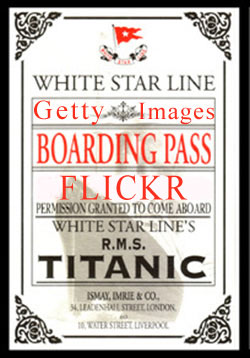
The scene from the movie Titanic where the musicians continue to play (info here) as the ship is sinking, is, to me, evidence of the musicians' head-in-the-sand (pardon the soon-to-be-pun) mentality they exhibited.

Just as the water breached the hull, filling decks, trapping passengers unaware, so too, is the sinking hulk of Getty Images doomed to sink into the history books as the largest photo agency in the world, sunk by the iceberg microstock.

The ship that is Getty Images has essentially broken in two. There's the bow of the ship, represented by their Rights Managed Stock, a consolidation of countless other agencies' rights-managed collections. This was the most prominent of the business, yet when the microstock iceberg slashed its' hull, the stern, made up of iStockphoto and JupiterImages, became the dividing point within the company. Now, this ship has ceased forward motion, and life preservers are being handed out to the hundreds of employees who, over the last year or so, have departed.

(Continued after the Jump)

Just as this article notes about Captain Smith, "His legendary skills of leadership seem to have left him, he was curiously indecisive and unusually cautious", so too "Captain Klein" seems to have taken a 'everything will be a-okay' approach, when he wrote yesterday "We must take decisive steps to ensure we emerge from this recession strong and able to best preserve the success of Getty Images" in his missive to the "engine-room" and "crew" of the R.M.S. Getty (in this case, R.M.S. stands for "Rights Managed Stock").

The paying customers are fleeing, or headed to the stern, for a better opportunity to survive. But how will they? Getty's customers have suckled at the teet of free and cheap for so long, that a budget for a piece that used to be $5,000, and would bring in a handsome profit to Getty and the contributing photographer, has, over the past few years, been slashed to costs of $100 or less. It's like the smack dealer who offers free or cheap samples, gets the addict hooked, then raises rates. Whomever is the Robert Ballard of Getty Images will have to salvage the visual riches of Getty's rights managed collections, and let the steerage visuals sell for fractions of a cent, and then Gettys' Ballard will have to figure out how to raise the rates on clients who have built their budgets based upon deflated budgets. Yet, raising rates on a free-and-cheap clientele will likely proove harder than the actual raising of the Titanic.

Just as the radio callsign of the Titanic was MGY, the stock ticker for Getty was GYI. Just as the route for the Titanic, built in the Harland and Wolff shipyard, was the U.K. to New York City, "Captain Klein's" business dealings took him from Hambros Bank Limited in the U.K., to now being in New York. Almost 100 years ago to the day, The Flickr Collection debuts on GettyImages.com on March 11, 2009, construction of the Titanic began on March 31, 1909 (info here). Funded by J.P. Morgan, the founder of the same company that reported "JPMorgan Chase on Wednesday ratcheted up its expectations for losses", back in November (here) as "Captain Klein" tried to suggest they were doing the right thing "We have tried very hard to avoid lay offs during the continued turmoil in the world’s economy. However, it is now clear that we have no alternative." While these comparisons take a humorous tact, they do point to the notion that sometimes when you build it too big, and get a notion in your head of "unsinkable", that troubling mindset could well apply to Captains Smith and Klein with relatively little humor and a great deal of criticism of the course both have charted.

If you are still employed at Getty Images, you are those musicians. You know your ship is sinking. Telling your clients that everything is just swell and not to worry, is like band leader Wallace Hartley striking up the next upbeat ragtime tune as the deck listed 40 degrees to port, and as the IT people continue to stoke the steam-powered engine of the Titanic turned Getty. With the job market bleak, and 8% unemployment figures, I don't blame you for going down with the ship, and collecting every last paycheck before you're deemed redundant, but I do hope you have found your place amongst the last life boat passengers, have your rolodex in place to depart under escort by a rent-a-cop guard. Don't leave any ramen in your desk drawer, you may need it as you wait out the downturn.

If you know your company is going down, don't lie. Lying is what gets people in trouble, as in, false representations to clients. If you learn that your company is closing down in a specific period of time, it is likely unlawful to collect fees for a license that you know extends beyond that date, so be sure to check with your own attorney for the best legal advice on this, but know that lying is what gets people in trouble as people are looking at people to point fingers at, and lay the blame on.

Please post your comments by clicking the link below. If you've got questions, please pose them in our Photo Business Forum Flickr Group Discussion Threads.


[More: Full Post and Comments]

Sunday, November 25, 2007

The BBC & The 'Infinite monkey theorem'

It's nice to see that the venerable old BBC can write an article about how Shutterstock/et al are changing the landscape, and revealing the damage it's doing to photographers like Shannon Fagan, which is reporting that "his livelihood is under attack thanks to a proliferation of websites dedicated to amateur and semi-pro stock photography called "microstock".

Their ilk (the microstock sites) defend their model, suggesting "...'We're targeting a different market,' says Stephen Kapsinow from Stockxpert, another stock photography website." IF that were the case - the notion that the images would be used just for school reports, or even a mom-and-pop startup who's never even thought of licensing images, it might be more palatable. However, that's not altogether the case. Designers are procuring images for commercial and corporate clients with a budget and billing those budgeted fees of hundreds of dollars, and instead, paying pennies on the dollar.

And what do the iStalkers have to say?

(Continued after the Jump)

Over in their forums, here, some are suggesting the article "...it's well-balanced and informative...", but that's a minority opinion. Instead, they take offense at snippets of the article which report that " quality is no longer a priority", and "amateur snappers do not have to be very skilled." It stands to reason that the "Infinite monkey theorem" here might just well apply. When an organization of 80,000+ photographers worldwide are snapping thousands of photos a year, this comes strikingly close to the theorem's parameters.

They then try to align themselves with Ghandi, citing him - "First they ignore you. Then they make fun of you. Then they fight you, Then you win." The problem is, as another iStocker suggested, "Oceans of mediocrity wouldn't matter at all if the search results were sorted in such a way that the cream rose to the top..." and this may well be the problem - photo buyers will want a controlled, filtered, and sorted solution, like PhotoShelter's Collection, or through Digital Railroad's Marketplace.

The article reports "Shutterstock.com was set up after founder Jon Oringer became frustrated with his lack of opportunities as a semi-pro photographer....'I went looking for a place to sell them. The top agencies didn't return my phone calls.'" So, I guess, if you can't be them, screw them? If he'd have set up an agency with market pricing, no one would have blinked. Sound familiar?

The founder of iStockphoto, during an interview with DesignSessions, is noted that he "...started his design career in 1994, as a clerk in the mail room of Image Club Graphics, a Calgary company credited with being the first to put RF images on CD-ROMs. After a piece of software essentially eliminated his job..." he then moved to and fro, and then "...During these years, Bruce sharpened his skills as a photographer...He calls iStockphoto a "true example of success born from failure." After deciding he was not going to make it in the traditional stock photography business, Bruce created a free Web site to share his images...and iStockphoto was born."

Could it be that these "frustrated" and "born from failure" photographers are living out their retribution?

Please post your comments by clicking the link below. If you've got questions, please pose them in our Photo Business Forum Flickr Group Discussion Threads.


[More: Full Post and Comments]

Tuesday, April 10, 2007

Bill Gates and Micro...stock?

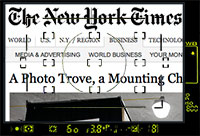
More than one person was kind enough to alert me to an interesting article about microstock and Corbis and their soon to be new CEO. In today’s New York Times article by Katie Hafner, A Photo Trove, a Mounting Challenge, there are a few interesting excerpts:
What Corbis did not foresee was the rise of so-called microstock agencies like Fotolia and iStockPhoto. These sites take advantage of the phenomenon known as crowdsourcing, or turning to the online masses for free or low-cost submissions.
True. Corbis was somewhat blindsided by this, but it was Getty who’s acquisition of iStockPhoto gave the model credence. You can slap a dress and some lipstick on a sow, but a pig’s a pig, regardless of the shade of lip gloss.

Please post your comments by clicking the link below. If you've got questions, please pose them in our Photo Business Forum Flickr Group Discussion Threads.


[More: Full Post and Comments]

Tuesday, July 29, 2008

Royalty-Free's Decline, and Jupiter Images' Demise

Paul Melcher's blog - Thoughts of a Bohemian -Jupiter is Not Responding, talks about the decline in the Royalty-Free market:


Without significant numbers, it is hard to figure out why Jupiter is having such a hard time. Guess is that they are suffering from the same effect as Getty Images : a declining rights manage market, a suffering traditional RF demand, and a microstock division not covering for the losses.
And that got me to thinking that it might be time to dust-off an old perspective that needs to be re-visited.
(Continued after the Jump)

Simply put - if you need a photograph of a man waving a flag with fireworks behind him, and I sell it to you for one time, or a limited rights package, when you need it again, you'll pay me again - and likely pass that expense on to the client. If, instead, I sell it to you once, for an unlimted amount of time and uses, I only get paid that once (and often a fraction of the charge of the first time) and you can use it forever - still likely to pass the "standard rights-managed charge" to the client - obstensively for "access to your image library" (of RF images.)

What flunkie accountant didn't see that this well would eventually run dry? Lots of up-front one-time CD sales for $249 with 100 images, organized by theme - all you can eat/use. There's no back-end resales of those images to that client - ever.

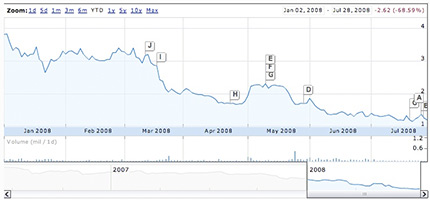
In the quest for Wall Street appeasement, Getty rolled-up many smaller companies, and slashed and burned their way through the industry. Jupiter Images (Nasdaq: JUPM) has watched a similar fate appear. Meckler points to the chart below (a 68% decline in 6 months, and heck, a year ago it was $8.14, now it's down to $1.20), and it sure looks like Getty's chart:


Should we be surprised? Nope.

Fortunately, things can begin anew, without the Gettys and Jupiters of the world (in their current form), once they're gone. The images of people using cell phones will become dated, so too people with cars, hairstyles, clothing styles, and other things that make a photo look old. When was the last time a stock image of a CRT television was used? In a few short years, the image to show was a flat-screen TV, and with the 2009 shift to digital by the broadcasters, CRT televisions are done and gone for - so to images that include them. A Motorola flip-phone? So 90's!

August 7th, when much of New York is vacationing in the Hamptons, Jupiter will have their 2Q financial results (MarketWatch reports here), and Meckler suggests they're reveal there a slashing of upwards of 100 employees. When you run into once of these employees, remind them that the historical excuse for why they were attempting to devalue the business by selling microstock/Royalty-Free - "I was just doing my job", or "I was just following orders", just doesn't excuse their behavior.


Please post your comments by clicking the link below. If you've got questions, please pose them in our Photo Business Forum Flickr Group Discussion Threads.


[More: Full Post and Comments]

Saturday, October 10, 2009

Getty Images - Business Fantasy Update

For those of you Getty-ites who are no longer in the seemingly ever-shrinking inner circle of Getty Images, you're likely missing the pie-in-the-sky missives from the Wizard himself, Mr. Jonathan Klein. Kleins' delusions musings about the future of the stock photography industry and Getty's place in it is like watching a CNBC panelist advise you to buy AIG:


Mr. Klein and the green-eyeshade brigade have resplendent ideas that are more in line with the musings of the great Hunter Thompson while on a bender with Amy Winehouse. Yet, because of his pedigree (not to mention the fact that his title is co-founder and CEO) the dwindling masses of Getty true-believers (note - those are the people who have not gone through their intervention yet) drink Kleins' missives as Jim Jones followers drank his Kool-Aid.

In recent days, Klein has, like Moses from on high, handed down what he terms his "Business Update", with a variety of confidences and pride that are best saved for the likely future screenplay - Fear and Loathing in Seattle. (Hint - that's the fear his writings could convey in the form of more layoffs, and the loathing the sobered-up employees have after the bender juice wears off). Reading the missive, and the commentary that follows it, you'll realize these analogies are not too far off their mark.

If you want to read the musings of Mr. Klein, feel free to read on:

(Continued after the Jump)

Business Update

Jonathan Klein Co-founder and Chief Executive Officer

Hello from New York!

I have just returned from a busy week in Seattle with the Senior Leadership Team. We met to share ideas, plan for 2010, get complete clarity about the strategy and vision and, finally, to spend time together as we had not met since April of last year. The feedback we have received from the attendees was absolutely clear – it was a great week and one of the best SLT meetings in the history of the company. It is important that I share with the whole company some of the key issues that were covered.During the meetings, we spoke candidly about where we are today. But more importantly, we focused on the opportunities ahead in 2010, and the significant investment we will be making in our future.

2010: Investing in our Future Growth

Simply put, 2009 has brought unprecedented changes to Getty Images, and the world. To name just a few: we have experienced a meltdown in the economy, a collapse in financial markets, acceleration in the decline of print advertising, and that is just for starters. We have taken our company private, obtained new owners, added a number of great SVPs (all of whom were internal promotions), reduced headcount, had a major clampdown on spending, acquired our second largest competitor, accelerated the integration of that business, brought in management consultants, paid no bonuses, decided not to give pay raises, froze pension matches in the US and launched many new initiatives, including with Flickr, with our partners from Time and now Daylife. If that was not enough, we worried about revenues since the beginning of the year and completely realigned our budget to respond to the environment.

Just reading this far-from-comprehensive list is quite exhausting. Yet, I could not be prouder of our team – employees at all levels of our company – in both HOW we have managed these and other events, as well as WHAT we have done. The way we behave matters and the Leadership Principles have always been, and will continue to be, the filter through which we have made tough decisions.

The choices we’ve made have been the right ones. I am absolutely confident that we have done almost everything right in this recession to be positioned well when it ends.

2010: Investing in our Future Growth

Businesses are using imagery more than ever. This is great news for us, but it also means that we must shift our business model and change the way we operate to more directly align with how our customers use imagery, and where our business is going.

The major trends we are seeing in our business today are:

· Traditional creative stills (RM and RF) is becoming a smaller part of our business. Our customers use more imagery online, which means more volume, but at a lower price. Big-spend print campaigns are not dead, but there are certainly fewer.

· iStockphoto is the fastest growing part of our business. It is expected to hit $200 million in revenue this year – that is growth of more than 35 percent.

· Editorial imagery (news, sport, entertainment and archive) is also growing. We are taking market share and will grow significantly when market conditions improve and also when there are more major sports events next year. We were once thought of as outsiders in this area, and we are now regarded as stewards and leaders. There are many countries in which we can achieve major growth in this area.

· Newer and higher-growth businesses are key to our success. Yes, Life.com and our partnership with Daylife are highly strategic. But this is not just about the “sexy new stuff.” It is about the businesses that have enormous growth opportunities, like footage, music, news, sport, entertainment, image.net and Media Manager. We also see growth potential in the Media and Corporate segments, as well as in certain countries and regions.

These trends, among others, have led us to our Key Initiatives and Overriding Objective for 2010.

Overriding Objective: Achieve company-wide revenue growth

Getty Images did not grow overall revenues in 2009. We must be a growing business, and we must increase our revenue in 2010.

Through continued focus on the Leadership Principles, our five Key Initiatives for 2010 will be:

1. Implement Project Perspective

About four months ago, we brought in a leading global management-consulting firm, Bain & Company , to help us look hard at areas where we can and should improve. Bain gave us a fresh, outside perspective on how our business is run. They focused mainly on the areas of sales, finance, and editorial and creative operations. I think it’s important to note that, unlike many businesses that Bain are brought in to review, they quickly realized that our business was tightly run and managed, and there were far fewer savings to be had than they had originally anticipated. That said, the plan is now complete, and now we begin doing what we do very well – execution and implementation.

The main outcome of Project Perspective is the crucial need to drive our customers to increase the amount of unassisted sales so that we can remove the administrative burdens that currently fall on our sales and finance organizations. In order to do this properly and responsibly, our infrastructure must be improved. This means we will be increasing our normal technology investment by approximately $6 million, or 25 percent, to complete infrastructure and technology projects. Many of these projects have been waiting for years to be completed, and we will now finish this work, enabling us to be a more efficient business. Project Perspective takes us from being the best in our industry, to becoming the best in any industry, from both a back end and customer facing perspective. It is a continuation of the work we have done to make it easier for customers to purchase from us, as well as to convert prospective buyers into Getty Images customers.

The timing is right. As a private company, we can now focus on our long-term strategy and invest in our business for growth. It’s important to mention that implementing Project Perspective will take time; there will be much more information coming to you soon as the plans are put into place, so stay tuned.


2. Build the market-leading subscription business

Subscription is a fast growing part of the market, and an area where we have had a long-standing gap in our product portfolio. Jupiterimages Unlimited brings a very good base from which to start, but we will create an entirely new subscription business that builds upon it. This new subscription product will be a major initiative, with significant marketing support. It also represents a major collaboration between Getty Images and iStockphoto. We may not be number one in subscription – YET – but we know how to get there and will get there.

3. Sell all products in all markets

As I noted earlier, traditional creative stills continues to decline, and even if we see a bump in revenue here after the recession, we must expect that the trends will continue for it to be a smaller part of our overall business. Yet we know customers are using more imagery than ever, and want our services across the board. This means we must sell more products to drive growth. We have seen some great success with some of the new pricing models for creative imagery, with cross-selling footage, music and our other products in 2009 – and we must accelerate that in 2010. Offering ALL our customers ALL our products and services in ALL segments and in ALL countries remains critical.


4. Enhance and build on iStockphoto's leading position in microstock and as the digital content destination for designers

iStockphoto is the fastest growing part of our business, and it is the market-leader in microstock. But we cannot be complacent. We must embrace microstock, and we must evolve it. There are many synergies with the rest of the company that we will capitalize upon, especially in marketing, product development and technology. Additionally, designers are a growing segment for us, and iStockphoto has great brand and market position to allow us to broaden our product offering with this customer base.


5. Improve website conversion rates

In recent months, we have seen significant success in growing traffic to our sites. However, we are facing challenges converting these visitors into buyers. This is not just a website issue – it’s also about product, pricing and licensing models. This Key Initiative dovetails directly with implementing Project Perspective – converting visitors into purchasers on our website means more unassisted sales. This is key to our long-term business, growing revenue and growing our business.

You may see an overall theme emerging from our 2010 Key Objectives and Initiatives – in fact, it was also the overall theme of our recent SLT meetings – Investing in Growth. After one year of being a private company, and after navigating the rough road of 2009, we can and must think strategically, long-term, big picture.

In the last few months, the bad news has come in droves. But optimism has played a key role in getting us through these tough times, and I am proud of the way we have handled it. It is up to all of us to continue to step up and inspire excellence. As we head into 2010, I look to each of you to collectively embrace optimism and to increase our standards of performance. We must also continue to maintain our strong focus on the Leadership Principles. They have been a key part of our company for eight years now, and have been essential to navigating the tricky times of the past 18 months. I am very proud of this, and am more certain than ever that we must continue to adhere to them as we turn our focus to growing the business.

Finally, on a personal note, thanks so much for being on my team during this period. I know you are all working harder than ever, you have sacrificed personal time and put more of yourself into our company than ever before – this has not gone unnoticed. We will emerge from this year and this recession a much stronger company.

Getty Images will be 15 years old next year and this is the best team we have ever had at the helm. 2010 will be a big year for us, and I look forward to the important work we will do together.

Thank you,

Jonathan Klein

Co-founder and CEO


Let's take break out a few things, worthy of commentary:

Suggestions about being "...one of the best SLT meetings in the history of the company" and ending with "Getty Images will be 15 years old next year and this is the best team we have ever had at the helm" is hyperbole at its' best. This double-use of the word "best" is just laughable when you look at the history of the company, in the high-flying days when the company was at $92 a share on open market.

Usually, when someone in the higher echelons of a company writes "Simply put, 2009 has brought unprecedented changes to Getty Images, and the world", they are speaking in the positive sense. Yet, the "unprecedented" is in reference to the negative aspects "meltdown in the economy" and "acceleration in the decline of print advertising" and others. He goes on to talk about all the great SVPs they've hired, and then holds out the hope to those who did not get a promotion that theirs just might be coming, when he writes "(all of whom were internal promotions)". Nice way to hold out hope. He goes on with the superlatives "Yet, I could not be prouder of our team – employees at all levels of our company – in both HOW we have managed these and other events, as well as WHAT we have done. " Really? How about the pride you had when you aquired WireImage, team members that secured sports league contracts, and so on? You're prouder now than before? Really?

Klein acknowledge the obvious when he notes "Traditional creative stills (RM and RF) is becoming a smaller part of our business" followed by "iStockphoto is the fastest growing part of our business. It is expected to hit $200 million in revenue this year – that is growth of more than 35 percent", but what he does not do is link the two. The growth of iStockphoto has been at the expense of the RM/RF image revenues. Thus, a 35% growth of 10,000 $1 sales means you grew your business at the expense of about 4 of your previously stated average RM sale of $970. Wow, that's great!

Klein states "Getty Images did not grow overall revenues in 2009. We must be a growing business, and we must increase our revenue in 2010. " Good luck on that one. With the growth of $1 images, and the decline (in several cases self-inflicted price-point declines) of RM image licenses, I don't see how that can happen.

Klein acknowledges that they had Bain & Co in, in an effort to slash costs. Their conclusion? not much fat on the bone to cut. You could have saved a lot of money if you had just asked your over-worked photographers and front-line editors who would have told you this, and then maybe they could have gotten those bonuses you said you didn't pay.

Klein discusses their goal to "build the market-leading subscription business", which has been the laughing stock of many of your contributors, who point to $0.46 payments from these business models as the real analysis of where stock photography is going - down the tubes.

Klein cites the reality that "traditional creative stills continues to decline, and even if we see a bump in revenue here after the recession, we must expect that the trends will continue for it to be a smaller part of our overall business." Hmmm, does that mean you're done wreaking havoc in this market and you're headed off to ruin other markets in the same way?

It was just a short time ago Getty's new website was touted to have "Numerous enhancements make it easier than ever to find a specific image or discover an expanded selection of relevant visuals", and "Extensive customer input and usability studies informed the development of Getty Images' added site features", with Klein being quoted as saying “We owe our customers a great deal of credit for this innovative rebuild...[t]heir input and expertise has allowed us to preserve the strengths of the old site and introduce a host of new features, resulting in a more agile and interactive gettyimages.com that is uniquely equipped to enrich the current and future communications landscape.” Yet, in the missive above, Klein acknowledges "we are facing challenges converting these visitors into buyers. This is not just a website issue..." - thus, this great website is an issue, and it's not the only one. I thought you said your customers told you what they want - and now they don't want it? Which one is it?

Klein begins to close the piece "In the last few months, the bad news has come in droves. But optimism has played a key role in getting us through these tough times, and I am proud of the way we have handled it. " I would submit that it's not the optimism of your staff that got your remaining staff through the tough times, but rather, fear of being unemployed, and their loathing for the guy that has carried their company into the gutter and created a laughing stock. Hey, there's something - can you monetize humor? I think there are laugh-tracks you could hawk for a few pennies over at Pump Audio!

Klein closes with "Getty Images will be 15 years old next year and this is the best team we have ever had at the helm. " Really? Kids at 15 are just getting their learners permit, and you seem to have driven Getty into a ditch, spinning your wheels in the process because there wasn't an experienced adult at the helm. Too bad you can't actually be required to have a license to do what you do, otherwise those along for the ride wouldn't have seen your company dash their dreams. As the elderly are eventually required to turn in their licenses when they are a danger to themselves and those operating within their proximity, perhaps someone should come to you, Mr. Klein, pat your on the back, and tell you your time to run the Getty ship is over, given the damage your business models have done.

Please post your comments by clicking the link below. If you've got questions, please pose them in our Photo Business Forum Flickr Group Discussion Threads.


[More: Full Post and Comments]

Saturday, August 4, 2007

I told you so? No, not really. (Well, maybe, sort of)

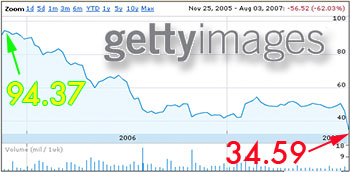
Recently, I posted an article about shorting Getty's stock as the only good short-sighted idea I could find. I was quickly criticized by Dan Heller both on my comments, and in a lengthy blog post. Interestingly enough, it was his Getty commentaries (in general) that got him hired as a stock analyst. Previously, Heller said he didn't see a downside and that the stock would stay the course. While I have never been hired as a stock analyst before, and wouldn't know where to begin if I was, perhaps they called the wrong guy? Heller's 8/2 blog entry is missing something - an acknowledgement that, either by luck or by learn-ed observation, I got it right. Getty's stock plummeted almost 20% this past week, and over this weekend, sits at $34.59. With more than one fund having millions invested in Getty, those folks still holding GYI are have taken a huge hit and are probably pretty upset. Could it have cut the other way? Sure. Could it drop again at the next quarterly report when the new website is finally launched? Quite probably, given that, in the final stretch, they fired the person incharge of that process, as Daryl Lang, over at PDN, reported in this interesting article that's a must read, along with previous related posts worth reading for further insight. Silly decision on Getty's part.

For those analysts trolling for insights - here's one, for free: When your profits are based upon ad clients and rights-managed image licensing, with an average license of around $200 or so, and you are seeing a decline in that model because you also now are the proud owner of iStockPhoto, where the license is about $1, and that model is growing while the rights-managed model is shrinking, take a hint - Jupiter Images stock (JUPM) just sunk below the $7 mark - you should be lucky that GYI is where it is right now.

One of the problems is, I wasn't actually saying you should short the stock when I posted it. It was an analysis of the stock's past performance more than anything else, and it was a critical commentary on the contract conditions under which freelancers produce work for Getty. I was suggesting that working for Getty is a short-sighted idea, that is bad, and that, shorting their stock was about the only short-sighted idea I could find. It was a funny play on words to make the point about how bad GYI is for the field of photography that they rely on. I hadn't shorted it before, and I didn't short it this past week. As they always post as a disclaimer "past performance is not an indicator of the future...".

Getty has given validation to the istockphoto company, and more importantly, it's model, and is further encouraging other companies to buy up other microstock competitors. In addition, while high end clients may have gone to Getty for imagery before, and avoided the cheaper options, now those RM clients are far far more comfortable avoiding paying the "front of house white tablecloth prices" for a meal, and instead, going around back to the alley entrance to get the same meal on a paperplate for a fraction of the price.

Try this - Go to the Getty Images site, and, say, you are looking for a photo of The White House. Under "news editorial", not a single photo on the front page, with a search return (as of today) for 'the white house' - 46495 images found, is of the actual White House. It's all photos of the President. Changing to "all editorial" instead of "news", yields 51614 images found, but again, no photo of the actual building I am searching for.

Finally, when searching the "creative" division, I get 127 images found. Really? Only 127? The first page of about fifty images yields only 30 images that fit the bill, and there are mis-identified images as well, including one of the Capitol, and one of a field of Cactus with a white building (house?) at the top of the frame.

Go to istockphoto, and the first three images from the home page search are what is being sought, including this one - The White House on iStockPhoto.

This image on istockphoto, submitted by DHuss, looks remarkably like this one submitted as a part of the National Geographic Society's collection, photographed by Richard Nowitz.

This one, on the Getty Images site shows the White House at dusk. So does this one, on iStockPhoto.

Interestingly enough, the iStockphoto site yielded more to choose from (182), and the right results, first.

A search for "golden gate bridge" on Getty yields 555 images. An Istockphoto search? 870. Both front pages yield perfectly usable photos, sharp, clear, all angles, and so forth.

I could go on, there are countless examples, you get the point. While Getty isn't revealing how much of their RM clients are turning to the IStockPhoto solutions, clearly, the content is there for the picking, and, based upon the White House example above, iStockPhoto is actually a better resource.

I've been criticized by others for suggesting that what people are doing, and the microstock model in general, is bad for the field of professional photographers. That doesn't make what I am saying false, people just are choosing to bury their heads in the sand. Consider this - when a paper or lumber company plants seedlings as they cut down 100-year-old trees, they will never see that benefit themselves, not in their, nor their grandchildren's lifetimes, but it is "priming the pump" for future forestry opportunities. This is a long-term good idea. Getty's (and they are, by no means, alone) way of paying photographers diminishes the creative stock, and they are depleating it faster than they are replentishing it. There is no reforestation. Getty is the big dog in town, and has a responsibility to "reforest" the creative population, and protect their current assets. They are not doing this to support long-term growth, they are doing this to appeal to Wall Street demands. Next up? Well, let's see - when a stock tanks from a high of over 90, to below 40, with no signs of a resurgence, and only a hope of stopping the blood-letting, there needs to be more of a transfusion than the dumping of the website leadership, a wholesale new CEO is needed. Jonathan Klein needs to head to the unemployment line - perhaps the next 1.5 million dollar glitch needs to be related to his salary ( Andy Goetze over at Stock Photo Talk has a 2004 article giving you some ideas as to his past compensation.)

Forbes reported what happened at GYI. An AP article notes "Baird analyst Steven Ashley cut his price target...He also noted that demand is shifting toward less expensive images....", and then went on to say GYI was still attractive "...since most of its images are owned by independent photographers and are created at their expense."

Right. The indpendents still own their own work, and can sever ties with Getty under their contract terms. That means that Getty could have a lot of empty hard drive space and idle servers, which is why they are working very hard to secure wholey-owned content which can't walk on a whim.

Thanks to Stanley Rowin for writing here about Heller's blaming "human behavior", and noting that perhaps, I got it right. Rowin points out "...it’s the stupid humans that make up the market force that determine how photography is priced, no longer the photographers." Right Stan - the bean counters cannot possibly know what goes into being a photographer, the costs, and thus, when properly schooled in their own self worth and costs-of-being-in-business, a photographer can properly value their own work. There's one exception I know of - John. He's an accountant in Baltimore who is also a professional photographer - he gets the right brain and the left brain stuff!


Please post your comments by clicking the link below. If you've got questions, please pose them in our Photo Business Forum Flickr Group Discussion Threads.


[More: Full Post and Comments]

Thursday, July 10, 2008

Microsoft Pro Photo Summit 2008 - Recap

What can I say about the Microsoft Pro Photo Summit that just concluded today on the Microsoft Campus in Redmond, Washington? Well, let's start with what other folks have said:

There was a degree to which I would echo the question PDN asked - is amateur the new professional? I can't say that you are, by definition, a professional photographer if you've been paid for your photography. There's an interesting thread over on SportsShooter about this, where someone wants to become an NPS member along these lines. Jeff Greene posited the question to Miss Anieila about her future, and ended his question "...when you turn pro." This set forth Jeff's assumption that she wasn't already, and her response was that she considered herself a professional because she'd been paid for her work.
(Continued after the Jump)

Yet, Jeff's question was an informed one - as Jeff perceives that a professional is one who's profession is photography, and one's profession is defined by, I'd think, what you do to earn a living. Let's take the question first to Merrian-Webster:
Professional - "participating for gain or livelihood in an activity or field of endeavor often engaged in by amateurs (a professional golfer) b: having a particular profession as a permanent career (a professional soldier) c: engaged in by persons receiving financial return (professional football)"
By that definition, and let's consider that an old-school definition, possibly in need of updating, she might not have yet achieved "professional" status. However, she's among the "new school/new paradigm" photographers that are emerging, so, looking to a possible new-school definition, turning to Wikipedia for a slightly more verbose definition, Wikipedia details Professional, in part:
A professional is a person in a profession which requires certain types of skilled work requiring formal training or education...A professional(Kamal Shanmugam) is a worker required to possess a large body of knowledge derived from extensive academic study (usually tertiary), with the training almost always formalized. Professionals are at least to a degree self-regulating, in that they control the training and evaluation processes that admit new persons to the field, and in judging whether the work done by their members is up to standard. This differs from other kinds of work where regulation (if considered necessary) is imposed by the state, or where official quality standards are often lacking. Professions have some historical links to guilds in these regards...Typically a professional provides a service (in exchange for payment or salary), in accordance with established protocols for licensing, ethics, procedures, standards of service and training / certification.
Now, that presents problems too, because of the notion that the field of photography could certify those allowed to call themselves professionals like doctors of lawyers. That has always been a complaint of my fellow photographers - that they wished there was some certification process, a union, or some other way to "police" the profession, and to that end, PPA has instituted certifications, but few photojournalists or commercial photographers I know have them, or even know of them. They are used by the many wedding and family/school portrait photographers, but it's a start. Interestingly, New York State is trying to require a certification of Wedding photographers - likely after a legislator or legislator's staff member had a bad experience with one (Lightchasers blog entry here, entire proposed law here). ASMP has a review process for admitting members, and other organizations, like the WHNPA and APA have as a requirement the recommendation of current members.

Surely, other notions put forth question the "PRO" level of the summit - with presentions suggesting that you should give away your work for bloggers to use on the internet for the purposes of getting your name out. I questioned Lou Lesko on this, as he was the one who proposed that idea saying that this model in the analog/old-school days was called "will work for photo credit", and over the years has not turned out to be a viable business model.

This event was surely a "PRO" photography summit, and where there might be questions about the benefits to "professionals" about presenting istockphoto photographers, self-portrait artists like Ms. Aniela (Flickr site, her site) fame coming from Flickr, the notion that you should work for today's version of a digital photo credit, there should be no question that these perspectives and paradigms will continue to have an impact on those that earn their livelihood behind the lens and meet both the Merriam Webster ("participating for gain or livelihood in an activity or field of endeavor often engaged in by amateurs") and Wikipedia (a professional provides a service (in exchange for payment or salary), in accordance with established protocols for licensing, ethics, procedures, standards of service and training / certification) definitions of "Professional".) definition.

Jim Pickerell spoke on the subject of Microstock, as noted in the PDN piece, and did his best against Lise Gagne, who talked about how great it was to be among the most prolific istockphoto producers, after she herself was used to paying several hundred dollars per use for images during her time as a designer - a job she got fired from because she was spending so much time making $1 images for microstock. As she kept talking, I kept thinking "I know that that image that you sold for $1 left so much money on the table you'd be retired in Fiji with what you could have earned licensing even a tenth of those images for traditional rates".

I was asked to speak again this year and update attendees on the subject of Orphan Works, and I was asked to present opposite Vic Perlman, General Counsel and Managing Director of ASMP. I thought twice, and then three or four more times, about that idea, but since my proposed presentation topic on the state of search engine optimization in our field, and how things are evolving (I had a great plan to talk about some of MSN's value to photographers) got nixed, I accepted, after trying to talk to two other people about being there instead. Given my serious criticisms of the ASMP position, and my otherwise appreciation for the work they do in so many other areas, I preferred to talk about SEO, but it was not to be. I felt that much of the audience, albiet experts in the field of photography's many facets, likely knew little about the legislative process, so I opted to spend 3-4 minutes of my time giving people a primer on it, and then get into all the problems of the current version of Orphan Works. Both Vic and I agreed that the chance of the final bill getting all the way through and headed to the President's desk for enactment was highly unlikely, we did disagree on the extent to which the bill will look different in it's final form from what it looked like now. Backstage Vic and I discussed other issues on copyright unrelated to this, yet there were a few folks (and I'm guessing from ASMP) that expressed a concern that I might attack ASMP onstage, as if, somehow, I am an unreasonable person. Hmmm, not sure why those that had those concerns felt that way, but that had never been my approach. In fact, with the vast number of problems with the current version of the House bill that I believe are fixable, and my interest in conveying the legisltive process primer, I had my hands full with talking about that. So, if you were among the two or three people reading this that had that concern - I'm sorry that I didn't live down to your expectations. Of note was almost the complete absence of panel discussions this year - the differing perspectives Vic and I presented on the status of Orphan Works could have been augmented with the perspective from the other side - someone from the libraries or museums. Yet, in the end, I felt that people's attention was drawn to this serious issue of Orphan Works, and that has a net positive benefit in the end. If you're interested in the changes that I discussed, and how they would take the form of amendments to the 5/8 version of the bill, send an e-mail to orphanworks-AT-photobusinessnews.com and an autoresponder will give you a link to download the PDF. It's a fairly extensive and exhaustive 30 page document.

One of the things that was presented here were visual stimulation and insights from Frans Lanting, reknowned nature photographer and Melina Mara, from the Washington Post. Against a heavy backdrop of mind-overfowing information on the state of the industry, and peeks into the future, both presentations provided a left brain break to allow the right brain to get in some exercise, and both were appreciated by me.

The audience seemed to be made up of about 20% full-time photographers who rely on getting and keeping paying clients to pay their bills (as differentiated from people who produce products or services to be used by photographers but also are photographers themselves) and a presentation by Skip Cohen, of WPPI on marketing to photographers was engaging and entertaining. I am guessing that the CTO's, company Presidents, and CEO's on hand were not as engaged as I was. I certainly enjoyed what Skip had to say. He said he was condensing into 10 minutes or so a four hour presentation he normally would do on the topic, so that tells me to tell you that if you're somewhere where Skip is doing that four hour presentation, make sure you don't miss it.

Other things that were amazing was the demonstration of the PhotoSynth application, which it was said, could be released as early as this Fall. I will be among the first to get my hands on it - it's an amazing application that would cause me to upgrade my aging PC and just so I can install and use it - for that reason alone. I also concluded that adding a Windows Home Server (currently only available in the US through HP) is on my to-order list when I get back to the office. A $599 or so cost for the ability to access my data back in the office - even in parallel with Apple's Back to My Mac capabilities - is a small price to pay, in my opinion.

Also something that I really enjoyed was the impromtu breakout session (that actually happened during lunch on Thursday) with half of the Expression Media team. They talked about the current version, and listened (and took copious notes) from the feedback that was provided. If you're a Lightroom or Aperture evangelist, don't count Expression out - they have some amazing plans as they move forward.

Also of interest was the presentation by David Reicks, on behalf of the Stock Artists Alliance, on metadata, and how it is being handled by several of the big agencies. I'll write more on this later, but suffice it to say that it was an eye opener on a Thursday afternoon that kept my attention.

Josh Weisberg did an excellent job of shepherding the speakers along (including me, when I ran 3 minutes over), posing good start-off questions of each of the presenters after each presentation, and minimized the "we're running behind" issue that so often arises at conferences like this - that was no small feat.

I was able to have about 80% of the offline conversations during the breaks and reception that I wanted to have. As I was leaving for the airport, Neil Latham, who was the ever-so-patient speaker liason, thanked me and said he looked forward to seeing me at next year's summit, if not before. Me too, Neil. I look forward to the next Summit - it provided an abundance of insights into the future, and learned perspectives on the state of our industry.


Please post your comments by clicking the link below. If you've got questions, please pose them in our Photo Business Forum Flickr Group Discussion Threads.


[More: Full Post and Comments]
Next Posts