Sunday, August 19, 2007

Digital Railroad’s Marketplace - Summary

Digital railroad of course, must serve it self (and it's investors). However, that turns out to be a byproduct of serving up images (mine, and many others) that generate revenue for photographers. And we, in turn, get to serve up services that meet client access needs, as well as serving the secondary market for these images, post-assignment, that is rights-managed stock.

Back in the analog days, I used to consider that whenever I was sending my agent, Black Star, my images, it would be at least six months before I actually saw any revenue from them, sort of like priming a pump. Yet, that point would be arriving in October with an April “opening”, yet it’s months before that and checks are arriving - out of the gate no-less. Controlling which of my images goes on my branded site, as well as out to the Marketplace is important to me.

Am I pleased that DRR also is providing a vehicle for Royalty-free images? No. However, I think that they have to at least say that they offer that, but I hardly think that they will be able to sustain themselves on their 20% revenues from the nominal, one time revenues that RF would bring them.

It seems like this train has left the station and is full steam ahead. If you’re not aboard now, DRR and Marketplace is worth a serious look. I'd expect that, in short order, whether via additional image licensing, or as a mark-up-able service to clients, both the Marketplace and Digital Railroad's services could be a profit center for you too.

Digital Railroad – All Aboard?
Digital Railroad’s Marketplace - Overview
Digital Railroad’s Marketplace - Getting the Word Out
Digital Railroad’s Marketplace - Client Experience
Digital Railroad’s Marketplace - Photographer Experience
Digital Railroad’s Marketplace - Summary


Please post your comments by clicking the link below. If you've got questions, please pose them in our Photo Business Forum Flickr Group Discussion Threads.


[More: Full Post and Comments]

Au Contrare Mon Frere! Or, Tip for Microstockers: Don't Quit Your Day Jobs

I have great respect for my colleague Jim Pickerell. So much so that almost about a decade ago, I hired him as an expert witness. Yet, I'm going to have to disagree with his example of a microstock success - Erik Reis: Microstock Success Story, over on Black Star Rising.

I responded, in parts:

  • "microstock photographer Erik Reis is happy with his results." You cannot equate this individual's being "happy" with their results, as someone who's an example of a success story. Just as people can be successful and not happy, so to, can people - especially hobbyists - be happy and not successful.
  • Jim then writes about Reis, that he "acknowledges that only about 10 percent are good sellers." Ok, so, out of 1,338, only 133 are good sellers. That's not so good for a year's work. Even worse for two year's work. My advise to Reis - don't quit your day job.
  • Then Jim goes on to reveal "As is the case with the majority of the more than 70,000 microstock photographers, he has chosen to put the same images on many different sites."...Every stock agency (including Getty and Corbis) specifically preclude you by contract from placing the same images with them, because it's been proven to be bad for the agencies, and, as noted by clients - it's been proven to upset clients when they find the same images in searches at many different places.
  • The one shining point is the insight that iStockPhoto is not a satisfactory revenue producer, and that other smaller sites are better for them.

Please post your comments by clicking the link below. If you've got questions, please pose them in our Photo Business Forum Flickr Group Discussion Threads.


[More: Full Post and Comments]

Thanks for the Tip Amazon - But Where the Hell is Nikon?!?

Amazon.com let slip the details of the latest Canon, which thanks to this thread over at Fred Miranda, we can now peruse:

Canon EOS 1Ds Mark III 21.1MP Digital SLR Camera (Body Only)
Price: $7,999.99

Product Features and Technical Details
Product Features

* 21.1-megapixel full-frame CMOS sensor
* Large 3.0-inch LCD display with Live View and seven brightness settings
* 5 fps at shutter speeds 1/500 second or faster (for bursts of up to 45 Large/Fine JPEGs or 15 RAW images)
* sRAW mode; 35-zone metering system; 45-point AF; integrated Self-Cleaning Sensor Unit
* Powered by LP-E4 lithium-ion battery pack; stores images on CF, SD, or some SDHC memory cards

Technical Details

* Effective resolution: Approximately 21.1 million pixels (total pixels: approximately 21.9 million)
* Recording pixels: 5616 x 3744
* Sensor type: Full-frame CMOS sensor, with primary R-G-B filtration (28 x 18.7 millimeters)
* Pixel size: 6.4 microns square
* Lens focal length factor: None (1x)
* Imaging processor: Dual DIGIC III image processors
* Maximum frames per second: 5 frames per second (fps) at shutter speeds 1/500 second or faster, in all recording modes
* Drive modes: Single; silent (single-frame); high-speed continuous (5 fps; adjustable 5 to 2 fps); low-speed continuous (3 fps; adjustable 4 to 1 fps)
* Maximum number of frames / burst: JPEG: 45 (full-resolution, Level-8 fine compression); RAW: 15; RAW plus JPEG: TBA
* Flash sync speed: Up to 1/250, with EX-series Speedlites
* Shutter "lag" time: Approximately 55 milliseconds (from half-way to fully depressing shutter button)
* Start-up time: 0.15 seconds
* Image type: JPEG, RAW (14 bit); improved A/D conversion to 14-bit processing for 16,384 individual tones
* Highlight tone priority: Improve tonal range in highlight areas by approximately 1 stop (C.Fn II-2)
* Noise reduction: Long exposures 1 second and longer (C.Fn II-1); high-speed ISO images (C.Fn II-2)
* Storage media: Compatible with two card slots and external storage media; CompactFlash (Type I or II, including MicroDrives); SD card slot (SDHC-compatible for 2GB higher SD cards); USB external hard drives (requires optional WFT-E2A wireless transmitter)
* Recording options: Multiple media recording options: record to only one memory card; record the same image to both SD and CF card; record RAW image to a CF card and JPEG image to a SD card
* New additional features: Files can be automatically written to another media if card beomes full; select different image sizes and save to different media (example: different JPEG sizes); record same image using all three media options, including external hard drive; copy files manually from one card to another, or to connected USB hard drive
* Image format options: JPEG (compression adjustable in 10 steps on menu); RAW ("CR2" RAW file format); RAW + JPEG (selectable on rear LCD panel); sRAW ("CR2" small RAW file format; 1 /4 file size of full-resolution RAW, approximately 5.2 megapixels)
* Resolution options: Large: 5616 x 3744 (approximately 21.0 million pixels); "Medium 1": 4992 x 3328 (approximately 16.6 million pixels); "Medium 2": 4080 x 2720 (approximately 11.0 million pixels); "Small": 2784 x 1856 (approximately 5.2 million pixels); "RAW": 5616 x 3744 (approximately 21.0 million pixels); "sRAW": 2784 x 1856 (approximately 5.2 million pixels)
* Data recording format: DCF 2.0 and EXIF 2.21; EXIF 2.21--applies "Adobe 1998 RGB" color space tag to images
* Sound recording: Maximum 30 seconds per sound clip (more than one clip can be assigned to each image)
* Folder settings: Create new folder and select on memory card
* 3-part approach to dust reduction: EOS Integrated Cleaning System; self-cleaning sensor unit--low pass filter in front of the sensor vibrates at a very high frequency for about four seconds to "shake" off loose dust and dirt; occurs on start-up and shut down--can also be activated by user or totally disabled; Dust Delete Data: a test shot is taken and any dust spots are "mapped" and added to each image's text data; automatic removal possible in Canon DPP software; manual: user can lock up mirror to blow off any dust or have service technician wipe sensor clean
* LCD monitor: 3.0-inch (diagonal) TFT color; approximately 100% coverage; approximately 230,000 pixels
* Playback options: Single image; single image with info and histogram; 4-index or 9-index image; magnified zoom display
* Live View type: Electronic viewing of scene, directly off imaging sensor, on LCD monitor
* Coverage: Approximately 100%
* Metering: Real-time evaluative metering (off CMOS imaging sensor)
* Grid display: Two vertical and two horizontal lines; can be turned on or off by user
* Aspect ratio: Masking for 6:6, 3:4, 4:5, 6:7, 10:12, and 5:7
* PC live view: Enabled using EOS Utility (v.2.0) (use computer monitor as viewfinder)
* Shutter speed range: 30 seconds to 1/8000, plus bulb (1/3, 1/2, or full-stop increments when user-set)
* Maximum flash sync speed: 1/250 second
* Anticipated shutter durability: 300,000 exposures
* ISO range: 100 to 1600, in 1/3-stop increments; ISO 50 and 3200 can be added via ISO extension on menu; new ISO safety shift (camera shifts ISO in Tv or Av mode if needed to preserve exposure)
* Exposure modes: Manual, Aperture-priority, Shutter-priority, Program, Bulb
* Metering: 63-zone metering linked to 19 AF points; Evaluative metering (63-zone, linked to active AF point); Center-weighted metering; Partial metering (approximately 8.5% of the picture area); Spot metering (approximately 2.4% of the picture area); Options: Center only; linked to any of 19 AF points; and Multi-spot metering up to 8 readings
* Metering range: EV 0 to 20 (all patterns; at normal temperatures)
* Exposure compensation: Possible in any Auto exposure mode; up to +/- 3 stops, in 1/3-stop increments
* Exposure bracketing: 2, 3, 5, or 7 shots (selectable with C.Fn I-6); up to +/- 3 stops, in 1/3-stop increments; Standard Auto bracketing, via aperture and/or shutter speed
* Compatible flashes: Canon EX-series Speedlites (TTL flash not possible with non-EX speedlites)
* E-TTL II: 63-zone metering with EX-series speedlites; evaluative E-TTL flash metering (can be averaged over all 63 metering zones); distance information now used from compatible Canon EF lenses for flash calculations
* Flash metered manual: Possible with flash in Manual mode, via FEL button
* Flash exposure lock: 2.4% Spot metering of pre-flash illumination
* Flash exposure compensation: Possible on body for certain speedlites (up to +/- 3 stops, in 1/3-stop increments)
* Flash exposure bracketing: Possible with 580EX II, 580EX, 550EX, MR-14EX, and MT-24EX (set on Speedlite)
* Hi-speed flash speed: Possible with EX-series Speedlites, up to 1/8000 second , normal maximum x-sync is 1/300
* PC socket: Standard; sync line voltages up to 250v are OK through PC socket or hot shoe
* Number of AF points: 45 (inside of ellipse area of focus screen); 19 high-precision cross-type points (require f2.8 or faster lens for cross-type coverage); 26 assists points (require f5.6 or faster lens)
* Number of cross-type points: 19 points--any of these can be user-selected with manual AF point selection (high-precision type points; require a f2.8 or faster lens; center point requires f4 or faster)
* Focus modes: One-Shot AF (for stationary subjects); AI Servo AF (for tracking moving subjects)
* Manual AF point selection: 19 AF points ( default); inner 9 AF points (via C.Fn III 9-1); outer 9 AF points ( via C.Fn III 9-2)
* Automatic AF point selection: Possible in both One-shot and AI Servo AF modes
* AF On button: AF button on rear of body executes AF and metering; AE Lock button can switch functions with AF On button via C.Fn IV-2-1
* Viewfinder coverage: 100%, vertically and horizontally
* Eyepoint: 20 millimeters
* Magnification: 0.75x
* Focusing screen: Ec-C IV (new standard focusing screen); interchangeable with Ec-series screens from all previous EOS-1 series cameras
* Diopter: -3 to +1.0 (user-adjustable); further adjustment possible with Eg series diopter lenses
* Mirror lock-up: Possible via C.Fn III-14; new: option to have mirror remain up for multiple pictures, until SET button is pressed
* Eyepiece shutter: Built-in; activated by lever to right of eyepiece
* White Balance modes: Auto (WB is read off of CMOS imaging sensor only); Pre-set (Daylight, Shade, Cloudy Tungsten, Fluorescent, Flash); Custom (reading taken off 18% gray card or white object; up to 5 custom readings can be stored); Color Temperature (range 2500k to 10,000k; 100k increments); Personal WB settings--PC-1 to PC-5 (up to five, created in computer and uploaded into camera)
* White Balance compensation: Alter white balance in amber-blue direction, and/or magenta-green direction +/- 9 levels
* White Balance bracketing: Alter White Balance in amber-blue direction or magenta-green direction, up to 15 mireds
* Picture Style: Allows user to easily adjust the "look" of JPEG images, or RAW files processed with Canon software; six presets: Standard, Portrait, Landscape, Neutral, Monochrome, Faithful; adjustable settings: Sharpening, Contrast, Color Saturation, and Color Tone
* Digital terminal: USB 2.0 Hi-speed (Type B port)
* Video output terminal: NTSC/PAL
* System extension terminal: 15-pin terminal (connects new wireless file transmitter WFT-E2A)
* Remote control terminal: N3-type terminal
* Custom functions: 57 Custom Functions (personal functions built into Custom Functions)
* My Menu: Up to six menu settings can be stored separately for quick access
* Battery: Lightweight LP-E4 lithium-ion battery pack
* Battery information: Current power source in use (battery, AC adapter, etc.); remaining capacity (displayed in 1% increments, on camera's LCD monitor); current shutter count on this battery charge; recharge performance (displays when battery should be discarded; 3 levels)
* Main switch: Three settings: Off, On, and On with Quick Control Dial active
* Camera body exterior material: Magnesium alloy
* Chassis material: Magnesium alloy, including mirror box
* Operating temperature range: 32 degrees to 113 degrees F (0 degrees to 45 degrees C); 85% or lower relative humidity
* Dimensions (W x H x D): 6.1 x 6.2 x 3.1 inches (156 x 160 x 80 millimeters)
* Weight (without battery or CF card): 41.3 ounces (1205 grams)


What I want to know is - Where the HELL is Nikon's D3 annoucement?!?! It's been promised and rumored for some time, and I am going to be excited to see it's specs, but what the hell? How can Canon produce the Mark II, and then the !d Mark III, and now the 1Ds Mark III, and you boys at Nikon are still seeminly asleep at the switch!

While I am a dual system shop right now, using Canon and Nikon systems, I am looking forward to the new D3, but it should have atleast been announced by now. Grrrrr.
Please post your comments by clicking the link below. If you've got questions, please pose them in our Photo Business Forum Flickr Group Discussion Threads.


[More: Full Post and Comments]

Friday, August 17, 2007

My Phones and E-Mail Are Working

Dear OnRequest -

Recently I spoke with a second person who reported that you have said to them that you have tried to get in touch with me about my reporting about your failed business model(s), and my otherwise critical position about how you're trying to generate enough revenue to be: a) profitable; b) a takeover candidate, or c) ???

So, I checked, and my phones work. I looked back in all my e-mail from pre-blog launch to present, and no correspondence. And, since I actually archive my junk/trash, I checked there to. Nope. Zip. Nada. I got nothing from you.

Apparently, when you were talking to a few photographers who have expressed reservations about your business model and manner in which photographers can generate revenue from a relationship with you, your folks have come back and said things like oh, you mean that Washington DC photographer? We've tried to reach out to him, but he's not interested in talking to us. Now, that's not a direct quote (otherwise it'd be in quotation marks) but the gist of what was said to them.

If you want to get in touch with me, and provide a cogent response to what has been written and reported, please do so. However, going around and suggesting that you have done so without actually doing so is disengenuous, and quite possibly dishonest. If you'd like to respond and take apart what I've written and provide an e-mailed point-by-point response, feel free to do that too. I'll review it, and be happy to provide a follow-up piece that includes it, with any applicable commentary on my part.

The last word I heard from OnRequest was when David Norris responded to another questioner in the audience at the Microsoft Summit, who was challenging the figure Norris cited (which was somewhere above $20k if I recall) for an entire library for T-mobile to use for their new campaigns, and who was suggesting that that figure was way way too low. Whatever the actual figure, the photographer in the audience doing the challenging knew whereof he spoke when he responded that the figure was a low low low amount.

Soon I'll be reviewing what your staff has referred to as your latest contract. Supposedly, it's better this go 'round, as nothing there jumped out at the person who was kind enough to provide it. However, a contract is a form of 'the price of admission'. It gets you in the door. Next will be - how fair is what you're paying for what you're providing. Are you treating the creative talent as day laborers - paid once and never again? Or, are you paying them 50/50 or all licensing revenues as an agency, or 80% to them and 20% to you when acting as their rep? I look forward to reviewing it, and, if you actually wanted to contact me, rather than just pay that act (of picking up the phone or e-mailing me) lip service, feel free to do so. If you have concrete examples of how your business is not just serving your clients, but also acting on behalf of the photographers and creative talent that you will rely on for any longevity, I am happy to review it.


Please post your comments by clicking the link below. If you've got questions, please pose them in our Photo Business Forum Flickr Group Discussion Threads.


[More: Full Post and Comments]

The Cult of the Amateur

As I was pondering my post for today, the Colbert Show was on, and I was doing some paperwork review. One of the guests on the show was Andrew Keen, author of The Cult of the Amateur: How today's Internet is killing our culture, and I paused and watched. In fact, I was so intrigued, I hit the "record" on my Tivo, and watched the interview several times. Here are some quotes from their exchange:

Andrew Keen: "The internet is destroying our culture.."
Stephen Colbert: "....I can go on any old web site and find pictures of any old art I want…"
AK: "That’s stealing culture...The problem with the internet is it is making it increasingly difficult for artists to earn a living because everyone is stealing."
SC: "You’re just an elitist...Here’s my problem. You say the internet is just for amateurs, and that the amateurs don’t actually create great culture."
AK: How do you pay your rent?
SC: I get paid by the advertisters who give the money to the network who give the money to me.
AK: I think you’re supporting my argument....The fact is, you are a professional artist making money through the sale of advertising, on television...On the internet though, people are stealing your content. They’re putting it on YouTube. They’re undermining you as a creatve artist."
SC: "Right, and my parent company Viacom is sueing YouTube for a billion bucks, and I am sure I am getting acut of it."
AK: "Are you in support of that lawsuit?"
SC: "Oh absolutely, Go get ‘em guys."
I encourage you to get the book. While I don't believe the book will change the swelling tide, what it will do is give you insights into the new frontier, and how you can adapt to it.

Evolve or die. Differentiate yourself or perish. Being a professional photographer is not for the weak of heart or diminished drive. A friend in Baltimore sent me a few interesting Flickr links, which I delved deeper into:
A listing of all Nikon D2x users on Flickr shows an upward trend this past year of this $4500 camera:

With almost 8,000 images uploaded just yesterday. Their full Nikon chart can be seen here.

For Canon, all 1Ds Mark II cameras also shows an upwards trent this past year of this $7,000 camera:

With over 5,000 images uploaded just yesterday. Their full Canon chart can be seen at here.

These insights are not meant to scare you, but rather, to be enlightening. Reporting this isn't going to somehow reduce the number of amateurs giving their work away for free using $10,000+ in camera equipment. Reading the book will help you understand the inside machinations of what's happening, and why. When you know how and why it's happening, you can then better understand how to develop your own roadmap of your career in photography. As a byproduct of this, It can also help you to better understand the mind of those amateurs, and how you could engage those most effectively when the opportunity arises, and, perhaps, in your community, school them how they are contributing to the decline of the creative products of professionals.
Please post your comments by clicking the link below. If you've got questions, please pose them in our Photo Business Forum Flickr Group Discussion Threads.


[More: Full Post and Comments]

Thursday, August 16, 2007

A Debate Worth Paying Attention to!

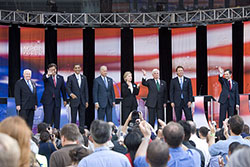
Debates debates debates. Everyone's having one. CNN, Youtube, and to the right is the debate I had to interrupt my vacation to cover in Chicago for a day - the union's democratic debate on Soldier Field. The first debates that will really matter in the presidential field won't really come until the spring. Yet, a debate worth paying attention to is that about your future as a photographer.

Enter Photoshelter, with a forum of travelling debates they've dubbed "Photography 2.0: The Business of Photography in the Web Era," to give you some real insights. A panel of photographers AND clients has been assembled in cities across the country. From the press release:

The series will commence in
New York City on September 14, 2007,
with subsequent events to be held in
  • Atlanta, September 17
  • Chicago, September 19
  • Portland, OR, September 24
  • San Francisco, September 26
  • and the Los Angeles-area, September 28
Photographers of any experience level who are interested in the future of commercial photography are encouraged to attend.
This won't be some dry presentation either - when you get photographers and clients together talking about their future working together, it'll be an informative exchange. They've got: Brittney Blair, Art Director for Chicago Magazine; George Pitts, Professor of Photography at Parsons School of Design and former Photography Director at Life magazine; Marnie Beardsley, Global Director of Art Buying, Weiden + Kennedy; Jennifer Miller, former Director of Photography, JANE magazine; Shannon Hall, Photo Director, BlackBook Magazine; Asha Schecter, former Photo Research Editor, The New Yorker; and over 20 photographers including Bill Frakes, Chase Jarvis, Amanda Marsalis, Chris McPherson, Brian Ulrich, Michael Zagaris and many more.

Now, don't expect Ms. Blair to be in NYC, she'll be in her respective city. Each city will have a solid representation of local talent and local talent-buyers.

Oh, and I forgot the best part - it's FREE! Hurry up though, as space is limited. To register, and learn more, click here.
Please post your comments by clicking the link below. If you've got questions, please pose them in our Photo Business Forum Flickr Group Discussion Threads.


[More: Full Post and Comments]

.Mobi and Mobile Platforms

PDN's Pulse blog is reporting on the latest evolution of websites - the mobile website. While Caesar Lima is among the first, I am in production to adapt my own site to the mobile platform, and that should be up soon. Caesar is using a link from his main site to a "/iphone" sub-folder. I'd submit that that will work for a few months as a cool gimmick, and then he'll be wishing he just did "/mobile" or some other non-specific title, as other devices are not far off.

For my mobile site, I've registered "http://JohnHarrington.Mobi" and "http://John-Harrington.Mobi" several months ago, and they will, once the mini-site is active, be viewable there, however, they will also be viewable by going to a page off of JohnHarrington.com which will have something like "/mobile" or some other variation that makes sense, in a generic way.

If you're stuck with JSmithPhoto.net, perhaps now is the time to get your .Mobi account with your full name! I know of many a big name photographer who's .Mobi domain name is still available. (I checked).


Please post your comments by clicking the link below. If you've got questions, please pose them in our Photo Business Forum Flickr Group Discussion Threads.


[More: Full Post and Comments]

Sunday, August 12, 2007

A Penny for your Thoughts

I was passing through a drive-through during my trek through the Northwest these past few days, and there I found an interesting insight. "Jack", of Jack-In-The-Box fame, was cited as the source for the phrase:
"Whoever said 'a penny for your thoughts' was a cheapskate."
Who knew this wisdom was a tangential byproduct of fast food? (For the 'Straight Dope' on the initial phrase, click here.)

It's so appropo to creatives. People continue to devalue what your mind dreams up, and what your mind sees. With technology making exposure and focus so much less of a hurdle to a usable image, the value of what's in your mind's eye becomes far more valuable. What you see. How you see it. How you frame it. When you trigger the shutter closed.

At some point, we evolve, as "paid people" to a cap for what we are worth as a physically producing worker. Attorneys, doctors, and consultants, are paid hundreds and thousands of dollars an hour for their extensive knowledge-bases, for their talents, unrelated to how long or how physical their work is. So too, are we, as creatives, best valued for our thoughts - how creative we are, and how we can best solve creative challenges when we're presented with them.

Remember, you set the price for your thoughts, and what your bring to the table. Don't let others dictate to you what you're worth - they will, almost without exception, undervalue (either intentionally, or unintentionally) your contributions.
Please post your comments by clicking the link below. If you've got questions, please pose them in our Photo Business Forum Flickr Group Discussion Threads.


[More: Full Post and Comments]

Wednesday, August 8, 2007

Who's the Genius Who Concepted this?

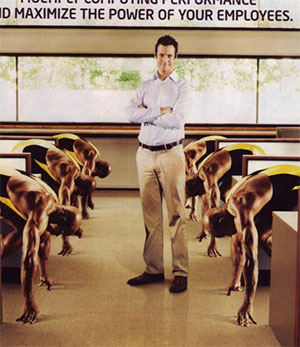
I see, to a degree, that you're multiplying "one" employee, and thus, it makes sense that it's a photoshop job on this one, composting multiple images of the same subject. But I have to ask - who styles these ads!

Everyone that I asked about this came away with the quizical "what were they thinking?" question on their minds!

Gizmodo did a piece on it, (you can see the full ad here) and now, apparently, a Vice President has been sent out to be the recipient of slings and arrows. Her statement on the subject:

Intel's intent of our ad titled "Multiply Computing Performance and Maximize the Power of Your Employees" was to convey the performance capabilities of our processors through the visual metaphor of a sprinter. We have used the visual of sprinters in the past successfully.

Unfortunately, our execution did not deliver our intended message and in fact proved to be insensitive and insulting. Upon recognizing this, we attempted to pull the ad from all publications but, unfortunately, we failed on one last media placement.

We are sorry and are working hard to make sure this doesn't happen again.

~ Nancy Bhagat Vice President, Director of Integrated Marketing
While I find it hard to believe that, AFTER the media placements had been sent out, they failed to catch only one. This could have been done better if the employees had been older white men, and the "boss" the same race, hispanic. There were other ways to execute this than the way it was.

As the photographer on the campaign, it would be your responsibility to obtain client approval on the final image before calling a wrap. Further, when you're involved in the casting, you should be sensitive to these issues - you are a part of a team concepting and dealing with the details on an ad. In the end, however, if the assignment was, say, $10,000 to produce for all your fees and expenses, and you seperately had a line item for two dozen insertions in various trade magazines over the course of a year, that rights package could be worth another $20,000 in licensing fees. However, if the client kills the campaign, unless your paperwork is written correctly, you may loose almost all of that additional revenue. Further, at that ad agency, you'll get little or no more work because you'll likely be known as the photographer that produced an ad that was critisized as being insensitive at best, and racist at worst, so you'll loose additional assignments from that firm down the road.
Please post your comments by clicking the link below. If you've got questions, please pose them in our Photo Business Forum Flickr Group Discussion Threads.


[More: Full Post and Comments]

Tuesday, August 7, 2007

Speedlinks 08/7/07

I'm off to cover the Presidential debate in Chicago today, so here are today's Speedlinks.

  • PopPhoto's Blog - Has an update on the NYC "true crime of photography" issue, and, in general, they're a good resource for you to bookmark.

  • American Journalism Review - There's an interesting take on the use of Photoshop in the news/editorial business, and digital forensics.

  • A thread over at lightsalkers - This thread is suggesting, based upon a comment by Editorial Photographers UK that those on lightstalkers are somehow trust fund photographers (oh, please!)
  • Dan Heller's blog - Titles his latest post as an homage to Admiral Stockdale, and gives me about as much of an acknowledgement as I am due -- to wit: "even a clock that doesn't run is right twice a day". He goes on to set the record straight about what he does (and does not) do, and it's worth a read.
Now go! Check 'em out, and come back soon!
Please post your comments by clicking the link below. If you've got questions, please pose them in our Photo Business Forum Flickr Group Discussion Threads.


[More: Full Post and Comments]
Newer Posts Older Posts