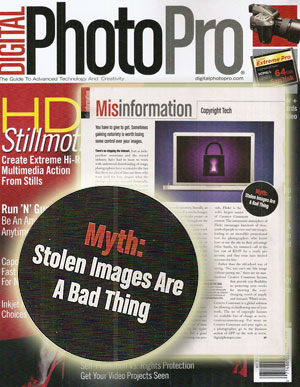
 There are plenty of purveyors of misinformation on the web, and to be sure, in print too. Yet, I was shocked to find one whose core readership are DIGITAL PHOTOgrapher PROs (hence Digital PhotoPro) telling photographers that it is a myth that "stolen images are a bad thing." What kind of idiotic advice is that, anyway?
The article, Misinformation - Copyright Tech, on the last page of the magazine (pg 118) itself espouses the notion that you can gain notoriety if your images propagate over the internet, and are appreciated by "...a lot of fans out there who want stuff for free." (I'll address that one later).
The article then says "The fine line between good publicity and outright thievery is a matter open to debate." No - that's idiotic line #2.
The article then suggests that Creative Commons is a good solution for photographers who want to share their work. Let's get this straight - Creative Commons is a mechanism for conveying a license (i.e. permission) for end users that is set by the photographer. Most people who use CC licenses are granting broad rights, often seeking only photo credit, or allowing for all uses except commercial. This - CC is a manner of granting PERMISSION to do something.
(Continued after the Jump)
There is all manner of PWC (person with camera) in the world who doesn't give a damn if they ever make a dime of their photography. Their "payment" is photo credit, an atta-boy, or bragging rights amongst their PWC peers. However, images that are "stolen" are done so without anyone's permission. If you leave a broken toy on your front lawn and it gets stolen in the night, you may not care enough to call the police, and in fact, might thank the unknown thief for taking something you were going to throw away. Yet, in the end, not only is it still theft, but you are also telling the thieves that in your neighborhood it's ok to steal, and the next thing to go will be items of value. Teaching a community that theft is ok is just plain wrong. Telling a readership of photographers that they should get over it, and evolve from "...the old-school way..." The article then suggests that CC "...provides you flexibility in protecting your works for meeting the ever-changing world of supply and demand." So, DPP editors - which is it? It's a "Myth [that] stolen images are bad thing", or, you should use CC to protect your work? You CANNOT have it both ways.
The article suggests your work will be appreciated by "...a lot of fans out there who want stuff for free." Guess what? Fans who want stuff for free is a growing audience that...wait for it...won't want to pay you. So, you can grow an audience of people who want to free-load off your creative works, which will not pay your bills.
I looked to see who wrote the article, or generally writes that column - but I couldn't find a name. Perhaps no one was willing to put their name behind the piece? Perhaps it was written collectively by the editorial staff. Among the "professional advisers" on the masthead are Jeff Schewe, Doug Sperling, and Ryan Stevens, alongside contributing editors John Paul Caponigro, Robert Hawk, Michael Guncheon, and William Sawalich. I am pretty sure that most if not all of them would NEVER want their images "stolen", let alone endorse the notion that stolen images is an idea that should be spread around. Some might want a broad CC license granted to their work, but that's a license/permission, not a promotion of the attitude that theft is ok.
In addition, a CC license extends to every single person on the planet, is perpetual and irrevocable. Further, CC does not clearly distinguish between commercial and non-commercial use either. Lastly, when applying a CC license you FOREVER forfeit the right to issue an exclusive license to anyone who approaches you to use that image. CC is a great means of destroying your exclusive rights and sapping nearly all of the value out of an image.
Please post your comments by clicking the link below. If you've got questions, please pose them in our Photo Business Forum Flickr Group Discussion Threads.
[More: Full Post and Comments]