Monday, May 4, 2009

Book Scanning Technology
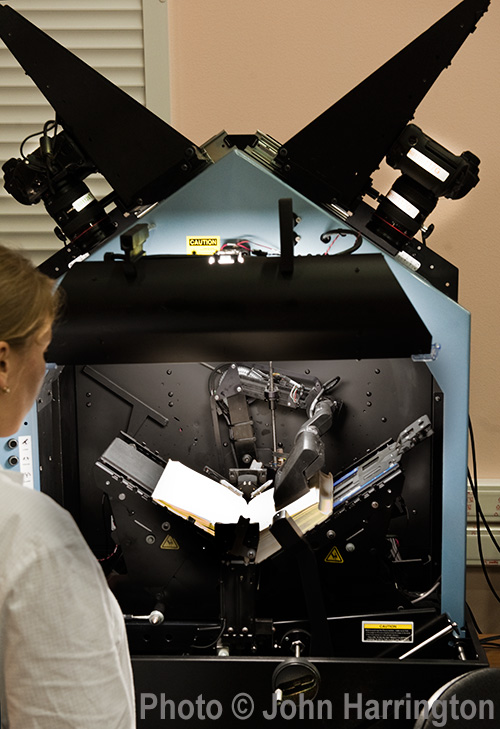
Ever wonder how it's possible to digitize books by the thousands? Who's turning all those pages? Well, wonder no more, as here's the answer - a neat little contraption with two Canon EOS cameras, and a vacuum that automatically turns the page after a high resolution image is made of each page.

We recently had the opportunity to see the digitization in action - the same process that Google is using in their project. These are custom-made units, and the connectivity is amazing. The operator is simply on hand to trigger the page capture (buttons, on the left of the console, slightly visible in this image), and swap the books. Everything else is automated. With a room full of these devices, it's no wonder the process of digitizing all the worlds' books is almost half-way complete!
(Continued after the Jump)

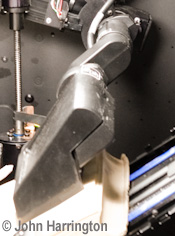
At left, note the black piece covering the right page. That is the vacuum, which has is about to turn the page, from right to left. Watching the vaccum in action, once it gets past the peak point, and begins to decend to the left, it releases the vaccum, and the page naturally falls down. The vaccum moves out of the line of sight of both Canon cameras, and both facing pages are captured, and then the vacuum moves back into position to make the next pair of images.

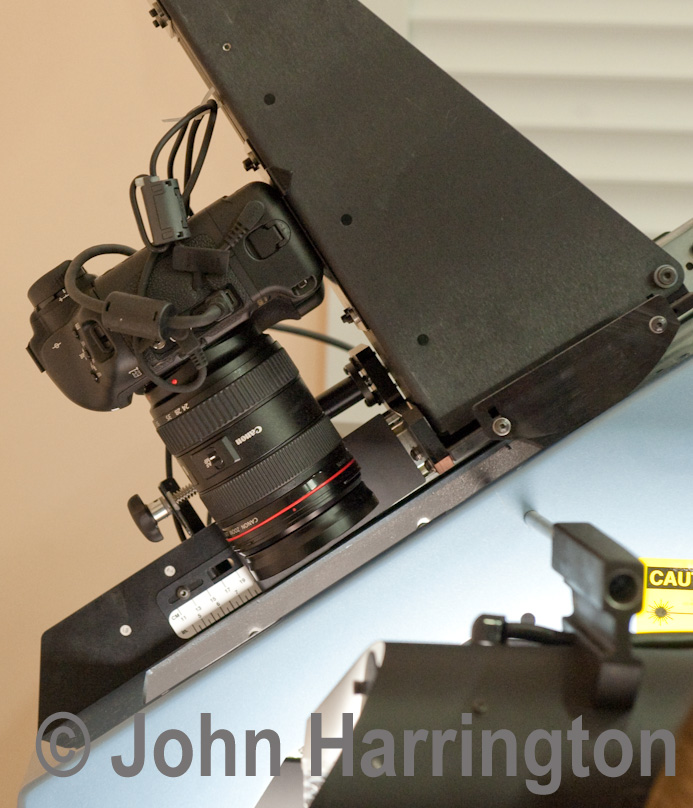
A closer look at the lens choice, shows a 24-70mm f2.8 L series lens being chosen. This would make sense, allowing the operator to make adjustments when books got larger, or smaller. The ports in use are clearly the shutter release, the USB, and the power adapter. In this closeup, the lens appears to be set at or near the 70mm mark, and the lens is also set to MF (manual focus).
This device allows for books of all ages (and even levels of fagility, if watching the delicate vaccum in action is any indication) to be digitized very quickly. New Scientist seems to be suggesting (Google sees infrared in plan to scan world's books, April 4, 2009) that scanning these books is taking too long, but that didn't look like a slow process to me, I was amazed at the speed of these machines. NPR wrote about Google's Patent application, in The Secret Of Google's Book Scanning Machine Revealed (4/30/09), but, as with all USPTO applications, the line illustrations leave a little to be desired.

Back in 2004, Information Today wrote - Google and Research Libraries Launch Massive Digitization Project , (12/20/04), about the process, and Googles plans, but to see it in action, is amazing. I was watching as books far and away out of copyright were digitized. This is in contrast to the lawsuit filed against Google, and, as reported in the Washington Post - Google Settles Publishers' Lawsuit Over Book Offerings (Washington Post, October 28, 2008), but which, as reported just last week (Google Battles For ‘Opt-Out’ Extension To Deadline In Book Lawsuit, 4/29/09),
"Internet search giant Google has requested before a judge a two month extension to a deadline for authors and publishers to opt out of a settlement to a legal battle over its intention to develop the world’s largest digital library, the Associated Free Press accounted. Google’s decision was prompted after a group of authors and their heirs asked the US District Court judge hearing the case to give a four month extension to the already effective May 5 deadline so that the “enormously complex” settlement could receive the time it was due for study."
So, the discourse continues - now with a few more visuals for you to contemplate.

Please post your comments by clicking the link below. If you've got questions, please pose them in our Photo Business Forum Flickr Group Discussion Threads.

[More: Full Post and Comments]

Get the DAM Book!

Get 'em while they're hot! Peter Krogh's The DAM Book, Second Edition is now out!

Peter's First Edition is great, and I strongly recommended it in my book. Now, he's updated it (the First Edition was from 2005!) and he includes all sorts of pointers for the latest Lightroom and Photoshop workflow solutions. It's the best and only real book that provides solutions and throughly thought out ways of thinking for the individual photographer's digital asset management needs.

There's not much more to say today, than "do not pass go. Do not collect $200. Simply spend your $31.49 and order this book now."

(Comments, if any, after the Jump)


Please post your comments by clicking the link below. If you've got questions, please pose them in our Photo Business Forum Flickr Group Discussion Threads.


[More: Full Post and Comments]

Sunday, May 3, 2009

Pete Souza - Recording History - A CBS Profile

Below is a nice piece on Pete and the work he is doing documenting history in the making.

(Comments, if any, after the Jump)


Please post your comments by clicking the link below. If you've got questions, please pose them in our Photo Business Forum Flickr Group Discussion Threads.


[More: Full Post and Comments]

Friday, May 1, 2009

Is The Amateur Really A Threat to the Pro?

Consider the photographer who has an unlimited amount of time to accomplish an image. Or, the student, who has a week or two to complete an assignment on, say, lighting a bowl of fruit. Or, the hobbyist photographer, who stumbles upon a great image. Are these photographers a threat to the photographer who works on assignment?

(Continued after the Jump)

I submit that they are not, in almost all cases. Judy Hermann, over at the ASMP Strictly Business blog wrote a few days ago - A Walk in Your Client's Shoes - and noted, in part, "If it was your job on the line, what would you need to see, what would you need to hear, what would you need to know to feel safe hiring a particular photographer?"

A track record of success is one of the key elements that a prospective client is looking for. Sometimes, a client is looking for multiple jobs for the same client in a portfolio over a period of time - say, a campaign. This suggests continuity and consistency that they can depend upon. Sometimes, a client will see your coverage of a significant event, and determine that if you were hired (i.e. depended upon) to cover *that* event for someone, surely you could cover X event that your prospective client needs you for. And sometimes, not seeing just sample work on a website, but clips and covers is a demonstration that you can deliver on time and with a high degree of certainty.

When you are a student, you might shoot the assignment three or four times, realizing you missed a critical issue each time, and then, finally got it right. The hobbyist photographer can take thousands of images of the sunset, their kids, and so on and, based upon the laws of statistics, eventually get an amazing shot. Sometimes, they simultaneously stumble into *how* to make that image, and thus repeat it. Usually, however, they don't. Einstein once famously said "The definition of insanity is doing the same thing over and over again and expecting different results.”

No one has to say "he's a professional accountant", or, "she's a professional doctor." Merriam-Webster sets forth the use of the word "professional" - "participating for gain or livelihood in an activity or field of endeavor often engaged in by amateurs {a professional golfer}", thus, "professional photographer" needs the modifier "professional" in front of it. As does "professional surfer", "professional volleyball player," and, yes "professional bass fisherman."

Journalist Samuel Friedman wrote, in the CBS News piece - Outside Voices: Samuel Freedman On The Difference Between The Amateur And The Pro:
To treat an amateur as equally credible as a professional, to congratulate the wannabe with the title “journalist,” is only to further erode the line between raw material and finished product. For those people who believe that editorial gate-keeping is a form of censorship, if not mind control, then I suppose the absence of any mediating intelligence is considered a good thing.
Rob Haggart, over at A Photo Editor, defined professional by quoting a Mario Batali, in writing that the difference between an "amazing amateur chef and a professional chef is the ability to make that perfect meal 100 times in a row." Thus, the counter to Einstein's insanity definition, is the definition of "professional" that I will put forth here. The definition of professional is "doing the same thing over and over again and expecting similar results."

How many times a month can a magazines' photo editor commission an assignment and get nothing usable back before their job is on the line? Once? Twice? If twice every other month a shoot was unusable, their judgement would be called into question and in short order they would lose their job. How about the advertising job, where the photographer can't deliver while the ad agency rep and their client are both on set, and the shoot fizzles because of the photographers' inability to deliver?

The challenge for the photo editor, art buyer, and so on, is to separate the wheat from the chaff, the professional who can deliver, from the amateur who has a nice portfolio, but can't be counted on with a high degree of certainty to produce. The problem arises, when the prospective client is not comparing apples to apples, but the professional and the amateur, as if they are interchangeable. It's one thing when the art buyer is looking at a stock image - it either is good enough, or it's not. It either meets their needs, or it doesn't.

However, when it comes to assigning work, commissioning it, or otherwise asking for images of non-repeating, or not-re-shootable work, getting a professional who can deliver, means the amateur will lose out. When the amateur doesn't lose out, a risk greater than gambling in Las Vegas is undertaken, and the commissioning party is betting their job. Over time, those who fail to discern the differences between the amateur and the professional, become the chaff to their "wheaty" brethren who survive in their field.

Please post your comments by clicking the link below. If you've got questions, please pose them in our Photo Business Forum Flickr Group Discussion Threads.


[More: Full Post and Comments]