Monday, August 13, 2012

TIPS60 - Keeping Your Memory Cards Organized

Here is another of our videos offering tips and inisights into the business of photography. a transcript of the video is included after the jump. This segment is about organizaing your memory cards.

(Continued after the Jump)
TRANSCRIPT: Here a few thoughts on organizing your memory cards. I'm John Harrington.

Obviously, we use memory cards for all the cameras were working with these days. Were no longer shooting film, as much as we have a nostalgic impression of film, we are shooting all digital. Organizing our memory cards so they don't get lost, files don't get misplaced is really critical. So one of the things that we do when were organizing our memory cards, is as we have fresh memory cards, memory cards that haven't been shot. We'll have them in our card wallet like this. When we shoot them well actually turn them over so that the back side of the memory card, with our phone number and contact information, is on it. Now. When we're done and bring those images into the office, well actually use post-it notes we use a set of 3M post-it notes here. The post-it notes get pulled out. They're actually just the right size for a memory card. They fit on the back, let us put some notes on there about exactly what's on there.

Please post your comments by clicking the link below. If you've got questions, please pose them in our Photo Business Forum Flickr Group Discussion Threads.


[More: Full Post and Comments]

Monday, August 6, 2012

TIPS60 - Sticking with your marketing campaign

Here is another of our videos offering tips and inisights into the business of photography. a transcript of the video is included after the jump. This one offers a few insights into the importance of sticking with your marketing campaign.

(Continued after the Jump)
TRANSCRIPT: Here a few thoughts on marketing and sticking with your campaign. I'm John Harrington.

When you're out there putting your information out in front of a prospective client some marketing studies have shown that you actually need to have that information in front of that client nine times in order for them to do business with you for the first time. One of the challenges, of course, is every time you place your information in front of a client they really only, one out of every three times is they only ever see consciously. So if one out of every three times they are seeing your information consciously and you need to actually put your information in front of them consciously nine times that's twenty seven times. Twenty seven marketing outreaches. So when you're starting your campaign, getting your information out there and you're sending out two or three promo pieces or promo emails or however you're getting your marketing information out there, don't be discouraged when you find out that no one's responding to you after the fourth, fifth or even tenth attempt. Because the reality is they've only ever seen it a few times. So stick with your marketing campaign.


Please post your comments by clicking the link below. If you've got questions, please pose them in our Photo Business Forum Flickr Group Discussion Threads.


[More: Full Post and Comments]
Monday, July 30, 2012

TIPS60 - Do you need a business license for your business?

Here is another of our videos offering tips and insights into the business of photography. In this one, we discuss the need for a business license, and other considerations.

(Transcript and comments (if any) after the Jump)
TRANSCRIPT:
Here are a few thoughts on whether or not you need a business license for the photography business you're running. I'm John Harrington.

Lots of businesses require business licenses some are far more formal than others. As a photographer there's lots of things that you worry about and you may not be aware that in your jurisdiction you actually may need a business license. So you want to look into your jurisdiction and whether not a business license is required for the services that you're providing, You have to be very careful and make sure that you're working within all of the rules and regulations of the town or city that you're living in.

There may be even state licensing requirements, you have to provide them with a tax ID or some other document the show's that you are paying taxes. Sometimes you need be paying sales tax depending upon the type of service you're providing and your jurisdiction. Be sure to check with your local jurisdiction and your accountant about all these things. Your accountant is one of your best friends when it comes to finding out things like this. So business license - definitely look into it and see if you need one.


Please post your comments by clicking the link below. If you've got questions, please pose them in our Photo Business Forum Flickr Group Discussion Threads.


[More: Full Post and Comments]

TIPS60 - An Introduction to the TIPS60 series

Here is an introduction to the TIPS60 video series - another of our videos offering tips and inisights into the business of photography. a transcript of the video is included after the jump.

(Transcript after the Jump)
TRANSCRIPT:
Hi I'm John Harrington and over the next - I don't even know how long - we're gonna talk to you in small sixty second blocks about a variety of different things related to the business of photography. We're going to talk a little bit about marketing, we're going to talk about business essentials, accounting software, everything that I can think of under the sun to talk to you about.

Hopefully, I can keep each time down to sixty seconds or less. So over the next couple of I don't know how long, we're going to be trying to do one a week, maybe a few more as time permits and share with you some businesses insights. As you know I'm the author of the book ""Best Business Practices for Photographers"", a book has that been really well received and so what I'm trying to do now is to put a face to the name and get some more information out there so that people can grow their business and become successful photographers.

So, hopefully, over the next months, years, or so we'll be talking to you once a week on video for about sixty seconds about the business of photography and how your business can grow and prosper.

Please post your comments by clicking the link below. If you've got questions, please pose them in our Photo Business Forum Flickr Group Discussion Threads.


[More: Full Post and Comments]
Tuesday, June 26, 2012

The Value of an Upgrade

Wish it were the case that we could return to the days where a 1960's era Hasselblad could be loaded with the latest and greatest advances in film technology to make an amazing photograph. I remember the days when I could "upgrade" from Ektacrome (EPP) to E100G, or even the E100VS. I loved going from Fuji Astia to Provia and the various speeds of Velvia. The technological advances in those films are decades ahead of when the cameras they could be loaded into were designed.  For many reasons this is unfortunate, yet, for many more, we live in an era where our ability to produce images that are amazing. And then, you have people who still think it is acceptable to not only use Photoshop CS3, but then complain that it won't work with the raw camera files because you couldn't upgrade to, say, CS5. Really? I'm not even suggesting in this case that you make it to CS6 (although you should), because even though I have CS6, I also use CS5 to process my Nikon D4 files. 

If you consider that it costs you about $200 every 18 months for the upgrade to a product you use almost every day, why would you be so cheap as to not want to be able to afford about $0.37 a day on your software upgrade? Or, if you are complaining about using an older computer, consider that a brand new MacBook Pro runs $1,200, and if you replaced it in 2 years, that's $1.64 a day for your ability to use it, or, heck, if you are crazy and amortize your computer over the IRS allocated 5 years, then it's only $0.66 a day, but really, WHO uses a computer that's over 5 years old other than your mom, who just surfs the web and types a few Microsoft Word files from time to time? 

Professionals use professional tools. At $70 a month for your internet (Verizon FIOS 15/5Mbps), you're paying more per day ($2.33) than the cost to keep your computer up to date and upgrade Photoshop ($1.64 + $0.37 = $2.01). Computers don't last forever - they're not designed to.  Hard drives are designed to last approximately 10,000 hours. A $100 hard drive thus, costs you $0.01 per hour, or $0.24 per day to own, until it is prone to crash. 

And as to compatibility, who remembers the Kodak Photo CD format? (PCD)? (info here ) The last update was December 1998, and it's difficult (at best) to access those files in the latest version of Photoshop. Zip Disks? Who can open those with ease? What about using the Nikon scanner software with the latest computer? Time and technology march on. So should you. And, who's fault is it that the latest Nikon software doesn't run on the latest Dell/Windows 7/Mac computers? Not them. Yet, the scanner actually does work just fine if you use a third party scanning solution like those from Vuescan, Hamrick, or Silverfast (see here )  Like I said, technology marches on. (and even 4 years ago, a Mac, for example, was comparably priced to PC's according to Tom's Hardware, here, so stop complaining about the price of a Mac!) Is it smarter for Nikon to put their money into maintaining every flavor of NikonScan for the few people who still need it, or encourage you to spend a few bucks with a third party vendor?  And why haven't you either already scanned all your film, or, smartly, outsourced all your scanning to a vendor?

And then there are the people who upgrade both their cameras to the latest camera, and then complain about the cost of upgrading their computer from time to time. Who does that? It's a tool folks - a necessary one within your workflow. The camera captures the images, but the computer handles everything from there. 

If you want to run the cheap route, and maintain compatibility for years to come, shoot JPEG only. While you're at it, upload using your dialup, or carry your portable Osborne or TRS-80 booted into DOS into the local library and use their free internet. I am sure you can also plug in your Polaroid Sprintscan and save on that power suck and scan all your C-41 you shot in bulk-loaded film cartridges that has aged velvet light traps. Seriously folks, we're professionals. There is value in maintaining a working line of products that are in keeping with the times. I am not suggesting you need to be "bleeding edge", nor even "cutting edge", just keep up so your "edge" doesn't dull, and don't blame the manufacturers for delivering a product and software line of products that make our lives easier and more rapidly get us back to doing what we got into this for in the first place - making great images.


Please post your comments by clicking the link below. If you've got questions, please pose them in our Photo Business Forum Flickr Group Discussion Threads.


[More: Full Post and Comments]
Sunday, June 17, 2012

Earning a Living as a Photographer


Being a professional photographer - and the definition of that would be best encapsulated here - is a challenge. We've written before about the fallacy of the pride in being a starving artist. In most every profession I can think of, you put in your time financially challenged, with some modicum of success as a result of years of hard work. Most people understand that you pay your dues, and then you can do okay. Yet, as photographer James Maden points out in his most recent article on SportsShooter.com - Should You Become a Professional Photographer - "There can be few other careers where you regularly work for the world’s largest companies like the New York Times and Time Magazine, are at the pinnacle of your career yet don’t earn enough to make a living." 


As Madelin notes, and is also cited in the British Journal of Photography, the winner of one of the world's most prestigious photojournalism contests, Samuel Aranda, was quoted as saying "They called me yesterday around 7pm, and told me that I had won the World Press Photo," Samuel Aranda tells BJP in his first interview of the day. "At that exact moment, I was checking my bank account because I didn't know how I was going to pay my rent this month. I was crunching numbers to make it work."  Aranda, in his early 30's was on assignment for the New York Times, and is represented by the Corbis agency. "

This state of affairs is a problem.

(Continued after the Jump)
Countless photographers - extremely talented photographers - find themselves several months past where Aranda found himself crunching the numbers, their having to stop shooting professionally, for financial reasons. Either they don't have healthcare and go bankrupt having to pay the bills from a health issue, or they can't afford the rent because they're not being paid enough, or even because a corporate monolith has a 60/90/120 day pay cycle, while the photographer has to pay all their bills every 30 days. 


The experience and talent that shutters operations and moves on to a career that is less fulfilling, and also, making less of a difference in the world - is lost. Sure, a young upstart with a clean credit rating, all their school loans deferred for 6 months after graduation (or, maybe, paid for by parents), will step in.  Then, 6-12 months later, they will find themselves in Aranda's shoes - crunching the numbers to pay the bills, but without the award that *might* bring in a few more assignments to further defer eviction, or bankruptcy. 


One of the biggest concerns of historians as the digital photography evolution is taking place, is while almost every photographer is making many more photographs than they ever did before, not only is the storage medium not as permanent as film/prints, but that people will just delete things, causing a historical void. The only think worse than this, is for talented professional photographers to either have never entered a financially unviable field, or having had to close up shop after the bills outweigh the income, thus creating an even greater void.

Nothing, of course, will happen with clients raising their rates, until there is a void of photographers available to fill assignments.  I once had an experience where a colleague who was charging $200 or so to a client for years was unable to do an assignment, and the client called me. For that particular type of assignment, my rate was just under $1,000. I did that one, and 2-3 more that year, and then I heard through the grape vine that my colleague was upset with me because I had used up the client's budget, and so there was no more work. That seemed to be an odd perspective. I would have preferred he appreciate that my assignments illustrated that the client was willing to pay more, and that, in the future, he might consider a higher (and more sustainable) fee, and that the client would, no doubt, have to raise their budget in future years (or borrow from another line item in their overall budget) to pay for photography.  Sometimes, photographers are their own worst enemies.


Please post your comments by clicking the link below. If you've got questions, please pose them in our Photo Business Forum Flickr Group Discussion Threads.


[More: Full Post and Comments]
Sunday, May 27, 2012

Citizen Journalism Fails Viewers at the BBC

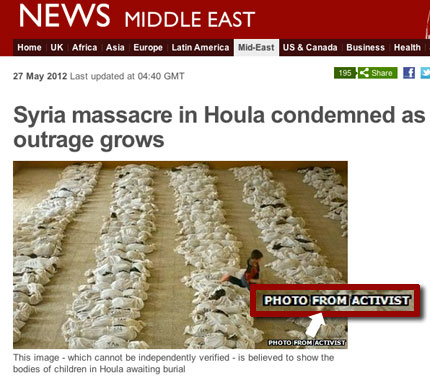
Fact-checking took a holiday at the BBC today, as a credit line of "photo from activist" was used to identify propaganda promoting the activist's cause, on the front page of the BBC's website for an article titled "Syria massacre in Houla condemned as outrage grows." The problem? Among the many, is that this photograph, purported to have been taken on or about Friday, May 25th, 2012 in Houla, Syria, and represented in the photo caption as "believed to show the bodies of children...", was actually taken on May 27, 2003, 9 years earlier, in Al Musayyib, Iraq, by photographer Marco Di Lauro, a photojournalist for Reportage by Getty Images.

The front page of the website, below, shows the image in it's mis-credited and mis-represented form:
The image here shows the image on Di Lauro's website, with the proper caption:

"An Iraqi child jumps over a line of hundreds of bodies, in a school where they have been transported from a mass grave, to be identified. They were discovered in the desert in the outskirts of Al Musayyib, 40 km south of Baghdad. It has been estimated that between 10,000 and 15,000 Iraqis had been reported missing in the region south of Baghdad. People have been searching for days for identity cards or other clues among the skeletons to try to find the remains of brothers, fathers, mothers, sisters and even children who disappeared when Saddam's government crushed a Shi'ite uprising following the 1991 Gulf War."
Di Lauro, who is a freelance photographer represented by Reportage by Getty Images, also licenses this image on the Getty website here.

As noted above, there are many problems - here are a few of them:
(Continued after the Jump)

Problem? Taking an Activist's image

It should not be the case that someone whom is identified as an "activist" should be given the credence of a journalist, and have their propaganda disseminated under that banner. A statement they make is (and must be) fact-checked, as should any visuals they provide. BBC Director of the World Service and Global News, Richard Sambrook, who wrote in Nieman Reports, from The Nieman Foundation for Journalism at Harvard, of "Citizen Journalism and the BBC" during his tenure at the BBC, wrote at the time (Winter, 2005) "...From now on, news coverage is a partnership." Sambrook notes, accurately, "How can our journalistic reputation be protected when we are not fully in control of our content?" Indeed, Mr. Sambrook. This "partnership" was violated by an activist with their own agenda.

Problem? Citizen Journalists
It must be said that Sambrook is not now at the helm of any BBC division, but he was a reporter for the BBC and left in 2010. Surely, Sambrook's imprint was left on those who came after his departure. Sambrook defends citizen journalists, with initiatives like the BBC Action Network's iCan, saying "As someone who supports this new direction, I don’t suggest the BBC staff abdicate their responsibility for accuracy, fairness or objectivity. There will always be a central place for editorial judgment to be applied. That judgment is the essential brand value of major news organizations. As we open up to contributions from the public, we must do so in a way that is consistent with our editorial values." At that same time, Sambrook authored another article for Nieman Reports, touting "The BBC’s College of Journalism" writing "The BBC is establishing a College of Journalism to raise and support editorial standards...the College of Journalism will also focus on ethics and values and building knowledge on key themes and issues, such as Europe and the Middle East...So far, 10,000 staffers have completed an online editorial policy course (the biggest BBC interactive training initiative yet), and 8,000 staff members have attended workshops on sources and attribution." It is clear that whomever edited the article must have missed that workshop on sources an attribution.

In that same issue of Nieman Reports, Santiago Lyon, at the time (and still) Director of Photography for the Associated Press and Lou Ferrara, who was an online editor for the Associated Press, wrote in an article "With Citizens’ Visual News Coverage Standards Don’t Change" that "‘In an era in which digital alteration of images is increasingly easy, credibility is everything.’" In fact, as they note of an image they saw on a BBC website, they (the AP) went through the process of locating the citizen photographer, obtained rights, and then distributed the image. Lyon's team, no doubt, also vetted the veracity of the image during that process. Of the veracity of all citizen journalism content "The same journalistic standards that are currently applied to mainstream media sources will need to be applied to all citizen-produced material. Verification is crucial."

Problem? Stealing from someone
This activist saw it fit to steal from a photographer. Di Lauro puts his life on the line to make a living and produce images that reveal to the world what is happening. He should be afforded the ability to continue to do so, and copyright, and rights to his images, gives him the ability to continue to tell the story.

Problem? No fact-checking. 

The caption attempts to offer an out, indicating "This image - which cannot be independently verified - is believed to show the bodies of children in Houla awaiting burial." According to the BBC, and other news sources, while there were at least 90 people killed, 32 were children under the age of 10. In 30 seconds, I was able to count about to 25 bodies in the row second from the left, and multiply that by 3 for the 3 center rows of the 5 depicted, and that's 75 estimating that there are also 25 on the two outer rows depicted and we're at 125. Clearly, there are way more than 32 bodies in this photograph, and there are even more than 90.

Clearly, more questions needed to be asked of the source.

Problem? No correction listed
An update of the story just before 8am GMT, did not list a correction, or editorial note about the mis-credited and mis-characterized photograph. The BBC simply made it as if it didn't exist and never did anything wrong. Di Lauro, and Getty Images have recourse for the theft of his intellectual property. While they of course have recourse with the activist, they also have recourse with the BBC as well.

Problem? Di Lauro had recourse - but his recourse would be much less, or non-existent, if Orphan Works had existed
There have been many conversations about the "orphaning" of photographs, whereby someone strips the metadata and and other indications of image ownership from an image, and then uses that image for their own purposes and ends, and when the actual creator of the photograph is identified, they are unable to stop the uses of their image - whether in an accurate depiction of something, or, in this case, as propaganda completely disconnected from the reality in the image. While it is reasonable to assume that a news organization, presented with the evidence of falsehood, would remove a mis-representing image, commercial entities, or uses where the users don't care or are otherwise unsavory, may well keep the image up, under the misguided notion that the end justifies the means. While the efforts to make orphaned works legally allowable in the United States (a dubious at best consideration relative to signatories to the Berne Convention, which would likely apply in this UK use) went away a few years back, the effort continues to percolate with people who believe much of intellectual property should not be given any control by it's creators. I would hope that even those orphan works proponents would agree that the theft of intellectual property in this manner should not be allowed in whatever final form they hope for in their legislative efforts.

In the end, it was because Di Lauro became aware of the theft of his image and the mis-characterization of it that the BBC no longer has it on their website. It was not because of the efforts of the editors of the BBC doing their due diligence. According to the screen grab the story was updated at 04:40 GMT, and the screen grab we have is timed at 12:26 GMT, so for at least 9 hours the BBC was profiting off of Di Lauro's image, and that is assuming that the photo was first posted during the 4:40am update, and taken down right after the screen shot was made. A screen shot a few hours later shows a video instead. How many other times has this happened? Whether it's a CNN iReporter, Fox News' uReport, being an MSNBC Citizen Journalist, or a part of the BBC's Action Network's iCan, Citizen Journalist representations must carry at least as high a burden of proof as that of professional journalists, if not higher. Interestingly enough, The BBC closed up their iCan experiment because, according to BBC News editor Peter Horrocks in this article "the level of involvement in it compared to the cost was inappropriate." As such, in April of 2008, just 5 years in, the grassroots effort wasn't working. While the iCan effort isn't exactly comparative to iReporters or uReporters, the notion of laying the responsibility on the public at large for engaging in reporting is fraught with pitfalls and risks. The BBC took a risk while their standards were on holiday, and that risky move failed them miserably.


Please post your comments by clicking the link below. If you've got questions, please pose them in our Photo Business Forum Flickr Group Discussion Threads.


[More: Full Post and Comments]
Tuesday, May 22, 2012

Getty Images Returning to the Stock Market with an IPO?

According to the NASDAQ website (here) the Financial Times is reporting that Goldman Sachs has been retained to consider an IPO and other options. Photo Business News reported that federal regulators had approved Hellman & Friedman taking Getty private (Getty Images - Moving Forward, 3/19/08) at a rate of $2.1B (according to Forbes) and $2.4B according to the Nasdaq site. They are considering a valuation for the IPO of $4B. Getty at one point saw highs of $90+ a share in their heyday, before plummeting and then going private. With the Shutterstock IPO revealing their average stock sale of $2.05 per image in an SEC filing (as reported by Photo District News, here), how can Getty see a $4B valuation? Dubious, at best.

(Comments, if any, after the Jump)

Please post your comments by clicking the link below. If you've got questions, please pose them in our Photo Business Forum Flickr Group Discussion Threads.


[More: Full Post and Comments]

Monday, May 14, 2012

USA Today ≠ US Presswire at US Olympic Media Summit (And Beyond)

When you think "olympic" the concept of "top of their game", or "monumental" comes to mind. While "Olympic" refers generally (and usually) to the Olympic Games, it is often used as a verb (no doubt much to the chagrin of Olympic Officials) to characterize the best. This year, when the Olympics arrives in London, it seems that USA Today is sending in the farm team rather than the best, when it comes to their photography staff, for the most part.

USA Today staff photographers with decades of experience covering sports were told last week that, well, their services wouldn't be needed in London. USA Today Sports Media Group Company, which now owns the US Presswire photo wire service, known to some as the "let's all work for photo credit, press-file hot dogs, and a few stock sales" photography operation, decided that they would choose the team going to cover the olympics this year, save for just one well regarded USA Today photographer. If there was any doubt that the staff will be wet behind the ears, you need look no further than the list of those credentialed - Richard Mackson's teenage kid seems to be credentialed as a part of the team of pros going over and she either just (or will soon) graduate from...wait for it... high school.

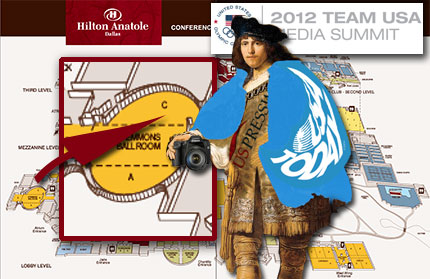
If you're looking to talk to the USA Today photo booth out at the Olympic Media Summit at the Hilton Anatole, going on today and tomorrow, they won't be there. Well, the booth is there - in Stemmons Ballroom C (on the right as you walk in), but it's not actually staffed by USA Today staffers - instead, it's staffed by US Presswire staff and contractors. So if you see someone wearing a USA Today credential, shirt, or beneath one of their banners, it's really a US Presswire person cloaked in the storied name of USA Today.

For decades, the USA Today photo staff has put forth the best of the best to cover the Olympics. So too has Sports Illustrated, and other storied organizations that see covering the Olympics as the pinnacle of sports photography. I am sure that Getty Images will be quite interested to know that US Presswire is parading around under the cloak of USA Today, seeing as the US Olympic Committee encourages people (here) to contact Getty for rights-manged images, noting "In addition, Getty Images has a vast archive of U.S. Olympic-related images." In fact, according to the Getty website here, they say "...As the official photographic agency of the International Olympic Committee since 1988, we have the imagery you need to set your Olympics coverage apart." While I am sure that USA Today has shared content with their sister organization (Gannett) newspapers in the past, it doesn't take much to consider that Getty's revenues will be affected by US Presswire syndicating their content from the Olympics outside of USA Today and Gannett. Then again, maybe not. Maybe Getty is right - their coverage may well be "...set...apart.." and not even in the same league as USPWs. In this case, Getty is the big leagues, and, yes, coming full circle, the USA Today team, filled with USPW photographers, seems to be the farm team.

I'm guessing that the new President and Publisher of USA Today, who will be reporting to Gannett (NYSE: GCI), Larry Kramer, (announced just today, here) will be wondering why a teenager is on the credentials list along with so many other US Presswire photographers when his thoroughbred sports photographers didn't make the cut. According to the USA Today article, he's in charge of the USA Today Sports Media Group, so this issue falls right under his responsibilities list.

(Comments, if any, after the Jump)

Please post your comments by clicking the link below. If you've got questions, please pose them in our Photo Business Forum Flickr Group Discussion Threads.


[More: Full Post and Comments]
Thursday, May 10, 2012

Copyright Small Claims Court - The Discourse of Benefits & Challenges

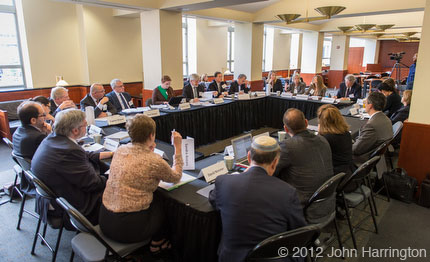
The US Copyright Office held a roundtable discussion today in Washington DC, at the George Washington University Law School on the subject of how (and if) to propose implementing a form of a Small Claims Court for copyright infringement claims. The roundtable was filled with rights-holders from around the country who came to share their views on the benefits and challenges that a Small Claims Court venue would have on rights-holders. In his opening remarks, David Kappos, the Under Secretary of Commerce for Intellectual Property and Director of the United States Patent and Trademark Office, said that the issue of an Intellectual Property "Small Claims" system is a "burning platform," that must be addressed.

(Continued after the Jump)


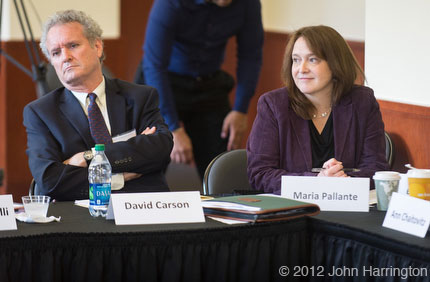
The Registrar of Copyrights, Maria Pallante (below right) listened intently throughout the discussions, as did David Carson (below left), counsel to the Copyright Office. Pallante is looking to increase the number of deposits, and to evolve the online registration system in a way that works for copyright owners, as well as make protecting copyrights easier for copyright holders.

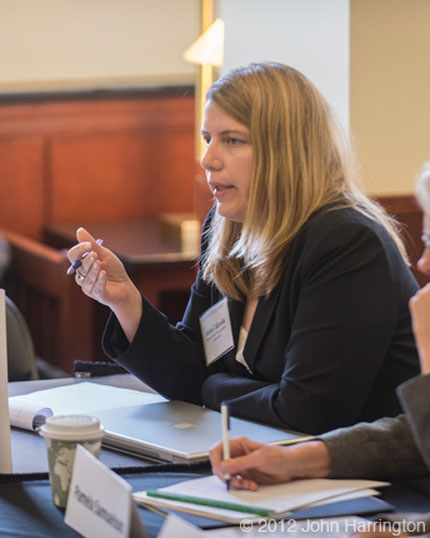
The National Press Photographer's Association Advocacy Chair, Alicia Wagner Calzada, a highly regarded photographer, and also an attorney for the NPPA, make a number of points - among them the challenge that if the issue of fair use could 'eject' a claim from the Small Claims Court, that, for many photojournalists (and members of the NPPA) whose work is of a highly newsworthy nature, this is a common defense of infringements that NPPA members face, and would be problematic.

Calzada (above) said of the meeting "One thing appears clear--this is not a simple fix. The event was very productive in terms of shining a light on the challenges to crafting a small claims solution for copyright infringement. It is clear that there are genuine obstacles, including some constitutional issues. What I took away from the discussion is that the challenges are not insurmountable. It is, however, important to create a system that will uphold constitutional scrutiny or it will be a wasted effort."

Also on hand was counsel for the American Society of Media Photographers (below right rear), Victor Perlman, and Executive Director Eugene Mopsik (below center). The ASMP has maintained an ongoing relationship with the Copyright Office and Congress in many issues facing photographers today, and has done much to further photographers' interests and protect their rights. Mopsik said of the meeting "The GW Roundtable brought together some of the best IP experts from industry and education along with representatives from a broad spectrum of trade associations and interest groups. The day was spent in a combination of informational presentations followed by discussion of specific proposals for "Small Claims" solutions. It think that it was very valuable for Maria Pallante and the other Copyright Office and PTO representatives. It gave all of the attendees much to think about and was very useful in unveiling issues previously not considered."


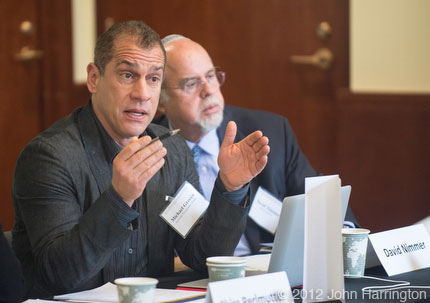
On hand for the American Photographic Artists, Michael Grecco (below left), and the author of APA's proposal and highly respected copyright attorney David Nimmer (below right) spoke about the challenges of implementing a Small Claims Court and offered a solution to make it work. Grecco commented "The session was a think tank with some of the greatest minds in Copyright sussing out the possibilities of a Fast Track, or Small Claims system for Copyright issue." Interestingly, one of APA's comments that were a part of their proposal offerred that "The best protection for low-economic-value claims would arise from making automatic the recovery of attorney’s fees and statutory damages by prevailing plaintiffs. By contrast, current law affords those remedies only for the benefit of copyright proprietors who, prior to the commencement of infringement, have registered their work in the records of the United States Copyright Office. Accordingly, under existing law, infringement of then-unregistered works remains beyond practical redress." The proposal calls for a Small Claims Court to be "applicable to simple copyright infringement cases that seek to recover no more than $80,000. Consenting parties can have their positions quickly evaluated by a Magistrate Judge sitting in the appropriate United States District Court in which the case is pending."


ASMP's Mopsik said of the idea of Small Claims "ASMP supports an ADR solution to small claims and believes that it should be as easy and simple for a photographer to navigate as possible." and the NPPA's Calzada said "virtually any solution is years away, though I know that for photographers who deal in daily deadlines and constant infringements, it cannot happen soon enough. Hopefully, it will be worth the wait." APA's Grecco said "I was very proud that APA's proposal, written by attorney David Nimmer, with Special Counsel Edward C. Greenberg, it played a major role in todays discussions. It was the one proposal that could be enacted relatively quickly and easily in the existing Federal Court system and had a good chance of sustaining a Constitutional challenge."

Related - Comments & Proposals Submitted:


Please post your comments by clicking the link below. If you've got questions, please pose them in our Photo Business Forum Flickr Group Discussion Threads.


[More: Full Post and Comments]

Newer Posts Older Posts