Primer & Refresher: Terms & Conditions: TERM 2
 Term #2: "2. FEES, CHARGES AND ADVANCES: Client and Client’s representatives are jointly and severally responsible for full payment of all fees, charges and advances. The rights licensed, fees, charges and advances set forth in this Agreement apply only to the original specification of the Services. Additional fees and charges shall be paid by Client for any subsequent changes, additions or variations requested by Client. All advance payments are due prior to production."
"FEES" - Fees are typically your photographic fees, your pre- and post-production fees, travel fees, and so on.
"CHARGES" - Just another way of specifying what your client is paying for, but could include monies owed for services rendered in production of props, shopping, and so on.
"ADVANCES" - You want money up front, you say? Damn straight! There are countless times where a client you're working for must advance you monies, and you should do so. Large travel expenses, charges to secure expensive props or services, and so on. There are countless different types of expenses that the client should be paying for, up front. You ARE NOT their lender or bank, and should not be floating major expenses on their behalf.
"Client and Client’s representatives" - This means that if your client is an ad agency, PR firm, or is otherwise a representative or agent of their end client, that not only is the firm/agency responsible, but so too is their end client.
"jointly and severally responsible" - This is a legal phrase, which specifies that a multiple parties have the responsibility to share the liability and obligation together, and that no party may put off the obligations or responsibilities on any other.
" for full payment of all fees, charges and advances." - This means that after paying you just a portion, they have not absolved themselves of responsibility for the other amounts due. Further, that one party (where there are two) may not pay just 50% and say "I paid you my half, so I don't owe you anymore and I can use your photos..." or any other similar claim. The emphasis is on the word "full", and that it applies to "all" of the different monies owed.
"The rights licensed, fees, charges and advances set forth in this Agreement apply only to the original specification of the Services." - This means that when the client specifies that they want three setups instead of two, or a portion of the work done the next day, that these items thus fall outside of the "original specification" that is "set forth in this Agreement" (note the capitalization of "Agreement", that's important, as it refers to this document in total, and not some seperate or partial or other agreement that is unnamed or unspecified.
"Additional fees and charges shall be paid by Client for any subsequent changes, additions or variations requested by Client." - This specifies that you'll have to pay more for "changes, additions or variations" which can be as major as "we're shooting in Cancun instead of the local beach", or as simple as "we're not photographing two people in a group, it's now a group of four." When these changes take place, you should have on hand a "change order" to accomidate the "variations requested by Client."
"All advance payments are due prior to production." - In other words, advance payments must be made before you're to start any work -- which of course seems obvious, but, it could be said that an advance is due before final delivery, before travel commences but after pre-production, and so on. If there's a way to parse a term in an Agreement to the client's favor, you can be assured that they will exercise that opportunity. As such, it's important to set forth as many things as possible.
Please post your comments by clicking the link below. If you've got questions, please pose them in our Photo Business Forum Flickr Group Discussion Threads.
 Today was an interesting day. I spent the morning with an electron microscope, the afternoon with an ambassador, and this evening with a Member of Congress. I am currently sitting in the lobby of a hotel that is far more expensive than I can afford, crafting this missive. What prompts me to write today? Oh, the world-wide-web. Yes, that wild-wild-west of the photographic landscape, where people with pictures are under the impression that the fact that they have a JPEG means they can put the photos on Flickr, MySpace, or their own company website. Oh, so wrong.
  On the road to that little state called Rhode Island. Next Thursday (March 8th & 9th) marks my sixth time presenting at the
 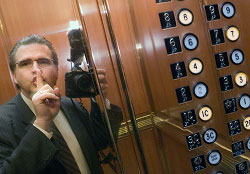 Many a time I've been heading into a client's office for a meeting, and stepped on the elevator with one or two other folks. On the ride up, I was concious that, maybe one or two of the other folks I am in the elevator with may end up being in the meeting with me, so I'd better not say anything that would put me in a poor light. My tie better be adjusted, or I shouldn't be finishing a donut or soda while heading skyward.
 Ok, so, just as I hate it that people are stealing Microsoft's Windows, and Adobe Photoshop, I too get upset when the Galactic Empire's IP gets (allegedly) stolen. Worse yet, it's by an organization I really admire --
  If that's the case though, then why is this now the article? It's the same article, but the photo has been removed entirely, not replaced with a non-watermarked one.
 On the heals of that photograph however, comes a bit of history. A search of The Consumerist yields
  From our friends at the Coloradoan.com, comes this little insight:
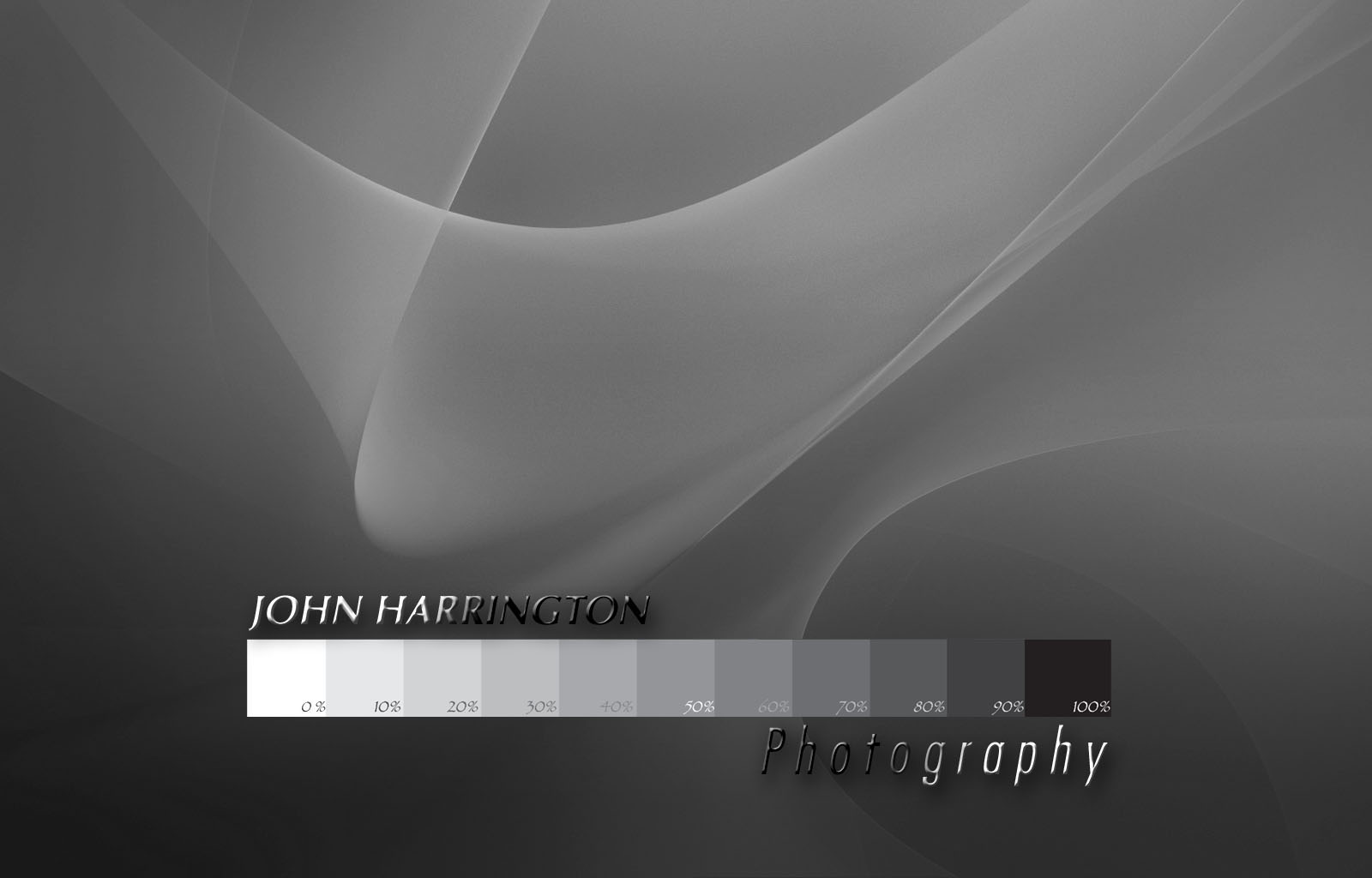
 When you're taking your laptop (or, maybe desktop for a big shoot) on location to an assignment, what does your desktop look like? Is it professional? Helpful?
 I'm headed to Chi-town! The last time I was in Chicago it was for a guerilla-style photo shoot along the shoreline, no permits, no plan (as the client dictated), and, at one point, no subject! (ask me about that at the presentation.) I am looking forward to my trek there to talk business with a bit more advance planning! Each time I gather with a group of people who are so focused on growing their knowledge about the somewhat confusing side of the business of photography, I get excited. If you've got a copy of my book, and feel it'll be worth more when you sell it on e-bay with my signature, bring it down and I'll be happy to sign it, as it's not for sale there.
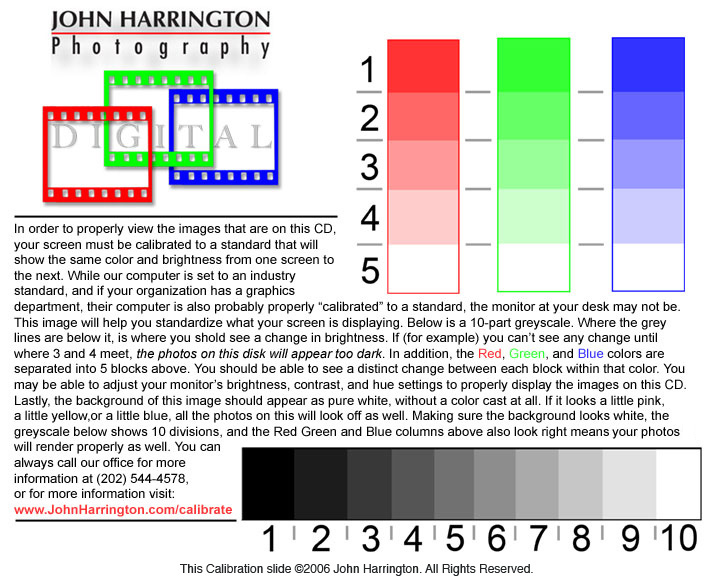
 So, how many times have you had a client call to say "the color is too dark", "to pink", or they otherwise object to how it looks on their screen?
  If you''ve ever seen a non-flatpanel (i.e. old school screen type) where you can see that something's been displayed on the screen for a very long time, that's called screen burn in, and is a demonstration of the fact that the screen's phosphors age and wear out. That is why screen savers were invented - literally, to save the screen from constantly displaying one image, thus causing that image to burn into the screen. Where items and objects move (like the flying toasters, or the manufacturers logo) the burn won't happen. On an LCD screen, there is much less likeliness that you'll get screen burn, what you usually get is " temporary image persistence", meaning that the image looks like it's burned in, but most of the time, it goes away after a short period of time. A typical LCD lifespan is 50,000 hours of use compared to 15000 to 25000 for a CRT. Lifespan, however, is referring to when it will no longer function, not when it can no longer be calibrated. I would submit that those figures are about half of the above numbers. So, for a CRT, where someone has their computer on 10 hours a day, that's about 2.8 years on the short end, and when left on continuously, that's a lifespan of less than 1 year. For the LCD, at half-life, that's 2.85 years before you can expect your LCD to fail.
 Lastly, if you've ever walked into a Circuit City or Best Buy, and looked at a wall full of monitors, displaying the same image, but some looking better than others, while brand can be a point, the more germaine point is that none of the monitors were adjusted and calibrated to look their best, they were unboxed, and plugged in. Further, I've heard of sales managers going in and making the "on sale" monitor look it's best by making adjustments to the color/sharpness and so on causing the buying public to gravitate to the one on sale. The point is, you must calibrate your monitor using the
  calibrators so that you have set your monitor to a known industry standard scale. Once you've done that, whatever you deliver, will be independantly "perfect", and when someone looks at the image on a non-calibrated monitor, you will have some ground to stand on, and a review of the image(s) on the monitor in the clients' art or graphics departments (where hopefully they are calibrated) will alleviate your clients' concerns.