Monday, May 4, 2009

Book Scanning Technology
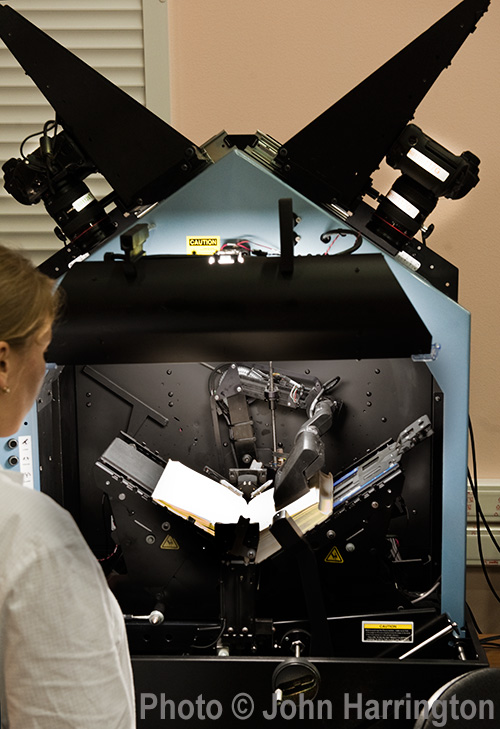
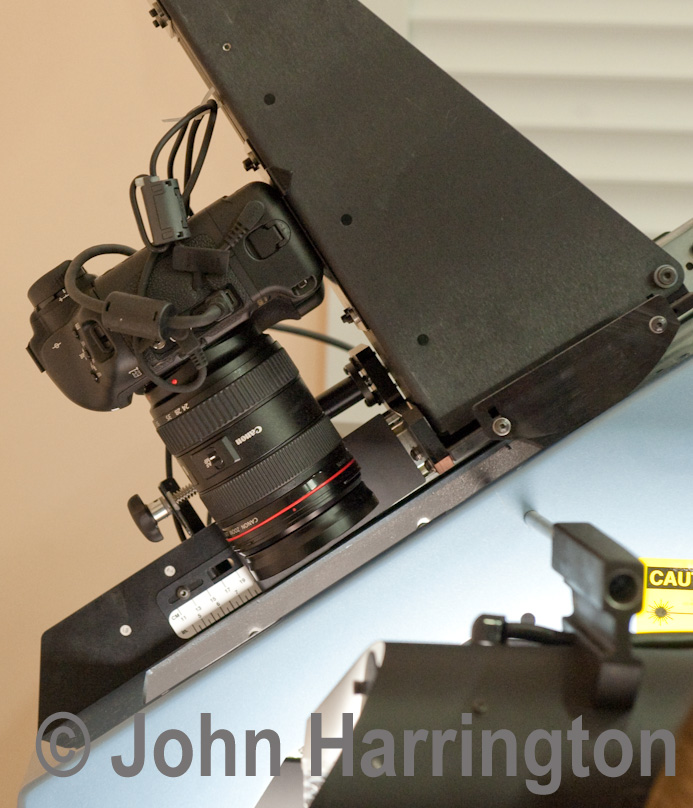
Ever wonder how it's possible to digitize books by the thousands? Who's turning all those pages? Well, wonder no more, as here's the answer - a neat little contraption with two Canon EOS cameras, and a vacuum that automatically turns the page after a high resolution image is made of each page.

We recently had the opportunity to see the digitization in action - the same process that Google is using in their project. These are custom-made units, and the connectivity is amazing. The operator is simply on hand to trigger the page capture (buttons, on the left of the console, slightly visible in this image), and swap the books. Everything else is automated. With a room full of these devices, it's no wonder the process of digitizing all the worlds' books is almost half-way complete!
(Continued after the Jump)

At left, note the black piece covering the right page. That is the vacuum, which has is about to turn the page, from right to left. Watching the vaccum in action, once it gets past the peak point, and begins to decend to the left, it releases the vaccum, and the page naturally falls down. The vaccum moves out of the line of sight of both Canon cameras, and both facing pages are captured, and then the vacuum moves back into position to make the next pair of images.

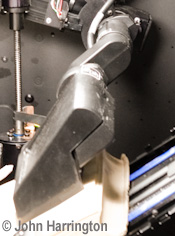
A closer look at the lens choice, shows a 24-70mm f2.8 L series lens being chosen. This would make sense, allowing the operator to make adjustments when books got larger, or smaller. The ports in use are clearly the shutter release, the USB, and the power adapter. In this closeup, the lens appears to be set at or near the 70mm mark, and the lens is also set to MF (manual focus).
This device allows for books of all ages (and even levels of fagility, if watching the delicate vaccum in action is any indication) to be digitized very quickly. New Scientist seems to be suggesting (Google sees infrared in plan to scan world's books, April 4, 2009) that scanning these books is taking too long, but that didn't look like a slow process to me, I was amazed at the speed of these machines. NPR wrote about Google's Patent application, in The Secret Of Google's Book Scanning Machine Revealed (4/30/09), but, as with all USPTO applications, the line illustrations leave a little to be desired.

Back in 2004, Information Today wrote - Google and Research Libraries Launch Massive Digitization Project , (12/20/04), about the process, and Googles plans, but to see it in action, is amazing. I was watching as books far and away out of copyright were digitized. This is in contrast to the lawsuit filed against Google, and, as reported in the Washington Post - Google Settles Publishers' Lawsuit Over Book Offerings (Washington Post, October 28, 2008), but which, as reported just last week (Google Battles For ‘Opt-Out’ Extension To Deadline In Book Lawsuit, 4/29/09),
"Internet search giant Google has requested before a judge a two month extension to a deadline for authors and publishers to opt out of a settlement to a legal battle over its intention to develop the world’s largest digital library, the Associated Free Press accounted. Google’s decision was prompted after a group of authors and their heirs asked the US District Court judge hearing the case to give a four month extension to the already effective May 5 deadline so that the “enormously complex” settlement could receive the time it was due for study."
So, the discourse continues - now with a few more visuals for you to contemplate.

Please post your comments by clicking the link below. If you've got questions, please pose them in our Photo Business Forum Flickr Group Discussion Threads.


[More: Full Post and Comments]

Get the DAM Book!

Get 'em while they're hot! Peter Krogh's The DAM Book, Second Edition is now out!
Peter's First Edition is great, and I strongly recommended it in my book. Now, he's updated it (the First Edition was from 2005!) and he includes all sorts of pointers for the latest Lightroom and Photoshop workflow solutions. It's the best and only real book that provides solutions and throughly thought out ways of thinking for the individual photographer's digital asset management needs.

There's not much more to say today, than "do not pass go. Do not collect $200. Simply spend your $31.49 and order this book now."

(Comments, if any, after the Jump)


Please post your comments by clicking the link below. If you've got questions, please pose them in our Photo Business Forum Flickr Group Discussion Threads.


[More: Full Post and Comments]

Sunday, May 3, 2009

Pete Souza - Recording History - A CBS Profile

Below is a nice piece on Pete and the work he is doing documenting history in the making.

(Comments, if any, after the Jump)


Please post your comments by clicking the link below. If you've got questions, please pose them in our Photo Business Forum Flickr Group Discussion Threads.


[More: Full Post and Comments]

Thursday, April 30, 2009

Is The Amateur Really A Threat to the Pro?

Consider the photographer who has an unlimited amount of time to accomplish an image. Or, the student, who has a week or two to complete an assignment on, say, lighting a bowl of fruit. Or, the hobbyist photographer, who stumbles upon a great image. Are these photographers a threat to the photographer who works on assignment?

(Continued after the Jump)

I submit that they are not, in almost all cases. Judy Hermann, over at the ASMP Strictly Business blog wrote a few days ago - A Walk in Your Client's Shoes - and noted, in part, "If it was your job on the line, what would you need to see, what would you need to hear, what would you need to know to feel safe hiring a particular photographer?"

A track record of success is one of the key elements that a prospective client is looking for. Sometimes, a client is looking for multiple jobs for the same client in a portfolio over a period of time - say, a campaign. This suggests continuity and consistency that they can depend upon. Sometimes, a client will see your coverage of a significant event, and determine that if you were hired (i.e. depended upon) to cover *that* event for someone, surely you could cover X event that your prospective client needs you for. And sometimes, not seeing just sample work on a website, but clips and covers is a demonstration that you can deliver on time and with a high degree of certainty.

When you are a student, you might shoot the assignment three or four times, realizing you missed a critical issue each time, and then, finally got it right. The hobbyist photographer can take thousands of images of the sunset, their kids, and so on and, based upon the laws of statistics, eventually get an amazing shot. Sometimes, they simultaneously stumble into *how* to make that image, and thus repeat it. Usually, however, they don't. Einstein once famously said "The definition of insanity is doing the same thing over and over again and expecting different results.”

No one has to say "he's a professional accountant", or, "she's a professional doctor." Merriam-Webster sets forth the use of the word "professional" - "participating for gain or livelihood in an activity or field of endeavor often engaged in by amateurs {a professional golfer}", thus, "professional photographer" needs the modifier "professional" in front of it. As does "professional surfer", "professional volleyball player," and, yes "professional bass fisherman."

Journalist Samuel Friedman wrote, in the CBS News piece - Outside Voices: Samuel Freedman On The Difference Between The Amateur And The Pro:
To treat an amateur as equally credible as a professional, to congratulate the wannabe with the title “journalist,” is only to further erode the line between raw material and finished product. For those people who believe that editorial gate-keeping is a form of censorship, if not mind control, then I suppose the absence of any mediating intelligence is considered a good thing.
Rob Haggart, over at A Photo Editor, defined professional by quoting a Mario Batali, in writing that the difference between an "amazing amateur chef and a professional chef is the ability to make that perfect meal 100 times in a row." Thus, the counter to Einstein's insanity definition, is the definition of "professional" that I will put forth here. The definition of professional is "doing the same thing over and over again and expecting similar results."

How many times a month can a magazines' photo editor commission an assignment and get nothing usable back before their job is on the line? Once? Twice? If twice every other month a shoot was unusable, their judgement would be called into question and in short order they would lose their job. How about the advertising job, where the photographer can't deliver while the ad agency rep and their client are both on set, and the shoot fizzles because of the photographers' inability to deliver?

The challenge for the photo editor, art buyer, and so on, is to separate the wheat from the chaff, the professional who can deliver, from the amateur who has a nice portfolio, but can't be counted on with a high degree of certainty to produce. The problem arises, when the prospective client is not comparing apples to apples, but the professional and the amateur, as if they are interchangeable. It's one thing when the art buyer is looking at a stock image - it either is good enough, or it's not. It either meets their needs, or it doesn't.

However, when it comes to assigning work, commissioning it, or otherwise asking for images of non-repeating, or not-re-shootable work, getting a professional who can deliver, means the amateur will lose out. When the amateur doesn't lose out, a risk greater than gambling in Las Vegas is undertaken, and the commissioning party is betting their job. Over time, those who fail to discern the differences between the amateur and the professional, become the chaff to their "wheaty" brethren who survive in their field.

Please post your comments by clicking the link below. If you've got questions, please pose them in our Photo Business Forum Flickr Group Discussion Threads.


[More: Full Post and Comments]

Wednesday, April 29, 2009

I Do Solemnly Swear: Photographs of the 2009 Inauguration

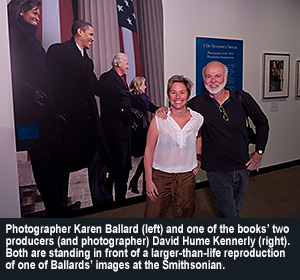
Wednesday, April 29th, is a pretty cool day. It's the day that the Smithsonian opens their exhibit - I Do Solemnly Swear: Photographs of the 2009 Inauguration - featuring the photography produced for the official inaugural book. The Smithsonian touts the exhibit thusly:

This exhibition features approximately 50 framed color and black-and-white photographs printed by Kodak, highlighting the week-long events surrounding the historic Presidential Inauguration of Barack Obama. Included in the exhibition are photographs by both professional and amateur photographers who recorded events surrounding the peaceful American transfer of power. The photographs on view include selections from the National Museum of American History's new acquisition of 2009 inaugural photographs by leading photojournalists, including David Hume Kennerly, Bob McNeely and Karen Ballard.

The full list of photographers who participated in the book is:

(Continued after the Jump)


David Hume Kennerly - Producer and Photographer
Bob McNeely - Producer and PhotographerMatthew Naythons - Producer and Photographer
Thomas K. Walker - Creative Director and PhotographerKaren Ballard - PhotographerAndre Chung - Photographer
Daniel Cima - PhotographerAnne Day - PhotographerHector Emanuel - Photographer

John Francis Ficara - Photographer
Gil Garcetti - PhotographerJohn Harrington - Photographer
Sam Kittner - PhotographerPete Marovich - PhotographerGreg Mathieson - Photographer
Paul Morse - PhotographerDaniel Rosenbaum - Photographer
Mark Sennet - Photographer
Pete Souza - PhotographerBruce Talamon - PhotographerClarence Williams - Photographer

The exhibit opens today, Wednesday, and runs through July 12th, 2009. One name you might note up there is yours truly, and it was an honor to be a part of the team.

Please post your comments by clicking the link below. If you've got questions, please pose them in our Photo Business Forum Flickr Group Discussion Threads.


[More: Full Post and Comments]

Tuesday, April 28, 2009

Lotsa Little Things Are Actually Really Big Deals

While we have been swamped to the far ends of our bandwidth here at Photo Business News, lots has been happening. Just because we've not been commenting daily, does not mean we haven't been paying attention.

The magazine world is turning upside down. Video is becoming stills, and ad revenues are slashing frequencies of publication. While it's cool to see Esquire innovating like that, we predicted the Red Camera would do just this just over a year ago - One more nail in the coffin (3/18/07), with sports being in the cross-hairs. Now that a COVER was done, doing inside pieces are now demonstrably a piece of cake, and events (yes, that means sports, for sure) that are regularly covered by TV will find red cameras being used to allow for you to be able to choose the best moment in time.

The world of Search Engine Optimization has, for photographers, exploded. Previously, SEO was limited to people who just knew how to optimize websites. liveBooks has made white-hat SEO a cornerstone of their website offering, and they are, by far and away, the best of the photographer-centric website providers to do SEO. Blake Discher has been traveling the country for ASMP for some time, doing his presentation - Is Your Web Site Making You Money?, and recently, PhotoShelter threw the doors wide open, with a Free SEO Toolkit, took on website designers when it comes to SEO, in their piece - Is Your Web Designer Full of Crap?, taked about the importance of page titles, and even went into the importance of URL legibility, in Make Your URL's Like Your Photos: Beautiful. If people actually read what they were writing, and actually acted upon the information, they would be kicking ass and taking names on website positioning on Google. Now, Seth Resnick, who is probably just as insane when it comes to web optimization and SEO as I am, has jumped (back) into the game, with a program at the end of next month through his seminar on search engine optimization in Miami. Seth has been doing SEO as long as I have, and he knows his stuff. The key to learning from him is to figure out a way to shift his speeding-Ferrari mind down to like first gear with the clutch not fully engaged so that you can understand what he's talking about. If you go, bring a tape recorder, because you'll learn about 10% while listening to him live, and 10% more the next time you listen, and so on. Seth comprehends SEO like few other people I know.

Meanwhile, the good folks (and an advertiser here at PBN) have just released FotoQuote Pro version 6, that include 86 New Pricing Categories, including 35 Video Stock Footage Categories, and over 30 Dedicated Web Usages as well. If you know these folks, they're the real deal and they know what they're talking about when it comes to pricing, and the coach feature for each usage is really really insightful.

(Comments, if any, after the Jump)


Please post your comments by clicking the link below. If you've got questions, please pose them in our Photo Business Forum Flickr Group Discussion Threads.


[More: Full Post and Comments]

Thursday, April 23, 2009

Price Negotiations

If you consider that anyone who is trying to lower the price you are asking is an "enemy", then, the old adage that applies is "know thy enemy."

I am not talking here about people who have not clearly spelled out an assignment, and you are thusly over-estimating it, or people who are trying to work you into their budget, but instead, I am talking about people who are looking to cut your fees to keep money in their pockets. While I don't see clients as enemies at all, I do need to understand their perspective when estimating a job, and also, have them understand mine. Knowing what a client is thinking is helpful in coming to a satisfactory solution for everyone.

But let's get one thing straight - people who price shop will always want a lower price, and studies have shown are far less loyal to you, and far more loyal to the bottom line.

(Continued after the Jump)

Over at The Consumerist, today's piece is titled "Do You Haggle", and they outline the perspective of the person doing the negotiating. So, I thought I'd do a counter to that (what they wrote is in italics), from the sellers' standpoint:
1. Never ever let the salesperson take over your shopping experience when you're buying expensive items, or when the store offers a certain discount. You must control the bargaining process.
Often a client does not know what goes into that price. A shoot fee, and then licensing? 'I thought I owned it', or 'what is this post-production charge, what do you need to do to the photos, I thought you didn't have to fix your photos?" These, and many others, are a part of educating the client on the value your images have.
2. Know that the posted price for a big ticket item can be brought down. This is especially the case now, in these difficult times.
Yes, you may be willing to negotiate in these tough times, but if your rate is $2,500 for an assignment, and you accept $1,800, it is likely you'll never get that $2,500 figure from that client when times improve. Be sure to "take away" something from the shoot. Say, shooting fewer images/set-ups, using a single person for hair and makeup/stylist, or limiting the rights package a bit more.
3. Never ever let them know that you really want something.
This is the true power of "no." When you tell the propective client, in a nice way, that you can't do it, if they really want you, they'll now want you more. If they see you as a commodity, then they may move on. So be it. You want clients that really want you.
4. Force yourself to leave if the merchant doesn't give you a lower price.
The contrary to this is "stick to your price. Thank the client for considering you, and tell them that you look forward to the opportunity to work together in the future, when price and budget are not such an issue. Further, let them know that if something goes wrong with the lower-priced photographer, you'll try to help them out with a re-shoot, if you can."
5. Remember, you are the client, you have money in your checking account which the seller desperately wants.
Yes, they are the client, and they called you. When you as the photographer are, in fact, desperate, you will do foolish things, so don't ever be, or even come across as, desperate. When the propective client becomes the client (i.e. has signed the contract) then, of course, do everything you can to make them happy.

REMEMBER: photography, no matter what anyone tries to tell you, is NOT a commodity.

Please post your comments by clicking the link below. If you've got questions, please pose them in our Photo Business Forum Flickr Group Discussion Threads.


[More: Full Post and Comments]

Wednesday, April 22, 2009

Your Piece of the Pie

Is it slow for you right now? If so, locating other avenues for revenue (within the field of photography, of course!) may be your next best solution.

Here in Washington, the area is buzzing with the notion that President Obama is making healthcare a major priority. Why? Well, it's not really because those folks want healthcare in this manner, but rather, because of all the opportunities that that new idea will bring to them. Healthcare automation, management, consultants, and so on. The list really does go on and on.

What does this mean for you?

(Continued after the Jump)

If there are healthcare providers in the area, this could mean more assignment work for you, and positioning yourself with those providers could mean near future work.

Today, is, of course, Earth Day, and just for the fun of it, we've "greened" the blog. But, could you position yourself to serve the "greening community"?

What about pursuing companies that are involved in the electric vehicles that are ramping up to be built? Parts suppliers? The conversion of gas stations to begin offering electric or hydrogen services?

Are there recyclers in your area that are growing their businesses, looking for new (or refreshed) marketing materials? Do they even know they need it?

On the flipside, if you are working with clients in the defense industry, you might want to revisit your diversification plans, since the President has also indicated a plan to scale those expenses back, and just yeserday the President instructed his cabinet to slash $100 million from their budgets, so if you are earning revenue from those avenues, that's a bit of a potential problem too.

There are plenty of avenues for revenue aside from the ones familiar to you. The key is to be thinking several steps ahead, and as trends change, you want to be on the front end of those changes and prepared for them.

Please post your comments by clicking the link below. If you've got questions, please pose them in our Photo Business Forum Flickr Group Discussion Threads.


[More: Full Post and Comments]

Friday, April 17, 2009

Lifetime Revenue Streams

Rob Haggert, over at A Photo Editor, has a great article up, entitled "Why Would You Quit Working with a Freelancer", that I posted a lengthy comment on, and the thread and comments are well worth a read. That said, what I wrote is a good standalone piece, so I've re-edited it, and am posting the thoughts here as well, since several projects have kept me tied up these past two weeks and have precluded me from having the bandwidth to write much of late.

So, enjoy, and I hope you make it over to Rob's blog to read more.

(Continued after the Jump)

There is an expectation is that our success rate must be greater than that of a surgeon in order to remain in business. There is no margin for error, even though a life is not on the line, just a blank space on a page in a publication.

I strive to meet - and exceed - client expectations, whether it is an editorial client or a corporate client. Often the "one for thee, one for me" approach caused the "one for me" to be the better image that the client used, even though it was not the assignment. Note - the "one for thee" comes first, then you can experiment.

Doug Menuez's recounting of the Business Week panel comments also is spot on. A photo editor only gets so many "the shoot didn't turn out" excuses before their judgement about what makes a good photographer gets called into question, and they are soon sidelined, or let go.

What makes a good photographer, first, and foremost, from a clients' perspective is one that can produce AN image, on time, and for the agreed upon budget. When that image meets basic quality standards, they might get a call again. When that image is better than average, they float to the top of the call sheet, and when that image is exceptional, they not only are the first to get calls all the time, they get flown around because there is significant value in a guarantee (or as close as you can get to one) of a great image regardless of the circumstances you throw at the photographer.

Case in point - I have one editorial client who is always calling me to make images that are a huge challenge. Small cubicles, mini offices with no decor and white walls, people in basement office space, and so on - you get the idea. Often they are cover images, but sometimes, inside ones. Every so often, I kid her and say "geez, when am I going to get an easy assignment", and her response is usually something akin to "I give you the hard ones because I know I will get good photos...", and while I certainly appreciate the vote of confidence, sometimes I think I might just like to walk in and knock it out, but, in the end, pushing those limits, and creating a silk purse out of a sows' ear is appreciated by this photo editor, and, in the end, keeps me working.

One of the messages I try to convey to colleagues is the lost revenue stick (carrot?) regarding a lost assignment:

1) You spend a great deal of effort making a prospective client aware of your work

2) You convince a prospective client to hire you for an assignment

3) You do a great job, and earn $2k for the shoot

4) Client calls you next month. you earn $1,500k or $2,500k on that job.

5) Over the life of this ONE client, you can earn tens of thousands of dollars, just from one consistently satisfied client.

6) One consistently satisfied client will recommend you to several other people over the course of their career, thus, one client can be the root cause of upwards of $100k in revenue, over your photographic career.

Now, if I told you that any given job that you would do for that client would cause that client to (at first) think twice about hiring you or (after a second screw up) not hire you, and thus, that single $2k assignment wasn't actually a $2k assignment, but rather a $100k lifetime revenue stream, how seriously would you take the assignment? Would you take extra cameras and lighting equipment "just in case"? Would you have a backup laptop? How many safeguards would you put in place to ensure that each and EVERY assignment went off without a hitch?


Please post your comments by clicking the link below. If you've got questions, please pose them in our Photo Business Forum Flickr Group Discussion Threads.


[More: Full Post and Comments]

Wednesday, April 15, 2009

The Associated Press and the NFL

It's official. The NFL sent out a message to the 32 club owners' Public Relations Departments, announcing the change. A particularly interesting passage from the memo that went out reads:

In addition to covering every NFL game and numerous other NFL events, AP will provide the league and its 32 clubs with full use of all AP NFL photos for editorial, marketing, and charitable use free of charge. AP also will coordinate the annual team headshot process.

Clubs will need to credential AP in a manner similar to Getty in years past.

So, AP will be getting more, (and presumably better) credentials, no doubt. This will give them (potentially) better access and a leg up on competition with Reuters, Agence France Presse, and so on. But, at what price? How much editorial integrity will be sacrificed by the AP in exchange for this commercial deal?

As we noted previously (NFL and the Wayward Getty Images, 4/9/09) , the AP carried images of the NBA brawl, but Getty's site, which originally had similar coverage up, were instructed (asked?) to remove them by the NBA. How will the future "black eyes" on the NFL be covered by the (now supposedly?) independent press that is the AP? The next "Michael Vick incident"? Another "wardrobe malfunction?" And what will happen to the AP guarantees if the players get locked out in two years for contractual reasons?

There is a lot to ponder in this new deal, and I surely expect much more to come. The full memo is after the jump, less the redacted e-mails and names.
(Continued after the Jump)

MEMORANDUM


TO: Club Public Relations Directors, Club Internet Directors

FROM: XXXXX, XXXXX

DATE: April 15, 2009

SUBJECT: NFL / Associated Press Agreement

We are pleased to report that the NFL has entered into an exclusive new commercial licensing agreement with The Associated Press for all NFL photos. Beginning this month and continuing through at least the 2011 season, AP will provide the services previously handled by Getty Images.

AP will serve as the NFL’s exclusive commercial photo distributor – the only entity authorized to sell NFL photos to NFL business partners and licensees. AP also will have the exclusive right to license NFL-owned historical photos for commercial use. AP is also willing to manage and license images owned by individual photographers, but it will be the decision of the individual photographer who owns the copyright on whether to work with AP. (AP will continue to license NFL editorial photos non-exclusively as it has in the past).

In addition to covering every NFL game and numerous other NFL events, AP will provide the league and its 32 clubs with full use of all AP NFL photos for editorial, marketing, and charitable use free of charge. AP also will coordinate the annual team headshot process.

Clubs will need to credential AP in a manner similar to Getty in years past. A recommendation with regard to specific numbers will be communicated in the months ahead.

The AP is one of the preeminent global news gathering organizations in the world and we believe that the services provided to clubs and the league will be outstanding. We appreciate the work that Getty did these last five seasons and we are confident that AP will service the clubs in a first-class manner going forward.

You will receive an e-mail shortly from AP with login information for its web site where you will be able to download photos. The e-mail will include instructions you can send to other members of your staff that also require access to AP’s web site.
We will follow up with Public Relations directors in the days ahead to provide additional information regarding specifications for headshots (the process will be similar to the one used in previous years).

To the extent that your team photographer is currently a Getty contributing photographer or if you receive questions from other contributing photographers, please have them contact XXXXX at AP (XXXXX@ap.org) for information about becoming an AP contributing photographer.

If you have any questions, please contact XXXXXXXX (PR), XXXXXXXX (Digital Media), or XXXXXX (AP –XXXXXX@ap.org).


Please post your comments by clicking the link below. If you've got questions, please pose them in our Photo Business Forum Flickr Group Discussion Threads.


[More: Full Post and Comments]
Newer Posts Older Posts