Friday, March 13, 2009

It's Friday, Do You Know Where Your Ballot Is?

Previously, we wrote and encouraged you to learn about, and subsequently, to vote "no" on the referendum before you (that likely just arrived in your mailbox), as an ASMP member (and if you're NOT a member, click here to join) your voice should be heard.

I wrote extensively about this previously (read it here), so I won't rehash what I wrote then, but I WILL repost it today as the deadline is March 15th (meaning mail it today or tomorrow!). Let me make one thing clear about this referrendum - I am not on ASMP's board, I was not in the past, and I don't currently have any plans to be on the board. Further, ASMP has not asked me to take a position, I am doing so because I think that the referendum is ill-advised, and will be detrimental if passed.

A few weeks ago, in response to an ASMP seminar in New York, the leader of this referendum - Scott Highton - sent out a missive with criticisms of the messages that were put forth, and suggested that what the presenter said at that seminar was "flat out wrong" and that the presenter "should be ashamed of misleading members this way."

As Scott Highton suggested in his letter in criticism of the brief remarks that the presenter made, Highton reports that the presenter said "the current By-Law referendum, and claiming that if passed, it would prevent talks like this from being presented by ASMP in the future."

Actually, what the presenter said was, in point-of-fact, the truth.

That presenter, who is on the National board of ASMP, and is a leading expert on digital asset management for individual photographers, would not be in the financial position to be traveling the country away from his photography business giving those talks. Other national board members who are experts in fields like website search-engine-optimization, and so on, would have to choose between volunteering their time to serve the membership at a national level, and giving presentations. Thus, the cream that has risen to the top and are volunteering as leaders on the national board could not also serve as traveling presenters to chapters, and earn a token amount of money for their 2-3 day commitment they have for each of the cities they have to travel to, loosing money because they were not available for photo assignments for their clients, and giving great benefit to the members their programs touch. And, let me remind you - these token payments are coming from sponsors via ASMP, and not coming out of membership dues.

Further, this referendum would eliminate the token $15k payment to the President for what is essentially a 40-hour a week job for a year. Further, the Library of Congress project that came to ASMP was, in-point-of-fact, brought to ASMP by a board member - and, if this referendum were passed - that would not - in fact could not - happen in the future.

What Highton hasn't been so forthcoming about is the fact that he was on the national board at the time that it was voted that directors should be paid, and he voted in favor of the very thing he is now opposing so hard. Scott Highton could easily paraphrase John Kerry's famous flip-flop line about funding the war, and say "First I voted for paying directors for giving talks, and now I am opposing it." Nice flip-flop Scott. Good luck getting elected.

(Comments, if any, after the Jump)


Please post your comments by clicking the link below. If you've got questions, please pose them in our Photo Business Forum Flickr Group Discussion Threads.

[More: Full Post and Comments]

One More Nail in the "Print" Coffin


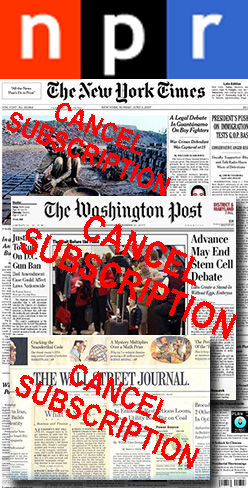
News Blues is reporting today that National Public Radio is cancelling all its newspaper subsciptions, effective immediately. The memo that went out read, in part, "This is a cost-saving measure company-wide". I would bet that NPR, with its national audience, will likely get many of their subscriptions comped, if the newspapers' marketing departments have anything to say about it.

Yesterday, they reported that the New York Times us unable to sell its corporate jet.

Really? Why would they have a jet still?

They themselves are reporting about the demise of the Seattle Post-Intelligencer here, and the newspapers that built their online models in the same way that the staff photographer took on freelance assignments, foretold the demise of the former, and the unsustainable business model of the latter.

(Comments, if any, after the Jump)


Please post your comments by clicking the link below. If you've got questions, please pose them in our Photo Business Forum Flickr Group Discussion Threads.


[More: Full Post and Comments]

Thursday, March 12, 2009

Just Words?

Photographer or Photography?

The Profession of Photographer, or The Photography Industry?


Over a decade ago, I had a big decision to make. It honestly didn't seem like a big decision at the time. In fact, I didn't think it was such an important one. However, it was. The question at hand was:

Do I call what I am doing: John Harrington - Photographer, or instead John Harrington Photography. Fortunately for me, I had Elyse Weisberg asking me this question, and instead of letting me make the wrong decision, Elyse was among the top photography consultants in the country, and without going into her CV, let's just say she worked with Eddie Adams, and wrote Successful Self-Promotion for Photographers.

What Elyse did was guide me to John Harrington Photography. She said "you're a business, and you want your clients to see you that way. When you're 'John Harrington, Photographer', you're seen as just an individual, and businesses want to hire other businesses." She needed say no more. This was one of the earliest stages of branding I participated in, and one that set me on the right path for the long term.

The question of The Profession of Photographer, or The Photography Industry is, at first blush, semantics, but is very important to distinguish.
(Continued after the Jump)


During the Presidential campaign, the power of words was dismissed by some. The power of possible plagarism on this very subject, came to the fore, as highlighted in this minute-long video. Words, and the choice of them, is critical. I mean, vitally critical.

We spend a great deal of time here in my office thinking and re-thinking our messaging. for example "I'll need to get you my contract for you to review and sign before I can get started" is an off-putting message. Instead, we use "we'll send along some paperwork for this assignment, and if you'd sign it, we'll be all set." Notice the use of "we" over "I". "some paperwork" over "my contract", "we'll be all set" over "before I can get started". Which one sounds more appealing to you? I've been attentive to this level of detail almost since the beginning - since discerning the difference Elyse put before me.

One of the most respected consultants in the political arena is Frank Luntz. Luntz is usually hired by Republicans, but even Democrats like John Kerry begrudgingly respect his genius. Luntz dissects, in his book Words That Work, how the words we use have impact. I have just finished his book, and it's full of post-it notes and dog-eared pages for me to return to, and it's also now out in paperback. The books' tagline is "It's Not What You Say, It's What People Hear ". This is a time-tested concept, in part made famous as a thread running through the Men are from Mars, Women are from Venus book, where the message was that when a man says something to a woman, she hears things he didn't say, and vice-versa with women speaking to men.
One of the points in the book was that using the word "industry" in the context of "Pharmaceutical Industry" suggested big business, uncaring bureaucrats, piles of money, and so on. What about, as Luntz points out, the Pharmaceutical Profession? That's your local pharmacist, or even possibly your own doctor who gives you a prescription? So too, when you say "Photography Industry", what comes to mind is not we photographers, it's things like Kodak, Fuji, Canon, Nikon, HP, and so on. In other words - big business. When we say "the photography industry is being devastated right now by X, Y, and Z", people don't think of the wedding photographer in Duluth, or the studio owner in New Orleans who is closing up his studio. If you, instead say "the profession of photographer is being devastated..." there is a more core sentiment felt for the individual small business owner that is a photographer. In fact, even changing the words to "the photography profession" dials back the individualistic components of what we do, if even just a little.

I want to strongly encourage you to think, re-think, and then, yes, think some more about the words you use. Luntz' book is certainly a great guidebook for that. However, not just the words you use to brand yourself, and in your correspondence to clients, but also in your phone conversations - how you answer the phone, negotiate, and so on. After every call or conversation, think about how you could have been more effective in that dialog, more succinct, or been more clear.

Words are not just words - they are the foundation of our communication, and are often short-changed.

Please post your comments by clicking the link below. If you've got questions, please pose them in our Photo Business Forum Flickr Group Discussion Threads.


[More: Full Post and Comments]

Monday, March 9, 2009

Getty Images And Paparazzi Pictures

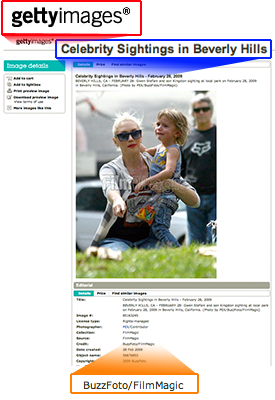
Getty Images has several distinct brands. However, unlike a guest at the Intercontinental who would not take offense in knowing that the same company owns Holiday Inn Express (IHG.com), knowing that income that supports Getty Images comes from Paparazzi "gotcha" moments, as well as helicopters flying overhead, and a mom trying to have a normal day at the park with a crying child, among the thousands of images that Getty Images is making money from, likely wouldn't sit well with the celebrities. Thus, the recent distribution deal between Getty Images and paparazzi agency Buzzfoto should be brought to the fore for a bit of discussion.

Would Brad Pitt have been comfortable knowing that he used Getty Images for his avenue of distribution for the first photos of one of his children, when they are also profiting from this photo of him, or this photo of Angelina?

Paul Melcher quotes, in his posting "It's Crazy, indeed", Getty's Global Vice President of Entertainment, Mark Kuschner , from a July 2007 article in the industry standard Variety Magazine:

”We’re never going to get into the business of the long lens, hiding in the bushes, hunting people down. Our business is based around relationships with celebrities and publicists and publications. The way we shoot is we’re invited. Paparazzi business is getting more play, but that’s also a very cyclical business.”


Never? Never ever? Oh, how the times have changed.

(Continued after the Jump)

Kuschner is quoted here as another segment of the Melcher quote "Our business is based around relationships with celebrities and publicists and publications. " So, I ask again - what do you think the celebrities you have built those relationships with would think about you profiting from their looking their worst through a backdoor channel?

The key players at WireImage, FilmMagic, and other companies built their companies on access, and ensuring that the celebrities they photographed, looked their best. I've personally seen more than one editing session where a celebrity image going out for distribution that had the celebrity looking less than their best would get axed. This was how these companies were built, and how they leveraged the relationships into companies that were then sold, and frankly, as long as everyone knows what's going on, there's nothing wrong with it.

Except when you make public statements that you would never do something, and then you do it when you think no one is watching.

Take a minute and dissect a single events' coverage.

Consider that a publication (either in print, or online), has just a few slots for images from a particular small to medium-sized event. If there is no "inside" photographer, then all the photos that are actually available, will come from the arrivals area. However, if you have these great images from inside, pairings of celebrities, those images will be more likely to get play than an arrival image - because they're better. Thus, When a publicist hires Getty or WireImage, and pays them $5,000, (and, by the way, the photographer gets about $250, for work-for-hire), that photographer is producing images inside, yet, on the outside, or in the bushes, or sneeking in through the kitchen (a la Blast 'Em) another photographer (or many of them) are producing images that places the same celebrities at the same event not only in a bad light, but also then has those images running side-by-side in searches.
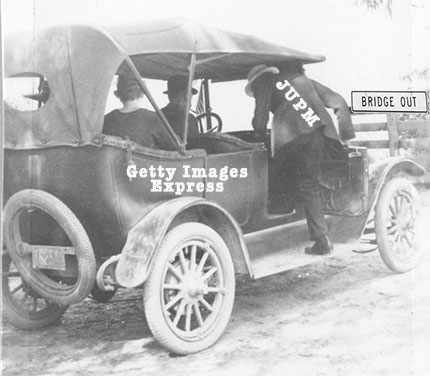
So, when a photo editor can choose the pretty inside images from the $5k photo shoot, or the "more realistic" images from Buzzfoto, where the celebrity may look less than their best, the publicist's efforts have been watered down, possibly to the point where they become ineffective, yet, in the end, Getty not only collected the $5k, but the royalties from the less than flattering images as well.

Melcher makes a similar point in his piece:
"But how do you combine being the official photographer for a premiere or party, where you are hired to shoot the event and thus play along the publicists demands that all look nice, happy, and beautiful to the needs of a marketplace that would much rather see the same group of people, drunk, sick, dirty and arrested ? Especially since you went through incredible efforts to shut out your competition from all these official events, forcing them to wait outside and thus get those unauthorized shots ?"


Getty is trying to have it both ways, and in the end, if even one celebrity with the next million-dollar exclusive they want to distribute (Pitt/Jolie, Cruise/Holmes, etc), choosing Corbis, Zuma Press, or another agency may well cost Getty far more than Getty will likely earn from the paparazzi images they said they were "never going to get into the business of."


Please post your comments by clicking the link below. If you've got questions, please pose them in our Photo Business Forum Flickr Group Discussion Threads.


[More: Full Post and Comments]

Saturday, March 7, 2009

Staff Photography - Disney Style

Staff photography, in some arenas, still exists. A search on Monster.com reveals a few positions that are open, but most are filled by word-of-mouth. The Office of Personnel Management is responsible for filling jobs within the Federal Government nationwide, and every state government has various staff photography jobs for a variety of reasons. Then there are those jobs working for catalog companies for furniture, clothing companies, and so on. Yes, some of those jobs are done by freelancers, especially the on-location stuff, but often, the clothing-on-white-seamless images are done in-house. By and large, these staff jobs are safe from cuts, especially those for the government.

While I have had the opportunity to have Disney as a client in the past, they have staff photographers at their resorts, and in a series of commercials they are running, use the job of photographer to sell the notion of a Disney vacation, under their new tag line - "What Will You Celebrate?" In fact, over a series of three commercials, lasting a minute each, they tell the story throughout a television program, within their theme "Short Stories".

Below, the three commercials are strung together, and worth a watch:


Interestingly enough, the value of photography - and the memories made with still images - is front and center throughout the pieces. So, what does Disney charge for these services?

(Continued after the Jump)

If you are having your wedding at Disney, here are their wedding photography rates. These rates are fair and reasonable when you consider the brand value of Disney, as well as the fact that you know you will get excellent photography, and an amazing setting as your backdrop. For these photographers, it is, no doubt, repetitive, but for each couple, who will never see other couples' photographs, it's an amazing memory.

At Disney Parks, you can get their Disney Photo Pass, and in one central location following your visit, wherever you had your photo taken by a Disney photographer, you can view and order the images online.

At this podcast, at around the 26 minute mark, you can hear an interview about the Photopass Portrait Sessions you can get for around $150 for 30 minutes of time. Here, you can learn more about what those photographers do. Unlike the photographers who wander other resorts or ball parks for just over minimum wage, these are full-time employees that likely are paid a living wage and have benefits. During the interview, the person being interviewed notes "all of your portrait images on a separate CD...and you are paying for that professional service... and you are getting copyright releases on the photos as well" which means you can turn up with the portraits to Wal-Mart/etc and legally get prints made from those files. Combining the portrait session with the around-the-park services costs you $200, so you get your own photographer(s) all over the Disney park for $200.

How does this work? How can this be profitable? Well, this works out to be $300 gross revenue per hour for these photographers that Disney collects. If you're a photographer working for Disney 40 hours a week, even if they're paying you $20 or $30 an hour, and earning $40-$60k a year (plus benefits), that's a decent starting wage as well as a tidy profit for Disney and also covers their overhead for back-office staffing, and so on.

Likely, other resorts offer similar staffing positions, and if there is a resort near you that does not have a package of photography they offer, taking the above models and considering how they could work for you and how you might sell them on it could help you make your own staff job a reality. During the initial contact, you can easily use the Disney URL's to convince a resort without photo services to offer them, since Disney is seen as the gold standard for resorts, it becomes an easier sell.

Will these be the most creative images you'll ever make? Nope. Could you get tired of working the same location over and over? Yup, probably. Will your photos be life-changing photojournalism? Definitely not. However, your images will make someone's trip memorable for sure, and you can remain a photographer instead of packing away the camera and changing fields entirely.


Please post your comments by clicking the link below. If you've got questions, please pose them in our Photo Business Forum Flickr Group Discussion Threads.


[More: Full Post and Comments]

Friday, March 6, 2009

Why is a Lens So Expensive?

Recently, I took to task a professional photographer for using a "prosumer" lens, and there was some defense of that photographer in their use of that prosumer lens. If you've ever shot with a prime lens versus a pro zoom, versus a prosumer variable aperture zoom, versus an off-brand zoom, and so on, you've likely seen a difference in quality, and variances in sharpness at the various apertures, which is one of the things I really like about the Popular Photography lens tests (read more here) so I can learn the sweet spot for each lens I own from a scientific standpoint.

Gizmodo has a great Article - Giz Explains: Why Lenses Are the Real Key to Stunning Photos (2/26/09) and there is this informative video about how a lens is actually made:


The Gizmodo article notes "The lens is, after all, your camera's eyeball—the image sensor or film can only record what comes in through the lens. It's what defines the picture's perspective, clarity and way more", which is why using the best lens (which almost always means 'most expensive') can assist in your producing better images.

(Comments, if any, after the Jump)


Please post your comments by clicking the link below. If you've got questions, please pose them in our Photo Business Forum Flickr Group Discussion Threads.


[More: Full Post and Comments]

Thursday, March 5, 2009

Boo Hoo, and Buh-Bye

Our colleagues over at StockPhotoTalk make a humorous jab at Getty/JupiterImages where they link to Oprah Winfrey's Layoff Survival Guide where there is an image of a laid-off worker, with the photo credit attributed to Jupiter Images.

Oh, the irony!

Back in October, I wrote - The Road To Hell Is Paved With Good Intentions: Getty Images Buys JupiterImages - " Make no mistake here, this is a consolidation of the deep-and-cheap portals...I see these two companies that have devastated the industry rate structures under the "let's sell 100 for $1 instead of $1 for $200", are two silly little delusional peas in a pod. All their private owners are trying to do is further solidify the market. Boo Hoo."

StockPhotoTalk quoted a Getty representative as saying "It is our intention is to bring together the best of each company's assets and people to better serve our customers. As with any acquisition, there will be areas of work duplication and overlap between the two organizations being brought together, creating redundancies. As a result, some Jupiterimages employees in the US will be leaving within the next 60 days."

So, let me get this straight:

(Continued after the Jump)


Images there used to sell for several hundred dollars per license. Then there were people brought on with new business models and grand ideas of selling them for a fraction of that. These people sold photographers' images for that fraction of the former sales figures. These people processed incoming images knowing that all the new images were going to be sold at the lower rates. These people talked to photographers and told them they couldn't get any more for their images than a dollar or two. These people signed contracts with photographers and then tried to call a do-over on them citing a typo ( Getty Uses A Nefarious Tactic To Raise Rates and Getty Bullies Photographers After Buying Agency), these people forced, by their own collective actions of acceptance and so on, a downward spiral in stock licensing rates, and now that 400 people are losing their jobs we are supposed to feel sorry for them? What about the countless photographers who can no longer earn a living at stock thanks to these people - where are the people feeling sorry for them? "I was just doing my job" is the reponse of the Getty/Jupiter people who would defend their devastation of this industry. No, sorry, that's just not going to cut it. When you are doing your job and you know what you're doing is harming the industry and harming people who's creative talents built the industry, "I was just doing my job" is not a defensible position.

I don't feel one iota of sadness for the collective lot of them. As this mainstream video news report shows, the subject in the interview - one former employee - recounts her picnics and halloween parties with co-workers, and her snapshots of her co-workers are shown. "The wonderful camaraderie - that is what I will miss more than anything" she says. She can move on to some other business in Peoria, and "just do her job", but the growing lot of former employees at Getty/Jupiter (and make no mistake about it - that pool of people will become a lake, then a sea, then an ocean, as automation increases) can file their way to the unemployment line. Buh-Bye.

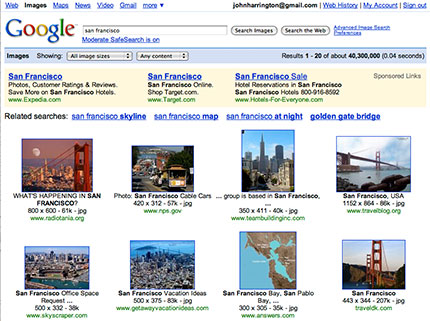
What's next? You can bet that as the now private Getty gets chopped up into little pieces, a company like Google will snap up the whole thing for what amounts to pocket change (relative to Google's billions in cash they have just sitting around) and make those images available for a penny or so, or heck, for all of Getty's wholey-owned content, the images will be free for screen resolution, and Google will make money running ads next to the photos, or licensing for a few dollars each higher resolution images, and Google will be smart enough to automatically embed tracking information to ensure you're not using the photo beyond when the license stipulates, or more than you're supposed to. Think I'm kidding? Right now, go to Google and type in "Grand Canyon" in the Google Images tab (or click here) and ABOVE the images, are three sponsored links. So too San Francisco, and countless other IMAGE searches!

Nope, not a tear shed here for the people who sat back, collected a paycheck, and convinced photographers that didn't know any better that the Getty/Jupiter pricing model was the best they could hope for. Thanks for screwing things up for the rest of us.


(Update: See screen grab below in response to comments about not seeing the ads in Google's Image Search results)


Please post your comments by clicking the link below. If you've got questions, please pose them in our Photo Business Forum Flickr Group Discussion Threads.


[More: Full Post and Comments]

Monday, March 2, 2009

Damn Uncle Sam

For years, I have been telling people that FIFTY PERCENT OF THEIR PROFITS GO TO THE GOVERNMENT.

No one listens.

I am not going to go out and do the math for every one of you out there, but that's the percentage. Get used to it. Plan for it.

One problem arises when you do do everything you can, and earn a good living, and then the person you've spent your life with dies, and because of bureaucratic red tape, you have to pony up hundreds of thousands of dollars.

Enter Annie Leibovitz.

(Continued after the Jump)

After Ellen reports (Annie Leibovitz is in a jam) that most of Annie's financial problems have come about because when her partner Susan Sontag died and left Annie several properties, Annie had to pony up FIFTY PERCENT of their value in taxes in order to keep them. Had Annie and Susan been seen in the eyes of the government as a legal couple, Annie wouldn't have had to pay anything.

Now, this isn't the place for a debate about same-sex marriage, and so on, so don't bother with that in the comments. The state should recognize Annie and Susan's relationship in some way so as to not tax the living hell out of them AGAIN. The problem is that those properties were purchased with after-tax dollars (likely), and the government is treating the assets as if they were transferred to some unknown third party, and re-taxing them.

Damn Uncle Sam.

Please post your comments by clicking the link below. If you've got questions, please pose them in our Photo Business Forum Flickr Group Discussion Threads.


[More: Full Post and Comments]

Your Future as a Photographer: Due Diligence Required

It's certainly unfortunate that the newspapers of today are struggling. Yet, it is, in large part, their own doing. This piece, by no means, has the answers, but there is a cautionary tale here, so bear with me.

Newspapers started giving away their content for free on the web, and those that tried the pay model (NYT, WSJ, etc) had no luck. The problem is, the newspapers did not set their per-eyeball-pair rates the same for the web as they did for the newspaper. That should have been an easy sell "hey local car dealer, you're paying $0.001 per subscriber, so you'll pay the same if that subscriber, or any other reader for that matter, sees your ad online...".

When we photographers had to make the transition from film to digital, I wrote a piece that appeared in the November 2002 ASMP Bulletin. I did a great deal of research in planning my own switch, and shared the results of that research in that piece.

In March of 2001, more and more of my clients were calling for digital images, beyond the one-off scans we did with the Nikon Coolscan. On a $43 roll of film charge we billed the client, with 37 proof prints, there was a charge to me of $16.39, with $26.61 in net profit. How could I establish pricing that preserved that profit center?

(Continued after the Jump)

What I did, was look back at a 6 month block of assignments (original PDF of spreadsheet here), and calculated the exact cost for each job, and then applied a "what if this job had been a digitally shot job" model to it (with 3 output options), and I quickly was able to determine that the pricing model that I had put forth would cover those profits, as well as an increase for this "new digital thing" that required an investment of capital to make available. That model, which stands today, covers my costs of having gone digital.

Take a trip in the Wayback Machine to March of 2001 and have a look at this edition of The Washington Post, and you see little to no ads. Newspapers continued to talk about how they weren't making any money online and it was costing them a boatload of money to build out and put up, and that was their excuse for not wanting to pay photographers for a secondary use on the website.

Hint - when you can't pay for the content to appear on your website, and your justification for the text being there is that it didn't cost much to put there because your staffer wrote the piece, that should be a sign that the economic model is flawed.

Understand this - The Washington Post is a publicly traded company, with bankers and accountants, and lawyers at their beck-and-call. Why they couldn't figure out a sustainable business model when I could for my small business floors me. It wasn't that hard.

I am, by no means, picking on The Washington Post, but instead using them as an example as compared to smaller papers who may not have had all the resources of the Post, but certainly could have followed their lead, if, in fact, they had chosen to be a leader!

Enter Amazon's Kindle 2.Very cool device, and I am eyeing one myself. The problem is, the Kindle has "text-to-speech" capabilities, which could, if allowed to continue unchecked, gut the $1 Billion-dollar audiobooks industry very quickly. Set aside the value in having someone who is talented at reading and can deliver the lines as the author intended them, and realize that the right to transfer the copyrighted material from one medium (print), to another medium (spoken word), is a controllable right, and the head of the Authors Guild, Roy Blount Jr, had a nice op-ed in the New York Times about how authors were not being paid for this.

Whenever there is a transitory time in the business (film to digital, print to web, text to speech) you're in, you must understand how that transition will impact your sustainability. The next business model that will impact still photographers is the video model. The video model, borne from Hollywood, is that the production is a collaborative piece, and that everyone that works on the piece is a work-for-hire contributor to the finished product, and most people that hire videographers expect to walk with the raw tapes and never pay you again. If you are a still photographer migrating to video, it is critical you understand how that model will impact your profit center for video, and if you want to try a different model.

If you're trying to grow your career as an artist, don't think that starting that career by doing work for free is a solution. There are plenty of latte-serving, broom-pushing, or lunch-special-order-taking former photographers/artists littering the landscape to serve as a grim reminder that longevity in this business is based not on talent, but on sound business practices. Penelope Trunk's Brazen Careerist website has some sound advice if you want to pursue a life as an artist.

Now, you might be wondering why I would send you to a blog post that starts off with "I do not think that people who want to create art need to get paid to do it. Do you get paid to have sex? No. Same thing." But it's message points like this "The starving artist routine is total bullshit. I know because I did it. Once you know that you are not going to make rent, you can't really make art. Because your sense of self-preservation insists that your brain focus on the possibility that you will be out on the street.", then she says something really cool - "So don't kid yourself...you can live like a pauper, but that limits the range of your art."

Newspapers kidded themselves. So too so many photographers. Don't kid yourself. Establish what your Cost of Doing Business is. Don't know how? Start here - the NPPA's Cost of Doing Business Calculator. Do your own due diligence on your future. You owe it to yourself.

Please post your comments by clicking the link below. If you've got questions, please pose them in our Photo Business Forum Flickr Group Discussion Threads.


[More: Full Post and Comments]

Saturday, February 28, 2009

Freelancers Are Not Journalists?

At a time when staff photographers are becoming extinct and being replaced by freelancers, the definition of journalist is on its' way to being gutted by the Congress, seeking to establish a definition of a journalist as such:

"The term "covered person" means a person who regularly gathers, prepares, collects, photographs, records, writes, edits, reports, or publishes news or information that concerns local, national, or international events or other matters of public interest for dissemination to the public...and includes a supervisor, employer, parent, subsidiary, or affiliate of such covered person."
Since your client isn't your supervisor, all the freelance contracts specifically exclude you from being and employee (and thus they are not your employer) you are not going to be defined as a journalist if this law passes with the House language intact.

What does this mean?
(Continued after the Jump)

Well, the bill that does this definition is the federal shield bill that allows you to protect your confidential sources, and it could affect your ability to seek press credentials from local, state, or federal organizations. The Senate version of this bill does not have the same language, and is far more broad:
the regular gathering, preparing, collecting, photographing, recording, writing, editing, reporting, or publishing of news or information that concerns local, national, or international events or other matters of public interest for dissemination to the public.
The Free Flow of Information Act of 2009 is going to redefine the landscape for freelancers, bloggers, and so on. This is a draconian move that organizations like the National Press Photographers Association, National Writers Union, American Society of Media Photographers, Professional Photographers of America, and, frankly, every other association that has news-gathering members, should be opposing.

Hopefully the various trade groups who will have their memberships impacted will be able to affect the House language before it gets voted on. If not, then hopefully the conference committee will rectify the differences in favor of the Senate language on this particular issue.

More information:


Please post your comments by clicking the link below. If you've got questions, please pose them in our Photo Business Forum Flickr Group Discussion Threads.


[More: Full Post and Comments]
Newer Posts Older Posts